LASIK in China: Costs, Safety & How We Arrange Your Surgery
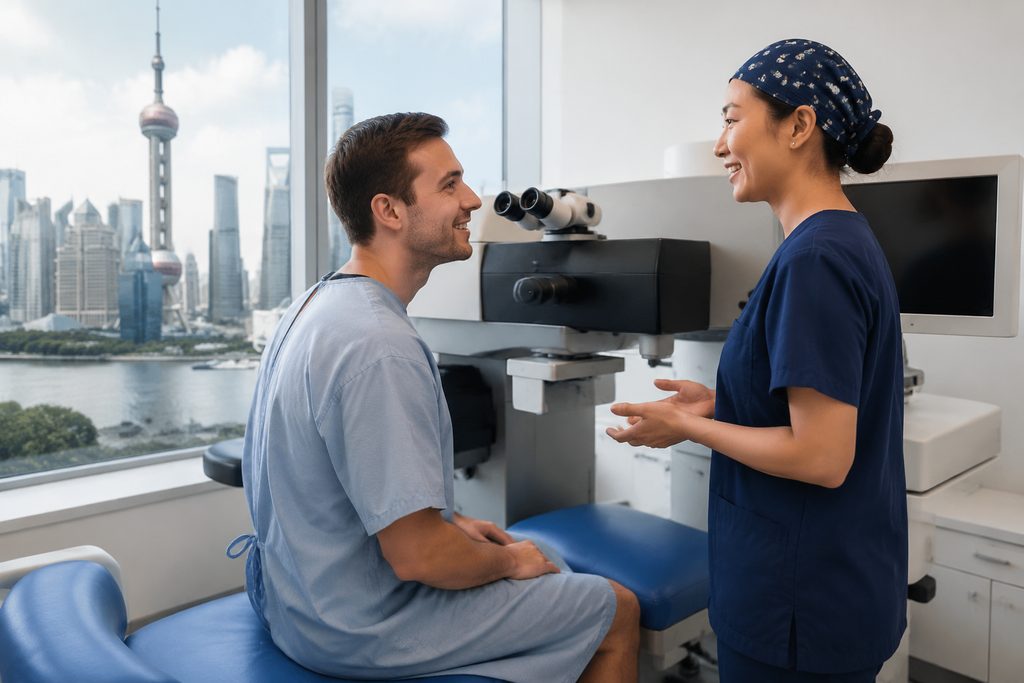
Can You Get LASIK in China? How We Arrange Your Laser Eye Surgery
Roughly 700,000 LASIK procedures are performed in China each year, according to industry estimates from the Chinese Ophthalmological Society. That volume dwarfs most Western markets. And it drives a hard question for international patients: can you actually access that expertise as a foreigner? The short answer is yes. The LASIK eye surgery cost China typically runs between $1,200 and $3,200 per eye, depending on the technology and hospital tier. Compare that to $2,200 to $4,500 per eye in the United States, and the math gets interesting fast. But cost alone should never drive a decision about your vision. This article explains exactly how the process works, what the real risks are, and how our team helps international patients navigate a system that was not built for walk-in foreigners.
We coordinate with ophthalmology departments at top-ranked public hospitals and JCI-accredited private international clinics. Our job is not to sell you surgery. It is to make sure you understand what you are buying, who is performing it, and what happens if something goes wrong. That starts with being honest about how the Chinese system actually functions.
How This Actually Works, Step by Step
The process for a foreign patient seeking LASIK in China is not complicated, but it is sequential. Skipping a step creates delays or rejections. Here is the real sequence.
Step 1: You send us your baseline eye data. This means a recent refraction test (no older than 6 months), corneal topography if you have it, your current prescription, and your age. A history of eye infections, dry eye, or autoimmune conditions matters. So does any previous eye surgery. We review this with the ophthalmology team before anything else happens.
Step 2: We identify two or three candidate hospitals. Selection depends on your prescription complexity, budget, and whether you prefer a public hospital’s high-volume LASIK center or a private international clinic with English-speaking staff. We do not recommend a hospital until we know your case.
Step 3: You have a remote pre-consultation. This is a video call with the ophthalmology team. They review your data, explain which procedure fits (standard LASIK, femto-LASIK, SMILE, or PRK), and tell you whether you are even a candidate. If your cornea is too thin, they will say so. This call costs between $100 and $300 for a standard international department consultation.
Step 4: You travel to China for the in-person evaluation. No reputable hospital in China will perform LASIK without a comprehensive on-site exam. That exam includes corneal thickness measurement, pupil size assessment, tear film evaluation, and a dilated fundus exam. Plan for this to take a full morning.
Step 5: Surgery happens, usually within 1 to 3 days of the evaluation. Public hospital international departments can often schedule the procedure quickly once you clear the evaluation. Private clinics sometimes offer same-day or next-day surgery. The procedure itself takes 10 to 15 minutes per eye.
Step 6: Follow-up. You will have a check at 24 hours, another at 1 week, and a final one around 1 month. If you leave China before the 1-month mark, we arrange a handoff protocol for your home ophthalmologist.
LASIK Eye Surgery Cost China: Real Numbers, Not Brochures
Pricing transparency in Chinese healthcare is improving, but it is still uneven. Public hospital international departments publish some fees. Private clinics publish more. Here is what we see in practice for international patients in 2025.
| Procedure Type | Public Hospital International Dept (per eye) | Private International Clinic (per eye) |
|---|---|---|
| Standard LASIK | $1,200 – $1,800 | $2,000 – $2,800 |
| Femto-LASIK (blade-free flap) | $1,600 – $2,400 | $2,500 – $3,500 |
| SMILE (small-incision lenticule extraction) | $2,000 – $2,800 | $2,800 – $4,000 |
| PRK / TransPRK | $1,000 – $1,500 | $1,800 – $2,500 |
These ranges vary by hospital and case complexity. A high myope with astigmatism will pay more than a mild myope. The LASIK price abroad comparison consistently shows China at 40% to 60% below US private-pay rates for equivalent technology. That is a real savings, but it should not be the only variable. A $1,200 LASIK at a hospital that rushes your corneal evaluation is not a bargain.
What does the price include? At public hospital international departments, the quoted fee usually covers the procedure, the surgeon’s fee, basic post-op drops, and the 24-hour follow-up. It may not include the pre-op evaluation ($100–$300), additional topography ($50–$100), or enhanced follow-up packages. Private clinics often bundle everything into one price, which is simpler but costs more upfront. Always ask for a written breakdown before you travel.
Is LASIK Safe in China? What the Data Shows
The honest answer is that safety depends more on the individual center than the country. China has some of the highest-volume LASIK centers in the world. Volume matters in refractive surgery. A surgeon who performs 2,000 procedures a year has seen complications a low-volume surgeon reads about in textbooks.
Serious complications from LASIK are rare everywhere. Flap complications occur in roughly 0.5% to 1% of cases. Infection rates are below 0.1% at major centers. Dry eye affects 20% to 30% of patients in the first month, though most resolve by 6 months. Night vision issues like halos and glare affect 5% to 15% of patients initially, with most improving over 3 to 6 months. These are global figures, not China-specific ones. The key question for is LASIK safe in China is not the country — it is the center’s infection control, the surgeon’s volume, and the quality of the pre-op screening.
Top public hospitals in Beijing and Shanghai run ophthalmology departments that would be competitive anywhere in the world. The Fudan-ranked top 100 hospitals include several with dedicated refractive surgery centers that perform 5,000+ procedures annually. That level of repetition matters. And the equipment is current. Most major centers use Alcon EX500 or Zeiss VisuMax platforms — the same machines used in the US and Europe.
What you should actually worry about is language and follow-up. If you cannot communicate post-operatively, you cannot report symptoms accurately. That is a safety issue. Our bilingual medical companion service exists precisely for this reason.
A Realistic Timeline
People underestimate the calendar. Here is what a real schedule looks like for an international patient from first inquiry to final follow-up.
| Stage | Duration | What Actually Happens |
|---|---|---|
| Initial inquiry and records review | Day 1 – Day 5 | You send eye data. We review it with the ophthalmology team. We confirm you are a preliminary candidate. |
| Video pre-consultation | Day 6 – Day 14 | Scheduling a video call with the specific hospital takes 1 to 2 weeks. The call itself is 30 to 45 minutes. |
| Visa processing (S2) | Day 15 – Day 45 | S2 visa processing typically takes 1 to 4 weeks depending on your home country’s Chinese embassy. You will need an invitation letter from the hospital, which we help arrange. |
| Travel and arrival | Day 46 – Day 50 | You fly in. We arrange airport transfer and hotel. Rest for 24 hours before your evaluation. |
| In-person evaluation | Day 51 | Full corneal workup. 2 to 4 hours. You get a final yes or no. |
| Surgery | Day 52 – Day 54 | Usually within 1 to 3 days of evaluation. Procedure is 10 to 15 minutes per eye. |
| Immediate follow-up | Day 53 – Day 60 | 24-hour check, then 1-week check. Vision stabilizes significantly in the first week. |
| Return home | Day 60 – Day 65 | Most patients fly home after the 1-week check. We provide a written handoff for your home ophthalmologist. |
| Final follow-up | Month 1 – Month 3 | Done by your local eye doctor. We remain available if they have questions for the Chinese team. |
The waiting steps people forget are visa processing and hospital document translation. Chinese hospitals require translated medical records. That takes a few days. And the S2 visa requires a formal invitation document from the hospital, which cannot be rushed. Plan for 6 to 8 weeks from first inquiry to surgery date. Anything faster is unrealistic. Anything much slower suggests a bottleneck you should ask about.
What Can Go Wrong — and What Happens Then
Yes, at top centers. Major public hospital ophthalmology departments and JCI-accredited private clinics use the same Alcon, Zeiss, and Schwind platforms found in Western refractive surgery centers. The machines are current-generation. The difference is not equipment — it is surgeon volume and pre-op screening rigor, which is why center selection matters more than country selection.
What if I have a complication after I return home?
Your home ophthalmologist manages the complication, using the surgical record you bring back from China. We facilitate communication between your home doctor and the Chinese surgical team if there is any question about technique, laser settings, or expected healing. You are not abandoned. But you
Frequently Asked Questions
Yes. The hospitals used for international patients are JCI-accredited and follow the same international safety standards as top hospitals in the US and Europe. Surgical teams perform high volumes of procedures — often more than their Western counterparts — which studies show leads to better outcomes.
Costs vary by procedure and hospital, but international patients typically save 40-80% compared to US prices — even when factoring in travel and accommodation. A consultation with our team will give you an exact, all-inclusive quote with no hidden fees.
Send us your existing medical reports to get started. We handle everything from hospital selection and appointment scheduling to visa assistance and post-operative recovery planning. Your medical records are reviewed by the specialist before you even book a flight.
For more medical information and treatment options in China, visit chinamedservices.com (China Medical Services).
