LASIK in China for Canadians: Full Vision Correction Support Without the Wait
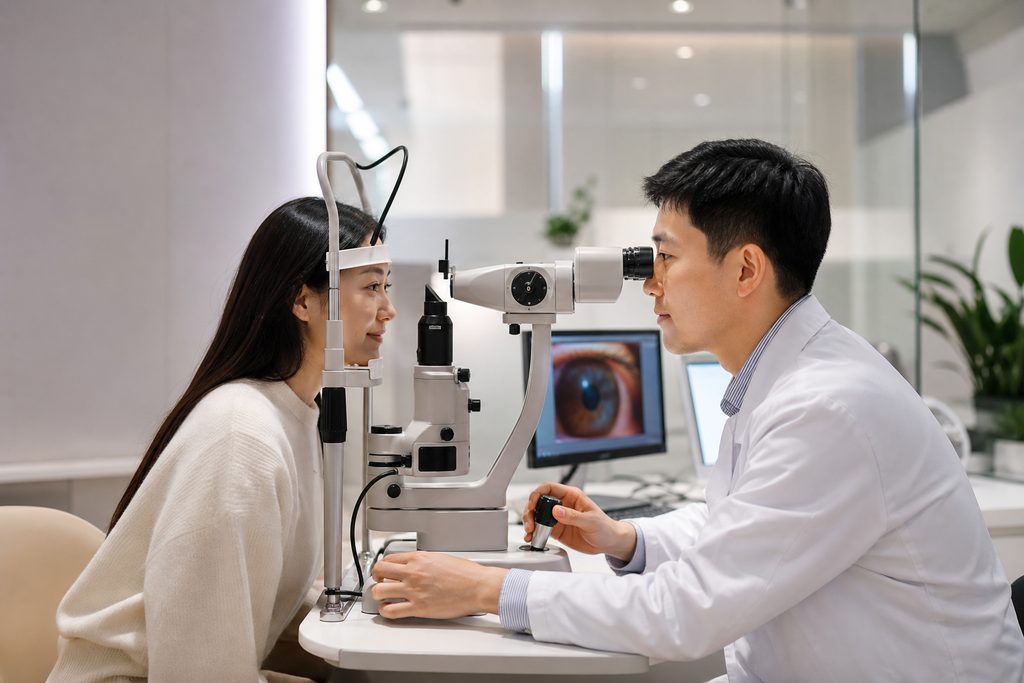
While Canadian patients often face LASIK costs exceeding $4,000 CAD per eye at private clinics with no public coverage, top-tier Chinese hospitals using identical German-engineered laser platforms complete the same bilateral procedure for roughly $1,500 to $3,000 USD total. That is not a discount-tier service. It is the structural result of high surgical volume, lower facility overhead, and a medical system where refractive surgeons routinely log thousands of cases annually. The question is not whether the technology is comparable. The question is whether the logistics of traveling for surgery make sense for you.
Key Takeaways
- Bilateral LASIK or SMILE at leading Chinese clinics runs $1,500–$3,000 USD, compared to $3,000–$4,500+ USD per eye in Canada.
- Shanghai and Beijing clinics deploy the same femtosecond and excimer laser platforms used in North America—Zeiss VisuMax, Alcon Wavelight, and Schwind Amaris.
- Language and follow-up care are real barriers; a bilingual coordinator and a plan for post-operative checks back in Canada are not optional extras.
- Not every prescription is suitable for surgery abroad—a detailed pre-assessment and a candid discussion about corneal thickness and dry eye risk must happen first.
The Problem: High Costs and No Public Funding for Elective Vision Correction
Laser eye surgery in Canada sits in a strange category. It is elective, so provincial health plans do not cover it. Patients pay out of pocket. And the price is steep. A standard bilateral LASIK procedure at a reputable Canadian laser center typically ranges from $3,000 to $4,500 USD or more, depending on the technology used and the surgeon’s profile. For a young professional or a parent budgeting carefully, that number can push the procedure years into the future.
Waiting does not just delay convenience. It extends years of purchasing contact lenses, solution, and prescription glasses. Over a decade, those recurring costs can rival the surgery itself. For Canadians living in smaller cities without multiple competing laser centers, there may be only one or two providers—and no real price competition. The financial barrier is real. So is the frustration of knowing the technology exists but feels out of reach.
Why China’s Refractive Surgery Sector Delivers Comparable Outcomes at a Different Price Point
The instinct is to assume lower cost signals lower quality. Sometimes that instinct is right. Here, it misses the structural economics. Chinese refractive surgery centers operate on volume that Canadian clinics cannot match. A single high-volume surgeon in Shanghai may perform 20 to 30 procedures in a morning. That throughput, combined with lower facility and labor costs, drives the price down without touching the technology budget. The laser platforms are the same German and Swiss machines found in Toronto or Vancouver. The difference is how many patients move through the room each day.
Surgical Volume Builds Procedural Fluency
There is a well-documented relationship in surgery between case volume and complication rates. A 2022 analysis in the Journal of Cataract & Refractive Surgery noted that surgeons performing more than 500 refractive cases annually had statistically fewer enhancement procedures and lower rates of visually significant flap complications. In major Chinese ophthalmology centers, refractive surgeons often exceed 1,000 cases per year. That is not a guarantee of a perfect outcome. No surgeon can promise that. But it shifts the probability in the patient’s favor.
Technology Parity: The Same Lasers, the Same Certifications
Walk into the refractive suite at Jiahui International Hospital in Shanghai or the ophthalmology department at Peking Union Medical College Hospital, and the equipment is immediately recognizable. Zeiss VisuMax femtosecond lasers for SMILE procedures. Alcon EX500 excimer lasers for wavefront-optimized ablation. Schwind Amaris platforms for transepithelial PRK. These are the workhorses of refractive surgery globally. The clinics maintain the same manufacturer-recommended service intervals. The difference is not the hardware. It is the cost structure around it.
How Safe is LASIK Surgery in China: The Regulatory Reality
China’s National Health Commission regulates refractive surgery under the same broad framework that governs all surgical procedures. Top-tier hospitals follow sterilization and informed-consent protocols that align with international norms. JCI-accredited facilities—and there are several in Shanghai and Beijing—undergo external audits that examine everything from medication labeling to surgical site marking. Safety is not a mystery. It is a function of hospital selection. Choose a facility with international accreditation and a documented refractive surgery volume, and the safety profile mirrors what you would expect in any advanced economy. Choose a discount clinic with no track record, and the risk profile changes. The location matters less than the specific institution.
What the Procedure and Recovery Actually Look Like for an International Patient
Most Canadian patients considering this are not medical tourists in the traditional sense. They are not combining surgery with a vacation. They want to know the timeline, the discomfort level, and when they can fly home. Here is the typical sequence when you work through a structured pathway.
Day one is a comprehensive pre-operative assessment. Corneal topography, pachymetry, dilated fundus exam, dry eye testing. The surgeon needs to rule out keratoconus, insufficient corneal thickness, and retinal pathology. If you wear contact lenses, you must stop wearing them for at least one to two weeks before this exam—soft lenses one week, rigid lenses longer. This is non-negotiable. The cornea needs time to return to its natural shape for accurate measurements.
If you are a candidate, surgery is typically scheduled one to two days later. The procedure itself takes roughly 10 to 15 minutes per eye. Topical anesthetic drops only. No needles. No sedation required. Most patients describe pressure, not pain. You are awake and responsive throughout. Someone needs to escort you back to your accommodation afterward.
The first four to six hours post-surgery are the hardest. Burning, tearing, light sensitivity. You keep your eyes closed as much as possible. Sleep if you can. By the next morning, the severe discomfort usually lifts. A follow-up exam checks the flap or lenticule position and measures uncorrected visual acuity. Most patients are functional within 24 to 48 hours. Dry eye and fluctuating vision can persist for weeks or months. That is true of LASIK anywhere.
You should plan to stay in China for at least five to seven days. That allows for the initial assessment, the procedure, and at least two post-operative checks before flying. The cabin air on a long-haul flight is aggressively dry. Preservative-free lubricating drops are essential. Your surgeon will clear you for travel only after confirming the cornea is stable.
Can Canadian Patients Get LASIK in China: Eligibility, Records, and the Hard Contraindications
The short answer is yes, but not everyone should. The refractive surgery candidacy criteria do not change because you cross a border. Unstable refraction is a hard stop. If your prescription has changed by more than 0.5 diopters in the past year, no ethical surgeon will operate. Autoimmune diseases like rheumatoid arthritis or lupus that affect wound healing are relative or absolute contraindications. Pregnancy and breastfeeding create temporary corneal changes that make accurate measurement impossible—surgeons will defer surgery until at least three months after lactation ends.
Corneal thickness is the single most common disqualifier. If your pachymetry readings show insufficient residual stromal bed thickness after ablation, you are not a LASIK candidate. Surface ablation like PRK or a phakic IOL might be alternatives, but that is a different conversation. Keratoconus or forme fruste keratoconus on topography is an absolute contraindication for LASIK.
You will need your full optometric records. At minimum: your most recent refraction, at least two years of historical prescriptions to demonstrate stability, and ideally a recent corneal topography scan from your Canadian optometrist. These records allow the Chinese surgical team to pre-screen you before you book a flight. A video consultation ahead of travel is not a formality. It is the step that prevents someone from flying 10,000 kilometers only to be told they are not a candidate.
Best LASIK Clinic Shanghai for Foreigners: What to Look For Beyond the Brochure
Shanghai has become the focal point for international refractive surgery patients, and for practical reasons. The city has multiple JCI-accredited hospitals with dedicated international departments. English-speaking staff are not a novelty—they are a baseline requirement at these facilities. The ophthalmology teams at these centers routinely manage patients from Europe, the Middle East, and Southeast Asia. They understand the documentation foreign patients need for insurance reimbursement and for their home optometrist’s follow-up care.
The question of which clinic is “best” depends on what you prioritize. Jiahui International Hospital offers a Western-style experience: English-dominant environment, direct insurance billing, and the Zeiss VisuMax SMILE platform. Shanghai East Hospital’s international department has a high-volume refractive surgery program with experienced surgeons. Parkway and United Family offer similar international-standard environments. What matters more than the brand name is the specific surgeon’s case volume with your type of refractive error. A surgeon who does mostly low myopia LASIK is not the same as one who routinely handles high astigmatism corrections.
Ask directly: How many SMILE or LASIK procedures has the surgeon performed in the past 12 months? What is their enhancement rate? What corneal imaging technology do they use for screening? A clinic that cannot answer these questions clearly is not the right clinic.
| Cost Factor | Canada (USD, Approximate) | China Top-Tier Clinic (USD, Approximate) |
|---|---|---|
| Bilateral LASIK (standard) | $3,000–$4,500+ | $1,500–$2,500 |
| Bilateral SMILE | $4,000–$5,500+ | $2,000–$3,000 |
| Pre-operative assessment | Often bundled | $100–$200 |
| Post-operative medications | $50–$100 | $30–$60 |
| Follow-up visits (3 months) | Often bundled or $100–$200/visit | $50–$100/visit |
The numbers in the table are not fixed quotes. They represent the range we see across partner hospitals. A China LASIK vision correction package for international patients typically bundles the pre-assessment, the bilateral procedure, and two or three post-operative checks into a single price. That bundled approach simplifies budgeting. What it does not cover is airfare, accommodation, or ground transport. Those are separate and variable. A realistic total trip budget, including surgery, flights, and a modest hotel for a week, often lands between $4,000 and $6,000 USD. That is still below the surgical fee alone in many Canadian cities.
Practical Considerations: Documentation, Payment, and Follow-Up Care After You Return
Enhancement rates after modern LASIK and SMILE are low—typically under 5% in published series. But they are not zero. If you need a touch-up procedure, you would need to discuss with the original surgeon whether returning to China is feasible or whether a Canadian surgeon would take over your care. Some Canadian refractive surgeons will perform enhancements on patients originally treated elsewhere, but they will charge for it. This is a risk you accept when you travel for surgery. The best mitigation is choosing a surgeon with a documented low enhancement rate to begin with.
Almost certainly not for the surgery itself. Provincial health plans exclude elective refractive procedures regardless of where they are performed. Some employer-sponsored extended health plans include a vision care benefit that might reimburse a portion of laser eye surgery, but you need to check the policy language. Most explicitly exclude out-of-country elective procedures. Get confirmation in writing from your insurer before committing.
The safest path is to work through a coordinator who can verify hospital credentials and surgeon case volumes before you pay anything. Ask for the specific hospital name and the surgeon’s name. Look up the hospital’s JCI accreditation status—it is publicly searchable. Ask how many of your surgeon’s cases in the past year were the specific procedure you need. A real coordinator will provide these details without hesitation. A broker who deflects or offers vague assurances should make you uncomfortable. The goal is not to find the cheapest option. It is to find a transparent one.
Your Next Step
The decision to travel for refractive surgery is personal. It hinges on your prescription stability, your corneal anatomy, your tolerance for logistical complexity, and your access to follow-up care at home. What we do at China Medical Services is help you get the facts you need to make that decision clearly. We are not a hospital and we do not provide medical advice or diagnoses. We connect you with accredited ophthalmology departments, arrange pre-travel video consultations so a surgeon can review your candidacy before you book a flight, and handle the on-the-ground coordination if you decide to proceed. If you want to understand whether this path makes sense for your eyes and your budget, start with a free consultation. No pressure. Just the information you need to decide.
Frequently Asked Questions
Yes. The hospitals used for international patients are JCI-accredited and follow the same international safety standards as top hospitals in the US and Europe. Surgical teams perform high volumes of procedures — often more than their Western counterparts — which studies show leads to better outcomes.
Costs vary by procedure and hospital, but international patients typically save 40-80% compared to US prices — even when factoring in travel and accommodation. A consultation with our team will give you an exact, all-inclusive quote with no hidden fees.
Send us your existing medical reports to get started. We handle everything from hospital selection and appointment scheduling to visa assistance and post-operative recovery planning. Your medical records are reviewed by the specialist before you even book a flight.
For more medical information and treatment options in China, visit chinamedservices.com (China Medical Services).
