Doing Laundry During Extended Medical Stay in China: A Complete Practical Guide
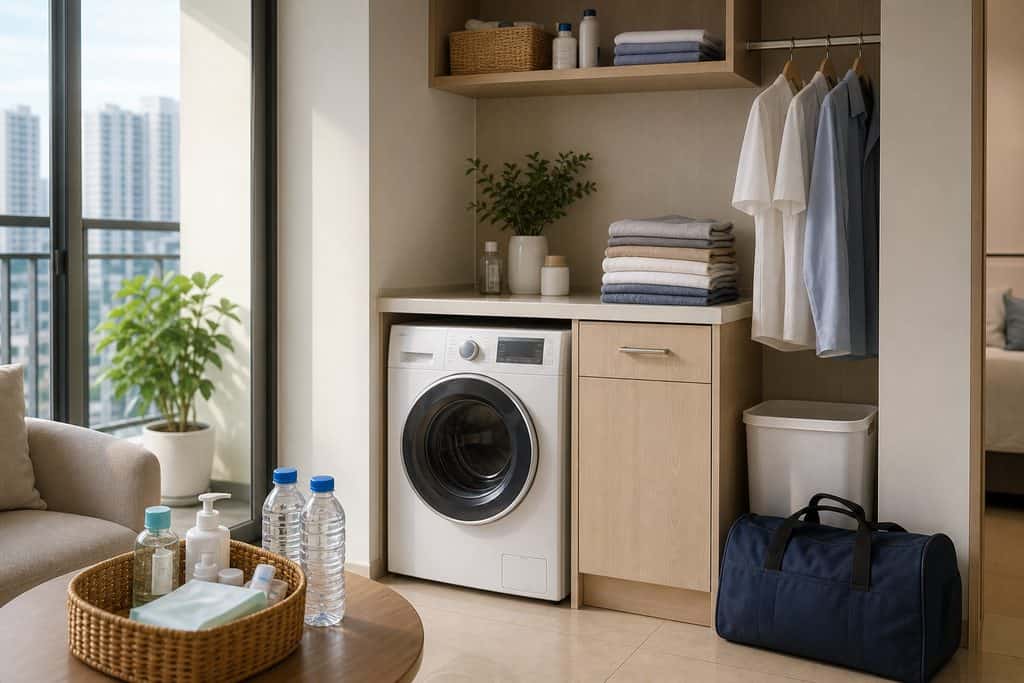
Key Takeaways
- Most Chinese public hospital wards do not provide patient laundry facilities — planning ahead for this basic need prevents significant stress during recovery.
- Serviced apartments and long-term stay hotels near Chinese hospitals offer the most practical solution, with in-unit washers and kitchenettes that support weeks or months of treatment.
- Laundry service for international patients in Beijing and Shanghai costs between $15-30 per load through hotel providers, but drops to $2-5 at neighborhood shops once you know where to look.
- Understanding the laundry landscape before you arrive means one less variable to manage when you are already navigating treatment in an unfamiliar system.
The Problem: You Packed for a Week, But Treatment Takes Months
When Sarah landed in Shanghai for her mother’s oncology treatment at Fudan University Shanghai Cancer Center, she packed seven days of clothing. The treatment protocol required eight weeks. By day four, she was hand-washing underwear in the hotel sink and draping damp shirts over radiators. This is not a minor inconvenience. It is a daily friction that compounds the exhaustion of managing care in a foreign country.
Medical travelers coming to China for complex procedures — orthopedic surgery, cancer treatment, cardiac rehabilitation — routinely stay four to twelve weeks. Some stay longer. The suitcase you arrived with was not designed for that timeline. And unlike a vacation, you are not spending your days sightseeing. You are shuttling between hospital appointments, managing medications, and recovering. Laundry becomes a logistical problem that demands a real solution.
China’s top-tier hospitals draw international patients precisely because the clinical outcomes rival Western institutions at a fraction of the cost. A cardiac bypass at Fuwai Hospital runs $12,000-20,000 compared to $120,000+ in the United States. That savings equation only works if the extended stay is sustainable. And sustainability includes clean clothes.
Why Long-Term Stay Hotels Near Chinese Hospitals Solve the Core Problem
The standard international hotel model — a room with a minibar and daily housekeeping — was built for three-night business trips. It fails medical travelers on two fronts. First, hotel laundry services charge per piece: $3 for a shirt, $5 for pants. Over eight weeks, that bill can exceed $800. Second, hotel rooms lack the space and equipment to handle laundry yourself.
Serviced apartments and extended-stay properties flip this equation. These are purpose-built for residents staying weeks or months. They come with in-unit washing machines, drying racks, kitchenettes, and separate living areas. They sit clustered around major hospital districts because they serve the same population: families here for treatment.
Volume and Geography: Where These Properties Cluster
China Medical Services maintains a database of 340+ top-ranked hospitals across 37 cities. The hospital density in Beijing and Shanghai creates natural accommodation corridors. In Beijing, the area around Peking Union Medical College Hospital and the Dongdan district hosts dozens of serviced apartment buildings. Shanghai’s Xuhui district, home to Zhongshan Hospital and the Shanghai Cancer Center, has a similar concentration.
These are not scattered randomly. The properties cluster within a 15-minute walk or a short metro ride of major treatment centers. A patient at West China Hospital in Chengdu can find extended-stay apartments in the Wuhou district that cater specifically to medical families. The front desks at these buildings are accustomed to guests who need flexible checkout dates and quiet environments for recovery.
Cost Reality: Laundry Service for International Patients in Beijing vs. DIY
Let us talk numbers. Hotel laundry service in Beijing runs $20-35 per load. A serviced apartment with an in-unit washer costs $50-80 per night. Over a six-week stay, the apartment saves $400-600 on laundry alone — not counting the kitchen, which eliminates restaurant meals for every dinner.
But there is another option that most first-time visitors miss. Neighborhood laundry shops — small storefronts with industrial machines — charge ¥15-30 per load, roughly $2-5. They wash, dry, and fold. Many will deliver to your building. The barrier is language: these shops rarely have English signage or English-speaking staff. A bilingual medical companion can bridge that gap on day one, showing you the nearest shop and explaining how the system works.
| Laundry Option | Cost Per Load (USD) | Convenience | Best For |
|---|---|---|---|
| 5-Star Hotel Service | $25-40 | High — pickup from room | Short stays under 5 days |
| Serviced Apartment In-Unit | $0 (included in rent) | Highest — do it on your schedule | Stays of 2+ weeks |
| Neighborhood Laundry Shop | $2-5 | Moderate — requires drop-off | Budget-conscious longer stays |
| Hospital Ward (Public) | Not available | None | Does not exist as an option |
Can I Do Laundry During a Hospital Stay in China? The Ward Reality
The short answer: no, not in a public hospital ward. Chinese public hospital inpatient rooms are functional and clinical. They provide a bed, a bedside table, and shared bathroom facilities. They do not provide laundry machines, laundry service, or space to hand-wash and dry clothing. This is not a flaw in the system — it is simply how public wards operate, serving high patient volumes efficiently.
Private and international hospital wards operate differently. Facilities like United Family Healthcare and Jiahui International Hospital offer private rooms with amenities closer to a hotel. Some include laundry service as part of the inpatient package. But these come at a higher cost — typically 1.5 to 2 times the price of a public hospital international department.
For most international patients, the practical arrangement involves a family member or companion staying in nearby accommodation and managing laundry there. The patient wears hospital gowns during the inpatient phase. The companion handles clothing for both of them from the apartment or hotel. This is the pattern we see work reliably across hundreds of medical stays.
How to Wash Clothes During a Long Medical Trip in China: Three Workable Paths
There is no single right answer. The right choice depends on your budget, your length of stay, and whether you have a companion traveling with you. Here are the three paths that actually work, based on what we see international patients use successfully.
Path 1: The Serviced Apartment Route (Most Common for Stays Over 3 Weeks)
Book an extended stay apartment for medical tourists in China with an in-unit washer. These properties exist in every major medical city. In Shanghai, look near Xuhui and Jing’an districts. In Beijing, focus on Dongcheng and Chaoyang. The apartments come furnished, with weekly housekeeping, and the washer is yours to use anytime.
What to expect: Chinese washing machines are typically front-loading units. Detergent is sold in liquid form at every convenience store. Drying is done on a rack — electric dryers are uncommon in Chinese apartments. In winter, apartments have heated flooring or radiators that speed up drying. In humid summer months, a portable dehumidifier helps. These cost ¥200-400 ($30-60) at any electronics store and make a real difference.
Booking tip: When reserving, confirm the washer is in-unit, not in a shared basement. Ask for a photo. Some older buildings list “laundry facilities” but mean a communal machine on another floor. You want the machine inside your apartment.
Path 2: The Neighborhood Shop Method (Best for Budget and Short Stays)
Every Chinese residential neighborhood has at least one laundry shop. They are small, independent, and efficient. You drop off a bag of clothes. They weigh it or count pieces. You pay a small amount. You pick it up the next day, washed and folded.
The challenge is finding one and communicating your needs. These shops do not advertise in English. They are not on Google Maps. They are on Chinese apps like Dianping and Meituan, which require Chinese-language search. This is where having local support changes the experience. A bilingual companion can walk you to the nearest shop on day one, explain the pricing, and arrange a pickup schedule. After that first introduction, you can manage on your own.
One practical note: Chinese laundry shops use lightly scented detergents by default. If you have fragrance sensitivities, bring your own unscented detergent and ask them to use it. A translated note on your phone works fine for this request.
Path 3: Hotel Laundry Negotiation (Only for Short Stays)
If you are staying under two weeks at a hotel, negotiate laundry pricing at check-in. Hotels catering to medical tourists — especially those near major hospitals — will sometimes offer a weekly laundry package rather than per-piece pricing. Ask explicitly: “Do you have a long-stay laundry rate?” The front desk may not volunteer this, but many properties have an unpublished rate for guests staying 7+ nights.
This path is the least cost-effective for extended stays. But for a 10-day trip where you need clean clothes twice, a negotiated hotel rate of $50-70 per week beats paying $200+ in per-piece charges.
Medical Tourism Accommodation with Laundry in Shanghai: A Neighborhood Guide
Shanghai deserves its own section because it receives the highest volume of international medical travelers in China. The city’s hospital cluster around Xuhui and the former French Concession creates a specific accommodation geography worth understanding.
The Xuhui district anchors around Zhongshan Hospital, the Shanghai Cancer Center, and the Eye and ENT Hospital of Fudan University. Within a 2-kilometer radius, you will find serviced apartment buildings like the Ascott Heng Shan and the Shanghai Centre Serviced Apartments. These are not budget options — expect $80-120 per night — but they offer full in-unit laundry, English-speaking front desks, and walking-distance access to treatment.
For medical tourism accommodation with laundry in Shanghai at a lower price point, look at the Jing’an district, about 20 minutes by metro from the hospital zone. Properties here run $50-70 per night. The metro ride is straightforward: Line 7 connects Jing’an Temple to Zhaojiabang Road station, a short walk from Zhongshan Hospital. Many patients make this commute daily and find the tradeoff acceptable.
A specific recommendation: the Hongqiao area, while farther from central hospitals, has a high concentration of newer serviced apartments built for business travelers. These properties often have better laundry facilities and lower rates than central locations. The metro ride to Xuhui takes 35-40 minutes. For a patient who needs to visit the hospital twice weekly rather than daily, this distance may be worth the savings.
Practical Considerations: What to Pack and How to Prepare
Laundry logistics start before you leave home. Packing with an extended stay in mind reduces the frequency of laundry runs and the stress of managing them.
Bring clothing in quick-dry fabrics. Cotton takes hours to air-dry in humid conditions. Synthetic blends and merino wool dry overnight on a rack. Pack a small bottle of concentrated travel detergent — enough for the first week while you locate a local supply. Bring a compact drying line with suction cups; not every apartment will have one, and hotel rooms definitely will not.
For payment, neighborhood laundry shops operate in cash or via WeChat Pay and Alipay. Set up one of these mobile payment apps before you travel. They are essential for daily transactions beyond laundry — taxis, meals, convenience stores. Your medical coordination team can guide you through the setup process during pre-arrival planning.
Visa documentation is another pre-travel essential. Medical travelers to China apply for an S2 visa, which covers short-term private affairs including medical treatment. Accompanying family members also apply under S2. The application requires an invitation letter from the treating hospital, proof of accommodation, and a treatment plan. Processing takes 1-4 weeks depending on your home country’s Chinese embassy or consulate. Start this process early — it is the single most common bottleneck we see in medical travel planning.
Frequently Asked Questions
Public hospital wards, including international departments, generally do not provide patient laundry service. You will wear hospital-provided gowns during your inpatient stay. Private international hospitals like United Family may offer laundry as part of their inpatient package — confirm this during pre-arrival coordination. For clothing worn by family members or companions, you will need an external solution.
If you book a serviced apartment with an in-unit washer, your laundry cost is effectively zero beyond detergent — budget $10-15 total for supplies. If you use neighborhood laundry shops twice weekly at $3-5 per load, budget $36-60 for the full six weeks. If you rely on hotel laundry service, budget $300-500. The accommodation choice drives the laundry cost far more than the laundry itself.
Every residential neighborhood in Chinese cities has laundry shops — they are ubiquitous. The barrier is discovery, not availability. If you cannot locate one, ask your hotel front desk to write the address in Chinese characters, or have your medical companion service identify the nearest option. In the short term, most serviced apartments have a front desk that can direct you, and some will even arrange drop-off and pickup for a small fee.
Yes. Chinese commercial laundry shops use industrial machines with high-temperature wash and dry cycles that are effective at sanitizing clothing. If you have specific concerns — post-surgical wound care, immunocompromised status — wash those items yourself in your apartment and use the shop for general clothing. There is no documented risk from commercial laundry services when standard hygiene practices are followed.
Your Next Step
Laundry is a small detail in the scope of a major medical journey. But small details accumulate. When you are managing treatment, recovery, language barriers, and the emotional weight of being far from home, the daily friction of dirty clothes is one burden you can eliminate with planning. Our team at China Medical Services helps international patients coordinate the full picture — hospital selection, visa documentation, accommodation near your treatment center, and the practical logistics that make an extended stay sustainable. We are not a hospital and we do not provide medical advice. We are the bridge between you and China’s top-tier medical expertise. If you are planning treatment in China and want to understand your accommodation and support options, reach out for a consultation. No pressure. Just clear answers.
For more medical information and treatment options in China, visit chinamedservices.com (China Medical Services).
