Liver Cancer Without Full Surgery: Ablation, TACE, and Costs in China
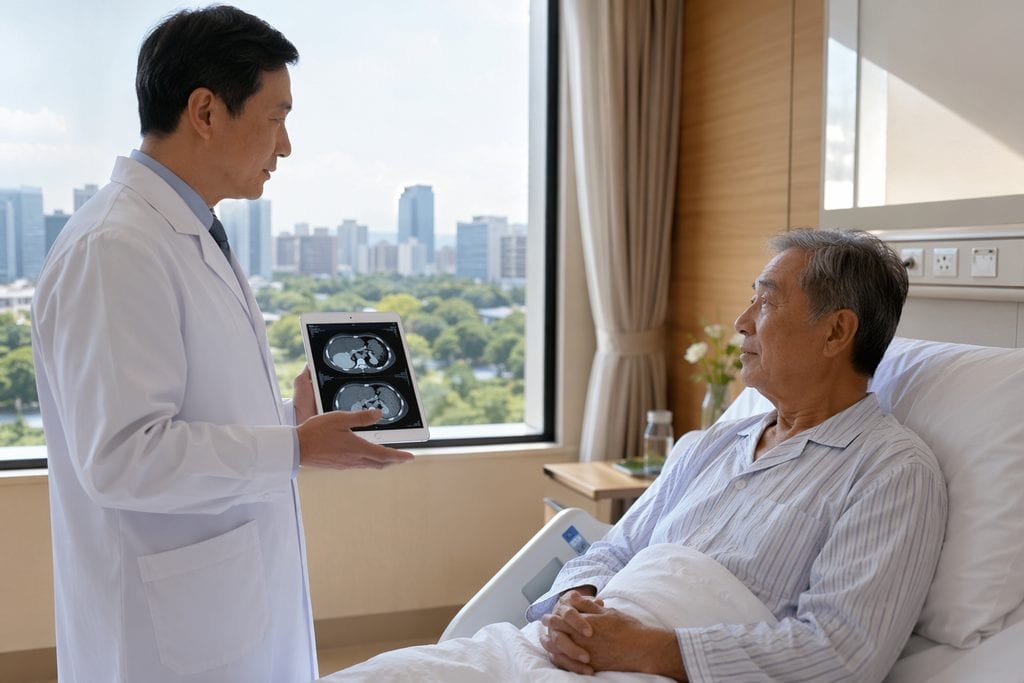
Liver Cancer Treatment Without Full Surgery: The Short Answer
Yes — many liver cancers can be treated without removing part of the liver. The most common non-surgical options are ablation (destroying tumors with heat, cold, or electrical current), TACE (transarterial chemoembolization — delivering chemotherapy directly into the tumor’s blood supply), and targeted or immunotherapy. These are not fringe alternatives. They are standard-of-care treatments used at major cancer centers worldwide, including the top-ranked oncology departments across China. For patients asking about liver cancer treatment without surgery cost China, the price range is typically between $5,000 and $25,000 for a complete ablation or TACE cycle, depending on hospital tier, tumor size, and number of sessions needed.
The caveat: “without full surgery” does not mean “without any procedure.” Ablation still involves needles through the skin. TACE involves a catheter through an artery in the groin. These are minimally invasive, but they are not non-invasive. And not every tumor qualifies — size, location, liver function, and whether the cancer has spread all determine eligibility. A tumor sitting right next to a major bile duct or blood vessel may not be safely ablatable. That is where a proper multidisciplinary review matters.
Who This Is Right For — and Who It Isn’t
Liver cancer treatment decisions hinge on the Barcelona Clinic Liver Cancer (BCLC) staging system, which considers tumor size, number of nodules, liver function, and overall health. Non-surgical options are typically first-line for patients in early and intermediate stages who are not good surgical candidates, or who choose to avoid resection.
Good candidates for ablation or TACE typically include:
- Patients with one to three small tumors (generally under 3–5 cm each, though thresholds vary by center)
- Those with compensated cirrhosis who cannot tolerate major liver resection
- Patients awaiting transplant who need “bridging” therapy to keep tumors controlled
- Older adults or those with significant comorbidities making surgery high-risk
- Patients with recurrent tumors after prior surgery
Who should not pursue this route:
- Patients with extensive tumor burden or portal vein invasion (unless receiving systemic therapy)
- Those with severely decompensated liver function (advanced cirrhosis, ascites, jaundice)
- Tumors in locations where ablation risks damaging critical structures
- Patients seeking a “gentler” option when surgery offers a genuine cure and they are fit for it
Avoiding surgery when surgery is the better oncologic choice can reduce survival. That is a hard truth. The goal is not to avoid the operating room at all costs — it is to match the treatment to the disease biology and the patient’s physiology.
The Options, Compared
Three main non-surgical approaches dominate liver cancer care. They work differently and suit different situations.
| Option | How It Works | Typical Indication | Approx. Cost in China (USD) | Hospital Stay |
|---|---|---|---|---|
| Radiofrequency or Microwave Ablation | Needle inserted through skin into tumor; heat destroys cancer cells | Early-stage, ≤3 tumors, each ≤3–5 cm | $5,000–$12,000 per session | 1–3 days, often outpatient |
| TACE | Catheter delivers chemo + embolic particles directly into hepatic artery | Intermediate-stage, multinodular, unresectable | $6,000–$15,000 per cycle (often 2–3 cycles) | 2–4 days per cycle |
| Targeted Therapy / Immunotherapy | Oral or IV drugs (sorafenib, lenvatinib, atezolizumab+bevacizumab, etc.) | Advanced disease, or combined with TACE/ablation | $2,000–$8,000 per month depending on drug | None for oral; IV every 2–3 weeks |
Which column fits you? If you have one small tumor and preserved liver function, ablation is often the most direct answer. If you have multiple nodules scattered across the liver, TACE is the workhorse. If the disease has spread beyond the liver, systemic therapy becomes the backbone — sometimes combined with local treatments. Many patients receive a combination: TACE followed by ablation, or TACE plus targeted therapy. That is why a single price quote before proper imaging review is usually meaningless.
Can Liver Cancer Be Treated with Ablation in China? What to Expect Logistically
The short answer is yes — can liver cancer be treated with ablation in China is a question we field regularly, and the answer is that ablation is widely available at major centers. Microwave ablation (MWA) is particularly common in Chinese hospitals because it achieves larger ablation zones faster than radiofrequency ablation (RFA). Many hepatobiliary surgery and interventional radiology departments in Beijing, Shanghai, and Guangzhou perform hundreds of these procedures annually.
Here is what the process looks like for an international patient:
- Remote review first. You send your existing CT/MRI images, lab reports (liver function, AFP, hepatitis markers), and clinical history. A specialist reviews them and gives a written opinion on whether ablation is feasible.
- In-person consultation. You travel to China, meet the interventional radiologist or hepatobiliary surgeon, and undergo a planning ultrasound or contrast-enhanced imaging if needed.
- The procedure itself. Typically 30–90 minutes under local anesthesia with sedation, or general anesthesia depending on tumor location.
- Post-procedure monitoring. One to three days in hospital. A follow-up CT or MRI within 4–6 weeks confirms whether the ablation zone fully covers the tumor.
One thing Western patients often underestimate: Chinese public hospitals are enormous and busy. Registration, payment, imaging, and ward admission involve multiple queues and Chinese-language forms. Without a bilingual coordinator, a simple ablation can consume a week of confusion. This is not a reason to avoid China — it is a reason to plan properly.
Is TACE Therapy Available in China for Liver Cancer? Yes — and It Is a Core Strength
Is TACE therapy available in China for liver cancer — absolutely. China has one of the highest volumes of TACE procedures globally, driven by the high prevalence of hepatitis B-related hepatocellular carcinoma (HCC). Chinese interventional radiologists have deep experience with complex TACE cases, including repeat sessions and combination protocols.
What makes TACE in China particularly relevant for international patients:
- High procedural volume at top centers means experienced operators
- Cost per TACE cycle is typically one-fifth to one-tenth of U.S. pricing
- Many centers use drug-eluting bead TACE (DEB-TACE), which delivers chemotherapy more slowly and with fewer systemic side effects than conventional TACE
- Combination protocols — TACE plus ablation, TACE plus targeted therapy, TACE plus immunotherapy — are actively studied and applied
Patients often ask about the best non surgical liver cancer hospital Shanghai. While we cannot name a single “best” hospital without reviewing your specific case, Shanghai is home to several institutions with internationally recognized hepatobiliary programs. Fudan University-affiliated hospitals and Shanghai Jiao Tong University-affiliated hospitals both operate high-volume liver cancer centers. The right choice depends on tumor characteristics, your budget, and whether you need English-speaking staff — which usually means the hospital’s international medical department or a private international hospital with an affiliated specialist network.
What It Costs: A Realistic Breakdown
Let us talk numbers plainly. The liver cancer treatment without surgery cost China varies by hospital tier. Public hospital standard wards are cheapest. International departments of public hospitals cost 1.5–2 times more but provide English coordination. Private international hospitals cost the most but offer Western-style service and direct insurance billing.
Here is a realistic range for a single ablation session:
- Public hospital standard pathway: $5,000–$8,000
- Public hospital international department: $8,000–$12,000
- Private international hospital: $12,000–$20,000
TACE cycles run similarly: $6,000–$10,000 in public pathways, $10,000–$15,000 internationally, and $15,000–$25,000 at private international facilities. Most patients need two to three TACE cycles spaced 4–6 weeks apart.
Targeted therapy for liver cancer price China deserves special attention. Generic sorafenib costs roughly $300–$600 per month in China, compared to $5,000–$8,000 for the branded version in the U.S. Lenvatinib generics are similarly affordable. Immunotherapy drugs like atezolizumab (Tecentriq) remain expensive everywhere — $3,000–$6,000 per dose — though Chinese domestic PD-1 inhibitors (camrelizumab, sintilimab, tislelizumab) cost $1,000–$2,500 per cycle. Many international patients combine local therapy in China with ongoing systemic therapy arranged through their home oncologist. That is a legitimate strategy worth discussing with your medical team.
What is not included in the procedure price: visa fees, flights, accommodation, meals, translation services, and any complications requiring extended stay. Budget an additional $3,000–$8,000 for logistics depending on length of stay and city.
Practical Considerations: Records, Visa, Payment, and Follow-Up
Getting treated in China requires more than booking a flight. Here is what you need to prepare.
Medical records. Hospitals will not schedule ablation or TACE without current imaging. Bring (or send digitally) contrast-enhanced CT or MRI from within the last 30–60 days, recent liver function tests, AFP tumor marker, hepatitis B/C serology, and any prior biopsy or treatment records. If records are not in English or Chinese, professional translation is required.
Visa. The appropriate category for medical treatment is the S2 visa, which covers short-term private affairs including medical treatment. Family members accompanying you also apply for S2. You will need an invitation letter or supporting documents from the hospital confirming your appointment. Processing times vary by embassy — allow 2–4 weeks. Do not apply for an M visa; that is for commercial and trade activities, not medical care.
Payment. Chinese public hospitals require prepayment — typically a deposit at admission, with additional payments as treatment progresses. Credit cards are accepted at international departments; standard wards may require cash, UnionPay, or Chinese mobile payment. International health insurance usually works on a reimbursement basis, meaning you pay upfront and claim later. Some private international hospitals offer direct billing with major insurers.
Language. Even in top hospitals, most frontline staff speak limited English. International departments mitigate this, but once you are in the CT suite or recovery ward, having a bilingual companion changes the experience entirely.
Follow-up. Ablation and TACE require imaging follow-up at 4–6 weeks, then every 3 months. You can do follow-up imaging at home and send results to your Chinese team for review. Many patients return to China annually for repeat evaluation. The relationship does not end when you board the flight home.
Frequently Asked Questions
For small, early-stage tumors, ablation can achieve complete tumor destruction with outcomes approaching surgical resection in selected patients. The five-year survival rates for ablation of solitary tumors under 3 cm are comparable to surgery in many studies. But “cure” depends on underlying liver disease — cirrhosis and hepatitis remain risk factors for new tumors even after successful ablation. Ongoing surveillance is non-negotiable.
To book liver cancer ablation treatment China, the process starts with remote review. You cannot simply call a hospital and reserve a procedure date. A specialist must first review your imaging and confirm eligibility. Once confirmed, the hospital’s international department can issue the documents needed for your S2 visa application. Coordination services can handle this entire sequence — translation, hospital matching, appointment scheduling, and on-the-ground support.
This is a real possibility, and you should plan for it. If follow-up imaging shows residual tumor, options include repeat ablation, a different local therapy, switching to systemic treatment, or reconsidering surgery if your condition has changed. The advantage of being at a comprehensive cancer center is that the team can pivot without you needing to find a new hospital. Ask about the center’s protocol for incomplete response before you commit.
Traveling with active cancer carries risks — fatigue, bleeding, infection, and decompensation. You need medical clearance before flying. If your liver function is borderline, a long flight may worsen ascites or encephalopathy. In some cases, staying closer to home for initial stabilization is the wiser choice, with China as a later option. A remote consultation can help clarify whether travel is advisable in your specific situation.
Your Next Step
Non-surgical liver cancer treatment in China is real, established, and significantly less expensive than in the U.S. or Western Europe. But it requires careful case review before any commitment. Our team at China Medical Services helps international patients navigate this — we are not a hospital, we do not diagnose or treat, and we make no promises about outcomes. What we do is connect you with appropriate specialists, translate your records, coordinate appointments, and provide on-the-ground support throughout your stay. If you are weighing ablation, TACE, or targeted therapy in China, start by sending your imaging for a written second opinion. That single step will tell you whether this path is even open to you — and what it would realistically cost.
For more medical information and treatment options in China, visit chinamedservices.com (China Medical Services).
