Lung Nodule Cancer Risk in China: Diagnosis, Costs, and Top Hospitals
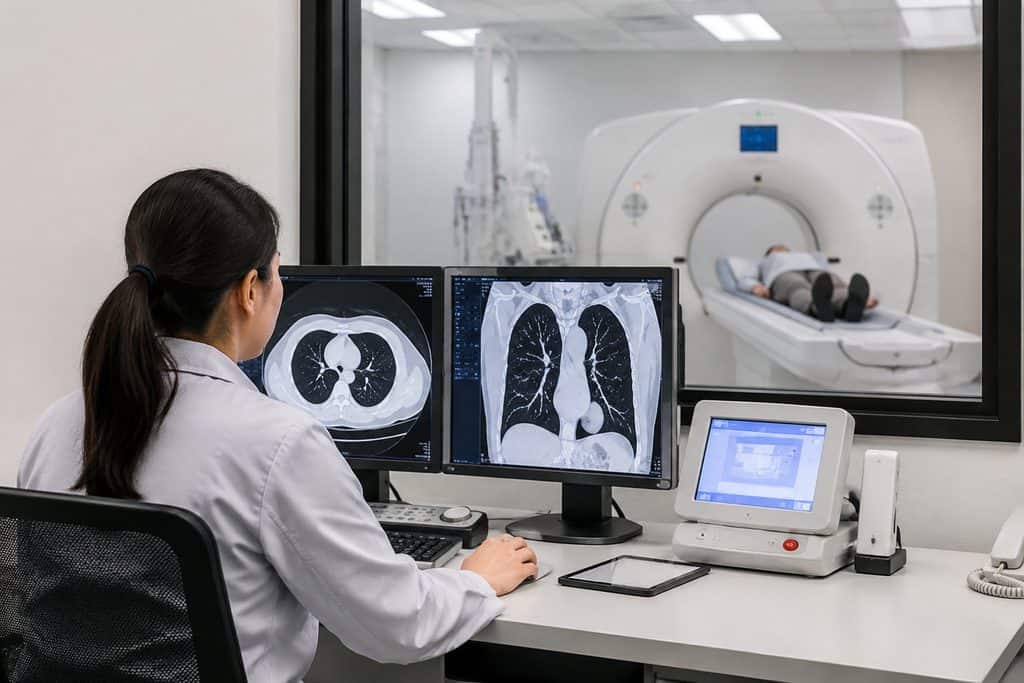
Lung Nodule Cancer Risk China Treatment: A Complete Guide for International Patients
Key Takeaways
- Roughly 95% of incidentally found lung nodules are benign, but size, shape, and growth pattern determine actual risk.
- China’s top thoracic centers perform over 10,000 lung cancer surgeries annually, far exceeding typical Western hospital volumes.
- Lung nodule removal in Shanghai costs between $8,000 and $18,000 at top public hospitals, compared to $40,000–$80,000 in the United States.
- Foreign patients cannot simply book a biopsy online; they need a formal in-person consultation first, which is where structured coordination helps.
According to a 2023 study published in Lung Cancer, approximately 1.5 million Americans are diagnosed with a lung nodule each year, yet fewer than 5% of those nodules ultimately prove malignant. The question “Can a lung nodule turn into cancer?” is not just theoretical. It is the single most common concern patients raise after an incidental CT finding. And when the answer is yes — or even maybe — the next question becomes: where do I get the best possible evaluation and treatment without waiting months or paying a fortune? That is where understanding lung nodule cancer risk China treatment pathways becomes genuinely useful.
Most nodules are harmless scars or granulomas. But some are early-stage adenocarcinomas, and catching those early changes the entire survival curve. The five-year survival rate for stage IA lung cancer exceeds 85%, while stage IV drops below 10%. The difference often comes down to how quickly a suspicious nodule gets biopsied or removed. China’s top thoracic hospitals have built massive clinical volume around exactly this problem. Their surgeons see more lung nodules in a month than many Western specialists see in a year.
The Problem: Waiting, Uncertainty, and Cost Barriers in Western Systems
A patient in the United Kingdom with a suspicious 8mm nodule might wait 6 to 12 weeks just for a follow-up CT, then several more weeks for a biopsy, and if surgery is needed, another 8 to 16 weeks for a thoracic surgical slot. The NHS itself reports that the 62-day cancer waiting time standard has been missed for lung cancer patients in recent years, with some regions averaging over 80 days from urgent referral to first treatment. In Canada, the median wait time from specialist referral to thoracic surgery is approximately 12 weeks, according to the Fraser Institute’s 2023 report.
In the United States, the barrier is less about waiting and more about cost. A diagnostic video-assisted thoracoscopic surgery (VATS) wedge resection for a lung nodule typically bills between $35,000 and $70,000, depending on the facility. Even with insurance, a high-deductible plan can leave a patient owing $8,000 to $15,000 out of pocket. And that is before pathology, anesthesia, and hospital fees are fully itemized.
So patients face a brutal trilemma: wait too long and risk progression, pay too much and face financial strain, or do nothing and live with anxiety. That last option is not neutral. A 2022 Journal of Thoracic Oncology review found that patients with indeterminate nodules experience measurable psychological distress comparable to a cancer diagnosis itself. The uncertainty is the disease.
Why China’s Thoracic Centers Deliver Results for Lung Nodule Evaluation
Clinical Volume That Changes Diagnostic Confidence
Shanghai Pulmonary Hospital performs over 12,000 thoracic surgeries annually, making it one of the highest-volume lung surgery centers on the planet. By comparison, a busy academic medical center in the United States might perform 800 to 1,500 thoracic cases per year. Volume matters because nodule evaluation is pattern recognition. A radiologist who reads 50 chest CTs a day sees subtle ground-glass opacity changes that a generalist might miss. A surgeon who removes 300 suspicious nodules a year has a refined sense of when to cut and when to watch.
China’s tiered hospital system concentrates complex cases in a relatively small number of elite centers. The Fudan University Hospital Ranking places about 100 hospitals in the top tier nationally. Among those, a handful dominate thoracic oncology. Their multidisciplinary teams review nodules weekly, often with pulmonology, radiology, oncology, and thoracic surgery at the same table. That is structurally different from fragmented Western referral patterns.
Technology Adoption at Scale
Chinese hospitals were early adopters of low-dose CT screening and AI-assisted nodule detection. Software tools now flag and measure nodule volume doubling times automatically. That means a patient who arrives with a CD of DICOM images from a scan done in London or Dubai can often get a same-day or next-day quantitative growth analysis at a major Chinese thoracic center. The radiomics platforms used in Shanghai and Beijing can predict malignancy risk with reported accuracy above 90% for certain nodule subtypes, according to research published in Nature Communications in 2022.
For surgical cases, uniportal VATS and robotic-assisted thoracic surgery (RATS) are now standard at top centers. The da Vinci Xi system is deployed at multiple hospitals in Shanghai and Beijing. A uniportal VATS wedge resection leaves a single 3–4 cm incision and often allows discharge within 48–72 hours. That is not experimental technology. It is routine volume.
Cost Advantage Without Quality Compromise
The phrase “cheap” makes Western patients nervous. Fair enough. But the cost difference is structural, not a reflection of quality. Chinese thoracic surgeons earn a fraction of US surgeon salaries. Hospital construction and operating costs are lower. Malpractice premiums are a tiny fraction of American levels. None of that affects the technical quality of a VATS resection or a CT-guided biopsy.
The result: a lung nodule wedge resection at a top Shanghai hospital costs between $8,000 and $18,000, depending on whether it is a public hospital international department or a private international hospital. The same procedure in the United States averages $50,000. Even adding flights, a hotel, and bilingual coordination, the total is often one-third to one-half of the US price. That is the honest math.
How Lung Nodule Evaluation Actually Works in China: A Step-by-Step Timeline
Here is what a patient with a suspicious nodule should expect when pursuing lung nodule cancer risk China treatment. The process is not as simple as emailing a hospital and booking a surgery date. Chinese public hospitals do not operate that way. But with proper coordination, the timeline is often faster than most Western systems.
Day 0–3: Remote record review. You send existing CT images (DICOM format preferred), radiology reports, and any prior scans. A thoracic specialist at a partner hospital reviews them and provides a written second opinion. This step costs $300–$500 and answers the core question: is this nodule actually suspicious enough to warrant travel? Some patients learn their nodule is clearly benign and never book a flight.
Day 4–14: Travel planning and visa. Foreign patients traveling for medical treatment use an S2 visa, which covers short-term private affairs including medical treatment. The hospital issues an invitation letter and treatment plan to support the visa application. Processing time varies by country, but most patients complete it within 10 business days.
Day 15–17: In-person consultation and imaging. You arrive in Shanghai or Beijing. The hospital repeats a thin-slice chest CT, often with contrast. If the nodule has grown since your last scan, the radiologist calculates the doubling time. A multidisciplinary team reviews the case. If the nodule is clearly low-risk, you may simply get a follow-up plan. If it is suspicious, biopsy or surgery is scheduled.
Day 18–22: Biopsy or surgery. A CT-guided needle biopsy can often be done within 48 hours of the consultation. If surgery is recommended, a VATS wedge resection is typically scheduled within 3–7 days. Hospital stay is usually 2–4 days for uncomplicated cases.
Day 23–30: Pathology and discharge. Final pathology takes about 5–7 working days. If the nodule is benign, you fly home with documentation and a clear follow-up plan. If malignant, the same surgical team can often proceed with a lobectomy during the same admission or a scheduled return visit, depending on staging and your preferences.
This timeline assumes no complications and a motivated patient. It is realistic, not guaranteed. But it is also dramatically faster than the 12–20 week pathway many Western patients face.
What the Numbers Mean: Interpreting Nodule Size, Shape, and Risk
Patients often ask: is a 8mm lung nodule dangerous can it be cancer? The answer is nuanced. Size alone does not determine malignancy. A 2021 Radiology meta-analysis found that nodules under 6mm have a malignancy risk below 1%, while nodules between 8mm and 20mm carry a risk of roughly 15–20%, depending on other features. But an 8mm ground-glass nodule with a solid component is far more concerning than an 8mm calcified granuloma.
Radiologists use the Fleischner Society guidelines to stratify risk. The key variables are:
- Size: Larger nodules are more likely malignant, but small nodules can still be early adenocarcinomas.
- Density: Pure ground-glass nodules are often indolent; part-solid nodules (ground-glass with a solid core) are more likely to be invasive.
- Border characteristics: Spiculated or lobulated margins suggest malignancy; smooth, well-defined margins suggest benignity.
- Growth rate: A doubling time of 20–400 days is typical for malignant nodules. Faster growth suggests infection; slower growth suggests benignity.
- Patient history: Smoking history, age over 50, and prior cancer diagnosis all raise pre-test probability.
So an 8mm nodule is not automatically dangerous. But it is not automatically safe either. The responsible approach is quantitative analysis — ideally with a same-day or next-day review by a high-volume thoracic radiologist. That is exactly the service model at China’s top thoracic centers.
Choosing the Best Thoracic Surgery Hospital in Beijing for Lung Nodule Care
Patients searching for the best thoracic surgery hospital Beijing for lung nodule typically encounter a short list of institutions that dominate the field. The Fudan University Hospital Ranking’s thoracic surgery specialty list consistently places a handful of Beijing hospitals among China’s top 10. These include:
- Peking Union Medical College Hospital (PUMCH): Known for multidisciplinary thoracic oncology and complex case management. Its international department handles foreign patients with English-speaking coordinators.
- China-Japan Friendship Hospital: A major center for lung cancer screening and minimally invasive thoracic surgery, with a dedicated international clinic.
- Beijing Cancer Hospital: Focused on oncology, with strong thoracic surgery and interventional radiology programs.
Shanghai offers comparable options, including Shanghai Pulmonary Hospital and Zhongshan Hospital Fudan University, both of which rank among the top thoracic centers nationally. For international patients, the choice often comes down to city preference, travel logistics, and which hospital’s international department has availability for the needed time window. You can explore our thoracic surgery department rankings for a fuller picture of specialty-specific hospital performance.
One practical note: public hospital international departments in Beijing and Shanghai typically charge 1.5 to 2 times the standard public rate, but they offer English-speaking staff, priority scheduling, and smoother registration. A private international hospital like United Family or Jiahui offers a fully Western-style experience with direct insurance billing, but at a higher price point — often $20,000 to $30,000 for the same VATS procedure that costs $10,000 to $15,000 at a public hospital international department.
Lung Nodule Removal Price Abroad: A Real Cost Comparison
Patients asking about lung nodule removal price abroad are usually comparing China, Thailand, India, South Korea, and Turkey. Here is how the numbers actually break down for a straightforward VATS wedge resection:
| Country | VATS Wedge Resection Cost (USD) | Typical Wait Time | English-Speaking Staff |
|---|---|---|---|
| United States | $40,000 – $80,000 | 2–6 weeks | Yes |
| United Kingdom (private) | $25,000 – $45,000 | 2–8 weeks | Yes |
| Germany | $20,000 – $35,000 | 2–4 weeks | Often |
| Thailand | $12,000 – $20,000 | 1–3 weeks | Yes (private hospitals) |
| India | $6,000 – $12,000 | 1–2 weeks | Variable |
| China (top public hospital international dept.) | $8,000 – $18,000 | 1–2 weeks | Yes (international dept.) |
| China (private international hospital) | $18,000 – $30,000 | 3–10 days | Yes |
The China advantage is not just price. It is the combination of price, speed, and clinical volume. India is cheaper, but the hospital quality variance is wider, and English proficiency in non-metropolitan centers can be inconsistent. Thailand is excellent for private care, but its thoracic surgery volume is lower than China’s top centers. South Korea is competitive but generally more expensive than China for equivalent procedures.
One more factor: pathology turnaround. Chinese hospitals with in-house molecular pathology labs can return EGFR, ALK, and PD-L1 results within 5–7 working days. That matters if the nodule turns out to be malignant and you need to make a treatment decision quickly.
Practical Considerations: Documentation, Visa, and Payment for Lung Nodule Care in China
Traveling to China for nodule evaluation requires more than a passport and a plane ticket. Here is what you actually need to prepare.
Medical records. Bring every prior chest CT on a CD or USB drive in DICOM format. JPEG snapshots of the scans are not sufficient for quantitative analysis. Include the radiology reports, any prior biopsy results, and a summary of your medical history. If you have had a PET-CT, bring that too.
Visa. The correct category is S2 for short-term medical treatment, not M. M visas are for commercial and trade activities. The S2 application requires an invitation letter from the Chinese hospital confirming your appointment. Processing typically takes 5–10 business days after submission, but this varies by embassy and country. Apply early.
Payment. Chinese public hospitals require prepayment before admission. International departments usually accept Visa, Mastercard, and sometimes wire transfer. Private international hospitals often bill insurance directly. Public hospital international departments generally do not — you pay out of pocket and seek reimbursement later. Budget for the full procedure cost plus a 20–30% buffer for unexpected items.
Language. Even at international departments, not every staff member speaks fluent English. Radiology technicians, phlebotomists, and discharge coordinators may speak only Chinese. A bilingual coordinator or companion can handle registration, queue management, pharmacy pickup, and translation. This is not a luxury; it is the difference between a smooth visit and a frustrating one.
Follow-up. If your nodule is benign or low-risk, you will likely be advised to repeat a CT in 6–12 months. You can do that at home and send the images back to the same Chinese radiologist for comparison. If surgery was performed, the hospital will provide a discharge summary, pathology report, and surgical notes in English upon request. Keep these for your home physicians.
Frequently Asked Questions
Yes, but the risk is low for nodules under 6mm. Malignancy risk rises with size, but even small nodules can be early adenocarcinomas, especially if they are part-solid or show growth on follow-up scans. The key is serial imaging and expert radiology review, not panic.
At a top public hospital’s international department, a VATS wedge resection typically costs between $8,000 and $18,000, depending on complexity and length of stay. Private international hospitals in Shanghai charge $18,000 to $30,000. These figures exclude travel and accommodation.
Is a 8mm lung nodule dangerous
For more medical information and treatment options in China, visit chinamedservices.com (China Medical Services).
