Top Lymphoma Hospital in Shanghai: Ruijin Hospital’s Edge
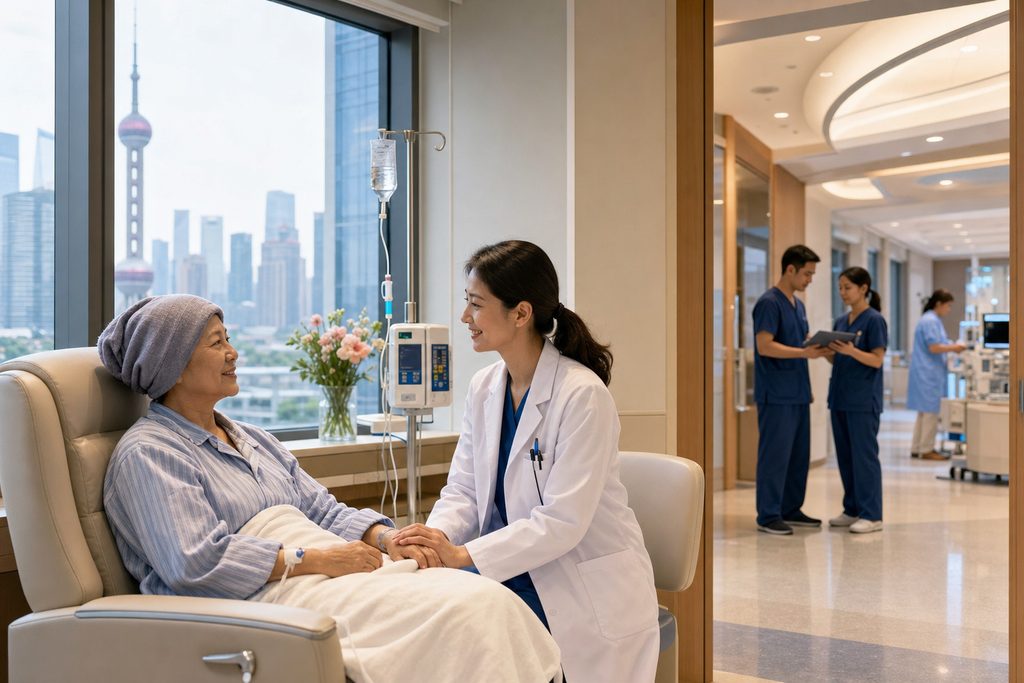
You have probably heard that receiving complex cancer treatment in China means accepting a lower standard of care. The opposite is true for specific specialties. Hematologic oncology at a few Chinese institutions operates at a scale and technical depth that is difficult to match anywhere. Ruijin Hospital in Shanghai is one of them. For a Western patient facing a lymphoma diagnosis, the question is rarely about whether the science exists. It is about access, cost, and coordination. The lymphoma treatment cost Shanghai ranges from $25,000 to $75,000 for standard first-line protocols, depending on the subtype and staging. That figure sits against a US benchmark that frequently exceeds $150,000 to $250,000 for equivalent care. The gap is real. But cost without a clear clinical pathway is meaningless.
Our team at China Medical Services works with international patients who need a realistic picture—not a brochure. Here is how a lymphoma patient actually navigates Ruijin Hospital.
How This Actually Works, Step by Step
The process starts with paper, not planes. You send us the pathology report, PET/CT imaging, bone marrow biopsy results, and any prior treatment records. A lymphoma specialist at Ruijin’s hematology department reviews those documents. This is the written second opinion stage, priced from $300 to $500. It is not a prescription. It is a clinical read on your diagnosis, staging, and whether your case fits the hospital’s treatment protocols.
What do you get back? A written analysis. It includes the Chinese team’s assessment of your subtype—diffuse large B-cell, follicular, mantle cell, Hodgkin, or another—and a proposed treatment direction. Sometimes the answer is: your current regimen is correct, stay where you are. That honesty matters.
If the review suggests coming to Shanghai, the next step is a video consultation with the specialty team, typically $500 to $800 for a top specialist. You discuss symptoms, treatment history, and goals. The doctors explain what they would do differently or reinforce. Only after this remote evaluation does it make sense to plan travel.
Why Ruijin Hospital Stands Out for Lymphoma
Ruijin is not a general hospital that happens to have an oncology floor. Its hematology department is one of the largest and most research-active in China. The hospital is consistently ranked among China’s top 10 for hematology in the Fudan University specialty reputation rankings. That is a meaningful distinction. The Fudan ranking is the most authoritative hospital evaluation system in China, covering 45 specialties. Ruijin appears in the top tier for blood diseases—a category that includes lymphoma, leukemia, and myeloma.
Is Ruijin Hospital good for lymphoma? The evidence points to volume. The department manages thousands of lymphoma cases annually. That volume translates into protocol familiarity that smaller centers cannot replicate. For rare subtypes—such as NK/T-cell lymphoma, which is more prevalent in Asia than in the West—Chinese hematologists often have deeper clinical exposure than their US or European counterparts. This matters if your subtype is uncommon.
But volume is not the same as personalized care. A public hospital of this size sees enormous patient flow. Without Chinese language ability, the experience can be disorienting. That is precisely where a bilingual medical companion changes the equation. We coordinate registration, queue management, payment, and translation—so you spend your energy on treatment, not logistics.
A Realistic Timeline
People underestimate the lead time. Here is what a typical pathway looks like for an international lymphoma patient considering Ruijin.
| Stage | What Happens | Realistic Duration |
|---|---|---|
| Day 1–7 | Document collection and certified translation of medical records | 1 week |
| Day 8–21 | Written second opinion by Ruijin hematology team | 2 weeks |
| Day 22–35 | Video consultation scheduling and completion | 2 weeks |
| Week 5–8 | S2 visa application with hospital invitation letter | 2–4 weeks |
| Week 9 | Arrival in Shanghai, in-person consultation, staging workup | 3–5 days |
| Week 10–12 | Treatment initiation (chemoimmunotherapy, targeted therapy, or trial enrollment) | 2–3 weeks after arrival |
| Month 3–6 | Active treatment cycles, response assessment | Varies by protocol |
The waiting steps people forget are document translation and visa processing. Certified translation of a full pathology and imaging record takes a week. The S2 visa—the correct category for short-term medical treatment in China—requires an invitation letter from the hospital and typically takes two to four weeks depending on your consulate. Do not book flights before the visa is approved.
What Can Go Wrong — and What Happens Then
The honest failure modes matter more than the success stories.
First, your records may be incomplete. If the pathology slides are not available for re-review, the Chinese team cannot confirm the diagnosis. Lymphoma treatment depends on precise subtyping. Without the original tissue block or adequate slides, the written opinion will be qualified. The fix is simple: request your pathology slides from the original lab before starting the process.
Second, the remote review may conclude that your case does not require travel. This is not a failure—it saves you money and disruption. We have seen cases where a US-based regimen was already optimal. The written opinion still has value: it gives you a second clinical perspective for under $500.
Third, treatment timelines can shift. Public hospitals in China run on high volume. Even with international department coordination, a specific specialist’s availability can delay the first in-person consultation by a week or two. We cannot promise a specific doctor on a specific date. We can promise that if we cannot secure the appointment we committed to, the coordination fee is refunded in full.
Fourth, insurance reimbursement is retrospective. Chinese public hospitals require prepayment. You pay for each treatment cycle upfront, then file for reimbursement with your insurer. If your insurer requires pre-authorization, start that process during the document review stage—not after you arrive.
How Lymphoma Is Treated in China: What Differs
The protocols are not exotic. Chinese hematologists follow the same international guidelines—NCCN, ESMO, and Chinese Society of Clinical Oncology (CSCO) adaptations. The drugs are the same: rituximab, CHOP-based regimens, bendamustine, BTK inhibitors, lenalidomide, and increasingly CAR-T cell therapy.
What differs is access and cost structure.
CAR-T is the clearest example. In China, approved CAR-T products for relapsed or refractory B-cell lymphomas are priced between $100,000 and $150,000 per infusion. In the US, the equivalent therapies cost $400,000 to $500,000. That is a three- to four-fold difference. Not every patient is a CAR-T candidate. But for those who are, the lymphoma treatment cost Shanghai can represent the single largest savings of any treatment category.
Biosimilars also play a role. China approved rituximab biosimilars years before some Western markets. The per-cycle cost of rituximab-based therapy in Shanghai is often 60–70% lower than US list prices. This is not inferior medicine. Biosimilars undergo rigorous equivalence testing.
What about clinical trials? Ruijin runs active trials in lymphoma, including novel bispecific antibodies and next-generation CAR-T constructs. International patients can sometimes enroll, subject to eligibility criteria and regulatory approval. Trial enrollment can reduce treatment cost to near zero for the drug itself, though hospitalization and monitoring costs remain.
Practical Considerations: Records, Visa, Payment, Language, Follow-Up
Records come first. You need the pathology report, immunophenotyping, cytogenetics, PET/CT imaging (DICOM files preferred), and a treatment summary if you have had prior therapy. All documents should be translated into Chinese for the hospital review. We handle certified translation as part of the coordination service.
The visa is an S2 visa, issued for short-term private affairs including medical treatment. Family members accompanying you also apply for S2. The hospital provides an invitation letter once the treatment plan is confirmed. Processing times vary by consulate. Do not apply for an M visa—that is for commercial and trade activities, not medical care.
Payment is prepaid at public hospitals. Bring a credit card with a high limit or arrange for international wire transfers. Some private international hospitals in Shanghai offer direct insurance billing, but Ruijin’s public system does not. If direct billing matters to you, consider a hybrid approach: treatment at Ruijin with recovery monitoring at a private facility like JCI-accredited international hospitals in Shanghai.
Language is the biggest daily friction. Ruijin has an international medical department with English-speaking coordinators. But the clinical floors, nursing stations, and pharmacy counters operate in Chinese. A bilingual medical companion from $300 per day handles the practical reality: queue tickets, lab results, medication instructions, and the hundred small interactions that make or break a hospital stay.
Follow-up at home is part of the plan. Before you leave Shanghai, the Ruijin team provides a written treatment summary and recommended monitoring schedule. Your home oncologist receives the full record. Subsequent follow-up can be done remotely through video consultations or by returning to Shanghai for interval imaging.
Frequently Asked Questions
Standard first-line chemoimmunotherapy for common B-cell lymphomas typically ranges from $25,000 to $75,000 for the full course, depending on the regimen and number of cycles. CAR-T therapy runs $100,000 to $150,000. These figures exclude travel, accommodation, and coordination services. Final costs vary by hospital and case complexity.
For common subtypes, Ruijin offers treatment quality on par with major Western academic centers, with significantly lower drug costs and comparable protocol adherence. For Asian-prevalent subtypes like NK/T-cell lymphoma, Ruijin’s clinical volume often exceeds Western centers. The trade-off is operational: a public hospital with high patient flow requires more coordination than a boutique Western private clinic.
Not through the standard outpatient system. Public hospital registration requires in-person queueing and Chinese language ability. The practical route for international patients is through the hospital’s international department or a coordination service that handles document preparation, appointment scheduling, and on-the-ground support. You cannot lock in a surgery or treatment date from overseas without going through this channel.
You receive a written opinion explaining the differences and the clinical reasoning. You are never obligated to act on it. Many patients use the written second opinion to have a more informed conversation with their home oncologist. The decision to travel or change treatment remains entirely yours.
No. China’s public health insurance does not cover foreign nationals seeking treatment in China. You pay out of pocket and seek reimbursement from your own insurer. Some international private hospitals offer direct billing, but public hospitals like Ruijin require prepayment.
Your Next Step
The decision to pursue lymphoma treatment in Shanghai starts with a clear-eyed review of your records. We are China Medical Services, a coordination team that connects international patients with top-tier Chinese hospitals. We do not practice medicine, and we do not promise outcomes. What we do is handle the friction: document translation, specialist access, visa guidance, and bilingual support on the ground.
If you have a lymphoma diagnosis and want to know whether Ruijin Hospital makes sense for your specific case, start with a written second opinion. Send your records. Get a clinical read. Decide with data, not guesswork. Request a free consultation to discuss your situation and whether this pathway fits.
For more medical information and treatment options in China, visit chinamedservices.com (China Medical Services).
