Massage Therapy Clinics in China: What Foreign Patients Need to Know
Massage Therapy Clinics in China: What Foreign Patients Need to Know
If you are searching for massage therapy clinics in China cost information, here is the short version: a standard one-hour body massage at a licensed clinic in a major city typically runs 150 to 500 RMB (about $20 to $70), while hospital-based tuina at a top-tier facility can reach 300 to 800 RMB ($40 to $110) per session. Packages of ten sessions often cut the per-visit price by 20 to 30 percent. That is a fraction of what the same treatment costs in London, New York, or Dubai.
But price is the easy part. The harder question is where to go, who is qualified, and how to tell a legitimate medical massage clinic from a spa that happens to own a massage table. That distinction matters enormously if you are dealing with a real injury, chronic pain, or a recovery plan.
What “Massage Therapy” Actually Means in China
In Western countries, massage therapy usually sits somewhere between wellness and physiotherapy. In China, the picture splits into three distinct worlds, and confusing them is the single most common mistake foreign visitors make.
The first is tuina (pronounced “tway-nah”), a branch of Traditional Chinese Medicine taught in universities and practiced in hospitals. Tuina practitioners train for years, and many hold hospital appointments. They treat herniated discs, frozen shoulder, post-stroke stiffness, and sports injuries. This is clinical work, not relaxation.
The second is the commercial spa chain — think of the ubiquitous foot-massage shops on every commercial street. Cheap, pleasant, and generally fine for a tired back. Not a place to take a spinal problem.
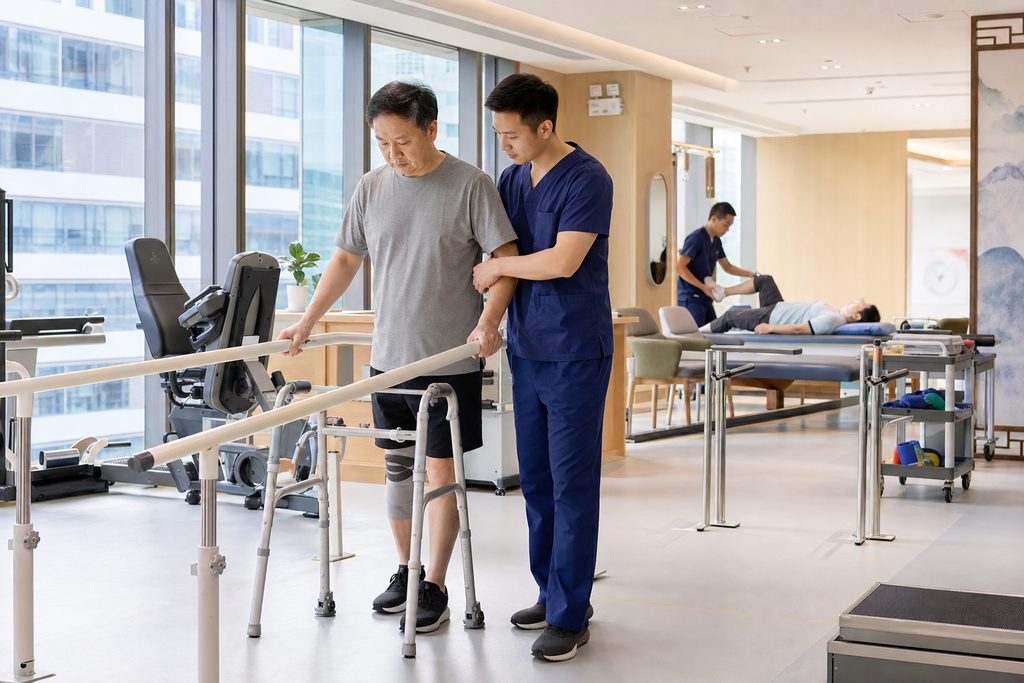
The third is the hospital rehabilitation department, where massage techniques blend with physical therapy, electrotherapy, and guided exercise. If you arrive with scans and a diagnosis, this is usually where you belong.
Massage Therapy Clinics in China Cost: Real Numbers by Setting
Prices vary widely by city, provider tier, and session length. The table below reflects typical ranges in Beijing, Shanghai, Guangzhou, and Chengdu as of 2025. Treat these as reference points, not quotes — every clinic sets its own rates, and hospital pricing follows provincial fee schedules.
| Setting | Typical Cost per Session | Session Length | English Support | Best For |
|---|---|---|---|---|
| Neighborhood spa / foot massage shop | 80–200 RMB ($11–28) | 60 min | Rare | Relaxation only |
| Mid-tier commercial massage clinic | 200–450 RMB ($28–63) | 60–90 min | Sometimes | Stress, mild tension |
| Hospital TCM department (tuina) | 150–400 RMB ($21–56) plus registration | 20–40 min | Limited; interpreter often needed | Clinical conditions |
| Hospital international / VIP clinic | 500–900 RMB ($70–126) | 30–60 min | Yes | Clinical care with English service |
| Private international wellness center | 600–1,200 RMB ($84–168) | 60–90 min | Yes | Convenience, insurance billing |
Notice the pattern. The cheapest option is also the least clinical. The most expensive option is not necessarily the best treatment — it is the most convenient and the easiest to navigate in English. Most foreign patients with an actual medical issue end up in the middle two rows.
For a ten-session tuina package treating a chronic neck or lower-back problem, budget roughly 2,000 to 5,000 RMB ($280–700) at a public hospital, or 6,000 to 12,000 RMB ($840–1,680) at a private international clinic. Compare that to $100 to $200 per session in the United States, and the savings become obvious.
How Much Does Massage Therapy Cost in China Compared With Home?
Here is a rough international comparison for a single 60-minute clinical massage session:
- United States: $80–150 (medical massage), $150–250 (physical therapy clinic)
- United Kingdom: £50–90 ($65–115)
- Germany: €60–100 ($65–110)
- UAE (Dubai): AED 300–600 ($82–163)
- China (public hospital tuina): $21–56
- China (private international clinic): $84–168
So the honest answer to “how much does massage therapy cost in China” is: somewhere between one-fifth and one-half of Western prices, depending on which tier you choose. The public hospital route delivers the biggest savings but demands patience and, usually, a Chinese-speaking companion.
Is Massage Therapy Safe in China?
At licensed hospitals and registered clinics, yes — the safety record is solid. Tuina is a regulated medical specialty, and hospital practitioners are licensed by the National Health Commission. Sterile linens, trained hands, and clear treatment boundaries are the norm.
The risks sit almost entirely in the unregulated sector. A few things worth knowing:
- Street-side “massage” shops sometimes offer services that have nothing to do with therapy. Reputable clinics do not.
- Aggressive spinal manipulation by an untrained hand can worsen a disc problem. If you have known spinal issues, insist on a hospital setting.
- Some commercial spas employ staff with a few weeks of training. Ask about credentials before booking anything clinical.
- Contraindications are universal: recent fractures, active infections, blood clots, severe osteoporosis, and certain cancers mean massage may be inappropriate. A qualified practitioner will screen for these. A spa attendant may not.
Finding the Best Massage Therapy Clinic in Shanghai (and Elsewhere)
Shanghai has the deepest bench of English-friendly options, which is why “best massage therapy clinic Shanghai” is such a common search among expats and medical travelers. The city hosts several hospital TCM departments with international wings, plus a dense cluster of private wellness centers in Jing’an and the Former French Concession.
Beijing follows closely, particularly around the Chaoyang district and the major teaching hospitals. If you want to book a massage therapy appointment in Beijing at a hospital-based clinic, expect to register in person on the day — most public hospital TCM departments do not accept overseas advance booking for routine outpatient visits. That is a structural feature of the Chinese system, not a flaw in any one hospital.
Chengdu, Guangzhou, and Hangzhou all have strong TCM traditions and lower prices than the two biggest cities. For a fuller picture of what each city offers international patients, our directory of top-ranked hospitals by city is a reasonable starting point.
Traditional Chinese Massage Therapy Packages in China: What to Expect
Multi-session packages are standard. A typical tuina course for a chronic condition runs 10 to 20 sessions over three to six weeks, often two or three visits per week. Hospitals sell these as a treatment plan rather than a “spa package,” and you will usually see the same practitioner each time.
Commercial clinics sell prepaid cards — 10 sessions for the price of eight, that kind of thing. Two cautions. First, prepaid cards at small shops carry real risk if the business closes. Second, a package is only worth buying once you have had one session and know the practitioner suits you.
For medical travelers combining treatment with a longer stay, tuina often pairs well with acupuncture and herbal consultation. Many hospital TCM departments offer all three under one roof, which keeps records coordinated.
Practical Considerations Before You Book
Language. Outside international clinics, English is uncommon. Bring a translation app at minimum, or arrange a bilingual companion for anything clinical. Misdescribing your symptoms to a massage therapist is a genuine safety issue, not just an inconvenience.
Payment. Public hospitals require upfront payment, usually by card, WeChat Pay, or Alipay — foreign cards work at some counters but not all. Private international clinics often bill insurance directly. Carry a backup payment method.
Documentation. If you are treating a diagnosed condition, bring your imaging and reports, translated if possible. A tuina practitioner who can see your MRI will treat you very differently from one working blind.
Visa. Routine massage therapy does not require a medical visa. If your trip includes actual hospital treatment, the applicable short-stay category is the S2 visa, used for medical treatment and private affairs — subject to current embassy requirements and supporting hospital documents. Note that the M visa is for commercial and trade activities and has nothing to do with medical care.
Follow-up. Massage therapy for chronic pain works best as an ongoing plan. Ask your practitioner to write down the techniques and frequency used, so a therapist at home can continue the approach.
Frequently Asked Questions
Commercial spas usually accept walk-ins, especially in the evening. Hospital TCM departments generally require same-day registration, and popular slots fill early — arrive when the department opens. International clinics prefer appointments and can often be reached by phone or email in English.
At a public hospital, roughly 2,000 to 5,000 RMB ($280–700) depending on city and condition. Private international clinics run two to three times that. Prices vary by hospital and case complexity, so confirm the total before committing.
Only under a qualified practitioner who has seen your imaging. Hospital tuina departments are equipped for this; commercial spas are not. Deep spinal manipulation by an untrained therapist can make a disc injury worse.
No. Ordinary tourism or business entry covers wellness treatments. If your itinerary includes hospital-based medical treatment, the S2 visa is the relevant category, and requirements should be confirmed with the nearest Chinese embassy or consulate.
Your Next Step
Massage therapy in China is inexpensive, widely available, and — at the hospital level — genuinely clinical. The challenge is not finding a clinic. It is finding the right one for your specific situation without wasting days on trial and error in a language you may not speak.
We are China Medical Services, a coordination team that helps international patients navigate the Chinese healthcare system. We are not a hospital and we do not diagnose or treat anything. What we do is help you understand your options, connect you with appropriate departments, and arrange bilingual support so appointments actually run smoothly. If you would like a clearer picture of what is realistic for your case, you can start with a free consultation — no pressure, no obligation.
This article is for general information only and is not medical advice. Massage therapy is not appropriate for every condition. Consult a qualified physician before beginning any treatment, in China or at home.
For more medical information and treatment options in China, visit chinamedservices.com (China Medical Services).
