Medical Treatment in China for Kazakh Patients: Costs, Hospitals, and How to Start
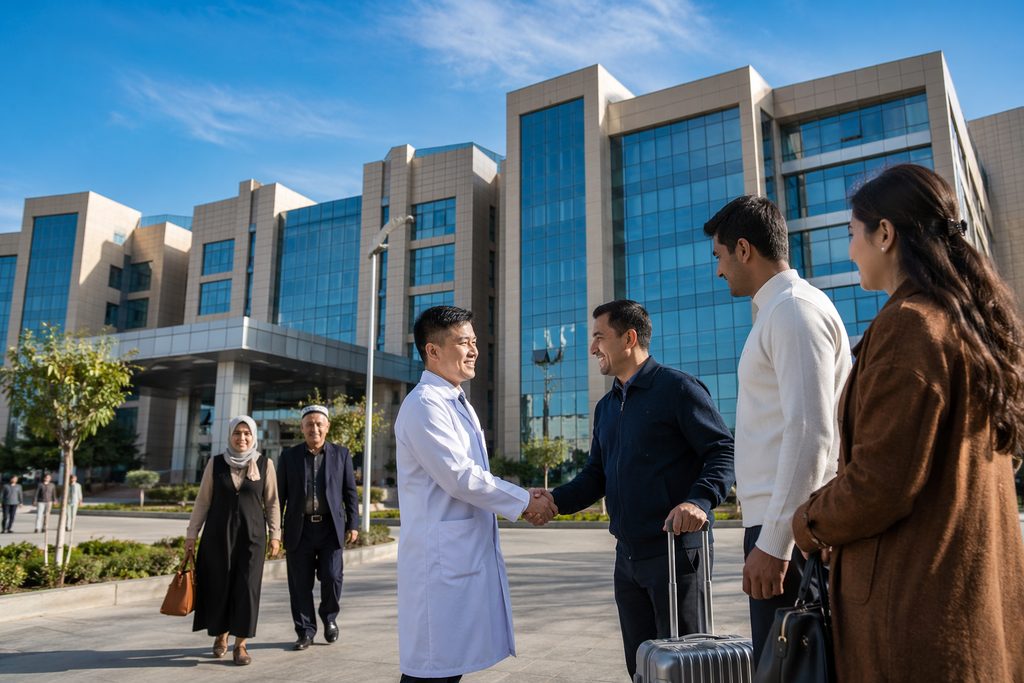
When Aigerim’s father was told he needed coronary bypass surgery, the family in Almaty faced a familiar arithmetic problem. The private clinic quoted roughly $28,000. The public queue stretched past eight months, and the surgeon they trusted had moved abroad. Her cousin, who had spent two years working in Urumqi, said something that surprised her: “Look at China.” Aigerim started searching that night, and like most families from Kazakhstan, Kyrgyzstan, and Uzbekistan, she found plenty of headlines and very little practical information.
That gap is what this guide is meant to close.
## Key Takeaways
- Top Chinese public hospitals perform complex cardiac, orthopedic, and oncological procedures at roughly one-fifth to one-tenth of US prices — a coronary bypass runs about $12,000–20,000 at a leading public hospital, compared with $120,000 or more in the United States.
- Geography matters for Central Asian families: Beijing and Xi’an are a short flight from Almaty, Bishkek, and Tashkent, and both cities host hospitals ranked in the Fudan Top 100.
- Public hospital outpatient registration cannot be booked from abroad in the ordinary channel. Surgery follows an in-person consultation, and securing a specialist slot in advance usually means going through a hospital’s international or VIP department at roughly 1.5–2 times the standard fee.
- Nothing here replaces an examination by a qualified physician. Use this article to plan, not to self-diagnose.
## The Problem: Distance, Cost, and a System That Doesn’t Explain Itself
Start with the numbers that push families to look abroad. A cardiac bypass in the United States averages well over $120,000 before complications. In Germany, patients frequently see quotes between €30,000 and €60,000 for comparable surgery. For a family in Kazakhstan paying out of pocket — and most Central Asian patients coming to China are self-pay — those figures are simply out of reach.
Then there is the waiting problem. Kazakhstan has made real investments in its own cardiac and oncology infrastructure, and Almaty and Astana host capable centers. But for certain subspecialties, the queue is long and the choice of surgeon is narrow. Kyrgyz patients often travel to Kazakhstan; Kazakh patients often travel to Russia or Turkey. Each option carries its own visa friction, language barrier, and price tag.
Language is the quieter obstacle. Russian is widely spoken in Almaty and Bishkek but far less common in Chinese hospitals outside Xinjiang and a handful of border cities. A patient who arrives in Beijing without Mandarin or a Mandarin-speaking companion faces a hospital that may see 10,000 or more outpatients in a single day. Signage exists in English at international departments, but the ordinary corridors are Chinese-only.
So the real question is not “Is China good?” It is “Can I actually navigate it?” That is a solvable problem, and the rest of this article is about how.
## Why China Delivers Results for Central Asian Patients
### Clinical Volume That Most Western Surgeons Never See
Fuwai Hospital in Beijing performs more than 14,000 cardiac operations a year — the highest volume of any heart center in the world. Volume matters in surgery. A team that performs 500 bypasses annually has seen the rare complications that a team performing 50 has only read about. China’s 340+ top-ranked hospitals — the top 5% of the country’s 35,000+ hospitals, as ranked by Fudan University and JCI — sit at the high end of that curve.
The Fudan ranking has two parts worth understanding. The general Top 100 is grouped into tiers (A++++ down to A) rather than numbered positions. The specialty reputation lists, covering 45 disciplines, do rank hospitals in the top 10 for each field. So “ranked among China’s top 10 for cardiac surgery” is a verifiable claim. “Number one hospital in China” is not something anyone can honestly assert.
### Cost Structure, Not Cost Cutting
The price gap is not explained by lower-quality implants or reused equipment. It comes from labor economics, hospital throughput, and procurement scale. A Chinese public hospital may run its operating rooms from early morning into the evening, six days a week. Nursing ratios in international departments are high, but salary scales are a fraction of US or German levels. Devices are purchased in enormous volumes.
That means a patient paying $15,000 for bypass surgery in Beijing is not buying a discount version. They are buying the same procedure in a system with a different cost base.
### Proximity That Central Asian Families Actually Feel
Beijing is a five-hour flight from Almaty. Xi’an, Chengdu, and Urumqi are all reachable within a day. Compare that with a 12-hour journey to Seoul or a 14-hour haul to Frankfurt with a connection. For a patient recovering from surgery, or for a family sending an elderly parent with a companion, distance is not a minor detail. It is the difference between a manageable trip and an ordeal.
## How Much Does Heart Surgery Cost in China? A Real Comparison
Cost is the first question almost every family asks, so here is a concrete table. All figures are ranges in US dollars and vary by hospital and case complexity.
| Procedure | China (top public hospital) | United States | Germany (typical) |
|---|---|---|---|
| Coronary artery bypass graft | $12,000–20,000 | $120,000+ | €30,000–60,000 |
| Heart valve replacement | $15,000–25,000 | $150,000+ | €35,000–65,000 |
| Total knee replacement | $8,000–15,000 | $35,000–75,000 | €15,000–25,000 |
| Spinal fusion (single level) | $10,000–18,000 | $80,000–150,000 | €25,000–45,000 |
| Comprehensive health screening | $500–2,500 | $2,000–8,000 | €1,000–3,000 |
These are hospital charges plus typical ancillary costs. They do not include flights, accommodation, or companion expenses. A realistic all-in budget for a two-week cardiac trip with one companion often lands between $18,000 and $28,000 — still a fraction of the US figure.
One important caveat: prices at private international hospitals in China are higher, often two to three times the public hospital rates, because they offer direct insurance billing and Western-style service. Patients with international insurance that covers China should compare both routes before deciding.
## Is It Safe to Get Treated in China as a Foreigner?
This is the question families ask with the most anxiety, and it deserves a direct answer rather than reassurance.
The honest answer: safety depends far more on which hospital and which department you enter than on which country you are in. China’s top-tier public hospitals meet international standards for sterility, anesthesia, and post-operative care. Many hold JCI accreditation, and their international departments are built specifically around foreign patients.
What is genuinely different is process. A few things you should know before booking anything:
– Outpatient registration is not bookable from overseas in the ordinary channel. You register on the day, in person, and surgery is scheduled only after an in-person consultation. This is a rule, not a preference.
– Advance specialist access runs through the international or VIP department. That channel offers senior physicians and English-speaking staff, and it costs roughly 1.5–2 times the standard fee.
– Public hospitals require prepayment. You pay upfront and claim from insurance afterward. Private international hospitals often bill insurers directly.
– Records must be translated. Chinese specialists work from Chinese-language records. A properly translated file is not a formality — it determines whether the consultation is useful.
If you want to understand how hospital selection works across the country, our guide to China’s top-ranked hospitals by city lays out the Fudan tier system and which cities host which specialties.
## Booking Medical Treatment in Beijing for International Patients: A Realistic Timeline
Beijing hosts 21 of the Fudan Top 100 hospitals — more than any other city. Here is what the process actually looks like, with realistic day markers.
Weeks 1–2: Records and remote review. You gather imaging, lab results, discharge summaries, and pathology reports. These are translated and submitted to the relevant specialty. A written second opinion typically comes back within this window, and a video consultation can be arranged if you want to speak with the team directly.
Weeks 2–3: Decision and visa. If the plan is feasible, you apply for an S2 visa, which is the short-stay category used for medical treatment and private affairs. Family accompanying you applies for S2 as well. Note that the M visa is for commercial and trade activity and has nothing to do with medical care. Final visa requirements rest with the embassy or consulate and depend on your supporting hospital documents.
Week 3–4: Arrival and consultation. You land in Beijing, complete registration at the international department, and attend the in-person consultation. This is the appointment that unlocks surgery scheduling.
Week 4 onward: Admission and procedure. Admission follows hospital rules and availability. No one can guarantee a specific surgeon or a specific date in advance — anyone who promises that is misrepresenting how the system works.
Recovery and return. Most cardiac patients spend 7–14 days in hospital and are cleared for travel after a follow-up assessment. Remote follow-up with the Chinese team remains possible after you return home.
## What Medical Tourism Packages in China Actually Cost — and What They Don’t Cover
The phrase “medical tourism package” gets used loosely. In practice, there is no single product. What exists is a set of coordination services, priced separately, that you can use à la carte or as a bundle. Here are representative ranges:
| Service | Typical price (USD) |
|---|---|
| Written second opinion from a top hospital specialist | $300–500 |
| Video consultation (standard international department) | $100–300 |
| Video consultation with a top specialist | $500–800 |
| Multidisciplinary team (MDT) video consultation | $1,500–2,000 |
| In-person top-specialist consultation coordination | $800–1,200 |
| Hospital appointment coordination (screening, outpatient, admission) | from $300 |
| Bilingual medical companion (per day) | from $300 |
| Airport transfer (round trip) | $200 |
Two things are worth flagging. First, these are coordination and interpretation fees — they are not hospital charges, and they are never payments for queue priority. Second, any consultation fee is credited in full toward on-the-ground coordination if you proceed within 90 days, applied once and to the coordination fee only.
What packages do not cover: the hospital’s own surgical and bed charges, medications, complications requiring extended stay, and travel insurance. Budget a contingency of 15–20% on top of the quoted surgical figure.
## Practical Considerations for Kazakh and Central Asian Families
Documents. Bring original imaging on disc or film, not just printed reports. Chinese radiologists prefer to read the source images. Get certified Russian-to-Chinese or Russian-to-English translations of discharge summaries and pathology reports.
Visa timing. Apply for S2 once you hold the hospital’s supporting documents. Processing typically takes one to two weeks, but this varies by consulate and season. Do not book flights before the visa is in hand.
Payment. Chinese public hospitals generally accept bank transfer and major cards, but foreign card limits and daily transaction caps can complicate large payments. Wire transfer in advance, arranged through the hospital’s international office, is usually smoother. Keep every receipt — you will need them for reimbursement.
Insurance. Most Kazakh and Central Asian insurers do not have direct billing arrangements with Chinese public hospitals. Expect to pay and claim. Private international hospitals are more likely to bill directly, but verify with your insurer before assuming coverage.
Language. If you do not speak Mandarin, arrange interpretation before arrival. A hospital day involves registration, payment windows, lab collection, imaging, and pharmacy — each at a different counter. For a detailed look at what that day involves, see our overview of bilingual medical companion services.
Follow-up at home. Ask the Chinese team for a written post-operative plan in English or Russian before discharge, including medication schedules and warning signs. Share it with your local physician within the first week home.
### Do I need a special visa to get medical treatment in China?
You apply for an S2 visa, which covers short-stay visits for medical treatment and private affairs. Accompanying family members apply under the same category. Requirements are set by the embassy or consulate and depend on your supporting hospital documents. The M visa is for commercial activity and is not used for medical care.
### Can I book surgery in China before I arrive?
No — not in the ordinary public channel. Surgery is scheduled only after an in-person consultation. What you can do in advance is submit records for a written second opinion or video consultation, which clarifies whether a procedure is feasible and what it would likely cost. Some international departments can pre-arrange a consultation slot, but the surgical date is confirmed only after the doctor examines you.
### How much should I budget in total?
For a cardiac procedure with one companion and a two-week stay, plan on $18,000–28,000 all-in, including hospital charges, flights, accommodation, and coordination services. Orthopedic and spinal procedures typically run lower. Always add a 15–20% contingency for complications or extended stay.
### What happens if something goes wrong during treatment?
Top Chinese hospitals have established complication-management protocols, and international departments provide English-speaking coordination. That said, you should carry travel medical insurance that explicitly covers planned treatment in China, and you should confirm in writing what the hospital’s policy is for extended stays before you are admitted. Ask this question during the consultation stage, not after.
### Are Chinese hospitals accredited internationally?
Many are. A significant number of China’s leading hospitals hold JCI accreditation, and all Fudan Top 100 hospitals meet national tertiary standards. If accreditation matters to you, ask the specific hospital directly — it is a reasonable question and international offices answer it routinely.
## Your Next Step
The core message is simple: China offers world-class surgical care at a fraction of Western prices, and for Central Asian families the geography works in your favor. The hard part is not the medicine — it is the navigation. Records, translation, visa category, hospital selection, and the in-person registration rule all have to be handled in the right order.
Our team at China Medical Services connects international patients with 340+ top-ranked hospitals across 37 cities. We are not a hospital and we do not provide diagnoses or treatment. What we do is translate your records, coordinate appointments through official international departments, arrange bilingual accompaniment, and guide you through the visa and travel logistics.
If you are at the beginning of this process, start with a records review. It costs nothing to ask, and it will tell you whether China is the right answer for your case before you spend a dollar on flights.
Frequently Asked Questions
Yes. The hospitals used for international patients are JCI-accredited and follow the same international safety standards as top hospitals in the US and Europe. Surgical teams perform high volumes of procedures — often more than their Western counterparts — which studies show leads to better outcomes.
Costs vary by procedure and hospital, but international patients typically save 40-80% compared to US prices — even when factoring in travel and accommodation. A consultation with our team will give you an exact, all-inclusive quote with no hidden fees.
Send us your existing medical reports to get started. We handle everything from hospital selection and appointment scheduling to visa assistance and post-operative recovery planning. Your medical records are reviewed by the specialist before you even book a flight.
For more medical information and treatment options in China, visit chinamedservices.com (China Medical Services).
