Minimally Invasive Surgery in China: Top Hospitals, Costs & How to Choose
Which Hospital in China Offers Minimally Invasive Surgery? A Data-Driven Guide for International Patients
Have you been quoted $45,000 for a laparoscopic procedure at home? Or told the wait for robotic-assisted surgery stretches past eight months? The question isn’t really which hospital in China offers minimally invasive surgery — it’s which one matches your specific procedure, budget, and recovery timeline. And that answer starts with understanding how dramatically the landscape has shifted.
Minimally invasive surgery cost China benchmarks typically run one-fifth to one-tenth of US prices. A laparoscopic cholecystectomy that averages $15,000–$20,000 in the United States often lands between $3,000 and $6,000 at a top-tier Chinese public hospital. Robotic procedures show similar spreads. But cost is only one variable. The real differentiator is volume: surgeons at major Chinese centers perform hundreds of the same procedure annually, which correlates with lower complication rates and shorter operating times.
Key Takeaways
- China’s top 5% of hospitals — 340+ institutions ranked by Fudan University and JCI — perform minimally invasive procedures at 20–50% of US costs.
- Clinical volume matters: surgeons at high-volume Chinese centers often complete 3–5 times more annual procedures than Western counterparts.
- Public hospital outpatient clinics cannot be pre-booked from overseas; international patients need the hospital’s international department or VIP channel for scheduled surgery.
- Language, payment, and post-operative follow-up are the three biggest operational hurdles — plan for them before you book a flight.
The Problem: Minimally Invasive Surgery at Western Prices Is Pushing Patients Into Debt
A 2023 analysis by the Kaiser Family Foundation found that 41% of American adults carry medical or dental debt. Surgical procedures — even laparoscopic ones — are a primary driver. The average out-of-pocket cost for a minimally invasive hysterectomy in the US runs $8,000–$12,000 after insurance. For the uninsured or underinsured, that figure triples.
Wait times compound the financial strain. In Canada’s public system, the median wait for elective laparoscopic surgery reached 27.4 weeks in 2023, according to the Fraser Institute. The UK’s NHS reported over 7.6 million people on waiting lists in early 2024. Patients in pain don’t have half a year to wait.
What happens when nothing changes? Conditions that were manageable become urgent. A hernia repair delayed by 12 months can turn into a strangulated hernia requiring emergency open surgery — longer recovery, higher risk, bigger bill. The status quo is expensive in every currency.
Why China’s Top Hospitals Deliver Comparable Outcomes at a Fraction of the Cost
Clinical Volume Drives Better Outcomes
Surgeons at Fudan-ranked hospitals in Beijing and Shanghai operate at volumes that are hard to match elsewhere. A cardiac surgeon at Fuwai Hospital — which performs over 14,000 cardiac surgeries annually — does more procedures in one month than many Western surgeons do in a year. The same pattern holds for laparoscopic general surgery, urology, and gynecology.
Volume isn’t just a number. A 2015 study in The Lancet found that for eight major cancer surgeries, hospitals in the highest volume quartile had significantly lower post-operative mortality than low-volume centers. The relationship between repetition and proficiency is well documented. When a surgeon performs 300 laparoscopic colectomies a year, complications that would be rare events elsewhere become routine management.
Technology and Efficiency at Scale
China now operates more da Vinci robotic surgical systems than any country except the United States. As of 2023, over 350 da Vinci systems were installed across Chinese hospitals, with domestic alternatives like the Kangduo and Toumai systems adding hundreds more. Robotic-assisted surgery is no longer a novelty in Shanghai or Guangzhou — it’s a standard option for prostatectomy, partial nephrectomy, and complex gynecological procedures.
The operational model is different too. Chinese public hospitals run on a scale that prioritizes throughput. Pre-operative testing is often completed in a single morning. Imaging results are available within hours, not weeks. For a patient who has already waited months at home, that speed is transformative.
Cost Advantage Without Quality Compromise
Lower cost does not mean lower quality. It means different economics. Chinese surgeons earn less than their US counterparts — often 80–90% less — but train at the same international conferences and publish in the same peer-reviewed journals. Hospital infrastructure at top-tier institutions rivals anything in Boston or Berlin. The cost difference comes from labor economics, not clinical shortcuts.
Let’s be specific. A robotic prostatectomy in the US averages $35,000–$50,000. The same procedure at a top Shanghai hospital runs $12,000–$20,000. Laparoscopic sleeve gastrectomy: $15,000–$25,000 in the US versus $6,000–$10,000 in China. The savings are structural, not promotional.
Best Hospital for Laparoscopic Surgery Beijing: What the Data Shows
When patients ask about the best hospital for laparoscopic surgery Beijing, the answer usually starts with Peking Union Medical College Hospital (PUMCH) and Chinese PLA General Hospital (301 Hospital). Both are Fudan-ranked in the top tier (A++++), and both operate dedicated minimally invasive surgery centers with English-speaking international departments.
PUMCH performs over 20,000 surgical procedures annually, with laparoscopic approaches standard for cholecystectomy, appendectomy, colorectal resection, and gynecological surgery. 301 Hospital runs one of the largest robotic surgery programs in northern China, with particular strength in urology and hepatobiliary procedures.
But “best” depends on your procedure. For minimally invasive cardiac surgery, Fuwai Hospital in Beijing is the global volume leader. For laparoscopic liver resection, Zhongshan Hospital in Shanghai performs more cases than any Western center. Our specialty rankings across 45 clinical departments break this down procedure by procedure.
How Much Does Keyhole Surgery Cost in Shanghai? Real Numbers for 2025
If you’re asking how much does keyhole surgery cost in Shanghai, here’s what current international department pricing looks like. These figures represent the hospital’s quoted range for international patients, excluding our coordination fees:
| Procedure | Shanghai (International Dept) | United States (Average) | Savings |
|---|---|---|---|
| Laparoscopic cholecystectomy | $3,500 – $6,000 | $15,000 – $20,000 | 70–80% |
| Laparoscopic hernia repair | $2,800 – $5,000 | $10,000 – $18,000 | 65–75% |
| Robotic prostatectomy | $14,000 – $22,000 | $35,000 – $50,000 | 55–65% |
| Laparoscopic hysterectomy | $5,000 – $9,000 | $18,000 – $30,000 | 65–75% |
| Laparoscopic sleeve gastrectomy | $7,000 – $12,000 | $15,000 – $25,000 | 50–60% |
These ranges vary by hospital tier, surgeon seniority, room type, and case complexity. A complex revision procedure at Ruijin Hospital’s international wing will cost more than a straightforward primary case at a mid-tier public hospital. Always request a written quote after the surgeon reviews your imaging.
Is Robotic Surgery Safe in China? What International Patients Should Check
The short answer: yes, at accredited centers. Is robotic surgery safe in China is a fair question, and the evidence supports a qualified yes. JCI-accredited hospitals in China — including United Family, Jiahui, and several public hospital international departments — follow the same safety protocols as JCI-accredited hospitals in the US, Singapore, or Germany.
What should you verify? Three things. First, the surgeon’s annual robotic case volume — ask for a specific number, not a vague assurance. Second, the hospital’s robotic surgery complication rate for your specific procedure. Third, whether the da Vinci system (or domestic equivalent) is hospital-owned or leased, which affects maintenance and technical support.
Chinese regulators have tightened oversight of robotic surgery since 2020. The National Health Commission now requires hospitals to report robotic surgery outcomes separately from conventional laparoscopy. That data is not always public in English, which is where a bilingual coordinator becomes valuable.
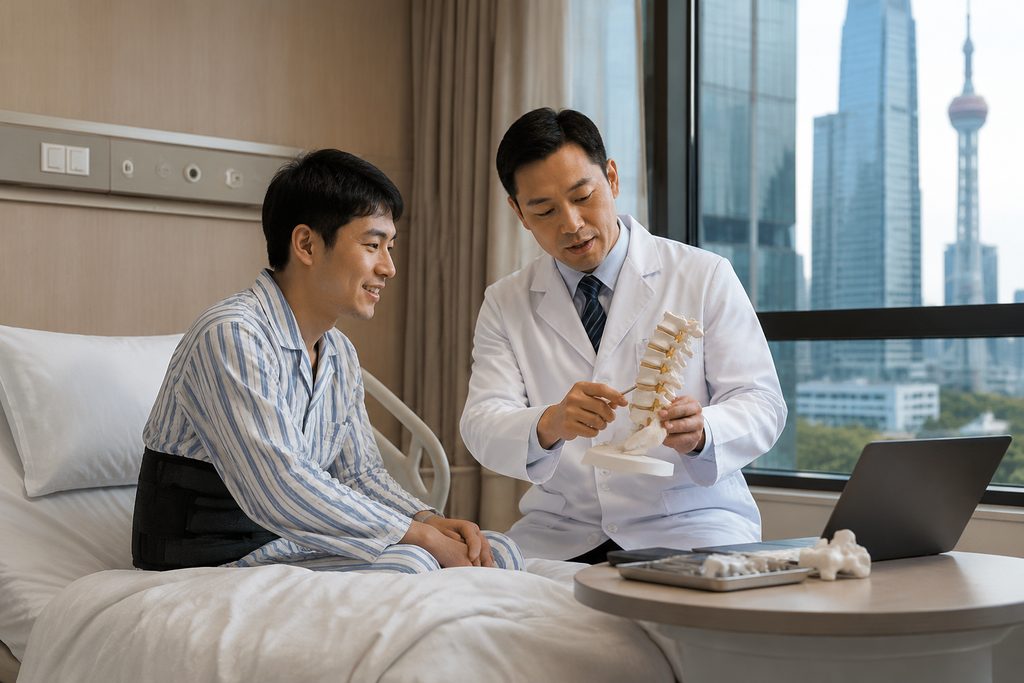
Top Minimally Invasive Spine Surgery Hospital China: Where Spine Patients Go
For patients researching the top minimally invasive spine surgery hospital China, three institutions dominate the conversation. West China Hospital in Chengdu runs the largest spine surgery department in the country, with over 8,000 spinal procedures annually. Peking University Third Hospital (PUTH) is the national reference center for spinal deformity and minimally invasive lumbar fusion. Shanghai Changzheng Hospital specializes in endoscopic spine surgery, with surgeons performing over 1,000 transforaminal endoscopic discectomies per year.
Minimally invasive spine surgery — including tubular microdiscectomy, endoscopic decompression, and percutaneous pedicle screw fixation — is well established in China. The cost differential is stark: a single-level MIS lumbar fusion that runs $80,000–$120,000 in the US typically costs $18,000–$30,000 at a top Chinese spine center. Recovery protocols are comparable, with most patients discharged within 3–5 days.
Explore our directory of Fudan-ranked hospitals by city to see which spine centers match your specific diagnosis.
Medical Tourism Packages for Laparoscopic Surgery China: What’s Actually Included
Searching for medical tourism packages for laparoscopic surgery China returns a flood of results, but most “packages” are marketing shells. What you actually need is a clear scope of services. A legitimate coordination package should include: hospital and surgeon matching based on your imaging and records, appointment scheduling through the hospital’s international department, bilingual accompaniment for all pre-operative visits, hospital admission support, and post-discharge follow-up coordination.
What it should not include: promises of specific surgery dates before the surgeon reviews your case, guarantees of a particular named specialist, or bundled “discounts” that obscure the actual hospital charges. Transparency is the test. If a package won’t itemize hospital fees separately from coordination fees, walk away.
Our service model is deliberately staged. You can start with a written second opinion or video consultation before committing to travel. That’s the lowest-risk way to test whether a Chinese hospital is the right fit for your procedure.
Practical Considerations: Visas, Payments, and Post-Operative Follow-Up
Foreign patients coming to China for medical treatment apply for an S2 visa — the short-stay category used for private affairs, including medical treatment. The S2 visa is typically issued for 30–90 days, which covers most minimally invasive procedures and initial recovery. If your treatment plan requires a stay exceeding 180 days, you would apply for an S1 visa instead. Family members accompanying you apply for their own S2 visas. Your hospital’s international department will issue an invitation letter and treatment confirmation, which you submit with your visa application. Approval is never guaranteed — apply early and keep your documentation complete.
Payment is another operational reality. Chinese public hospitals require pre-payment or deposit before surgery. International departments accept wire transfers and major credit cards, but private international hospitals like Jiahui or United Family offer direct insurance billing with many global insurers. If you’re using insurance, confirm reimbursement terms before you travel — most international insurers reimburse after the fact, not at the point of service.
Post-operative follow-up is the most overlooked piece. Most minimally invasive procedures require follow-up imaging or lab work at 2 weeks, 6 weeks, and 3 months. If you return home after one week, you need a plan for who reviews those results. Many Chinese surgeons now offer video follow-up for international patients, but confirm this before surgery, not after.
Practical tip: Bring digital copies of all imaging (DICOM format on a USB drive, not just printed films), a translated summary of your medical history, and a list of all current medications with generic names. Chinese hospital pharmacists work from generic drug names, not brand names.
Frequently Asked Questions
Not through the standard outpatient channel. Public hospital outpatient clinics operate on same-day registration — you cannot pre-book a consultation from overseas. The workaround is the hospital’s international department or VIP channel, which allows advance scheduling of consultations and surgery dates. This typically costs 1.5–2 times the standard rate but includes English-speaking staff and priority scheduling. Our coordination service handles this booking on your behalf.
This is the hardest question, and the honest answer is that cross-border complication management is the weakest link in medical travel. Your Chinese surgeon can provide video follow-up and coordinate with your local physician, but emergency care will happen in your home country. Before surgery, ask the Chinese hospital for a complete operative report, discharge summary, and imaging — all in English. Bring these to your local doctor. Most patients do well, but you should understand the limits of remote follow-up before you commit.
Private international hospitals in China — such as United Family, Jiahui, and Raffles — have direct billing agreements with major global insurers including Cigna, Aetna, Bupa, and Allianz. Public hospital international departments generally do not direct-bill; you pay upfront and submit for reimbursement. Check with your insurer before traveling, and get pre-authorization in writing if your policy requires it.
Look for two independent signals. The Fudan University Hospital Rankings are China’s most authoritative hospital ranking system, published annually since 2010. The top 100 general hospitals are grouped into tiers (A++++ through A), and 45 specialty rankings list the top 10 hospitals per specialty. JCI accreditation is the second signal — it means the hospital has passed international safety and quality audits. Our hospital database covers 340+ institutions that meet one or both criteria.
Your Next Step
The decision to travel for surgery is never purely financial. It’s about confidence — confidence in the surgeon’s hands, the hospital’s systems, and your own preparation. China’s top minimally invasive surgery programs offer volume, technology, and cost advantages that are hard to match anywhere else. But they require navigation: language, scheduling, records, and follow-up planning.
We’re China Medical Services, and we help international patients connect with China’s top-tier hospitals. We are not a hospital and we do not provide diagnoses or treatment. What we do is handle the coordination — hospital matching, appointment scheduling, bilingual accompaniment, and visa guidance — so you can focus on recovery. If you’re considering minimally invasive surgery in China, start with a conversation. Get a free consultation and we’ll help you figure out whether this path makes sense for your specific case.
For more medical information and treatment options in China, visit chinamedservices.com (China Medical Services).
