MR-Guided Focused Ultrasound in China: Incisionless Brain Tumor Access for Foreigners
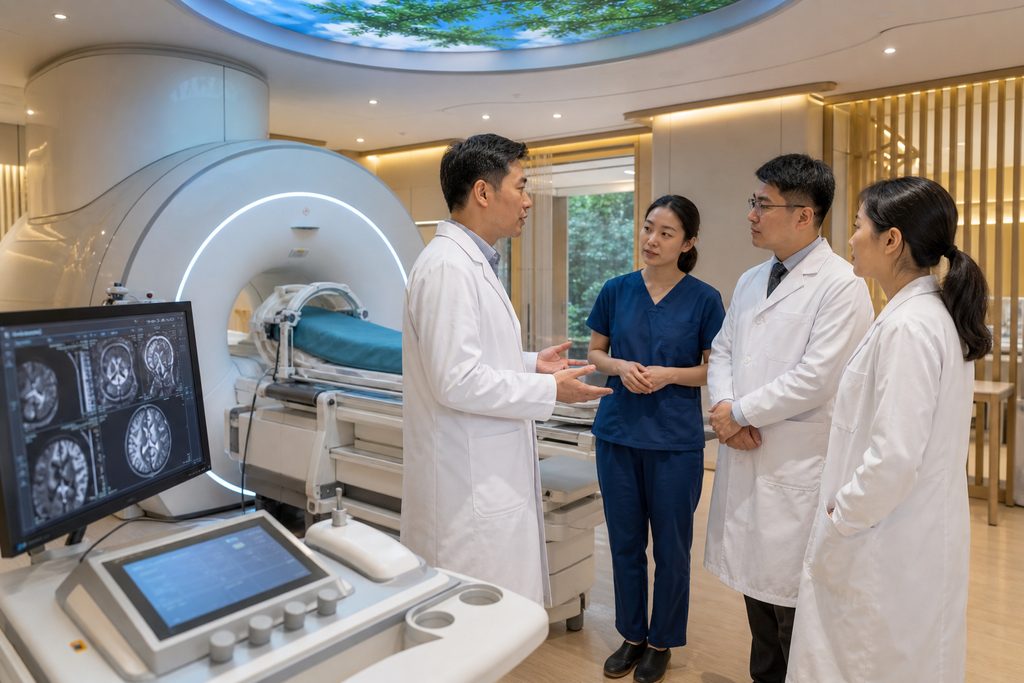
Imagine a brain surgery that involves no scalpel. No incision. No overnight hospital stay. For patients facing essential tremor or certain tumors, that reality exists. It is called MR-Guided Focused Ultrasound. The concept sounds like science fiction — using sound waves to destroy diseased tissue while you lie awake inside an MRI machine. But it is very real. And for international patients, accessing it in China is becoming a practical, cost-effective path forward.
Key Takeaways
- MRgFUS is an FDA-approved, incisionless procedure that uses 1,024 ultrasound beams to ablate brain tissue with sub-millimeter precision, guided by real-time MRI thermometry.
- Chinese hospitals have invested heavily in this technology, with major neurosurgery centers in Beijing and Shanghai now offering treatment packages priced 60-70% below US rates.
- Foreign patients face real barriers — language, medical record translation, and the S2 visa process — but a structured, staged approach (remote consultation first) mitigates the risk of traveling for a treatment you may not be eligible for.
- This is not a cure-all. Eligibility depends on skull density ratio, lesion location, and a negative history of certain implants. A thorough remote screening is the non-negotiable first step.
The Problem: When Medication Fails and Surgery Feels Too Risky
Essential tremor affects an estimated 7 million people in the United States alone. Parkinson’s disease adds another 1 million. For many, first-line medications like propranolol or primidone eventually stop working. The next step is often deep brain stimulation — drilling a hole in the skull to implant electrodes. It works. But it is invasive, requires hardware, and carries a 2-3% risk of serious infection or hemorrhage.
For patients with certain brain tumors, the calculus is even harder. Surgery might mean weeks of recovery and real cognitive risk. Radiation can damage surrounding healthy tissue. So patients wait. They watch and scan and live with the tremor or the tumor because the fix feels worse than the disease.
That is the gap MRgFUS fills. It treats the problem without opening the patient up.
How Does Focused Ultrasound Work for Essential Tremor and Tumors
The physics is elegant. A helmet-like transducer array fires 1,024 individual ultrasound beams through the skull. Each beam is too weak to cause damage on its own. But where they converge at a single focal point — about the size of a grain of rice — the combined energy raises the tissue temperature to 55-60°C. Thermal ablation. The target cells die. The surrounding tissue stays untouched.
Everything happens inside an MRI scanner. The MRI provides real-time thermal maps, so the neurosurgeon watches a live heat map of the brain and adjusts the beam millimeter by millimeter. The patient is awake, providing constant feedback. For essential tremor, the doctor will ask the patient to draw a spiral or hold a cup. The tremor often stops mid-procedure, before the final ablation is even complete.
Studies back this up. A pivotal 2016 trial published in the New England Journal of Medicine showed that patients receiving MRgFUS for essential tremor had a 47% improvement in hand tremor scores at 3 months, compared to 0.1% in the sham group. A 2020 follow-up study confirmed the benefit persisted at 5 years.
MRgFUS Brain Tumor Treatment Cost China vs. the West
Let us address the question that brings most patients to this search: the numbers. In the United States, a single-session MRgFUS thalamotomy for essential tremor costs between $30,000 and $50,000, depending on the facility and insurance negotiation. For tumor applications, which are often more complex and may require multiple sessions, the price can climb higher. In Western Europe, the range is similar — €25,000 to €45,000.
China operates on a different economic structure. The same procedure at a top-tier public hospital’s international department typically ranges from $12,000 to $22,000. That is a 50-70% reduction. The gap exists because of lower labor costs, hospital operational efficiency, and a deliberate government push to make advanced medical technology accessible. Not because of lower quality.
The neurosurgeons performing these procedures at centers like Huashan Hospital in Shanghai or Xuanwu Hospital in Beijing are often trained in the US or Europe. They publish in the same journals. They use the same Exablate Neuro systems manufactured by Insightec, the Israeli company that pioneered the technology. The hardware is identical. The cost structure is not.
| Procedure Component | US Estimated Cost (USD) | China Estimated Cost (USD) |
|---|---|---|
| Pre-procedure MRI & CT screening | $2,000 – $4,000 | $400 – $800 |
| Single-session MRgFUS thalamotomy (essential tremor) | $30,000 – $50,000 | $12,000 – $18,000 |
| Multi-session tumor ablation package | $50,000 – $80,000+ | $18,000 – $28,000 |
| Post-procedure 24-hour observation | $1,500 – $3,000 | $300 – $600 |
| International patient coordination (case management) | N/A (typically self-navigated) | From $800 |
Note: All prices are estimates and vary by hospital, case complexity, and exchange rate fluctuations. These figures represent the self-pay international patient price, not the local insured rate.
Can Foreigners Get MR-Guided Focused Ultrasound in China? Eligibility and the Screening Process
The short answer: yes. The detailed answer: it depends on your skull.
Not everyone is a candidate. The ultrasound beams must pass through the skull to reach the target. If your skull density ratio is too low — below 0.40 — too much energy is absorbed by the bone, and the treatment cannot be safely delivered. About 15-20% of patients are excluded on this basis alone. Other exclusions include: a history of bleeding disorders, certain metal implants, pacemakers, and lesions located too close to critical structures like the optic nerve.
This is why a remote screening is non-negotiable. You cannot book a flight, arrive in Shanghai, and expect treatment the next day. The responsible path — and the one our team facilitates — starts with a written second opinion. You send your existing MRI, CT, and medical history to the neurosurgery department at a hospital like Huashan Hospital in Shanghai. Their team reviews your skull density ratio, lesion characteristics, and overall suitability. Only after they confirm eligibility do you proceed to scheduling.
This remote step costs $300–500 for the written analysis. It is not a prescription. It is a gate-check. And if you are not a candidate, you have lost a few hundred dollars and a week — not the cost and exhaustion of an international trip.
Best Hospital for Incisionless Brain Surgery Shanghai: Where the Technology Lives
Shanghai is not the only city with MRgFUS capability, but it is the most accessible for international patients. Huashan Hospital, affiliated with Fudan University, operates one of the highest-volume neurosurgery departments in the world. Their functional neurosurgery team has been using the Exablate Neuro platform for several years and has treated both movement disorders and tumor cases.
What makes a hospital the “best” for a foreign patient is not just the technology. It is the infrastructure around it. Huashan has a dedicated international medical center with English-speaking staff. The hospital is accustomed to receiving patients from Southeast Asia, the Middle East, and increasingly from North America. The radiology department can receive and read DICOM files sent electronically. The billing office understands international self-pay and can provide itemized receipts for insurance reimbursement.
Beijing offers alternatives. Xuanwu Hospital and Tiantan Hospital both have strong functional neurosurgery programs. But Shanghai’s international ecosystem — direct flights, English-friendly hotels, a large expat community — makes it the practical first choice for most Western patients.
For a broader look at ranked neurosurgery departments across China, visit our specialty-specific hospital directory.
Focused Ultrasound Tumor Treatment Packages China: What a Journey Actually Looks Like
A treatment journey is not a single hospital visit. It is a sequence of steps, each with its own timeline. Here is what a typical 10-day trip looks like for a patient coming for an MRgFUS thalamotomy:
Day 1: Arrival in Shanghai. Airport transfer arranged. Rest. No medical activity.
Day 2: First hospital visit. In-person consultation with the neurosurgeon. Review of previously sent records. A fresh CT scan to confirm skull density ratio — this cannot be done remotely with sufficient precision. Blood work and physical exam.
Day 3: If CT confirms eligibility, the procedure is scheduled. The patient shaves their head — the transducer requires direct contact with the scalp. A stereotactic frame is fitted under local anesthesia. The patient enters the MRI suite.
Day 3 (continued): The procedure itself lasts 2-4 hours. The patient is awake, lying on the MRI table, communicating with the team. Multiple low-energy test sonications confirm targeting. Then the therapeutic sonications begin. For tremor patients, the effect is often immediate and dramatic.
Day 4: 24-hour observation in the international ward. Neurological exam. MRI to confirm the ablation site. Most patients are discharged by the afternoon.
Day 5-9: Recovery in Shanghai. No strenuous activity. The patient can walk, eat, and explore gently. A follow-up neurological exam on Day 8 or 9.
Day 10: Final clearance. Departure.
This timeline is idealized. Tumor cases may require multiple sessions spaced days apart. Any complication — a headache, temporary numbness — extends the stay. A good coordinator builds buffer days into the plan.
Practical Considerations: Visas, Payments, and the Language Barrier
Let us be direct about the friction points. They are manageable, but ignoring them will ruin your trip.
Visa: Medical treatment in China requires an S2 visa, which is a short-stay private affairs visa. You will need an invitation letter from the hospital confirming your treatment appointment. The hospital’s international department issues this. Processing time at your local Chinese embassy or consulate typically takes 4-7 business days. Do not book a non-refundable flight until the visa is in your passport. The S2 visa is not a “medical visa” — that category does not exist. M visas are for commercial trade and are not valid for medical treatment.
Payment: Chinese public hospitals operate on a pre-payment model. You deposit a sum upfront — typically the estimated full treatment cost — and the hospital draws from it. Any remainder is refunded at discharge. Major international credit cards are accepted at international departments, but inform your bank in advance. Wire transfers are common for larger amounts. WeChat Pay and Alipay dominate daily life in China; link your card before you arrive.
Language: The neurosurgeon likely speaks some English, especially if they trained abroad. The nurses, the CT technician, the billing clerk, the cafeteria staff — they almost certainly do not. A bilingual medical companion who can translate your symptoms, explain pre-procedure instructions, and argue with the payment window when a charge looks wrong is not a luxury. It is a necessity for anyone without fluent Mandarin.
Insurance: Most US and European insurers will not directly reimburse a Chinese public hospital. You pay out of pocket and seek reimbursement afterward. Get a detailed, itemized receipt and a copy of the medical record in English before you leave. Some international private hospitals in China, like United Family, can bill insurers directly, but they do not typically offer MRgFUS — the technology is concentrated in large public academic centers.
Frequently Asked Questions
The ablation is permanent — the targeted brain cells are destroyed and do not regenerate. Studies show tremor suppression persists at 5-year follow-up for most patients. However, tremor can return if the underlying disease progresses and affects new brain regions. It is a durable treatment, not a disease cure.
The most common side effect is temporary numbness or tingling in the fingers or lips, occurring in about 14% of patients. This usually resolves within weeks. Gait disturbance occurs in about 9% and also tends to be transient. The real-time MRI thermometry and patient feedback during the procedure are specifically designed to catch these effects early and adjust targeting before the damage becomes permanent. Serious, permanent complications are rare — less than 1% in major published series.
Yes. A companion is strongly recommended. They can stay in the waiting area during the 2-4 hour procedure. Afterward, you will be tired and possibly disoriented from lying still for hours. Having someone to help you back to the hotel, manage medications, and communicate any concerns to the nursing staff is invaluable. The S2 visa covers accompanying family members.
You will leave with a discharge summary in English, a CD of your post-procedure MRI, and a recommended follow-up schedule. Your local neurologist should receive these records and take over ongoing care. The treating Chinese neurosurgeon is typically available for one or two follow-up email consultations at no extra charge. For any long-term issues, your local doctor is your primary point of contact.
Your Next Step
MR-guided focused ultrasound is a remarkable technology, but it is a tool, not a miracle. The right candidate, screened carefully, can walk into a Shanghai hospital with a disabling tremor and walk out the next day with a steady hand. The wrong candidate — someone with an unfavorable skull density or an undiagnosed bleeding disorder — can waste time and money chasing something that was never suitable.
Our team at China Medical Services does not perform procedures or offer medical advice. We handle the logistics that make an informed decision possible: connecting your records with the right neurosurgery department, arranging a remote eligibility screening, and — if you are a candidate — coordinating the visa, hospital, and on-the-ground support for your treatment journey. If you want to explore whether MRgFUS in China is a realistic option for you, start with a conversation. It costs nothing and commits you to nothing.
Request a free consultation to discuss your case and eligibility.
For more medical information and treatment options in China, visit chinamedservices.com (China Medical Services).
