Claustrophobic? MRI Options in China: Open Scans Without Sedation
Key Takeaways
- Roughly 1 in 8 adults reports some degree of claustrophobia, and closed-bore MRI machines are one of the most common triggers — yet a scan is often the only way to confirm a diagnosis.
- China’s top-tier hospitals and private international clinics increasingly operate wide-bore and open MRI scanners, and many will scan anxious patients without sedation when the clinical question allows it.
- The real barrier is not machine availability — it is scheduling. Most public hospital outpatient imaging cannot be reserved from overseas in advance, so planning matters more than the scanner itself.
- Before you commit to any scan abroad, understand what the imaging is for, what your referring physician needs, and how the results will travel back home with you.
Have you ever climbed into a tube the width of your shoulders, heard the knocking start, and felt your chest tighten before the technician even left the room? For a lot of people, that moment is the entire problem with MRI.
The scan itself is painless, radiation-free, and one of the most informative tools in modern medicine. The machine is the obstacle. And if you have ever abandoned a scan halfway through — or avoided booking one at all — you already know how much that costs you in diagnostic certainty.
Here is the part worth knowing: getting an MRI without sedation cost China is often a fraction of what the same study runs in the United States, and a growing number of Chinese hospitals are equipped with scanners designed specifically for people who find closed-bore machines unbearable. This guide walks through what those options actually are, what they cost, and how to arrange one.
The Problem: When the Scanner Is Worse Than the Symptoms
Claustrophobia is not a character flaw. It is a documented physiological response, and MRI manufacturers know it. A frequently cited estimate suggests that between 4 and 30 percent of patients experience significant anxiety during MRI, depending on the study and the population — and a meaningful share of those patients either require sedation or terminate the exam early. When a scan is aborted, the referring physician loses the information they needed, and the patient is left with the same unanswered question plus a bill.
In the United States, the standard workaround has been sedation: oral lorazepam, intravenous midazolam, or in some cases general anesthesia. That works, but it adds cost, requires a driver, rules out an same-day return to work, and introduces its own small clinical risks. For patients with sleep apnea, cardiac conditions, or simply a preference to stay lucid, sedation is not a neutral choice.
So the question becomes practical rather than psychological. Is there a scanner that does not trigger the panic in the first place — and can you access it without a six-month wait?
Why China Delivers Real Options for Anxious Patients
China’s imaging capacity is enormous, and that scale changes what is available to you.
Wide-bore and open scanners are no longer rare
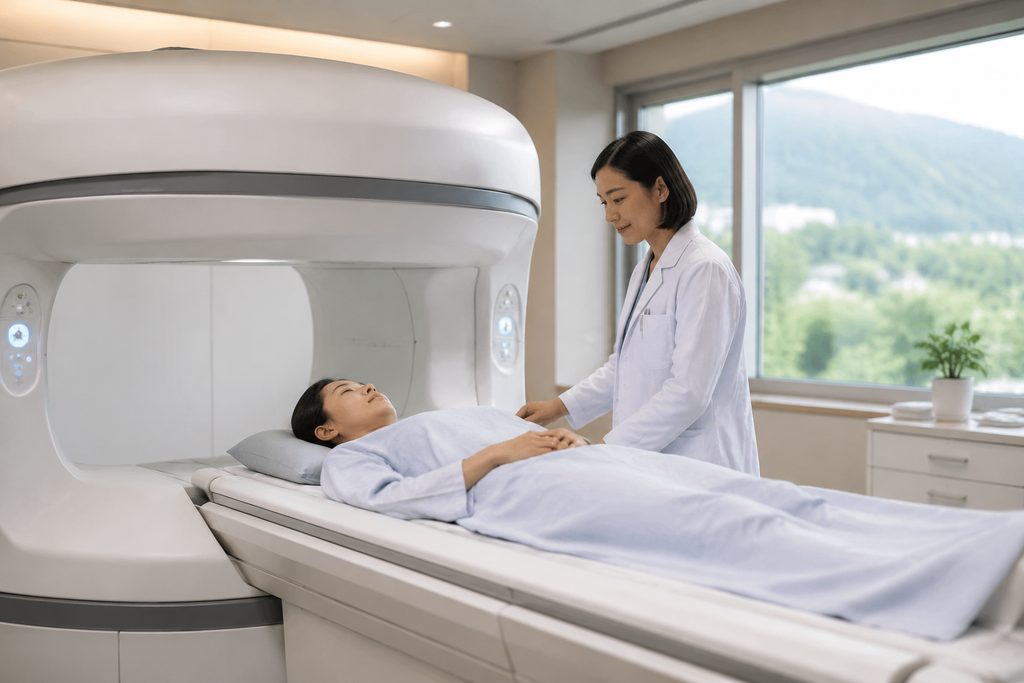
Wide-bore MRI systems — typically 70 cm across instead of the conventional 60 cm — are now common in major Chinese tertiary hospitals and in private international clinics. That extra ten centimeters sounds trivial until you are inside one. Open MRI, where the magnet is configured so the patient is not fully enclosed, is also available at selected facilities, though it comes with trade-offs in image resolution that your radiologist should weigh against the clinical question.
Scan times are often shorter than you expect
Patients frequently ask how long does an MRI take in Beijing hospital. For a single body region on a modern 3T scanner, a typical protocol runs 20 to 40 minutes of table time, with the actual scan sequence accounting for most of it. A full spine or multi-region study can run 45 to 60 minutes. Chinese high-volume imaging departments are efficient at moving patients through, which means less time lying still and waiting between sequences — a real factor for anyone fighting anxiety.
Cost is dramatically lower — without cutting corners
A brain MRI in a top Chinese public hospital generally runs the equivalent of a few hundred US dollars; the same study at a private international clinic in Shanghai or Beijing costs more but still sits well below typical US pricing. The structural reasons are straightforward: lower labor costs, high equipment utilization, and hospital pricing that is regulated rather than negotiated insurer-by-insurer. The scanners themselves are the same Siemens, GE, and Philips platforms you would see in a Western hospital.
Open MRI Scan Price Shanghai and Other Cities: What to Expect
Pricing varies by hospital tier, scanner type, whether contrast is used, and whether you are seen through a standard outpatient channel or an international department. The table below gives realistic ranges for planning purposes — final quotes must be confirmed with the specific hospital.
| Scan Type | Public Tertiary Hospital (USD) | Private International Clinic (USD) |
|---|---|---|
| Single region, no contrast (e.g., brain) | $150 – $350 | $500 – $900 |
| Single region with contrast | $300 – $550 | $800 – $1,400 |
| Multi-region (e.g., full spine) | $400 – $700 | $1,000 – $1,800 |
| Wide-bore or open scanner surcharge | $0 – $100 | Often included |
| Sedation support, if required | $100 – $300 | $300 – $600 |
For comparison, a non-contrast brain MRI in a US hospital typically bills between $1,200 and $3,500 before insurance, and an open MRI can run higher because fewer machines exist. That gap is the reason medical travel for imaging is growing — but cost is not the only reason to plan carefully.
Is MRI Safe for Claustrophobic Patients in China?
Safety and comfort are separate questions, and both deserve a straight answer.
From a clinical safety standpoint, MRI has no ionizing radiation. The main contraindications are implanted devices that are not MRI-conditional — pacemakers, certain neurostimulators, cochlear implants, some aneurysm clips — plus metallic foreign bodies in or near the eye. Every reputable hospital screens for these before you enter the scan room. If you have any implant, bring documentation. Do not rely on memory.
From a comfort standpoint, the answer depends on the facility. A well-run department will offer you a call button, earplugs or headphones, a mirror or prism glasses so you can see out of the bore, and a companion in the room if protocols allow. Some will let you go in feet-first for certain studies, which keeps your head closer to the opening. And a growing number will simply schedule you on a wide-bore machine if you say the word “claustrophobic” when booking.
Claustrophobic MRI Alternatives China Hospitals Actually Offer
A single-region scan at a top public hospital typically runs $150 to $550 depending on contrast use, while private international clinics charge $500 to $1,800. Comparable US studies often bill $1,200 to $3,500 or more. Final pricing varies by hospital and case complexity.
Standard public hospital outpatient imaging usually cannot be pre-booked from overseas — you register in person. International departments and private clinics do accept advance scheduling. If you need a specific scanner type or date, plan through one of those channels.
You can stop at any time. Technicians are trained for this and will bring you out of the bore immediately. The study may be incomplete, and you may be charged for the time used. Discussing anxiety in advance — and choosing the right machine — is the better path.
Your Next Step
Claustrophobia does not have to mean skipping the scan that could change your diagnosis. The options exist, the pricing is transparent, and the main work is coordination rather than courage.
We are a medical concierge service, not a hospital, and we do not provide diagnoses or medical advice. What we do is help international patients match with appropriate Chinese hospitals, coordinate appointments, arrange bilingual accompaniment, and navigate visa and travel logistics. If you would like to talk through what is realistic for your situation, you can start with a free consultation — no obligation, just a clearer picture of your options.
This article is for general information only and does not constitute medical advice. Imaging decisions should be made with a qualified physician who knows your history.
Frequently Asked Questions
Yes. The hospitals used for international patients are JCI-accredited and follow the same international safety standards as top hospitals in the US and Europe. Surgical teams perform high volumes of procedures — often more than their Western counterparts — which studies show leads to better outcomes.
Costs vary by procedure and hospital, but international patients typically save 40-80% compared to US prices — even when factoring in travel and accommodation. A consultation with our team will give you an exact, all-inclusive quote with no hidden fees.
Send us your existing medical reports to get started. We handle everything from hospital selection and appointment scheduling to visa assistance and post-operative recovery planning. Your medical records are reviewed by the specialist before you even book a flight.
For more medical information and treatment options in China, visit chinamedservices.com (China Medical Services).
