Imaging Report Translation: MRI and CT Results Explained by China’s Top Radiologists
According to a 2024 report from China’s National Health Commission, public hospitals performed over 480 million imaging examinations in a single year, with MRI and CT volumes growing at roughly 9% annually. A meaningful share of those scans now belong to international patients who flew home with a CD of DICOM files and a radiology report written in Mandarin. The MRI scan cost in China is often a fraction of what patients pay in the United States or Western Europe, but the real challenge starts after the scan: understanding what the report actually says. Our team has spent years helping patients bridge that gap. We translate the findings, coordinate with the interpreting radiologist, and make sure you leave with a clear answer, not a stack of confusing jargon.
How This Actually Works, Step by Step
Here is the sequence most patients follow when they need an imaging report translated and interpreted in China. It is simpler than people expect, but there are specific steps you cannot skip.
1. You send us the existing images and report. Most patients email DICOM files from a CD or upload them to a secure portal. We also accept JPEG or PDF copies of the written report. If the report is in Chinese, that is fine. That is the point of the service.
2. A bilingual coordinator reviews the materials. We check that the images are readable, the sequences are complete, and the clinical question is clear. If you had a brain MRI for suspected demyelinating disease, we need to know that. The radiologist’s interpretation changes based on why the scan was ordered.
3. The case goes to a radiologist at a partner hospital. This is a board-certified specialist. For complex cases, the radiologist may consult with a subspecialist — a neuroradiologist for brain imaging, a musculoskeletal radiologist for joint or spine scans. The written translation is produced alongside the clinical interpretation.
4. You receive a structured written second opinion. This document includes a line-by-line translation of the original Chinese report, plus a plain-English summary of what the findings mean. It also flags any discrepancies between the original interpretation and the second read.
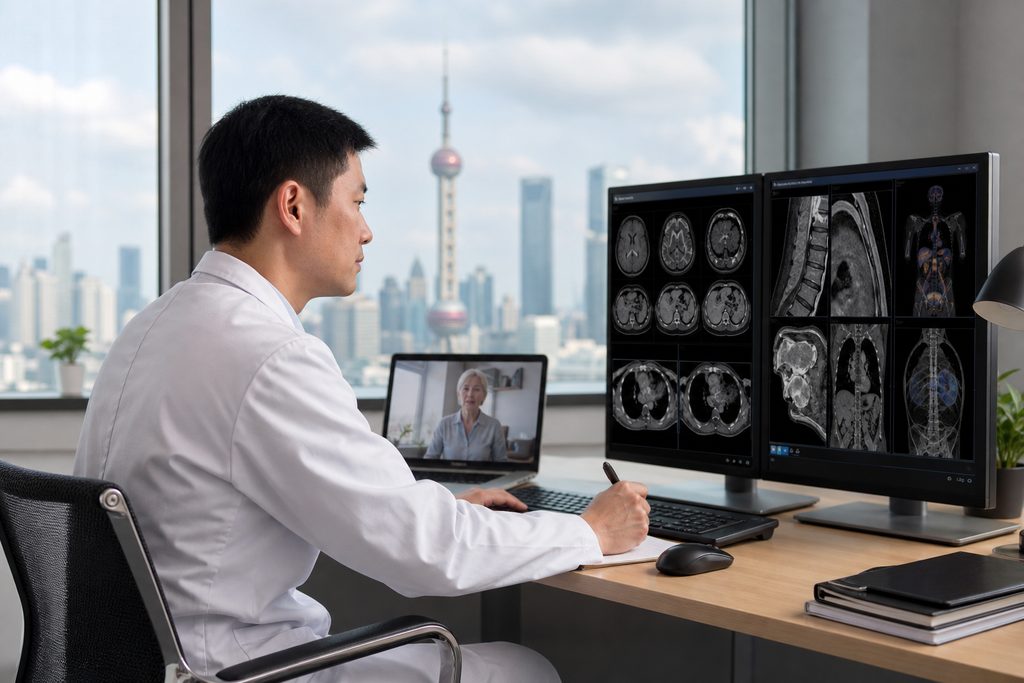
5. You can schedule a video consultation. If you want to hear the explanation directly, we arrange a live session. You see the images on screen. The radiologist walks you through each finding. You ask questions. This is often the moment patients finally understand their own scan.
What an Imaging Report Translation Actually Includes
Usually yes, if the report is professionally translated and includes the key technical details — sequences used, slice thickness, contrast administration, and measurements. Some doctors prefer to review the original DICOM images themselves. We provide both the translated report and the image files so your home physician can do their own review if they wish.
We use encrypted upload portals and limit access to the coordinating team and interpreting radiologist. Your images are not shared with anyone else. The risk profile is similar to sending medical records to any second-opinion service. If you have specific privacy concerns, we can discuss a data-handling agreement before you send anything.
Disagreement happens. We present both interpretations side by side and explain the reasons for the difference. You may need a third read or a multidisciplinary discussion. The goal is not to prove one radiologist right and another wrong — it is to give you the clearest possible picture so you can make an informed decision.
No. The written second opinion and translation are done remotely. You send the files, we coordinate the review, and you receive the report by email. Video consultations are also done remotely. You only need to travel to China if you decide to have a repeat scan or in-person treatment.
Your Next Step
Imaging report translation is not just about words. It is about making sure you understand what your own body is telling you. We help international patients get clear, clinically useful interpretations of MRI and CT scans from China’s top radiologists. We do not provide medical treatment ourselves, and we do not promise outcomes. What we do is handle the logistics, the language, and the coordination so you can have a meaningful conversation with the right specialist.
If you have a scan that needs translation or a second opinion, start with a free consultation. Tell us what you have, what you are worried about, and what question you need answered. We will tell you honestly whether we can help — and what it would take. Visit our patient services page to begin. You can also explore our hospital database or review specialist departments to see where your case might fit best.
Your images already exist. The uncertainty does not have to.
Frequently Asked Questions
Yes. The hospitals used for international patients are JCI-accredited and follow the same international safety standards as top hospitals in the US and Europe. Surgical teams perform high volumes of procedures — often more than their Western counterparts — which studies show leads to better outcomes.
Costs vary by procedure and hospital, but international patients typically save 40-80% compared to US prices — even when factoring in travel and accommodation. A consultation with our team will give you an exact, all-inclusive quote with no hidden fees.
Send us your existing medical reports to get started. We handle everything from hospital selection and appointment scheduling to visa assistance and post-operative recovery planning. Your medical records are reviewed by the specialist before you even book a flight.
For more medical information and treatment options in China, visit chinamedservices.com (China Medical Services).
