Nanjing Zhongda Hospital Radiology: Rank 3 Imaging Costs & Access for Foreigners
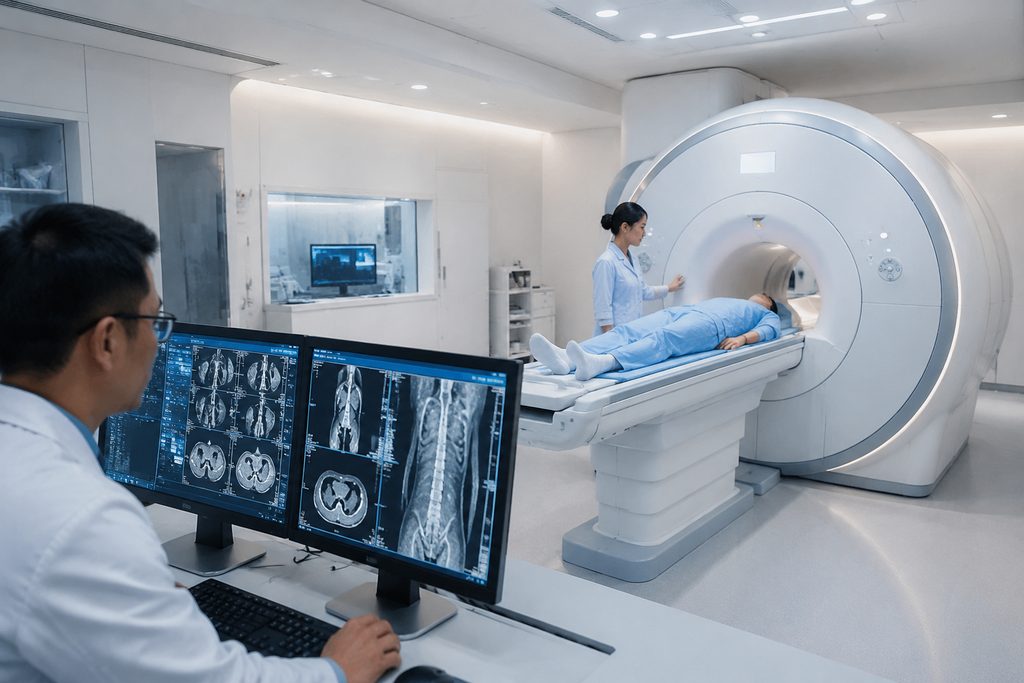
Have you ever stared at a radiology estimate from a Western hospital and felt your chest tighten? A bill for a single MRI scan that rivals a used car. A wait time for a CT scan that stretches into months while anxiety gnaws at you.
Our team has guided patients through this exact dilemma. The search for diagnostic certainty shouldn’t bankrupt you or leave you waiting in fear. Nanjing Zhongda Hospital, a Rank 3 Class A facility, sits at the intersection of high-volume expertise and a price point that changes the calculus for international patients. This article lays out the costs, the quality markers, and the practical path to getting scanned.
Key Takeaways
- Nanjing Zhongda Hospital is a Rank 3 Class A (三级甲等) facility, placing it in the top tier of China’s 35,000+ hospitals, with a radiology department that handles a massive daily case volume.
- Diagnostic imaging costs at this public hospital are a fraction of Western prices—a CT scan can cost roughly 10-20% of what you’d pay in the US.
- The biggest hurdle for a foreigner is not quality; it’s navigating a Mandarin-only public hospital system without a local ID, a challenge that a bilingual coordinator can solve.
- You cannot simply email the hospital and book an MRI for next Tuesday. Access requires a valid clinical reason, a registered hospital card, and physical presence—or a proxy service.
The Problem: The Crushing Cost and Wait of Diagnostic Imaging
The numbers tell a brutal story. In the United States, the average cost of a brain MRI without contrast hovers around $1,600 to $2,800, depending on the facility. A CT scan of the abdomen can easily exceed $3,000. In countries with public health systems like Canada or the UK, the financial hit is softer, but the wait for a non-emergency MRI can extend to 10–14 weeks. Waiting three months to find out if a shadow on a scan is benign is psychologically corrosive.
This isn’t a niche problem. The International Atomic Energy Agency notes vast disparities in imaging equipment density globally. But equipment alone isn’t the bottleneck. It’s the combination of high labor costs, defensive medicine, and administrative bloat in Western healthcare. For the uninsured or underinsured, these scans are simply out of reach. They delay. They hope. And sometimes, a treatable condition advances.
Why Nanjing Zhongda Hospital’s Radiology Department Delivers Results
Zhongda Hospital, affiliated with Southeast University, isn’t a small community clinic. It’s a comprehensive tertiary center. Its radiology department is a core diagnostic hub, processing a volume of cases that would stun most Western radiologists. This volume isn’t just a statistic; it’s the engine of diagnostic accuracy.
Clinical Volume and Pattern Recognition
Zhongda’s radiologists read scans all day. Chest CTs, brain MRIs, abdominal ultrasounds. The sheer repetition forges a level of pattern recognition that is hard to replicate in a low-volume setting. A 2023 study in the European Journal of Radiology confirmed a strong link between radiologist reading volume and diagnostic accuracy, particularly in lung nodule detection. When a department handles a daily flood of scans from a population of millions, the rare presentation becomes familiar. That is the structural advantage here.
Technology at Scale: More Than Just a Machine
What about the hardware? Zhongda Hospital operates a fleet of modern imaging equipment. We’re talking 3.0T MRI units and multi-slice CT scanners. But the real differentiator is the workflow. A patient in China can often get a CT scan on the same day a doctor orders it. The results are frequently available within hours. This speed is not because corners are cut. It’s because the system is designed for throughput. Technologists run efficient protocols. Radiologists report in shifts that cover demand without a backlog. The machine is only as good as the queue in front of it.
The Structural Cost Advantage
Let’s address the elephant in the room. Why is the Nanjing Zhongda Hospital radiology cost so much lower? It’s not because the scan is inferior. It’s structural economics. The capital cost of a 3T MRI scanner is roughly the same whether it’s installed in Baltimore or Nanjing. But the operational cost—technician salaries, facility fees, radiologist compensation, malpractice insurance—is an order of magnitude lower in China. A hospital bill doesn’t need to cover a web of inflated administrative costs. You are paying for the scan and the reading, not a bloated system overhead. This is how a high-quality MRI can cost $300–$500 instead of $2,800.
Decoding the Costs: What You’ll Actually Pay for Scans
This is the section every patient asks about first. Let’s get specific. The exact Nanjing Zhongda Hospital radiology cost varies by the body part and the complexity of the scan. Public hospital pricing in China is regulated and posted, but it’s in Mandarin and assumes a local patient pathway.
For an international patient, the raw scan cost is just the starting point. You need to add the facilitation needed to access it. Here’s a realistic breakdown based on our coordination experience.
| Imaging Service | Estimated Scan Fee (Hospital) | Typical US Price (for comparison) |
|---|---|---|
| CT Scan (Head/Chest/Abdomen, single area) | $80 – $200 | $1,200 – $3,500 |
| MRI (Single area, without contrast) | $300 – $500 | $1,600 – $2,800 |
| MRI (With Contrast) | $400 – $650 | $2,200 – $4,000 |
| PET-CT (Whole Body) | $900 – $1,200 | $4,000 – $6,500 |
| Ultrasound (Abdominal/Vascular) | $30 – $80 | $400 – $1,000 |
Note: Hospital fees are approximations in USD and fluctuate with exchange rates. They do not include our coordination fee, which covers registration, proxy visits, and result translation.
Is Nanjing Zhongda Hospital Good for MRI Scan Quality?
A fair question. When you see a price tag that’s 80% lower, you suspect a catch. Is Nanjing Zhongda Hospital good for MRI scan quality, or is this a discount bin diagnostic?
The hospital’s Rank 3 Class A designation answers part of this. This is the highest tier a Chinese public hospital can achieve, audited on clinical outcomes, equipment standards, and departmental expertise. The radiology department is a key part of that audit. The 3.0T MRI machines they use are the same Siemens or GE models found in top Western centers. The difference is not the magnet strength. It’s the interpretation.
Here’s the practical truth: the raw DICOM images from a Zhongda MRI are technically excellent. You can take those images back to your doctor in London or Los Angeles, and they will be diagnostic quality. The variable is the written radiology report. A standard Chinese report is often brief and structured differently than a Western narrative report. For this reason, many international patients request a second-opinion read from a Western radiologist, or they use our written second opinion service to get an English-language analysis from the Chinese specialist that bridges the communication gap.
How to Book a Medical Imaging Appointment at Nanjing Zhongda Hospital
You can’t book a medical imaging appointment at Nanjing Zhongda Hospital with a simple online form. The public hospital system works on a “doctor’s order first” model. A physician must see you, evaluate your clinical need, and issue an imaging requisition. Only then can you pay and schedule the scan.
For a foreigner, this creates a multi-step puzzle:
- Registration: You need a hospital medical card. This typically requires a passport and a local contact number.
- Specialist Consultation: You must see a relevant specialist—a neurologist for a brain MRI, an orthopedist for a knee scan—to get the order.
- Payment: Pay the scan fee at a hospital cashier, often in cash or via Chinese payment apps. Foreign credit cards are rarely accepted at public hospital windows.
- Scheduling: Take the paid receipt to the radiology department to get a time slot, which could be the same day or the next.
This process, done alone without Mandarin, can take a full day of confusion. Our proxy consultation service handles steps 1 and 2 for you. We take your existing medical records and imaging history to a relevant specialist at Zhongda. The doctor reviews your case and, if clinically indicated, issues the imaging order. We then schedule the scan. You fly in, get scanned, and we translate the findings. It turns a chaotic process into a single, coordinated visit.
Practical Considerations: Records, Visas, and the Language Barrier
Showing up unprepared wastes your money and the hospital’s time. Get these three things right.
Your Medical Records: Bring everything. Previous scans on a CD (DICOM format), written reports, and a summary of your clinical history. If the reports are not in English or Mandarin, get them translated. A Chinese specialist needs to see the trend. A lung nodule stable for two years means something different than a new finding. Without priors, you risk an unnecessary biopsy or a missed comparison.
Your Visa: You are coming to China for private medical treatment. The correct visa category is an S2 visa, which covers short-term private affairs including medical visits. The hospital can provide a supporting document—a treatment invitation letter—that you submit with your visa application. Do not apply for an M visa; that is for commercial trade and is not appropriate for medical travel. S2 visa processing takes time, so factor in at least two to four weeks.
The Language Reality: Zhongda Hospital is a public Chinese hospital. The signage, the registration kiosks, the cashier, the technologist positioning you in the MRI tube—they speak Mandarin. The radiologist’s report will be written in Chinese. This is not a barrier that a translation app reliably solves when you’re in a hospital gown, trying to understand if you need contrast dye injected. A bilingual medical companion who knows the hospital layout and medical terminology is the difference between a smooth scan and a stressful ordeal.
Frequently Asked Questions
At a top public hospital like Zhongda, a standard CT scan of one body area typically costs between $80 and $200 USD. This is the hospital’s direct fee for the scan itself, excluding any coordination, translation, or specialist consultation fees required to get the order. The price is regulated and far below Western private-pay rates.
Yes. Our written second opinion service works exactly this way. You send us your existing DICOM imaging files and clinical history. We deliver them to a Zhongda radiology subspecialist for an English-language written analysis. This is a diagnostic opinion, not a prescription, but it can confirm a finding or suggest a new direction before you commit to travel.
This is the hard question you need to ask. If an incidental finding requires immediate attention, you are already inside one of China’s top-tier hospitals, connected to Southeast University’s medical network. Our on-ground team can immediately pivot from imaging coordination to specialist referral. We can get you in front of a surgeon or oncologist, often within days, not weeks. The S2 visa allows for medical treatment, so you are legally covered to stay and receive care. We handle the hospital transfer and communication so you don’t have to navigate a crisis in a foreign language.
It depends on your policy. Many international insurance plans with out-of-network benefits will reimburse diagnostic imaging from a recognized Chinese tertiary hospital. Zhongda’s Rank 3 Class A status helps here—it’s a verifiable, high-level institution. You will need an itemized receipt (we help you get this) and a translated report. Check with your insurer before you travel. We cannot bill them directly for public hospital services, but we provide the documentation package you need for a claim.
Your Next Step
The value of a world-class MRI drops to zero if you can’t get the images interpreted correctly or if the logistical friction keeps you from getting on the plane. Our team exists to remove that friction. We are case managers, not a hospital. We do not diagnose. We connect you with the right specialist at the right institution, handle the paperwork, and put a bilingual expert at your side. If you need diagnostic clarity without the punishing cost, China Medical Services can build a pathway for you. The next step is a conversation, not a commitment. Tell us what you need, and we’ll map out a plan.
For more medical information and treatment options in China, visit chinamedservices.com (China Medical Services).
