NanoKnife IRE in China: Non-Thermal Tumor Ablation Access for Foreigners
What NanoKnife IRE Actually Does to a Tumor
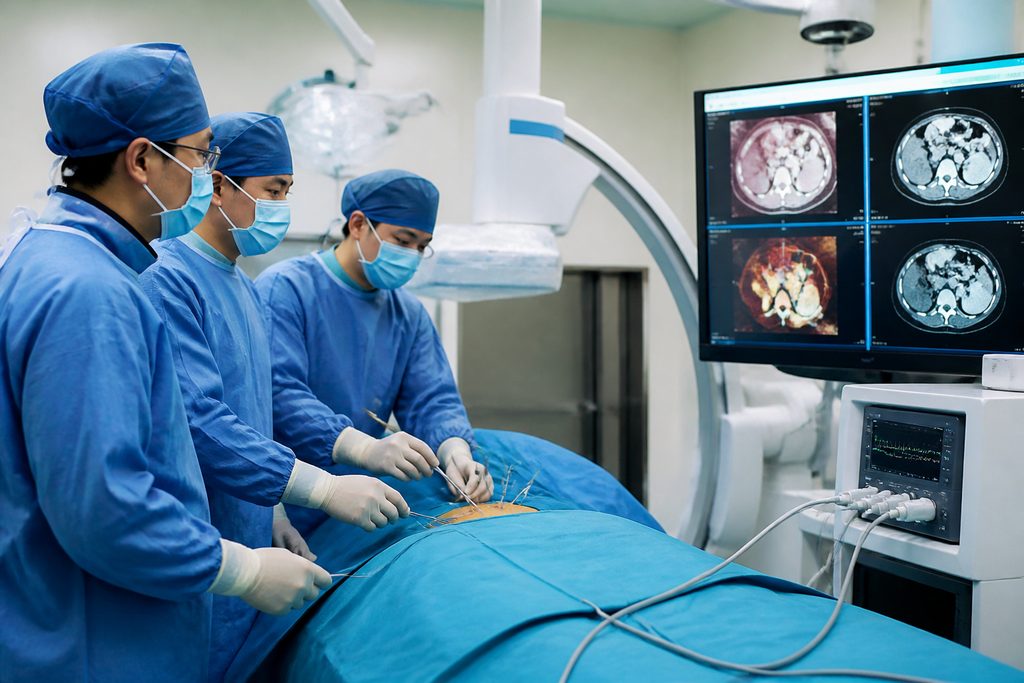
Most people understand ablation as burning or freezing. Radiofrequency heats. Cryoablation freezes. But both destroy everything in the zone—nerves, bile ducts, blood vessels, healthy tissue alongside the cancer. NanoKnife IRE, or Irreversible Electroporation, works on a completely different principle. It uses short, high-voltage electrical pulses to create permanent holes in the cell membranes of tumor cells. The cells die because their internal balance collapses. Not from heat. Not from cold.
That distinction matters enormously when a tumor sits wrapped around a critical structure. Think of a pancreatic tumor abutting the portal vein, or a liver lesion nestled against a major bile duct. Thermal ablation would risk destroying the duct or vessel wall. The electrical pulses of IRE target only the lipid bilayer of cell membranes. Collagen and other structural proteins that form the scaffolding of vessels and ducts remain intact. The tumor dies. The plumbing survives.
Clinical data backs this up. A 2019 systematic review published in Annals of Surgery examined IRE for locally advanced pancreatic cancer and found a median overall survival of 24.9 months in selected patients, with a low rate of serious complications directly attributable to the ablation itself. For liver tumors, a multicenter study in Radiology reported complete ablation rates above 85% for lesions under 3 cm, even those in difficult perivascular locations that would have been untreatable with thermal methods.
Our team regularly fields inquiries from patients who have been told their tumor is inoperable or too risky for conventional ablation. Sometimes that assessment is correct. But sometimes it reflects a lack of access to IRE technology rather than a true medical contraindication. The question becomes: where can you actually get this done, and what does it take to make it happen?
How This Actually Works, Step by Step
The process of accessing NanoKnife IRE in China as an international patient follows a logic that is straightforward once you understand it, but opaque if you are trying to navigate it from abroad alone.
Step 1: You send us your existing medical records. This means recent imaging—contrast-enhanced CT or MRI, ideally within the past 30 days—plus pathology reports, tumor marker labs, and a summary of any prior treatments. We need to see exactly where the tumor sits relative to vessels, ducts, and other structures. That anatomical relationship determines whether IRE is technically feasible.
Step 2: A specialist reviews your case. We forward your materials to an interventional radiologist or hepatobiliary surgeon at a hospital with active IRE experience. This is not a chatbot or a general intake coordinator. It is the physician who would ultimately perform the procedure. They evaluate whether IRE is appropriate, how many probes would be needed, and what the realistic treatment goal is—complete ablation, debulking, or palliation.
Step 3: You receive a written second opinion. This document outlines the feasibility assessment, the proposed approach, and a treatment cost estimate. It is for your reference and for discussion with your home oncologist. It is not a prescription. The fee for this written opinion ranges from $300 to $500, and if you proceed to treatment, that amount is credited in full toward the coordination service fee.
Step 4: You decide and we coordinate. If you choose to proceed, we handle hospital registration, appointment scheduling through the international medical department, visa support documentation for your S2 application, and on-ground logistics. You travel. You have the pre-procedure workup. The ablation happens. You recover. You go home with a discharge summary and imaging in English.
That is the sequence in plain terms. Each step has sub-steps, and things can shift, but nothing about this pathway requires guesswork once you have a knowledgeable coordinator on your side.
What NanoKnife IRE Actually Costs in China
Let us address the question that brings most international patients to this page: the NanoKnife IRE cost in China. This is not a procedure with a flat, universal price. The total depends on the number of probes used, the hospital tier, and whether you access care through the public general ward or the international VIP department.
A single NanoKnife probe in China typically costs between $1,800 and $2,500 USD. Most liver ablations require two to four probes. A pancreatic case, especially one involving the head of the pancreas with complex vascular encasement, may need four to six probes. The hospital procedural fee, anesthesia, imaging guidance, and inpatient stay add to the total.
| Cost Component | Estimated Range (USD) |
|---|---|
| NanoKnife probes (per probe) | $1,800 – $2,500 |
| Typical liver case (2–4 probes, total) | $12,000 – $22,000 |
| Typical pancreatic case (4–6 probes, total) | $20,000 – $35,000 |
| Hospital stay (3–7 days, ward) | $1,500 – $4,000 |
| International department surcharge | 1.5× – 2× base rates |
These figures compare sharply with the United States, where the same procedure, when available, can exceed $50,000 to $80,000 in total billed charges. Even at the upper end of the Chinese range, patients often pay one-third to one-half of what they would face at home—and that assumes their home-country insurer covers IRE at all, which many do not for pancreatic applications they deem experimental.
One nuance worth understanding: the international department surcharge is not a markup for foreigners. It reflects a different service tier—English-speaking coordination, private rooms, expedited scheduling, and dedicated nursing. For patients who speak Mandarin and can navigate the public system independently, the base rates apply. Most international patients choose the supported route. The tradeoff is cost versus navigability.
A Realistic Timeline
Timelines matter because cancer does not pause while paperwork moves. Here is what a typical international IRE treatment journey looks like, with honest ranges rather than best-case scenarios.
| Phase | Duration | What Happens |
|---|---|---|
| Document collection and translation | 5–10 days | You gather imaging (DICOM format preferred), pathology slides, treatment summaries. We arrange certified translation if originals are not in English or Chinese. |
| Specialist review and written opinion | 7–14 days | Materials go to the interventional team. They assess feasibility, probe count, approach. The written report is prepared and shared with you. |
| Decision and coordination | 3–7 days | You consult your home oncologist, family, insurer. If you proceed, we lock in the hospital slot and begin visa documentation. |
| Visa processing (S2) | 10–20 days | You submit the S2 application with the hospital invitation letter and treatment confirmation. Processing times vary by country and season. Expedited options exist in some jurisdictions. |
| Travel and pre-procedure workup | 3–5 days | You arrive. Blood work, repeat imaging if needed, anesthesia clearance, consent discussion. The procedure is usually scheduled within 48–72 hours of completing workup. |
| Procedure and inpatient recovery | 3–7 days | The ablation itself takes 1–3 hours under general anesthesia. Post-procedure monitoring for pain, enzyme spikes, and any complications. Most patients are ambulatory within 24 hours. |
| Total, from first contact to procedure | 5–9 weeks | This is a realistic window. Some cases move faster. Some hit delays in visa processing or require additional pre-procedure optimization. |
The longest variable is almost always visa processing. We have seen S2 visas issued in under a week in some countries and take over a month in others. There is no way to guarantee a specific timeline. What we can do is prepare the documentation package meticulously so that no administrative deficiency on our end causes a rejection or delay.
What Can Go Wrong—and What Happens Then
Every medical procedure carries risk, and a responsible discussion of IRE must acknowledge the failure modes plainly. This is not marketing language. This is what we tell patients before they commit to travel.
The tumor is not fully ablated. IRE relies on precise probe placement and adequate electrical field coverage. If the tumor is larger than anticipated on pre-procedure imaging, or if probe placement is suboptimal, residual viable tumor may remain. The standard response is short-interval follow-up imaging at 4–6 weeks. If residual disease is confirmed, options include repeat IRE, thermal ablation if now feasible, or systemic therapy. The decision belongs to the treating team and the patient.
A structure that was supposed to be spared is injured. IRE is designed to protect vessels and ducts, but no technology is perfect. Portal vein thrombosis, bile duct stricture, or pancreatic leak can occur. Rates in large series are low—under 5% for major complications—but they are not zero. Chinese hospitals with high IRE volumes have protocols for managing these events, including interventional radiology rescue procedures and surgical backup.
You travel and are deemed not a candidate after all. This is rare when a thorough remote review has been done, but it can happen. The pre-procedure workup may reveal disease progression that was not visible on the earlier imaging, or a change in anatomy that makes safe ablation impossible. In that scenario, the hospital team discusses alternative options—systemic therapy, clinical trials if available, palliative measures. The coordination fee for the visit is not refundable, but we work to ensure you leave with a clear plan, not just a canceled procedure.
The cost exceeds the estimate. Probe count is the main variable. The pre-procedure plan may call for four probes, but intraoperative ultrasound or CT guidance may reveal that five or six are needed for adequate coverage. We advise patients to budget a 20–30% contingency above the written estimate. The hospital provides an updated cost breakdown before proceeding.
These are the real failure modes. They are manageable, but they require honest expectation-setting upfront. A coordinator who promises zero risk is not doing their job.
How to Choose the Right Hospital for IRE in China
Not every hospital that owns a NanoKnife generator uses it frequently or well. The best hospital for irreversible electroporation in Shanghai or elsewhere in China is not necessarily the one with the most famous name. It is the one with the highest case volume and the most experience with your specific tumor type and location.
IRE is a technically demanding procedure. Probe placement must be parallel within millimeter tolerance. The electrical parameters must be calibrated to the tissue impedance. The ablation zone must be modeled in real time. These are skills that improve with repetition. A center that performs 10 IRE cases per year cannot match the proficiency of one that performs 100.
When evaluating a hospital, ask these questions directly:
- How many IRE procedures has this specific interventional radiologist performed for my tumor type in the past 12 months?
- What is the center’s complete ablation rate on first-attempt IRE, confirmed by follow-up imaging?
- What is the major complication rate, and how are complications managed—does the center have 24/7 interventional radiology and surgical backup?
- Will the procedure be performed with intraoperative CT guidance, ultrasound, or both?
- What is the protocol for post-procedure pain management and discharge planning?
In China, the hospitals with the deepest IRE experience tend to be major university-affiliated centers in Shanghai, Beijing, and Guangzhou—the same institutions that appear on the Fudan Hospital Ranking in the top tier. These hospitals see high volumes of complex hepatobiliary and pancreatic cases, which drives proficiency. Our database covers 340+ top-ranked hospitals across 37 cities, and we can help you identify which centers have active, high-volume IRE programs relevant to your diagnosis.
One practical note: IRE for pancreatic cancer is performed more selectively than IRE for liver tumors. Fewer centers offer it, and the eligibility criteria are stricter. If you are researching how does NanoKnife ablation work for liver tumors versus pancreatic applications, understand that the liver data is more mature and the availability is broader. Pancreatic IRE is typically reserved for locally advanced, non-metastatic disease and is often combined with chemotherapy. A center that excels at liver IRE does not automatically have equivalent pancreatic experience.
Is NanoKnife IRE Safe for Pancreatic Cancer Specifically?
The safety question deserves its own section because pancreatic IRE carries risks that liver IRE does not. The pancreas is a finicky organ. It sits deep in the retroperitoneum, surrounded by the duodenum, bile duct, portal vein, and superior mesenteric vessels. Electrical current near the duodenal wall can cause thermal injury despite IRE’s non-thermal mechanism, because current density near metal probes can still generate localized heating.
The published safety data is reassuring within its limits. The largest prospective series, including the IMPALA and PANFIRE studies, reported 90-day mortality rates under 3% in experienced centers. Major complications—primarily bile leaks, duodenal leaks, and portal vein thrombosis—occurred in 8–15% of patients. These are not trivial numbers. But they must be weighed against the alternative, which for many patients with locally advanced pancreatic cancer is continued chemotherapy with a median survival of 11–13 months.
The key variable is patient selection. IRE is safest when the tumor is under 3.5 cm, does not encase more than 180 degrees of the superior mesenteric artery, and is not directly invading the duodenal wall. Patients who fall outside these parameters may still be candidates, but the risk profile shifts meaningfully. A responsible center will tell you when the risk outweighs the potential benefit. Our role is to connect you with a team that makes that judgment honestly.
Practical Considerations: Records, Visa, Payment, and Follow-Up
Beyond the medicine, there are logistical realities that determine whether the journey works.
Medical records. You need recent, high-quality imaging in DICOM format—not JPEGs, not printed films photographed with a phone. Contrast-enhanced CT or MRI within 30 days is standard. Older scans may be accepted if your disease is stable, but the interventional team will almost always want fresh imaging before the procedure. Pathology slides should be available for re-review if the original diagnosis was made more than 90 days ago.
Visa. Medical treatment in China falls under the S2 visa category, not the M visa. You will need an invitation letter from the treating hospital and confirmation of your treatment arrangement. We provide the documentation package and guidance, but the visa decision rests with the Chinese embassy or consulate in your country. Processing times vary. Plan for 10–20 business days, and do not book flights until the visa is in hand.
Payment. Chinese public hospitals and their international departments operate on a prepayment model. You deposit an estimated amount upfront, and the hospital draws against it. If costs exceed the deposit, you top up. If they come in under, the balance is refunded. International insurance is rarely accepted for direct billing at public hospitals; you pay and seek reimbursement. Private international hospitals in China, such as those listed on our private hospitals page, may offer direct billing, but few of them perform IRE. The procedure is concentrated in large public academic centers.
Follow-up at home. You will leave China with a discharge summary in English, a CD of post-procedure imaging, and a recommended follow-up schedule. The first follow-up scan is typically at 4–6 weeks. You will need a local oncologist or interventional radiologist willing to receive these records and continue your care. We can help coordinate communication between your home physician and the treating team in China, but the ongoing relationship is yours to manage.
Frequently Asked Questions
A full IRE procedure in China typically ranges from $12,000 to $35,000 depending on probe count and hospital tier. Comparable treatment in the United States often exceeds $50,000 to $80,000. European pricing varies by country but generally falls between the two. The savings can be substantial, but they must be weighed against travel costs, visa fees, and the absence of insurance direct billing at most Chinese public hospitals.
Can I book irreversible electroporation abroad on a fast-track basis?
You can accelerate the process by having your records ready in digital format, responding promptly to requests, and choosing a coordinator who knows the
For more medical information and treatment options in China, visit chinamedservices.com (China Medical Services).
