Nasal Endoscopy in China: Booking Guide for International Patients
Nasal Endoscopy in China: Booking Guide for International Patients
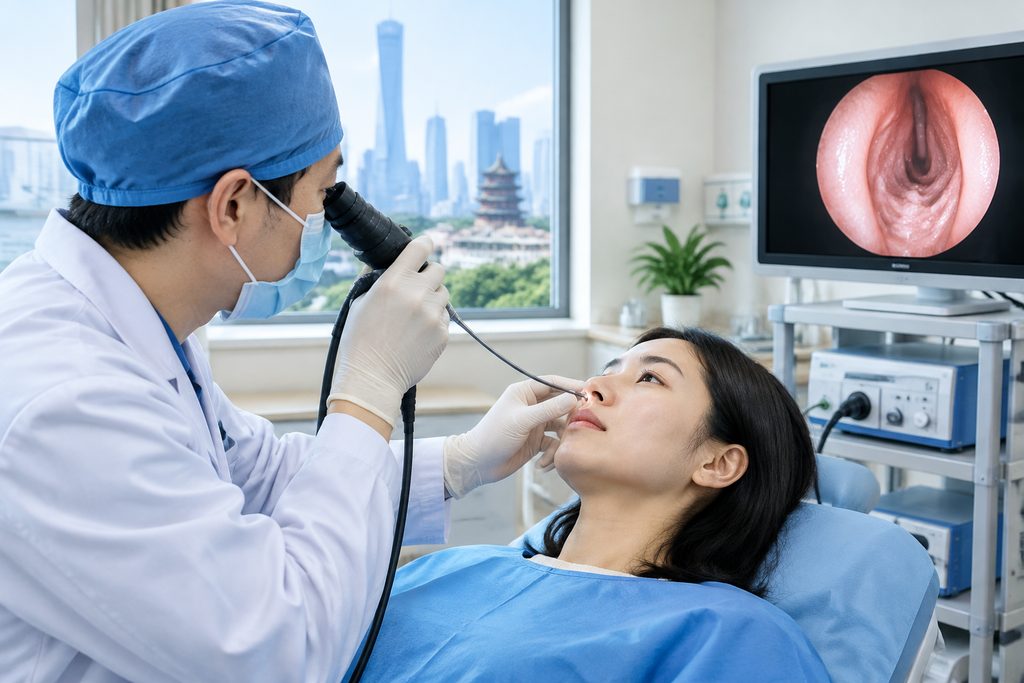
A nasal endoscopy is a simple, camera-based look inside your nose and sinus passages. A thin, flexible tube with a light and lens slides through the nostril, and the doctor sees everything on a screen — polyps, infection, a deviated septum, a stubborn blockage that never quite cleared up. No incision. No radiation. Usually under fifteen minutes. If you have been told you need one, or your symptoms have dragged on for months, the question is probably not “what is it” but “where do I get it done, and what will it cost?” That is where the nasal endoscopy cost China conversation starts getting practical.
China has become a realistic option for this kind of diagnostic procedure. The equipment is modern, the ENT specialists at major hospitals are experienced, and the price is a fraction of what you would pay in the United States or Western Europe. But the booking process has quirks that catch foreign patients off guard. This guide walks through the whole thing — costs, hospitals, timelines, and the parts nobody warns you about.
How This Actually Works, Step by Step
Here is the real sequence, from your first email to walking out of the clinic.
Step one: you send us what you already have. Existing CT scans, previous endoscopy reports, allergy tests, a note from your doctor at home — anything relevant. If you have none of that, a written description of your symptoms works as a starting point.
Step two: a Chinese ENT specialist reviews your file. Not a call center. An actual ear, nose, and throat physician at a hospital in our network looks at your records and gives a written opinion on whether an endoscopy is appropriate, what type (flexible or rigid), and whether you need imaging first.
Step three: you get a plan and a price range. This is where the numbers firm up. A straightforward diagnostic endoscopy at a public tertiary hospital runs far less than the same procedure abroad. If the doctor recommends a biopsy or a sinus CT in the same visit, that gets added.
Step four: appointment coordination. Our team works through the hospital’s official international department or VIP channel to secure a slot. Public hospital general clinics do not accept overseas pre-booking — you cannot simply reserve a specialist’s time from another country. The international and VIP pathways exist precisely for this, and they cost more.
Step five: you arrive, and a bilingual companion meets you. Registration, payment, finding the right floor, translating the doctor’s instructions — all handled. You focus on the appointment.
Step six: results and follow-up. Most endoscopy findings are explained on the spot. If a biopsy was taken, pathology takes a few days. We make sure you leave with a written report in English and a clear next step.
What a Nasal Endoscopy Costs in China — and Why the Range Is Wide
The nasal endoscopy cost China patients actually pay depends on three things: hospital tier, whether you use the international channel, and what else gets done in the same session.
At a public tertiary hospital through the standard channel, a diagnostic nasal endoscopy typically falls in the range of $80 to $200. Add a sinus CT and you are looking at $150 to $350 total. A biopsy pushes it higher. Through a VIP or international department, expect roughly 1.5 to 2 times those figures — the trade-off is English-speaking staff, shorter waits, and appointment times that actually hold.
Compare that to the United States, where a diagnostic nasal endoscopy alone commonly bills between $500 and $1,500 before insurance, and a sinus CT can add $300 to $1,000. The gap is real, and it is the main reason medical tourism for diagnostics has grown.
| Procedure / Service | China (public standard) | China (international/VIP) | United States |
|---|---|---|---|
| Diagnostic nasal endoscopy | $80–$200 | $150–$400 | $500–$1,500 |
| Sinus CT scan | $70–$150 | $120–$300 | $300–$1,000 |
| Biopsy (if needed) | $100–$250 | $200–$450 | $400–$1,200 |
| Bilingual medical companion | from $300/day | from $300/day | not applicable |
These are reference ranges. Final pricing varies by hospital and case complexity, and no quote is final until a physician reviews your specific situation. For a broader picture of how Chinese hospital pricing compares across specialties, see our breakdown of top-ranked hospitals in China.
Finding the Best ENT Hospital in China for Foreigners
China has more than 35,000 hospitals. The top 5% — roughly 340 institutions ranked by the Fudan University hospital index and JCI accreditation — are where you want to be for anything beyond a routine check. For ENT work specifically, you are looking at a smaller group.
Beijing and Shanghai dominate. Beijing has 21 Fudan Top 100 hospitals, Shanghai has 18, and Guangzhou follows with 10. Major ENT departments at hospitals like Peking Union Medical College Hospital, Zhongshan Hospital at Fudan University, and West China Hospital in Chengdu handle high volumes of complex sinus and airway cases. The Fudan specialty reputation rankings list the top ten hospitals per specialty, so you can verify a department’s standing rather than trusting a marketing claim.
For foreign patients, the practical split is this:
- Public tertiary hospitals — deepest expertise, lowest cost, but crowded and Chinese-language dominant. You need the international department or a companion.
- Private international hospitals — United Family, Jiahui, Parkway, Raffles. English-speaking staff, JCI certification, direct insurance billing, Western-style scheduling. Higher prices, easier experience.
- TCM hospitals — not for endoscopy itself, but relevant if your sinus issue is chronic and you want adjunct care. Our traditional Chinese medicine overview covers what that involves.
If you want to compare departments side by side, the specialty rankings by department are the fastest way to narrow the field.
A Realistic Timeline
People underestimate the paperwork and lead time. Here is what a typical path looks like, assuming no emergencies.
| Stage | What Happens | Duration |
|---|---|---|
| Records gathering | You collect scans, reports, symptom notes | 2–7 days |
| Written second opinion | Chinese ENT specialist reviews your file | 3–7 days |
| Appointment coordination | We book through the international/VIP channel | 5–14 days |
| Visa (S2) | Application with hospital supporting documents | 1–3 weeks |
| Travel and procedure | Arrival, companion support, endoscopy visit | 2–4 days on the ground |
| Results | Same-day findings; biopsy pathology if taken | 0–5 days |
Total from first contact to procedure: roughly three to six weeks. Visa processing is the variable that most often stretches the schedule, so start it early.
Is Nasal Endoscopy Safe in China?
Yes, in competent hands. The procedure itself carries minimal risk anywhere in the world — mild bleeding, brief discomfort, occasionally a sneeze. The real question is whether the operator and equipment meet standards, and at Fudan-ranked or JCI-accredited hospitals, they do. These are the same institutions that train physicians from across Asia.
What you should verify: that the hospital is on a recognized ranking or accreditation list, that the physician performing the scope is a qualified ENT specialist (not a trainee doing unsupervised work), and that sterilization protocols are followed. High-volume hospitals generally have strong infection-control records because they are audited constantly.
What Can Go Wrong — and What Happens Then
Honest failure modes, and the recourse for each.
The appointment you wanted is not available. Public hospital general clinics do not accept overseas pre-booking, and even the international channel has limited slots. If we cannot secure the appointment shown in your order, the coordination fee is refunded in full.
Your visa is delayed. S2 processing times shift with embassy workload. We provide the supporting hospital documents, but we cannot guarantee approval — that decision belongs to the consulate. Build buffer time into your plans.
The doctor recommends a different procedure. You might arrive expecting a simple scope and be told you need a CT first, or a biopsy. This is normal medicine, not a bait-and-switch. Costs adjust accordingly, and you approve before anything proceeds.
Language breaks down at a critical moment. This is the most common real-world problem. A doctor explains findings quickly, in Chinese, and you miss the nuance. A bilingual companion solves it. Without one, you are relying on hospital staff whose English may be limited.
Pathology takes longer than expected. Biopsy results can take three to five working days, occasionally more. Plan your departure with that in mind, or arrange for results to be sent to you.
Practical Considerations: Records, Visas, Payment, Follow-Up
Records. Bring everything in digital form and, where possible, translated. Chinese specialists read English reports, but a clean summary speeds things up.
Visa. Foreign patients coming to China for medical treatment use the S2 visa, which covers short-stay medical and private affairs. Family members accompanying you also apply for S2. Note that the M visa is strictly for commercial and trade activity — it has nothing to do with medical care. Stays beyond 180 days require S1. Always confirm current requirements with the nearest Chinese embassy or consulate, as rules change.
Payment. Public hospitals require prepayment; insurance reimbursement happens afterward, in your home country. Private international hospitals often bill insurance directly. Bring a card that works internationally, and confirm accepted payment methods in advance.
Insurance. Check whether your policy covers treatment abroad. Many do not, or require pre-authorization. Get that in writing before you travel.
Follow-up at home. Ask for a written report and any images on a USB drive or secure link. Your local ENT can continue care from that documentation.
Frequently Asked Questions
Shanghai prices sit at the higher end of the national range because of hospital tier and demand. A diagnostic endoscopy through the international channel in Shanghai typically runs $150 to $400, versus $80 to $200 at a standard public hospital elsewhere. Beijing and Guangzhou are similar. Smaller cities cost less but offer less English support.
Not directly at a public general clinic — those do not accept overseas pre-booking. You can, however, arrange it through a hospital’s international or VIP department, or through a coordination service that handles the registration. That is the realistic path for a foreign patient.
At accredited, high-volume hospitals, yes. The procedure is low-risk everywhere. The variables that matter are the operator’s qualifications and the hospital’s standards, both of which you can verify through Fudan rankings or JCI accreditation.
Yes — the S2 visa, with supporting documents from the treating hospital. Accompanying family members apply for S2 as well. Confirm the latest requirements with your nearest Chinese consulate, since documentation rules are updated periodically.
A typical package covers the consultation, the procedure itself, and interpretation support. Some include airport transfer and accommodation. Be cautious of any package that promises a specific specialist or a guaranteed surgery date — reputable providers coordinate on a best-effort basis and refund the coordination fee if the appointment cannot be secured.
Your Next Step
The core message is simple: a nasal endoscopy in China is affordable, safe at the right hospital, and entirely manageable for a foreign patient — provided you plan the logistics and do not assume you can book like you would at home. The savings are real, but so is the paperwork.
China Medical Services connects international patients with 340+ top-ranked hospitals across 37 cities. We are not a hospital and we do not practice medicine. We handle the parts that trip people up: written second opinions, appointment coordination through official hospital channels, bilingual medical companions, and visa guidance. No pressure, no obligation — just a conversation about whether China makes sense for your situation. When you are ready, start with a free consultation and we will tell you honestly what is possible.
This article is for general information only and does not constitute medical advice. Treatment decisions should be made with a qualified physician who has reviewed your individual case.
For more medical information and treatment options in China, visit chinamedservices.com (China Medical Services).
