Nasal Endoscopy in China: Cost, Booking, and What to Expect
Nasal Endoscopy in China: Cost and Booking
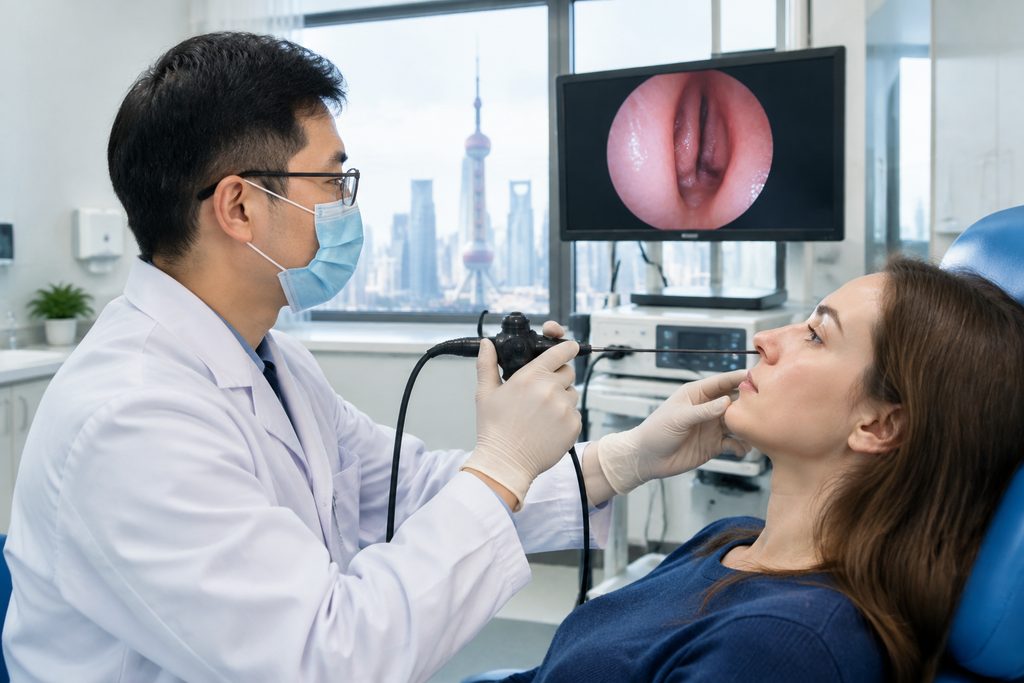
A nasal endoscopy is a simple, quick exam. A thin, flexible or rigid tube with a tiny camera slides into your nasal cavity, and a specialist looks directly at your sinuses, nasal passages, and the back of your throat on a screen. No radiation. No incision. Usually under fifteen minutes. If you have chronic sinusitis, nasal polyps, unexplained nosebleeds, or a blocked airway that never clears, this is the test your ENT wants before deciding anything else. For international patients, the practical question is narrower: what does a nasal endoscopy cost in China, and how do you actually book one without speaking Mandarin or navigating a hospital system built for volume? This guide answers both, honestly, including the parts that are inconvenient.
How This Actually Works, Step by Step
Here is the real sequence, from your living room to the exam chair.
Step one — you send what you already have. Forward your existing CT scans, prior endoscopy reports, allergy testing, and a short written summary of symptoms. Our team translates the relevant documents into Chinese and routes them to an ENT department that matches your case. Not every hospital is equally strong in rhinology, and matching matters more than brand name.
Step two — a specialist reviews the file. A Chinese ENT physician reads your records and confirms whether endoscopy is genuinely the right next step, or whether imaging alone already answers the question. Sometimes it does. We would rather tell you that than sell you a flight.
Step three — you choose how far to go. Options range from a written second opinion, to a video consultation where you speak directly with the ENT team, to an in-person visit. You are not locked into traveling.
Step four — booking and arrival. If you proceed, we coordinate registration, the hospital medical card, and the appointment slot. On the day, a bilingual companion meets you, handles queueing, payment, and translation, and stays through the exam.
Step five — results and a plan. Most endoscopy findings are discussed the same day. Biopsy results, if a sample was taken, typically take several days.
What Nasal Endoscopy Costs in China — Real Numbers
The headline figure surprises most Western patients. A diagnostic nasal endoscopy at a top-tier Chinese public hospital commonly runs $80 to $250 for the procedure itself. At a private international hospital with English-speaking staff and direct insurance billing, expect $300 to $700. In the United States, the same exam frequently bills at $1,500 to $4,000 before insurance adjustments.
That gap is real, but the procedure fee is not your whole cost. Here is what actually drives the total.
| Cost Component | Public Tertiary Hospital | Private International Hospital |
|---|---|---|
| ENT consultation | $15 – $60 | $150 – $400 |
| Nasal endoscopy (diagnostic) | $80 – $250 | $300 – $700 |
| CT of sinuses (if needed) | $100 – $300 | $400 – $900 |
| Biopsy + pathology (if taken) | $80 – $250 | $300 – $800 |
| Bilingual medical companion | from $300/day | |
| Hospital appointment coordination | from $300 | |
Prices vary by hospital and case complexity, and no honest provider quotes a final number before seeing your records. Anyone who does is guessing.
A Realistic Timeline
People underestimate the paperwork. Here is a schedule that reflects how things actually move.
| Stage | Typical Duration | What Happens |
|---|---|---|
| Records collection & translation | 3 – 7 days | You send reports; we translate and format them |
| Specialist review / written opinion | 2 – 5 days | ENT physician assesses whether endoscopy is indicated |
| Video consultation (optional) | 3 – 10 days to schedule | You speak with the team directly |
| Appointment coordination | 3 – 14 days | Slot confirmed at your chosen hospital |
| S2 visa application | 1 – 3 weeks | Requires hospital invitation documents |
| Travel & exam day | 2 – 4 days on the ground | Consultation, endoscopy, same-day findings |
| Biopsy results (if applicable) | 3 – 7 days | Delivered remotely or in person |
Total from first contact to exam: roughly three to six weeks if you need a visa. Patients already in China can often be seen within a week.
What Can Go Wrong — and What Happens Then
Honest failure modes, and the real recourse for each.
You cannot pre-book a standard public outpatient slot from abroad. This is the rule, not an exception. Public hospital registration typically happens on the day, in person. The workaround is the hospital’s international or VIP channel, which does allow advance scheduling — at roughly 1.5 to 2 times the standard price. If a provider promises you a guaranteed standard-queue slot weeks ahead, be skeptical.
The specialist may say endoscopy is unnecessary. Your CT may already show what matters. That is a good outcome, not a wasted fee. You saved a flight.
Visa timing slips. S2 applications require supporting hospital documents, and consulates set their own processing windows. We never guarantee approval — no one legitimately can. Build buffer into your dates.
The exam finds something requiring surgery. In Chinese public hospitals, surgery is arranged only after an in-person consultation. A remote opinion cannot lock a surgical date. If that is your situation, plan for a second trip or an extended stay.
A biopsy comes back inconclusive. Repeat sampling or additional imaging may be needed. Pathology turnaround adds days, not hours.
Is Nasal Endoscopy Safe in China, and How Do You Choose a Hospital?
Diagnostic nasal endoscopy is a low-risk procedure anywhere in the world. The recognized complications — mild bleeding, transient discomfort, rare infection — occur at similar rates regardless of country. The variable is not the procedure. It is the operator and the equipment.
China has over 35,000 hospitals. The top-ranked hospitals in our database represent the top 5% by Fudan University rankings and JCI accreditation, spread across 37 cities. For rhinology and ENT work, you want a tertiary hospital with a dedicated otolaryngology department and modern endoscopic equipment. Our department directory lists the leading hospitals by specialty, so you can compare before committing.
Three practical criteria:
- Does the ENT department handle high annual case volumes? Volume correlates with operator skill.
- Is there English-language support, or a bilingual companion arranged? A hospital with 10,000+ daily outpatients is not navigable without language help.
- Can the hospital provide the invitation documents your S2 visa requires?
Private international hospitals such as United Family, Jiahui, and Parkway offer English-speaking staff and direct insurance billing. They cost more. For a straightforward diagnostic endoscopy, many patients find a top public hospital’s international department delivers equivalent quality at a lower price.
Practical Considerations: Records, Visa, Payment, and Follow-Up
Records. Bring prior imaging on disc or as files, plus any previous endoscopy reports. Chinese specialists read English-language imaging reports reasonably well, but translated summaries speed everything up.
Visa. International patients traveling for medical treatment use the S2 visa, annotated for medical purposes. Stays beyond 180 days require S1. Accompanying family members also apply under S2. The M visa is a commercial and trade category and has nothing to do with medical treatment — if anyone tells you otherwise, they are wrong. Always confirm current requirements with the relevant Chinese embassy or consulate.
Payment. Public hospitals require prepayment; insurance reimbursement happens afterward, on your own policy’s terms. Private international hospitals frequently bill insurers directly. Confirm before you arrive.
Language. This is the single biggest friction point. Registration, payment, pharmacy, and directions are overwhelmingly in Chinese. A bilingual medical companion handles queueing, payment, wayfinding, and translation so you are not managing logistics mid-appointment.
Follow-up at home. Ask for your endoscopy images and a written report in English before you leave. Your local ENT can act on those directly.
Frequently Asked Questions
Typically $80 to $250 at a top public hospital and $300 to $700 at a private international hospital, versus $1,500 to $4,000 in the US. The procedure fee is only part of the total — consultation, imaging, and any biopsy add to it.
Not through the standard public outpatient queue, which registers patients on the day of visit. Advance scheduling is possible through a hospital’s international or VIP department, at roughly 1.5 to 2 times the standard fee. We coordinate those bookings directly with the hospital.
Yes. It is a low-risk diagnostic procedure with complication rates comparable to Western centers. The meaningful variables are the operator’s experience and the equipment, which is why choosing a high-volume tertiary ENT department matters more than the country.
Some providers bundle consultation, endoscopy, and translation into a package. Read what is actually included — many exclude imaging, pathology, and companion time. We quote transparently and confirm final pricing only after reviewing your records, since cost varies by hospital and case complexity.
Surgery in Chinese public hospitals is scheduled only after an in-person consultation. A remote review cannot reserve a surgical date. Plan for either an extended stay or a second trip, and never accept a guarantee of a specific surgeon or date in advance.
Your Next Step
A nasal endoscopy in China costs a fraction of Western pricing, and the quality at top-tier hospitals is genuinely strong. The real obstacle is navigation — language, registration rules, and visa paperwork — not the medicine. China Medical Services helps international patients match with appropriate hospitals, coordinate appointments, and manage logistics on the ground. We are not a hospital and we do not practice medicine; we handle the coordination so your specialist can focus on your nose. If you would like an honest read on whether endoscopy is even the right next step for you, start with a free consultation and send us what you have. No pressure, no obligation.
This article is for general information only and is not medical advice. Always consult a qualified physician about your individual condition.
For more medical information and treatment options in China, visit chinamedservices.com (China Medical Services).
