Needle Ablation China: Microwave and Radiofrequency for Liver, Lung, and Thyroid Tumors
Key Takeaways
- Thermal ablation in China costs roughly 60-80% less than in the US or UK, with a microwave ablation liver tumor cost China typically ranging from $4,000 to $8,000 depending on tumor size and hospital tier.
- Chinese interventional radiologists perform an exceptionally high volume of these procedures annually—often 5-10 times more than a typical Western counterpart—which correlates strongly with technical success rates above 95%.
- Language barriers and a complex public appointment system make self-booking nearly impossible for international patients; the VIP and international department channels are the only reliable entry points.
- You should understand that “package pricing” is not a universal concept in Chinese public hospitals. Most quotes are built around specific line items, and a coordinator who can audit that bill is as valuable as one who can translate it.
The Problem: When Waiting or Paying Isn’t an Option
You have probably seen the numbers. A liver tumor diagnosis comes with a heavy price tag in Western healthcare systems. In the United States, a single session of thermal ablation can bill out between $15,000 and $30,000. In the UK, NHS wait times for interventional radiology have stretched past 18 weeks in many trusts, with some patients waiting months just for a consultation. For a malignant nodule, that kind of delay is gut-wrenching. It feels like watching a small fire turn into a larger one while you stand behind a locked gate.
And it is not just a liver issue. Lung cancer patients with oligometastatic disease—where the cancer has spread to just a few spots—often find themselves in a gray zone. They are not surgical candidates. Systemic chemo has run its course. Ablation is the logical next step, but the local waiting list is long. Thyroid patients face a different version of the same nightmare: a growing nodule that is not yet dangerous enough to justify a full thyroidectomy, but too big to ignore. They are told to “watch and wait.”
That phrase haunts people.
The global medical travel industry has traditionally focused on big-ticket surgeries: heart bypasses, organ transplants, joint replacements. But a quieter, equally significant migration is happening in interventional oncology. Patients are getting on planes for a needle, not a scalpel. They are looking for precision, speed, and a price that does not wipe out their savings. China has quietly become the epicenter of that shift.
Who We Are
We are not a hospital. We do not hold a scalpel, interpret a CT scan, or prescribe a treatment plan. China Medical Services operates as your logistical partner. Think of us as the architectural firm that designs the bridge between you and China’s top-tier medical infrastructure. Our database covers 340+ top-ranked hospitals across 37 cities—institutions that sit in the top 5% of China’s 35,000+ hospitals, ranked by the rigorous Fudan University hospital rankings and JCI accreditation standards. We handle the visa guidance, the hospital matching, the appointment coordination through official international channels, and the on-the-ground bilingual support. You bring the medical history. We bring the map and the translator.
Why Needle Ablation in China Delivers Results
The question is not whether Chinese hospitals can perform thermal ablation. The question is why their interventional radiology departments have become high-volume centers of excellence that rival or surpass Western counterparts in specific technical metrics. The answer sits at the intersection of volume economics, technological adoption, and a healthcare system structured very differently from what you are used to.
Sheer Volume Creates Unmatched Technical Fluency
Let’s talk about numbers, because in interventional procedures, volume is a proxy for safety. A study published in the Journal of Vascular and Interventional Radiology has established a clear volume-outcome relationship for complex ablations: operators who perform more than 50 procedures annually have significantly lower complication rates. Now consider this: a senior interventional radiologist at a major Chinese cancer center like Fudan University Shanghai Cancer Center or Cancer Hospital Chinese Academy of Medical Sciences may perform 300 to 500 liver and lung ablation procedures per year. That is ten times the threshold for “high volume.”
They see rare anatomical presentations routinely. A tumor abutting the diaphragm? A nodule tucked dangerously close to the gallbladder or a major bronchus? These are Tuesday morning cases. The hydrodissection techniques used to protect adjacent organs—injecting fluid to create a safety buffer—are refined through constant repetition. When you ask about the success rate of thyroid nodule ablation in China, the published data from high-volume centers consistently shows technical success rates above 95% with a complication rate for permanent recurrent laryngeal nerve injury below 1%. Those numbers are not magic. They are the product of focus and repetition.
A Technology Landscape That Leaned Into Thermal Ablation Early
China’s hospitals adopted microwave ablation (MWA) with an enthusiasm that surprised many Western observers. While radiofrequency ablation (RFA) remains the dominant modality in the US and Europe, MWA has become the first-line thermal tool in many Chinese centers for liver and lung tumors. Why does this matter to you? MWA has intrinsic physical advantages. It generates higher intratumoral temperatures faster than RFA. It is less susceptible to the “heat sink” effect, where blood flow in nearby vessels cools the ablation zone and leaves viable tumor behind. It creates a more predictable, spherical ablation zone.
Chinese manufacturers like Nanjing ECO and Canyon Medical are global leaders in MWA antenna design. The technology is homegrown, widely available, and deeply integrated into clinical pathways. For a patient with a 3 cm hepatocellular carcinoma, a procedure that might take 12 minutes of active ablation time with RFA could be completed in 5 to 8 minutes with a modern MWA system. Shorter procedural time means less sedation, less risk, and a faster recovery. This is not theoretical. It is physics.
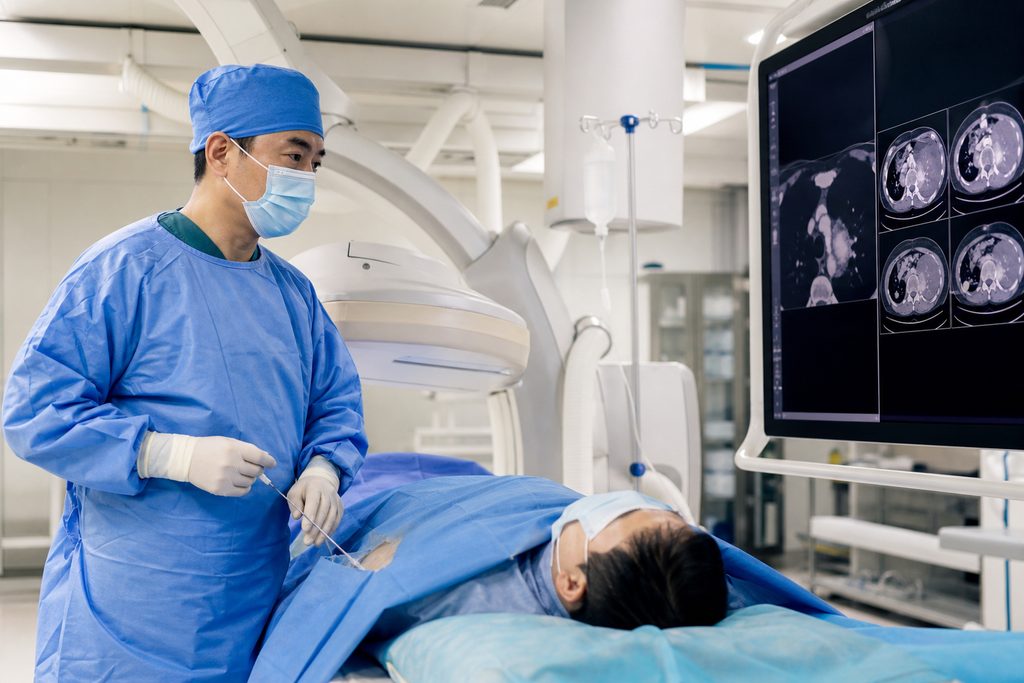
The same pattern holds for lung tumors. Finding the best hospital for radiofrequency ablation of lung cancer in Shanghai means looking at centers like Shanghai Chest Hospital or Zhongshan Hospital, where MWA and RFA are performed under CT guidance with extraordinary precision. These hospitals have dedicated CT-fluoroscopy suites that allow real-time needle tracking. The operator can see the needle tip advance millimeter by millimeter, adjust the trajectory instantly, and confirm the ablation zone before the patient leaves the table. That combination of imaging technology and operator experience is hard to replicate in lower-volume settings.
Cost Structures That Defy Western Logic—Without Sacrificing Quality
This is the part that makes people skeptical. How can the microwave ablation liver tumor cost China be so much lower without cutting corners? The answer is structural, not magical. Chinese public hospitals operate on a high-volume, low-margin model for domestic patients. Labor costs for highly skilled personnel—interventional radiologists, anesthesiologists, nurses—are substantially lower than in the US, not because they are less qualified, but because the overall wage structure in China’s healthcare economy is different. A top-tier interventional radiologist at a public hospital earns a fraction of their American counterpart’s salary, even though they may handle five times the caseload.
Equipment costs are also lower. Because Chinese hospitals purchase domestically manufactured MWA and RFA generators and antennas, the capital equipment cost per procedure drops. A single-use MWA antenna that might cost $1,500 in a US hospital can cost $400 to $600 in China. Those savings pass through to the patient bill.
For international patients accessing care through hospital international departments or VIP channels, the pricing sits between the domestic rate and the Western rate. You can expect to pay $4,000 to $8,000 for a liver MWA procedure, inclusive of the ablation device, CT guidance, anesthesia, and a short inpatient stay. A similar procedure in the US would rarely come in under $15,000 and could easily exceed $25,000. The affordable radiofrequency ablation for lung metastases abroad search query exists because patients have done this math and realized that a plane ticket, a hotel, and a procedure in Shanghai can cost less than their insurance deductible back home.
Does lower cost mean lower quality? The JCI-accredited international departments in Shanghai and Beijing operate to standards that are audited and certified. The Fudan hospital ranking system—China’s most authoritative—evaluates clinical reputation, research output, and quality metrics. The hospitals that appear in the top 10 for oncology and interventional radiology are not cutting corners. They are competing on outcomes. Their survival data for early-stage hepatocellular carcinoma treated with ablation is published in peer-reviewed journals and aligns with international benchmarks. You are not buying a discount procedure. You are buying into a different cost structure.
What You Need to Know Before Going Alone
We need to be direct about this. The Chinese healthcare system is not designed for walk-in international patients. It was built for a domestic population of 1.4 billion people. Trying to navigate it solo, without Mandarin fluency and without an understanding of how public hospital workflows operate, will exhaust you. Here are the barriers that break people:
- Public Appointment Systems Are Closed to You: The standard outpatient registration system—whether online or via hospital kiosk—requires a Chinese ID, a local phone number, and often a domestic payment method. Appointments for top specialists are released in batches and disappear in seconds. You cannot book from overseas. You cannot book without a local proxy. This is not a policy choice; it is simply how the system was built. The only viable pathway for an international patient is through the hospital’s official international medical center or VIP department, which operates on a separate, higher-cost track with dedicated coordinators and English-speaking staff.
- Payment Is Prepaid and Cash-Based: Public hospitals in China operate on a prepaid model. You deposit funds at admission, and charges are deducted daily. Credit cards are often not accepted, or have low transaction limits. International wire transfers can take days to clear. You need a local payment solution or a coordinator who can front the deposit and settle the final bill. Insurance direct billing is virtually nonexistent in public hospitals; it exists only in a handful of private international hospitals like United Family or Jiahui. You will pay out of pocket and seek reimbursement from your insurer later.
- Medical Records Must Be Translated and Formatted Correctly: A Chinese specialist will not review a stack of English-language medical records. They need a concise, professionally translated summary that follows the format Chinese clinicians expect: chief complaint, history of present illness, imaging findings with key measurements, pathology report, prior treatments with dates. A poorly translated record leads to a poor consultation. This is grunt work, but it is essential grunt work. Get it wrong, and the specialist may refuse to take the case.
How We Help You Navigate This
These barriers are real, but they are also solvable with the right operational support. Our process is built around the patient journey, not around selling a package.
Before you travel, we take your existing medical records—imaging discs, pathology reports, clinical notes—and have them translated and formatted by medical translators who understand both the source language and the clinical context. We then submit these records to the international departments of hospitals that match your specific clinical needs. If you have a hepatocellular carcinoma, we are not sending your case to a hospital that specializes in lung cancer. We match based on the Fudan specialty reputation rankings and the specific procedural volumes of the interventional radiology departments. When a hospital accepts your case, we coordinate a video consultation with the treating specialist. That consultation costs $500 to $800 for a top-tier expert, and every dollar of that fee is credited toward our on-the-ground coordination service if you decide to proceed with treatment within 90 days.
When you arrive, a bilingual medical companion meets you at the airport and stays with you through every step: registration, payment deposit, pre-procedure labs, the ablation procedure itself, and post-procedure observation. They translate in real time, explain what is happening, and handle the administrative friction that would otherwise consume your energy. They do not make medical decisions. They make sure you understand the medical decisions being made.
After the procedure, we coordinate your follow-up imaging schedule and ensure you leave with a clear, bilingual discharge summary and a plan for what happens next. Ablation patients typically stay in the hospital for 2 to 4 days, depending on the tumor location and the number of lesions treated. You are not abandoned at the hospital gate with a wave and a receipt. You leave with a documented treatment record, follow-up instructions, and a direct line back to your coordinator if questions arise.
Frequently Asked Questions
The safety profile of thermal ablation in Chinese high-volume centers is comparable to international standards. Major complication rates—bleeding requiring intervention, liver abscess, bile duct injury, or pneumothorax requiring chest tube—range from 2% to 4% in published series from top-tier hospitals. The key variable is operator experience. A center performing fewer than 50 liver ablations per year carries a different risk profile than one performing 400. That is why hospital selection matters more than country selection. The procedure itself is the same technique used worldwide. The safety delta comes from who is holding the needle and how many times they have held it before.
The concept of a fixed-price “treatment package” is common in medical tourism destinations like Thailand or India, but it is less standardized in Chinese public hospitals. What you can book is a coordinated care pathway through a hospital’s international department, which includes a pre-defined set of services: specialist consultation, procedure fee, device cost, anesthesia, and inpatient stay. The total will be estimated upfront based on your imaging and case complexity, but the final bill is typically line-item, not all-inclusive. Some private international hospitals in Shanghai and Beijing do offer more packaged pricing. We help you understand exactly what is included and what is not before you commit. That transparency is built into our hospital appointment coordination process.
This is the question everyone should ask and many are afraid to. Incomplete ablation—where a rim of viable tumor remains at the margin—occurs in roughly 5% to 10% of cases, depending on tumor size, location, and proximity to large vessels. The standard response is a repeat ablation session, typically performed within 1 to 3 months once the residual enhancement is visible on follow-up imaging. In Chinese hospitals, this repeat session is often performed at a reduced cost or as part of the original treatment plan if the need is identified during the immediate post-procedure CT. You should clarify this policy with your treating hospital before the first ablation. We can help facilitate that conversation so there are no surprises.
You do not need to guess. The Fudan University Hospital Rankings publish a specialty reputation list every year, ranking the top 10 hospitals in China for 45 different specialties, including oncology, respiratory medicine, and general surgery. We cross-reference that list with a hospital’s actual procedural volume and their international department’s experience with foreign patients. A hospital might be ranked number one for oncology research but have an international department that rarely handles English-speaking patients. That is a mismatch. We find the intersection of clinical excellence and operational readiness. Our specialty department rankings page breaks this down by clinical area so you can see the landscape before you make any decisions.
Most international health insurance plans will reimburse medically necessary treatment performed at JCI-accredited hospitals abroad, but the process is almost always retrospective. You pay the hospital directly, obtain detailed invoices and medical records in English, and submit a claim. We provide you with properly formatted documentation designed for insurance reimbursement. Some private hospitals in China, including those in our private international hospital network, offer direct billing with select insurers. For public hospital international departments, expect to pay upfront and claim back. Check with your insurer before you travel. Get pre-authorization if your policy requires it. We can help you gather the documentation needed for that pre-auth process.
Your Next Step
Needle ablation in China is not a mysterious, risky gamble. It is a calculated decision that makes sense when you look at the data: high procedural volumes, modern MWA and RFA technology, a cost structure that dramatically undercuts Western pricing, and safety profiles that hold up to international scrutiny. The challenge is not the medicine. The challenge is the logistics. That is what we solve. If you are considering thermal ablation for a liver, lung, or thyroid tumor and want to understand your options in China’s top hospitals, start with a conversation. No pressure. No hard sell. Just an honest assessment of what is possible and what it will cost.
You can reach our coordination team through our free consultation page. Bring your questions. Bring your imaging reports. We will help you build a clear picture of the path ahead.
For more medical information and treatment options in China, visit chinamedservices.com (China Medical Services).
