Neonatal and Pediatric Critical Transport Service China: NICU and PICU Transfer Coordination
Key Takeaways
- Dedicated neonatal and pediatric critical care transport in China uses mobile ICUs staffed by specialized teams, not standard ambulances.
- International coordination for a PICU or NICU transfer requires navigating hospital admissions, medical visas, and aviation regulations simultaneously.
- Direct cash deposits to public hospitals before admission are standard practice; international insurance reimbursement is almost always retroactive.
- Safety protocols on Chinese pediatric air ambulances are comparable to Western standards, using FAA/EASA-certified equipment and dual-power redundancy.
The Problem: Moving a Fragile Life Across Borders Without Losing Control
A critically ill newborn in Hanoi. A child on a ventilator in Manila. A premature infant in a local NICU in Lagos where the power supply is unreliable. When a family faces a pediatric medical crisis in a setting with limited resources, the instinct to move the child to a higher level of care is immediate and visceral. But the gap between that instinct and a safe transfer is vast. A standard medical evacuation flight is not enough. A commercial air ambulance without a specialized neonatal team is not enough. You need a mobile intensive care unit designed for a patient who might weigh less than two kilograms. The coordination required is not just medical—it is a logistical puzzle involving aviation authorities, hospital admitting privileges, customs clearance for controlled medications, and a visa category that most families have never heard of.
Most international families searching for a solution will quickly encounter the central question: what is the realistic nicu ambulance service cost China, and what does that price actually include? The answer is never a single number. It depends on distance, the level of care required during flight, and whether the receiving hospital is a public top-tier center or a private international facility. But understanding the cost structure is the first step toward making a decision rooted in facts, not panic.
Who We Are
We are not a hospital. We do not provide medical treatment, clinical diagnoses, or operate our own aircraft. Our team functions as the logistical architects for families who need to connect with China’s top-tier pediatric critical care resources. We bridge the gap between a child in crisis abroad and the specialized NICU or PICU beds inside hospitals ranked in the top 5% of China’s 35,000+ medical institutions. We handle the coordination layer that sits between a family’s fear and a safe arrival: verifying bed availability, structuring the admission process through official international departments, and ensuring the ground and air transport teams are briefed on the patient’s exact condition before any movement begins.
Why a Coordinated Pediatric Critical Care Transport in China Delivers Results
Clinical Volume Creates Unmatched Specialization
A major children’s hospital in Shanghai or Beijing manages a volume of neonatal surgical cases that would be spread across a dozen facilities in many Western countries. This concentration is not an accident. It is a structural feature of the Chinese healthcare system, where top-tier public hospitals serve as national referral centers. A pediatric cardiac surgeon at a Fuwai Hospital affiliate or a neonatologist at a top-ranked facility in our hospital network will see complex congenital anomalies at a frequency that simply does not exist in lower-volume systems. For a family considering an international PICU transfer, this volume translates into teams that have rehearsed the stabilization and transport of critically ill children thousands of times. When you ask about pediatric critical care transport Shanghai price, you are not just paying for a flight. You are paying for a team whose muscle memory is built on high-acuity repetition.
Technology Stacks Designed for Fragile Physiology
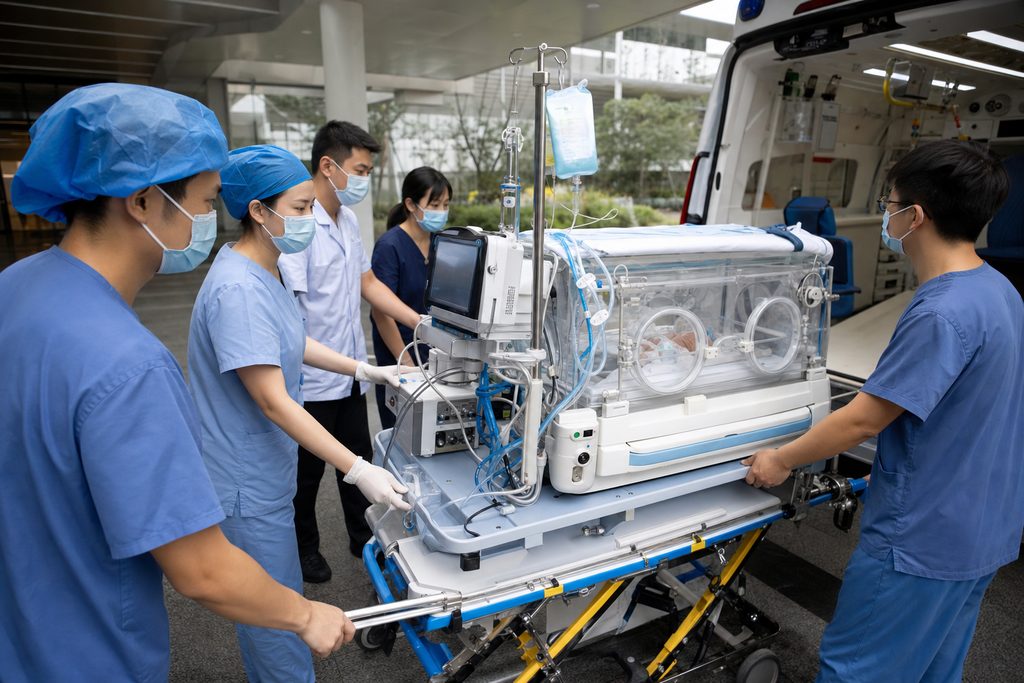
The equipment on a properly configured Chinese neonatal transport system is not an afterthought bolted into a standard aircraft. The transport isolette is a self-contained microenvironment with active temperature regulation, integrated ventilator with high-frequency oscillation capability, multi-channel infusion pumps, and invasive monitoring that transmits continuous data to the receiving NICU. Our team verifies that the transport provider uses FAA- or EASA-certified medical interiors with dual-power redundancy. The aircraft itself is configured so that the medical team has 360-degree access to the patient. This is not a business jet with a stretcher. It is a flying intensive care unit. The question “is pediatric air ambulance safe in China” deserves a direct answer: when the equipment and team meet international accreditation standards, the safety profile is comparable to any developed-world transport system. The variable is not the hardware. The variable is the coordination layer that ensures the right hardware is deployed for the right patient.
The Cost Structure: What You Are Actually Paying For
Let us address the financial reality directly. The nicu ambulance service cost China is typically composed of three distinct layers. First, the aviation component: aircraft charter, fuel, landing fees, and crew. This varies enormously by distance and is the single largest line item. Second, the medical team: a neonatologist or pediatric intensivist, a specialized NICU/PICU nurse, and sometimes a respiratory therapist. Their fees cover the door-to-door clinical care, not just the flight hours. Third, the ground coordination: two ambulance transfers, hospital admission deposits, and the administrative work of securing bed confirmation before the aircraft ever leaves the ground. A short-haul intra-Asia transfer might start from $25,000 to $40,000. A long-haul intercontinental transfer can exceed $120,000. These are not markups for luxury. They reflect the genuine cost of deploying a flying pediatric ICU with a full clinical team. Families who ask about how to book neonatal intensive care transport China are often surprised that the booking itself is not a simple online transaction. It requires a clinical case review, bed confirmation from the receiving hospital, and a payment guarantee structure that Chinese public hospitals will accept.
What You Need to Know Before Going Alone
Attempting to coordinate an international pediatric critical care transport without a local partner introduces risks that compound quickly. The barriers are not designed to exclude anyone. They are structural features of how Chinese hospitals and aviation authorities operate.
- Visa Requirements Are Non-Negotiable: Foreign nationals seeking medical treatment in China must apply for an S2 visa with a specific annotation for medical purposes. The accompanying parent or guardian also needs an S2 visa. This is not a tourist visa. The application requires an official invitation letter from the receiving hospital, stamped and dated. Without a confirmed bed and a hospital willing to issue this document, the visa cannot be processed. An M visa is for commercial business and is entirely unrelated to medical treatment. Attempting to enter on the wrong visa category can result in denial of entry or, worse, a delay that a critically ill child cannot afford.
- Hospital Admission Is a Sequential Process, Not a Reservation: A top-tier public hospital will not reserve a NICU or PICU bed based on a phone call or an email from a family. The admission must be processed through the hospital’s official international department or VIP channel. This requires translated medical records, a clinical assessment by the receiving department head, and a financial deposit. The bed is confirmed only after these steps are complete. Our coordination team manages this sequence, compressing what could take weeks into days, but the sequence itself cannot be skipped.
- Medical Records and Language Barriers Are Real: The receiving team needs complete clinical documentation: current ventilator settings, blood gas trends, medication drips, imaging files in DICOM format. All of this must be translated into medical Chinese with precision. A mistranslated medication name or a missing lab value can cause the receiving team to decline the case or, worse, accept it without full understanding. This is not a job for a general translator. It requires someone who understands both the clinical terminology and the specific documentation standards of Chinese hospital admissions departments.
How We Help You Navigate This
Our process begins with a single question: is the receiving hospital ready to accept this patient? We do not start with flights or visas. We start with bed confirmation. Our team contacts the international department of the target hospital, submits the translated clinical summary, and secures a written acceptance with an admission date. Only then does the transport planning begin. This sequence is non-negotiable because an aircraft cannot loiter in the air waiting for a bed to open up.
Once the bed is confirmed, we structure the transport in three phases. The sending phase: a ground ambulance from the current facility to the airport, with the transport team assuming care at the bedside—not at the aircraft door. The flight phase: direct routing with minimal ground stops, continuous monitoring, and real-time communication with the receiving PICU or NICU. The receiving phase: a ground ambulance from the arrival airport to the hospital, direct admission through the emergency department or a pre-arranged direct-to-unit transfer, and handover of care to the receiving attending physician. At every phase, a bilingual case manager tracks the patient’s location and clinical status, communicating with both the family and the medical teams. For families who later transition from emergency transport to ongoing care in China, any coordination fees already paid are credited in full toward our on-the-ground service package within 90 days.
We also handle the invisible work: ensuring the transport team’s medical licenses are valid for the jurisdictions they will cross, pre-clearing controlled medications with Chinese customs, and arranging the visa invitation letters so that the family’s paperwork is ready before travel. None of this is glamorous. All of it is essential.
Frequently Asked Questions
For a short-haul transfer within Asia—for example, from Southeast Asia to Shanghai or Beijing—the total cost typically ranges from $25,000 to $60,000. This includes the aircraft charter, the full neonatal or pediatric critical care medical team, ground ambulances at both ends, and bed coordination. The final figure depends on the distance, the patient’s clinical acuity, and whether a fixed-wing aircraft or a helicopter leg is required for the final approach. Long-haul intercontinental transfers from Africa, the Middle East, or Europe can range from $80,000 to $150,000 or more.
The process is structured and sequential. First, the receiving hospital’s international department reviews the translated clinical summary and confirms bed availability. Second, the family or their representative pays the admission deposit directly to the hospital. Third, the hospital issues the official invitation letter required for the S2 medical visa. Fourth, the transport team is briefed on the patient’s current status and assumes care at the bedside of the sending facility. Fifth, the patient is transported door-to-door with continuous intensive care. The key point: the hospital admission must be secured before the transport begins. No bed, no flight.
Yes, when the transport provider uses properly configured aircraft and accredited medical teams. The aircraft medical interior should be certified by FAA or EASA standards, with dual-power redundancy for all life-support equipment. The transport isolette must be a dedicated neonatal transport system, not a standard incubator strapped to a stretcher. The medical team should include a physician with fellowship training in neonatology or pediatric intensive care and a nurse with specific transport medicine experience. Our team verifies these credentials before any transport is approved. The safety record of accredited Chinese pediatric transport services is comparable to international benchmarks.
Technically, yes. Practically, it is extraordinarily difficult. The hospital will not issue an invitation letter without a confirmed bed. The bed cannot be confirmed without a clinical review and deposit. The deposit cannot be structured without someone physically present or with a trusted local representative. The transport provider needs a confirmed receiving physician name and bed number before they will accept the mission. A coordinator compresses these dependencies into a single workflow and manages the communication in both directions. Without one, families often find themselves in a circular deadlock where each party is waiting for the other to act first.
Your Next Step
Moving a critically ill child across borders is not a decision anyone makes lightly. The logistics are complex, the costs are significant, and the emotional weight is crushing. But when the local resources are not enough, and a higher level of care exists within reach, the path forward must be built on accurate information and reliable coordination. Understanding the real costs, the admission process, and the safety standards is the foundation. The rest is execution. If you are facing this decision, start with a conversation. We will tell you honestly what is possible, what it will cost, and how long it will take. No pressure. Just facts and a plan.
For more medical information and treatment options in China, visit chinamedservices.com (China Medical Services).
