Orthopedic Surgery in China: A Companion for Every Step
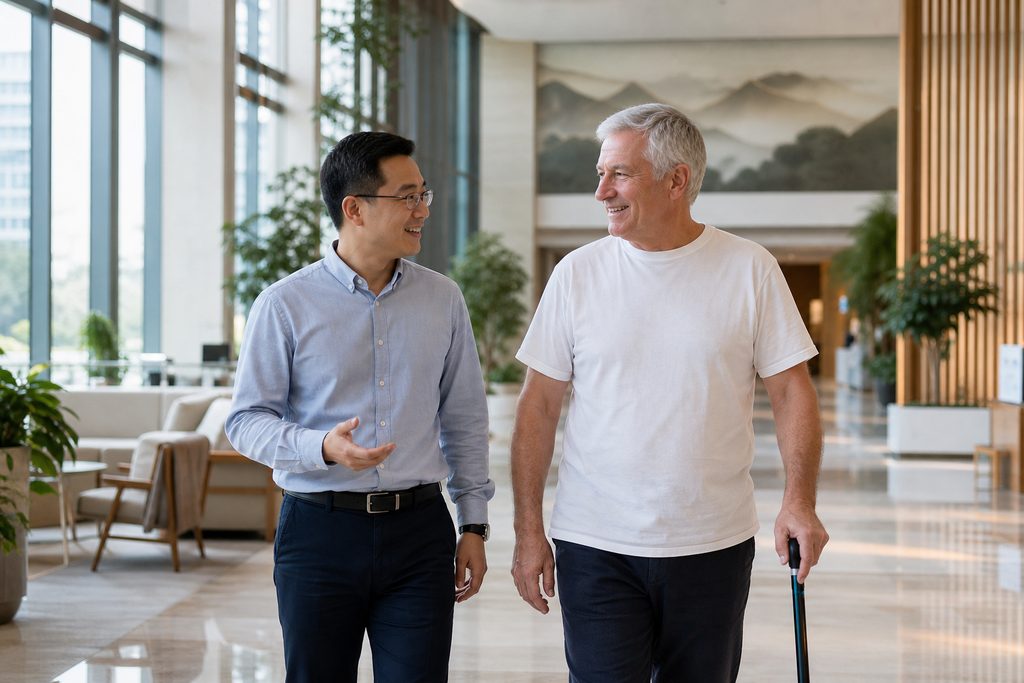
Have you ever looked at a six-figure quote for a knee replacement and wondered if there was another way? The orthopedic surgery cost China typically runs 70–90% below US prices, with top-tier hospitals performing thousands of these procedures annually. That gap closes fast once you factor in travel, lodging, and the reality of navigating a foreign hospital system alone. This guide maps out what that journey actually looks like, step by step.
We coordinate care for international patients across China Medical Services‘ network of 340+ top-ranked hospitals in 37 cities. Our team handles the logistics — hospital matching, appointment coordination, bilingual companions, visa guidance. We are not a hospital and we do not provide medical advice. What follows is what we have learned from years of helping patients move through this system.
Orthopedic Surgery Cost China: The Short Answer
A total knee replacement in a top-tier Chinese public hospital typically costs $8,000–$15,000. The same procedure in the United States averages $35,000–$70,000 before insurance. Hip replacement runs $9,000–$18,000 in China versus $40,000–$80,000 in the US. Spinal fusion sits at $15,000–$30,000 in China compared to $80,000–$150,000 stateside.
But that sticker price is not the whole story. Public hospital rates assume you navigate the system in Mandarin. International department pricing — where English-speaking staff and faster scheduling live — lands about 1.5–2 times higher. Still far below Western prices. But the gap narrows.
Who This Is Right For — and Who It Isn’t
This path suits a specific profile. You have a confirmed diagnosis and imaging already done at home. You need a procedure that is well-established — joint replacement, spinal fusion, arthroscopic repair. You are paying out of pocket or facing a long wait in your home country. You can commit 2–6 weeks for surgery plus initial recovery before flying back.
It is not right for everyone.
- You need emergency surgery — do not fly.
- You have unstable cardiovascular or pulmonary conditions — long-haul flights raise real risk.
- You expect the same administrative experience as a Western private hospital — Chinese public hospitals are efficient but crowded, and the pace can feel abrupt.
- You cannot arrange follow-up care at home — complications after joint replacement, while uncommon, require a local orthopedist who can see you within days.
If you are in the first group, keep reading. If you are in the second, staying home is genuinely the better call.
The Options, Compared
Three realistic routes exist for international orthopedic patients. Here they are side by side.
| Route | Knee Replacement Cost | Wait Time | Language Support | Insurance |
|---|---|---|---|---|
| US private hospital | $35,000–$70,000 | 2–8 weeks | Native | Direct billing |
| Chinese public hospital (standard) | $8,000–$15,000 | 1–3 weeks after in-person consult | Minimal English | Pay first, claim later |
| Chinese hospital international department | $12,000–$25,000 | 3–10 days after consult | English-speaking staff | Pay first, claim later |
| Private international hospital in China (JCI) | $20,000–$40,000 | 1–2 weeks | Full English | Direct billing common |
The standard public route saves the most money but demands the most from you. The international department route is the middle path — meaningful savings with far less friction. A JCI-accredited private hospital in Beijing or Shanghai feels closest to home but costs the most within China. Most of our orthopedic patients choose the international department of a major public hospital. Best balance of price and support.
Best Hospital for Knee Replacement Shanghai: Where the Volume Is
Shanghai is the strongest single city for joint replacement in China. The question we hear most often — best hospital for knee replacement Shanghai — has a layered answer. Shanghai Sixth People’s Hospital runs one of the highest-volume orthopedic surgery departments in the country. Zhongshan Hospital Fudan University and Ruijin Hospital also rank among China’s top 10 for orthopedics in the Fudan specialty reputation list. Volume matters in joint replacement. Surgeons who do 500 knees a year simply see complications that a surgeon doing 50 does not.
Beijing holds its own. Peking Union Medical College Hospital and Jishuitan Hospital — the latter a dedicated orthopedics and trauma center — are both elite choices. If you specifically want a JCI accredited orthopedic hospital Beijing, United Family and Jiahui operate JCI-certified facilities with Western-trained orthopedic surgeons. You will pay more. You will also get direct insurance billing and a fully English environment.
Which city should you pick? If all else is equal, go where the highest surgical volume is for your specific procedure. For knees and hips, that means Shanghai or Beijing. For complex spinal work, Beijing’s Jishuitan and Shanghai’s Changzheng Hospital both carry strong reputations.
Is Hip Replacement Safe in China? The Evidence
Is hip replacement safe in China? The honest answer: at top-ranked hospitals, yes — with caveats. China’s leading orthopedic centers perform hip replacements at volumes that rival any Western institution. Infection rates and revision rates at Fudan-ranked hospitals are published in peer-reviewed journals and fall within international norms. The implants used — Stryker, Zimmer Biomet, DePuy Synthes — are the same brands used in the US and Europe.
The safety gap is not in the operating room. It is in the system around it. Standard public wards may have 3–6 patients per room. Nursing ratios are lower than in Western private hospitals. Family members are expected to help with basic care — feeding, bathing, mobility support. If you come alone to a standard ward, you will struggle. That is precisely where a bilingual companion changes the experience. They do not replace nursing care, but they handle communication, paperwork, and logistics so you are not stranded.
International departments mitigate much of this. Private rooms are standard. English is spoken. The trade-off is cost — still far below US prices.
How Much Is Spinal Fusion Surgery Abroad? The Numbers
How much is spinal fusion surgery abroad when China is the destination? A single-level lumbar fusion in a Chinese public hospital runs $15,000–$25,000. Two-level fusions push toward $25,000–$35,000. Add international department pricing and you are at $22,000–$45,000. Compare that to $80,000–$150,000 in the US or $40,000–$70,000 in Western Europe, and the arithmetic is clear.
What drives the variance? Implant type is the biggest variable. Titanium versus PEEK cages, brand-name versus domestic hardware, minimally invasive versus open technique — each choice shifts the price by thousands. The surgeon’s seniority matters too. A department chair’s fee runs higher than a mid-career attending’s. And hospital tier: a Fudan top-10 orthopedics department charges more than a regional tertiary hospital.
Spinal fusion is not a place to bargain-hunt. The stakes are too high. Choose the hospital first, then accept the price.
What It Costs: The Full Breakdown
Surgery is the headline number. It is not the only one.
- Hospital deposit: Chinese public hospitals require prepayment. Expect to deposit 50–100% of the estimated surgical cost before admission. International departments sometimes accept credit cards; standard wards often require cash or Chinese bank transfer.
- Pre-op imaging and labs: $300–$800. Even with imaging from home, most hospitals repeat X-rays and bloodwork.
- Bilingual companion: from $300 per day. A 4-hour half-day or 8-hour full-day. Covers registration, queuing, payment, interpretation, and navigation.
- Airport transfer: $200 round-trip.
- Lodging for family: $50–$150 per night near major hospitals in Shanghai or Beijing.
- Post-op rehabilitation: $500–$2,000 depending on whether you stay in China for inpatient rehab or return home and continue there.
Total out-of-pocket for a knee replacement with international department care, companion support, and two weeks of lodging: roughly $18,000–$30,000. Still 50–70% below US cash prices.
Practical Considerations: Records, Visas, Payment, and Follow-Up
You cannot fly to China and walk into a top orthopedic department expecting same-week surgery. The system has rules.
Records first. Hospitals want recent imaging — MRI or CT within 3–6 months — plus a written diagnosis from your home orthopedist. Send these for a written second opinion ($300–$500) or a video consultation ($100–$800 depending on specialist seniority) before you book flights. This step confirms you are actually a surgical candidate and that the Chinese team agrees with the plan. Any consultation fee is credited in full toward on-the-ground coordination if you proceed within 90 days.
Visa reality. Medical treatment in China falls under the S2 visa category, with S1 for stays beyond 180 days. The hospital’s international department issues an invitation letter that supports your application. Family members traveling with you apply for their own S2 visas. Approval is not guaranteed, and processing times vary by consulate. Start this at least 6–8 weeks before your target surgery date.
Payment. Public hospitals do not bill your insurance directly. You pay, then claim reimbursement. Private international hospitals like those on our JCI-accredited list often handle direct billing. Bring multiple payment methods — credit card for the international department, and a way to move larger sums if the hospital requires a bank transfer.
Follow-up. You will fly home 1–3 weeks after surgery, depending on the procedure. Before you leave China, get a written discharge summary in English, all post-op imaging on a USB drive, and the surgeon’s contact protocol for questions. Then line up a local orthopedist at home before you depart. Complications are rare, but “rare” is cold comfort if you are the one with a question at 2 a.m. and no one to call.
Frequently Asked Questions
No — not at public hospitals. The standard rule is that surgery requires an in-person outpatient consultation first. The surgeon must examine you and review imaging before scheduling. What you can do remotely is arrange a video consultation or written second opinion to confirm the plan, then travel for the face-to-face consult and surgery in one trip. International departments can sometimes compress this timeline to a few days.
Top Chinese orthopedic departments manage complications at rates comparable to Western centers. But the follow-up system differs. If a complication arises after you return home, your local orthopedist becomes the primary responder, with the Chinese team available for remote consultation. This is why we tell every patient: do not leave China without a complete discharge packet and a confirmed local follow-up appointment. The surgery is only half the safety equation — continuity of care is the other half.
A translation app handles menus and taxi directions. It does not handle a nurse explaining post-op wound care at 7 a.m., or a billing office telling you your deposit is short, or a pharmacy counter asking which formulation of anticoagulant your surgeon ordered. In a system where a single-day outpatient volume at a major hospital can exceed 10,000 patients, the bottleneck is not language — it is knowing where to stand, what to hand over, and what to ask for. A companion solves that. Plenty of patients manage alone. The ones who have the smoothest experience usually do not.
At top-ranked hospitals, yes. Chinese orthopedic departments use the same international implant brands — Stryker, Zimmer Biomet, DePuy Synthes, Smith+Nephew — as US and European centers. Some hospitals also offer domestic implant brands at lower cost. If implant brand matters to you, confirm it during your remote consultation and get it in writing before you travel.
Your Next Step
The orthopedic surgery cost China advantage is real, but it only materializes when the logistics are handled properly. Wrong hospital, missing records, visa delays — any one of these can erase the savings. Our team at China Medical Services handles hospital matching, appointment coordination, companion support, and visa guidance for patients across 340+ hospitals in 37 cities. We do not diagnose, we do not treat, and we do not promise outcomes. We make sure you get to the right surgeon with the right paperwork and someone beside you who speaks the language.
Start with a free consultation. Tell us your diagnosis, your imaging, and your timeline. We will tell you honestly whether China makes sense for your case — and if it does, exactly what the next 90 days should look like. Book your free orthopedic surgery consultation here.
For more medical information and treatment options in China, visit chinamedservices.com (China Medical Services).
