Ovarian Cancer Second Opinion in China: Red House Hospital Costs & Process
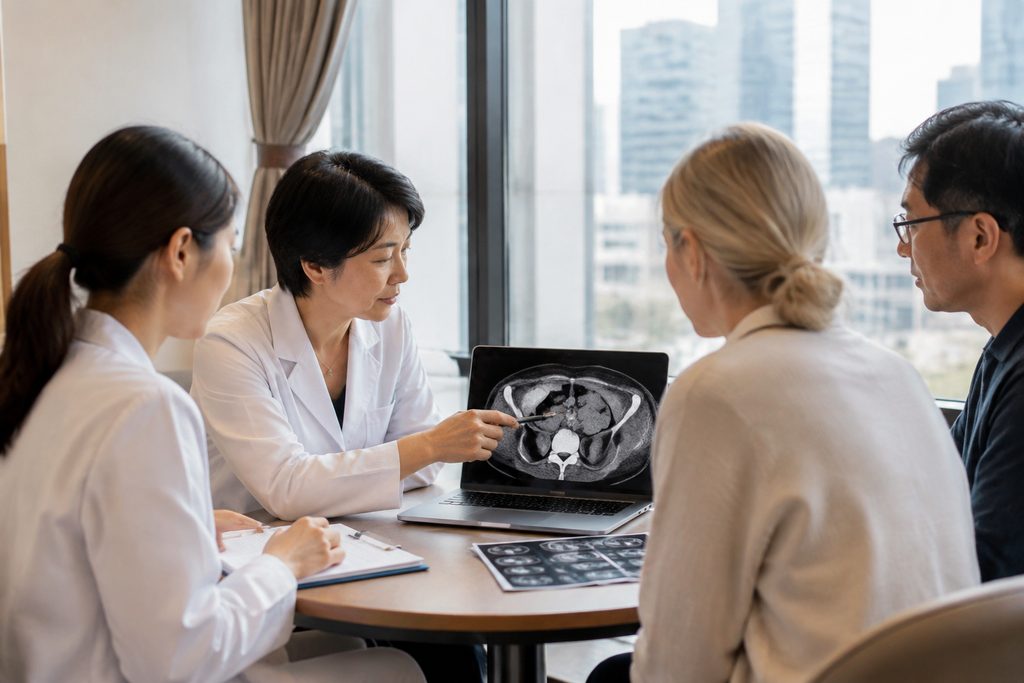
You’ve probably heard that getting a second opinion abroad means flying across the world, spending weeks in a hotel, and burning through savings before a single doctor looks at your scans. That’s the old model. A written second opinion for ovarian cancer from a top Chinese oncology center can now start from $300–500 — without leaving your living room.
But “Red House Hospital” is where things get complicated. There is no hospital in China officially named “Red House Hospital” (Hong Fang Zi Yi Yuan). The term circulates in some English-language forums and patient groups, usually as a nickname or mistranslation for a specific institution. Most often, it refers to Fudan University Shanghai Cancer Center (FUSCC) or Peking Union Medical College Hospital (PUMCH) — both housed in historically significant red-brick buildings and both ranked among China’s top 10 for oncology. This matters because you cannot book a second opinion at a nickname. You need the real institution, the real department, and the real process.
Ovarian Cancer Second Opinion China Cost: The Short Answer
A written second opinion from a top-tier Chinese oncology hospital typically costs between $300 and $500. A video consultation with a specialist runs $500–800. An in-person consultation coordination service starts at $800–1,200, not including travel or hospital fees.
That’s the headline. The caveat: these are coordination and professional service fees, not treatment costs. They cover medical record translation, submission through the hospital’s official international department, and the specialist’s written or verbal assessment. Actual surgery, chemotherapy, or targeted therapy costs are separate and vary significantly by hospital and case complexity.
Who This Is Right For — and Who It Isn’t
A second opinion from a Chinese oncology center makes sense in specific situations. Not every ovarian cancer patient needs one.
Good candidates include:
– Patients with recurrent or platinum-resistant ovarian cancer where standard protocols have stopped working
– Women diagnosed at stage III or IV who want a second perspective on surgical resectability
– Patients considering HIPEC (hyperthermic intraperitoneal chemotherapy) — a technique Chinese centers perform at high volume
– Families who want written documentation of treatment alternatives before committing to a major surgery
– Patients with rare histological subtypes (clear cell, mucinous, low-grade serous) where treatment evidence is thinner
You should probably not pursue this if:
– You are newly diagnosed with stage I disease and standard surgery is straightforward
– Your current oncologist is at an NCI-designated center and you’re satisfied with the treatment plan
– You need an emergency decision — international second opinions take days to weeks, not hours
– You cannot provide complete medical records in English or Chinese translation is not feasible
– You expect a Chinese second opinion to guarantee access to experimental drugs unavailable elsewhere
Being honest about who shouldn’t do this is part of the job. Not every case benefits from crossing borders, even virtually.
The Options, Compared
You have several paths to a Chinese oncology second opinion. They differ in depth, turnaround time, and cost.
| Option | What You Get | Typical Cost | Turnaround | Best For |
|---|---|---|---|---|
| Written Second Opinion | Specialist reviews records, issues written analysis and treatment suggestions | $300–500 | 5–10 business days | Patients who want documentation and time to think |
| Video Consultation | Live discussion with specialist, Q&A, verbal recommendations | $500–800 | 1–2 weeks scheduling | Patients with specific questions about surgical options or clinical trials |
| MDT Video Consultation | Multidisciplinary team (surgical oncologist, medical oncologist, radiologist) reviews case jointly | $1,500–2,000 | 2–3 weeks scheduling | Complex or recurrent cases needing multi-angle input |
| Proxy In-Person Consultation | Designated representative visits hospital with your records, consults specialist on your behalf | $800–1,200 coordination fee | Varies by hospital | Patients who need a local presence but cannot travel yet |
Most international patients start with a written second opinion. It’s the lowest-cost entry point and gives you a tangible document to discuss with your home oncologist. If the written opinion raises questions — or opens a door you want to walk through — you can upgrade to a video consultation. And here’s something worth knowing: any consultation fee is credited in full toward on-the-ground coordination if you later decide to pursue treatment in China within 90 days. That applies to the coordination service only, never to hospital treatment charges.
Red House Hospital Oncology Review: What the Term Actually Maps To
The phrase “Red House Hospital oncology review price” appears in search queries from patients who’ve heard the nickname somewhere — a forum post, a relative’s recommendation, a YouTube comment. Let’s clear this up.
There is no hospital registered under that name in China. When patients or overseas agents say “Red House Hospital” for cancer care, they are almost always referring to one of two institutions:
Fudan University Shanghai Cancer Center (FUSCC) — located in Shanghai’s Xuhui district. The main building is a distinctive red-brick structure that has stood since 1931. FUSCC is ranked among China’s top 10 for oncology in the Fudan specialty reputation rankings. It handles over 1.5 million outpatient visits annually and is a major surgical center for gynecologic cancers, including ovarian cancer cytoreductive surgery.
Peking Union Medical College Hospital (PUMCH) — in Beijing’s Dongcheng district. The historic main building is also red-brick, dating to 1921. PUMCH consistently ranks at the top tier (A++++) of the Fudan comprehensive hospital list and its gynecologic oncology department is a national referral center.
If someone tells you they can book a “Red House Hospital” second opinion, ask which institution they mean. If they cannot name the actual hospital, walk away. That’s the single most important piece of advice in this article.
For ovarian cancer specifically, you can browse the oncology rankings and hospital profiles in our specialty department database to see which centers rank in China’s top 10 for gynecologic oncology.
How to Get a Second Opinion from a Chinese Oncologist: Step by Step
The process is not complicated, but it is document-heavy. Here’s what actually happens.
Step 1: Gather your records. You’ll need pathology reports (including immunohistochemistry and any molecular testing like BRCA1/2 or HRD status), surgical reports if you’ve had debulking surgery, chemotherapy regimens with dates and cycles, CA-125 trend data, and all imaging reports. CT and PET-CT images themselves — not just the written reports — should be available as DICOM files or high-resolution scans.
Step 2: Translation. Records in English, French, Spanish, Arabic, or Russian need translation into Chinese for the reviewing specialist. Some hospital international departments have in-house translators; otherwise, a medical translation service handles this. Translation quality matters more than patients expect — a mistranslated pathology term can change a treatment recommendation.
Step 3: Submission. Your records go through the hospital’s official international patient department or a coordination service. This is not the same as walking into a public outpatient clinic. Public clinics in China cannot be pre-booked from overseas and require in-person registration on the day of the visit. International departments operate on a different track.
Step 4: Specialist review. A gynecologic oncologist reviews the full file. For a written second opinion, you receive a formal document with the specialist’s assessment, treatment suggestions, and rationale. For a video consultation, you speak directly with the specialist.
Step 5: Discussion with your home team. This step is non-negotiable. A Chinese second opinion is one input, not a replacement for your treating oncologist. Bring the written opinion to your next appointment. Compare. Ask questions. Decide.
Is Ovarian Cancer Treatment Safe in China?
Safety is the question every patient asks, usually phrased as “is ovarian cancer treatment safe in China” — and it deserves a direct answer.
For international patients treated through top-tier hospital international departments, the standard of care for ovarian cancer is comparable to major Western cancer centers. Chinese gynecologic oncologists follow NCCN and ESGO guidelines, and leading centers participate in international clinical trials. Surgical volume is a real advantage: a surgeon at FUSCC or PUMCH may perform more radical cytoreductive surgeries in a year than a typical Western gynecologic oncologist does in five. That volume translates to technical proficiency, especially for complex cases involving bowel resection or diaphragmatic stripping.
But “safe” depends on context. A public hospital’s general ward — where you’d navigate Chinese-language signage, crowded hallways, and limited English support — is a different experience from the international department. The medical care may be the same, but the logistics are not. International departments provide English-speaking staff, streamlined registration, and private or semi-private rooms. That comes at a premium: typically 1.5 to 2 times the cost of the standard public pathway.
There are also real limitations. Not every Chinese hospital accepts international patients for every procedure. Some experimental therapies available in China are not approved elsewhere, but the reverse is also true. And follow-up care after you return home requires coordination between your Chinese team and your local oncologist — something that works well when planned in advance and poorly when improvised.
What It Costs: Breaking Down the Numbers
The cost of an ovarian cancer second opinion in China has two layers: the professional service fee and the treatment cost if you proceed.
Second opinion fees (professional services):
– Written second opinion from a top oncology hospital: $300–500
– Specialist video consultation: $500–800
– MDT video consultation with 3+ specialists: $1,500–2,000
– Proxy in-person consultation coordination: $800–1,200
Treatment costs if you proceed (for reference):
– Radical cytoreductive surgery at a top-tier public hospital international department: $15,000–30,000
– Standard platinum-based chemotherapy cycle (international department): $3,000–6,000 per cycle
– HIPEC procedure: $10,000–20,000
– Targeted therapy (PARP inhibitors like olaparib or niraparib): $2,000–5,000 per month depending on the drug and dosage
These are ranges, not quotes. They vary by hospital, case complexity, length of stay, and whether you go through the international department or the standard public pathway. For comparison, the same surgery in the United States typically runs $60,000–120,000 before insurance adjustments. That cost differential is why many international patients first seek a written second opinion — to determine whether traveling for treatment is financially justified before committing to flights and hotels.
What’s not included: flights, accommodation, visa fees, meals, and any post-operative rehabilitation. Budget for those separately.
Practical Considerations: Records, Visas, and Follow-Up
The logistics of a Chinese second opinion are manageable, but they require preparation.
Medical records. Complete records are non-negotiable. Incomplete pathology or missing surgical notes will delay review or result in a qualified opinion (“based on available records, the recommended approach is…”). Gather everything before you submit.
Visa. If you decide to travel for in-person evaluation or treatment, you’ll need an S2 visa for short stays (up to 180 days) with medical treatment noted as the purpose. Family members accompanying you also apply for S2 visas. The hospital’s international department provides supporting documents, but approval is always at the discretion of the Chinese embassy or consulate. No one can guarantee visa issuance.
Payment. Chinese public hospitals, including international departments, generally require prepayment. International credit cards are accepted at major international departments, but confirm before you arrive. Insurance reimbursement is typically post-hoc — you pay upfront and claim from your insurer. Some private international hospitals in China (like United Family or Jiahui) offer direct insurance billing, but they are not the same as public hospital international departments.
Language. Top-tier international departments have English-speaking staff. Outside those departments — in hallways, radiology, or the pharmacy — English support drops sharply. If you’re traveling for treatment, a bilingual medical companion costs from $300 per day and handles registration, queueing, payment, navigation, and interpretation. It’s not a luxury for most international patients; it’s the difference between a manageable process and a stressful one.
Follow-up. After you return home, your Chinese oncologist will typically want follow-up imaging and CA-125 results at intervals. Coordinate this before you leave. Some international departments offer video follow-up consultations; others require written summaries from your local oncologist.
Frequently Asked Questions
Is a Chinese second opinion for ovarian cancer accepted by my home oncologist?
Usually, yes — but it depends on how you present it. Oncologists at major Western centers are generally open to reviewing opinions from FUSCC, PUMCH, or other Fudan-ranked institutions. The key is bringing the written document and asking specific questions: “Does this change your surgical plan?” “Would you consider HIPEC based on this assessment?” A second opinion is a discussion tool, not a confrontation.
Can I book an ovarian cancer consultation at Red House Hospital directly?
No — because “Red House Hospital” is not a registered institution name. You need to identify the actual hospital (most likely Fudan University Shanghai Cancer Center or PUMCH) and go through its official international patient department or a coordination service that works with that department. If a website or agent uses “Red House Hospital” without specifying the real name, treat that as a red flag.
What if the second opinion disagrees with my current treatment plan?
Disagreement is the point of a second opinion — not a failure of it. If the Chinese specialist recommends a different surgical approach, a different chemotherapy regimen, or a clinical trial, you now have more information than you had before. Discuss both plans with your home oncologist. Sometimes the answer is a hybrid. Sometimes the Chinese opinion confirms your current path, which is also valuable: you’ve paid for certainty.
How long does a written second opinion take?
Typically 5–10 business days from the time complete records are submitted and translated. Complex cases — recurrent disease, multiple prior surgeries, unusual histology — can take longer. Video consultations usually require 1–2 weeks of scheduling. If you need an answer within 48 hours, a Chinese second opinion is not the right tool.
Does a second opinion include treatment access in China?
No. A second opinion is an assessment and recommendation. It does not guarantee admission, surgery slots, or access to specific drugs. If you decide to pursue treatment in China after reviewing the opinion, that’s a separate coordination process. The consultation fee can be credited toward that coordination service, but treatment itself is billed separately by the hospital.
Your Next Step
A second opinion from a Chinese oncology center is a tool — one that costs a few hundred dollars and a week or two of waiting, and can either confirm your current path or open a new one. The value depends entirely on the quality of your records and the clarity of your questions.
Our team at China Medical Services helps international patients navigate this process — from identifying the right hospital and department to translating records, coordinating submissions, and arranging consultations. We are not a hospital, and we do not provide diagnoses or treatment recommendations. What we do is handle the logistics so you can focus on the medical decision.
If you’re considering an ovarian cancer second opinion in China, start with a conversation. Tell us about your diagnosis, your records, and what you’re hoping to learn. We’ll tell you honestly whether this path makes sense for your case — and what it would cost.
Request a free consultation to discuss your situation with our patient coordination team.
For more medical information and treatment options in China, visit chinamedservices.com (China Medical Services).
