Painless Endoscopy in China: Both Ends, One Nap Explained
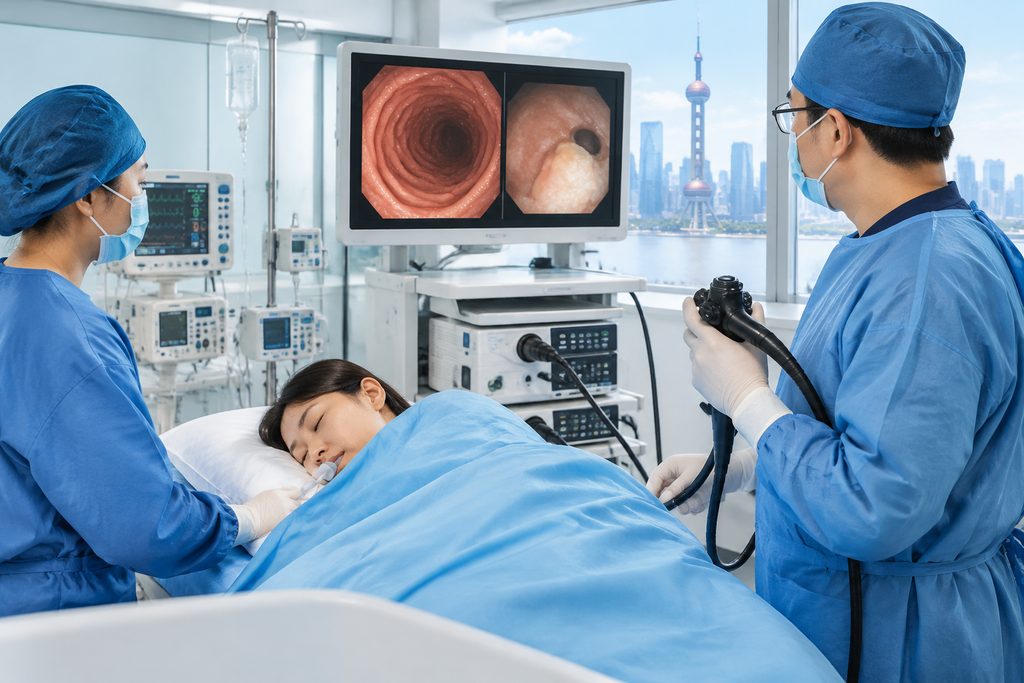
While patients in the United States routinely face $2,500 to $6,000 in facility and anesthesia charges for a combined upper endoscopy and colonoscopy, a sedated “both ends, one nap” package at a top-tier Chinese hospital often runs a fraction of that — and is frequently scheduled within days, not months. That gap is why searches for endoscopy and colonoscopy cost China have climbed steadily among expats, medical travelers and uninsured Americans. One nap, two scopes, and a price that does not require a payment plan.
Key Takeaways
- Combined upper endoscopy (gastroscopy) and colonoscopy under sedation — the “both ends, one nap” approach — is widely available at Chinese tertiary hospitals, with package pricing that typically undercuts US cash prices by 70-90%.
- Chinese gastroenterology departments handle enormous annual procedure volumes, which is one structural reason complication rates at major centers compare favorably with Western benchmarks.
- Public hospital general clinics generally cannot be pre-booked from overseas. Securing a specific date usually means going through a hospital’s international or VIP channel — at roughly 1.5 to 2 times the standard fee.
- You will need the S2 visa (annotated for medical treatment), not an M visa, and you should confirm current requirements with the nearest Chinese embassy before booking anything.
The Problem: Sedation Isn’t Standard Everywhere, and the Bill Shows It
In much of the world, a colonoscopy is an uncomfortable awake procedure. The United Kingdom’s NHS performs most colonoscopies with conscious sedation or none at all, and patients frequently describe the experience as the worst part of screening. In the US, sedation is routine — but the anesthesia itself can add $1,000 or more to the bill, and that is before the gastroenterologist’s fee, the facility fee and the pathology charges.
Cost is the other half of the problem. A 2023 analysis published in Gastroenterology found that the average commercial insurance payment for a screening colonoscopy in the US exceeded $2,000, while cash-pay patients often see quotes of $2,500 to $6,000 for a combined upper and lower scope. For anyone without generous insurance — expats, self-employed workers, early retirees, patients from countries with long public waitlists — the math is brutal.
So people look elsewhere. And increasingly, they look at China.
Why China Delivers on Painless Endoscopy and Colonoscopy
The case rests on three structural facts, not marketing claims.
Procedure Volume at a Scale the West Rarely Sees
China’s top-ranked gastroenterology departments perform tens of thousands of endoscopic procedures annually. A single large tertiary hospital in Shanghai or Beijing may run 40,000 to 60,000 endoscopies a year across its endoscopy center. That volume matters clinically. Operators who perform hundreds of colonoscopies per month develop the muscle memory that reduces perforation risk and improves polyp detection rates — the two metrics that define quality in this field.
For context, the American Society for Gastrointestinal Endoscopy has noted that adequate training requires a minimum of 275 supervised colonoscopies; many Chinese endoscopists at major centers exceed that in their first year of independent practice alone.
Sedation as the Default, Not an Upgrade
Painless endoscopy — wutong weichangjing in Chinese clinical shorthand — is the standard offering at tertiary hospitals. Most centers use propofol-based deep sedation administered by an anesthesiologist, which is why the procedure is genuinely painless and why patients wake up with no memory of it.
That last point deserves emphasis. Propofol sedation is not “twilight sedation.” You are asleep. The same anesthesia team monitors you throughout, and you recover in a dedicated post-anesthesia area before discharge. This is the model that makes a combined gastroscopy and colonoscopy feasible in one session — one anesthesia induction, one recovery, one appointment.
Cost Structure, Not Cost Cutting
Lower prices in China do not come from cutting corners. They come from labor economics, high-throughput endoscopy suites, and a healthcare system where the government sets procedure fees. An anesthesiologist’s time costs a fraction of what it does in the US. The scope itself, the sedation drugs, the pathology lab — these are comparable. What differs is the markup layered on top.
What a Combined Endoscopy Actually Involves, Step by Step
Here is the real sequence at a typical top-tier Chinese hospital, from the patient’s perspective.
Day 1 — Outpatient consultation. You meet the gastroenterologist, review your history, and receive a printed preparation protocol. If you have prior reports from home, bring them translated. This visit is mandatory; no hospital will schedule sedation without it.
Days 2-3 — Bowel preparation. For the colonoscopy portion, you drink a polyethylene glycol solution in split doses — typically 2 liters the evening before and 2 liters the morning of. This is the least pleasant part of the whole process. It is also non-negotiable; inadequate prep is the single biggest reason polyps get missed.
Procedure day — roughly 30 to 45 minutes of table time. You arrive fasting, an IV line is placed, propofol is administered, and both scopes are performed back-to-back. Gastroscopy usually takes 5-10 minutes. Colonoscopy takes 15-30 minutes depending on findings. If polyps are found, they are removed during the same session in most cases.
Recovery — 30 to 60 minutes. You wake in a monitored area, are given something to drink, and discharged with a written report. Biopsy results, if taken, typically return in 3-7 working days.
Total time from walking in to walking out: about half a day.
What It Costs, and How That Compares
Prices vary by hospital tier, city and whether you go through a standard or international channel. The table below reflects typical ranges at major tertiary hospitals; final quotes depend on hospital and case complexity, and additional charges apply if polyps are removed or biopsies are taken.
| Service | Typical China Range (USD) | Typical US Cash Price (USD) |
|---|---|---|
| Diagnostic gastroscopy (sedated) | $150 – $400 | $800 – $2,000 |
| Diagnostic colonoscopy (sedated) | $250 – $600 | $1,200 – $3,000 |
| Combined gastroscopy + colonoscopy, one sedation | $400 – $900 | $2,500 – $6,000 |
| Anesthesia fee (often bundled) | $80 – $200 | $500 – $1,500 |
| Polyp removal (per polyp, if needed) | $50 – $300 | $300 – $1,000+ |
| Pathology per specimen | $30 – $100 | $150 – $500 |
A painless endoscopy package Shanghai price at a private international hospital will sit at the higher end of these ranges — sometimes double — but includes English-speaking staff, direct insurance billing and shorter waits. At a public tertiary hospital’s international channel, expect roughly 1.5 to 2 times the standard fee for the same physicians and equipment.
For a broader view of how Chinese hospital pricing works across specialties, our overview of top-ranked hospitals by city breaks down the tiers.
Is Endoscopy Safe in China Hospitals? Reading the Evidence Honestly
This is the question that matters most, and it deserves a direct answer rather than reassurance.
Colonoscopy perforation rates at major Chinese tertiary centers are reported in the range of 0.05% to 0.1% — consistent with published rates from US and European centers. Sedation-related complications are similarly rare when an anesthesiologist is present, which is standard at tertiary hospitals.
What raises risk is not the country. It is the specific hospital, the operator’s volume, and whether an anesthesia team is involved. A few practical filters:
- Choose a hospital whose gastroenterology department appears on the Fudan specialty reputation ranking — these are the departments with the highest procedure volumes.
- Confirm that an anesthesiologist, not the endoscopist alone, will administer sedation.
- Ask whether the endoscopy center has a dedicated recovery area with monitoring.
- Bring your full medication list, especially anticoagulants. This is a genuine safety issue, not a formality.
Booking Endoscopy in China for Foreigners: What’s Actually Possible
Here is where expectations need calibrating.
China’s public hospital general outpatient system does not work like a Western booking portal. You cannot reserve a specific gastroenterologist’s clinic slot from abroad. Registration happens on the day, in person, often in a queue.
Surgery and sedated procedures follow a firm rule: no procedure without a prior in-person consultation. That means a two-visit structure at minimum — consult first, scope second — unless you go through an international or VIP channel that can compress the timeline.
What foreigners can realistically arrange in advance:
- An appointment at a hospital’s international department, where English-speaking coordinators handle registration.
- A pre-booked consultation slot, with the procedure scheduled immediately afterward.
- Interpretation support throughout, which matters more than most people expect — endoscopy consent forms, prep instructions and discharge notes are in Chinese.
If you want to compare private international options with JCI accreditation and direct insurance billing, our private hospital directory is a useful starting point.
Frequently Asked Questions
The procedure itself runs about 30 to 45 minutes on the table, with gastroscopy taking 5-10 minutes and colonoscopy 15-30. Add 30-60 minutes for recovery. From arrival to discharge, plan on roughly half a day.
You can secure a consultation appointment in advance through a hospital’s international channel, but the procedure itself requires an in-person visit beforehand. Most patients combine both into a single trip of 4-7 days, with the consultation on day one or two and the scope two to three days later.
Most Western insurers do not directly bill Chinese public hospitals. You pay upfront and submit for reimbursement. Private international hospitals more often offer direct billing with selected insurers — confirm before booking. Keep every receipt and the itemized statement; insurers typically require them.
Medical travel to China uses the S2 visa, annotated for medical treatment, with accompanying family members applying under the same category. The M visa is for commercial and trade activities and is not the correct category for treatment. Requirements change, so verify current rules with the nearest Chinese embassy or consulate before you apply.
Biopsies taken during the procedure typically return in 3-7 working days. If findings require treatment, the gastroenterology team will discuss options with you before you leave, and you can request a written summary in English for your physician at home. Nothing is done beyond the agreed scope without your consent.
Your Next Step
A combined sedated endoscopy in China is a genuinely practical option: one nap, two scopes, a half-day commitment and a price that rarely exceeds four figures. The trade-offs are real — you will likely need two visits, and public hospital logistics reward preparation.
China Medical Services is not a hospital and does not provide diagnoses. We are a coordination service that helps international patients navigate China’s hospital system — from matching you with an appropriate gastroenterology department to arranging interpretation and scheduling. If you would like to understand what is realistic for your situation, you can start with a free consultation and we will walk you through the options.
For more medical information and treatment options in China, visit chinamedservices.com (China Medical Services).
