Gastroscopy and Colonoscopy Package in China: Painless GI Screening with Translation Service
Key Takeaways
- A combined, painless gastroscopy and colonoscopy package in China typically costs between $400 and $900 — roughly 70% to 85% less than the out-of-pocket price in the United States.
- China’s top gastroenterology centers perform thousands of these screenings monthly, using the same sedation protocols and Olympus endoscopic systems found in leading Western hospitals.
- China’s public hospitals operate entirely in Mandarin. Registration kiosks, consent forms, preparation instructions, and recovery room communication are not available in English — making a translator or bilingual companion essential for safety.
- You cannot simply book a procedure online from abroad. Screening requires an in-person consultation first, and the fastest path to a scheduled appointment runs through a hospital’s international medical department or VIP channel.
The Problem: Delayed Screening Means Delayed Diagnosis
Colorectal cancer is the third most common cancer worldwide. It affects approximately 1 in 23 men and 1 in 25 women over a lifetime. The American Cancer Society dropped its recommended screening age from 50 to 45 in 2018 — not because the science changed, but because incidence in younger adults keeps climbing. Yet in countries like the United States, Canada, and the United Kingdom, the wait for a routine colonoscopy can stretch from three to nine months. For a combined gastroscopy and colonoscopy, the scheduling puzzle gets even harder. Two specialists. Two time slots. Two sets of sedation logistics.
Then there is the cost. A combined upper endoscopy and colonoscopy with anesthesia in a US outpatient center often lands between $4,000 and $10,000 for uninsured or high-deductible patients. Even with insurance, the out-of-pocket share can hit $2,500. That is a powerful incentive to delay. And delay is dangerous. A polyp removed today cannot become a tumor five years from now.
Some patients start looking abroad. They search for a painless gastroscopy colonoscopy package China price and find numbers that seem almost too low to believe. The questions come fast. Is sedation safe? Will anyone speak English? How do I even book this? This article answers those questions directly, with real data and no sugar-coating.
Who We Are
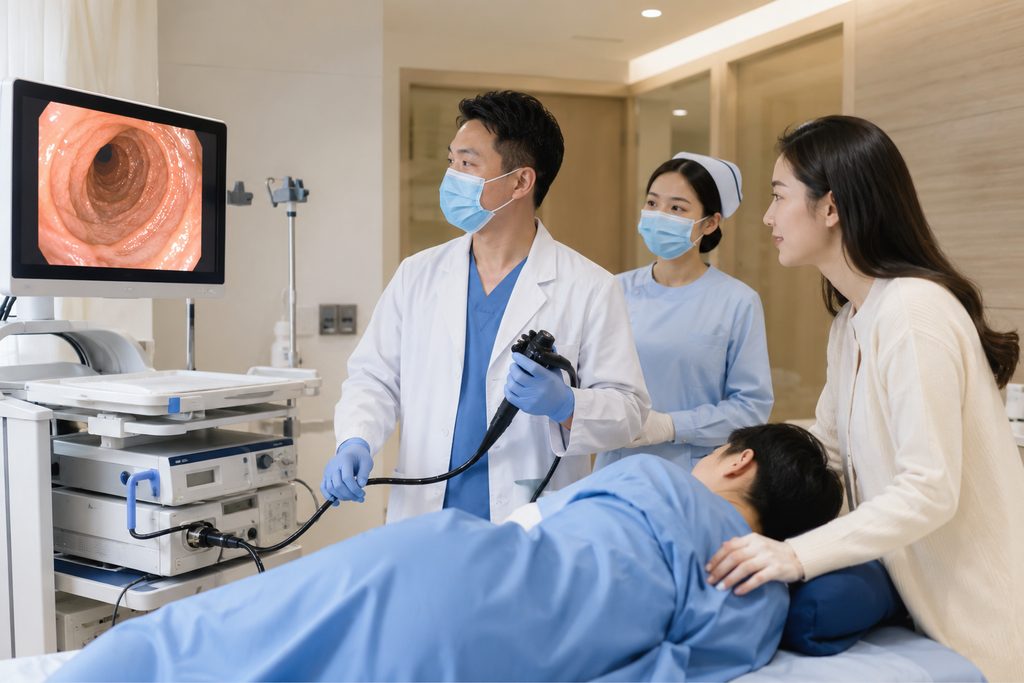
Walk into the endoscopy suite at Ruijin Hospital in Shanghai or West China Hospital in Chengdu, and you will see the same Olympus EVIS X1 or Fujifilm ELUXEO systems that populate endoscopy units at Mayo Clinic or Charité in Berlin. Narrow-band imaging, magnification endoscopy, and dye-spray chromoendoscopy are standard for screening procedures, not exotic add-ons. The capital investment in China’s top 100 hospitals over the past decade has been staggering. The equipment gap that existed 20 years ago has largely closed at the top tier.
Lower cost does not mean lower quality. It means lower labor costs, higher patient throughput, and a healthcare financing system that does not layer on the administrative overhead of American insurance billing. A Chinese public hospital does not employ hundreds of billing coders fighting with insurance companies over claim denials. That structural difference alone shaves thousands of dollars off the cost of a procedure. The gastroenterologist’s professional fee, the anesthesiologist’s fee, and the facility fee are all compressed relative to Western benchmarks — not because anyone is cutting corners, but because the entire cost stack is leaner.
What You Need to Know Before Going Alone
We have watched patients try to navigate this independently. Some succeed. Many do not. The barriers are real and they are not obvious from outside the system.
- Public hospital registration is entirely in Mandarin: The self-service kiosks, the WeChat mini-program appointment systems, the paper forms — none of it is in English. Even if you manage to register, the consultation with the gastroenterologist will be in Chinese. If you cannot describe your symptoms, your medical history, and your medication list in Mandarin, the doctor cannot safely clear you for the procedure.
- You cannot book a procedure from overseas through standard channels: Chinese public hospitals require an in-person specialist consultation before scheduling any invasive procedure. There is no online shopping cart for a gastroscopy and colonoscopy package. The consultation generates the procedure order. Without that order, the endoscopy suite will not touch you. This is universal across China’s public system.
- Payment is upfront and almost never via international credit card at public hospitals: Public hospital cashiers typically accept UnionPay, WeChat Pay, Alipay, or Chinese debit cards. Visa and Mastercard are often rejected. You need a local payment method or a service layer that handles the transaction on your behalf.
- The S2 visa is the correct category for medical treatment: You need an S2 visa with the purpose of medical treatment noted. Your accompanying family member also needs an S2. An M visa is for business and commerce — using it for medical treatment can lead to issues at the border or during a hospital admission. The invitation letter from the hospital is a key document for the visa application.
How We Help You Navigate This
These barriers exist for structural reasons. They are not malice or incompetence — they are the natural result of a healthcare system designed for a domestic Mandarin-speaking population of 1.4 billion people. International patients are a tiny fraction of patient volume. The system does not bend for them. We bridge the gap.
When you contact us about booking a gastroscopy and colonoscopy with translator China, the first thing we do is understand your clinical situation and timeline. We then identify the appropriate gastroenterology department — public hospital international wing or private international hospital — based on your budget, preferred city, and any specific clinical concerns. We coordinate the initial consultation appointment. On the day of that consultation, a bilingual medical companion meets you at the hospital, handles registration and payment, and sits with you during the doctor visit to ensure nothing is lost in translation.
If the gastroenterologist clears you for the combined procedure, we then lock in the endoscopy appointment, relay the full preparation instructions in clear English, and confirm all medication adjustments. On procedure day, your companion is with you from check-in through discharge — making sure you understand every instruction, every consent form, every post-procedure restriction. You wake up from sedation with someone who speaks your language and can tell you exactly what the doctor found.
After the procedure, we provide a translated summary of the findings. If biopsies were taken, we track the pathology results and deliver them to you in English, with the option of a follow-up video consultation to discuss the implications. If polyps were removed, we coordinate the recommended surveillance interval — typically a repeat colonoscopy in 3 to 5 years, depending on the histology.
This is what medical tourism China GI screening package English speaking looks like in practice. Not a glossy brochure. Just logistics, executed carefully, with a human being at your side.
Frequently Asked Questions
Can I really book a combined gastroscopy and colonoscopy from outside China?
You cannot book the procedure itself remotely — Chinese law and hospital policy require an in-person consultation first. But you can absolutely coordinate the entire pathway before you travel. We arrange the consultation appointment, the procedure slot immediately after, and all the logistics in between. You fly in, attend the consultation, complete the prep, and undergo the screening — all within a single trip of about 5 to 7 days. The key is having someone on the ground who can hold the appointments and communicate with the hospital in real time.
What happens if they find a polyp or something concerning?
If a polyp is found during the colonoscopy, the gastroenterologist will typically remove it on the spot (polypectomy) and send it to pathology. There is usually a small additional fee for the polypectomy and the histopathology lab work — typically $50 to $200 depending on the number and size of polyps. Pathology results take 3 to 7 days. We track those results and deliver them to you in English. If the findings require further intervention, we can coordinate a follow-up consultation or, in rare cases, a therapeutic procedure. If a mass or lesion is found during the gastroscopy, biopsies are taken and the same pathology process applies.
Is the sedation the same as what I would get in my home country?
Propofol sedation, administered by a dedicated anesthesiologist with continuous monitoring, is the standard in the hospitals we work with. The drug is the same. The monitoring equipment is the same. The safety protocols — pre-procedure ECG, blood work to check kidney and liver function, nothing-by-mouth rules — are the same. The main difference is that you will not understand the anesthesiologist’s questions unless a translator is present. That is the safety gap we close.
How do I handle the bowel prep in a hotel room?
This is a practical concern that does not get enough attention. Bowel preparation requires reliable, immediate access to a private toilet for several hours. Book a hotel room with a proper enclosed bathroom — not a shared facility or a hostel. Stay within 15 minutes of the hospital. Stock your room with clear liquids (broth, clear juice, bottled water) before prep day — you will not want to go out once the solution takes effect. Wet wipes and a mild barrier cream reduce discomfort significantly. It is not glamorous, but it is one afternoon and evening. By the next morning, you are done.
What if I have a bad reaction to the sedation or a complication during the procedure?
Serious complications from diagnostic upper endoscopy and colonoscopy are rare — roughly 1 in 1,000 for perforation or significant bleeding, and far rarer for sedation-related events when an anesthesiologist is managing the case. The hospitals we coordinate with are large, full-service teaching hospitals with intensive care units, blood banks, and 24-hour emergency surgical capability. If something goes wrong, you are already inside a facility that can handle it — not a standalone endoscopy center that would need to call an ambulance. That said, no procedure is zero-risk. The gastroenterologist will review your specific risk factors during the pre-procedure consultation.
Your Next Step
A combined gastroscopy and colonoscopy is one of the highest-yield health screenings a person can do. It finds problems before they become crises. Doing it in China — through the right channel, with the right support — can save you thousands of dollars and months of waiting, without any compromise on the quality of the procedure itself. The trade-off is that you need to travel, prepare in an unfamiliar environment, and trust a system you do not fully understand. We help with all three.
If you are considering this, start by getting informed — not by committing. Request a free consultation with our team. We will walk you through the options, the costs, and the timeline, with no pressure and no obligation. You deserve clear answers before you make any decision about your health.
For more medical information and treatment options in China, visit chinamedservices.com (China Medical Services).
