Parent Room-In Service in China: Staying with Your Child Throughout Hospitalization
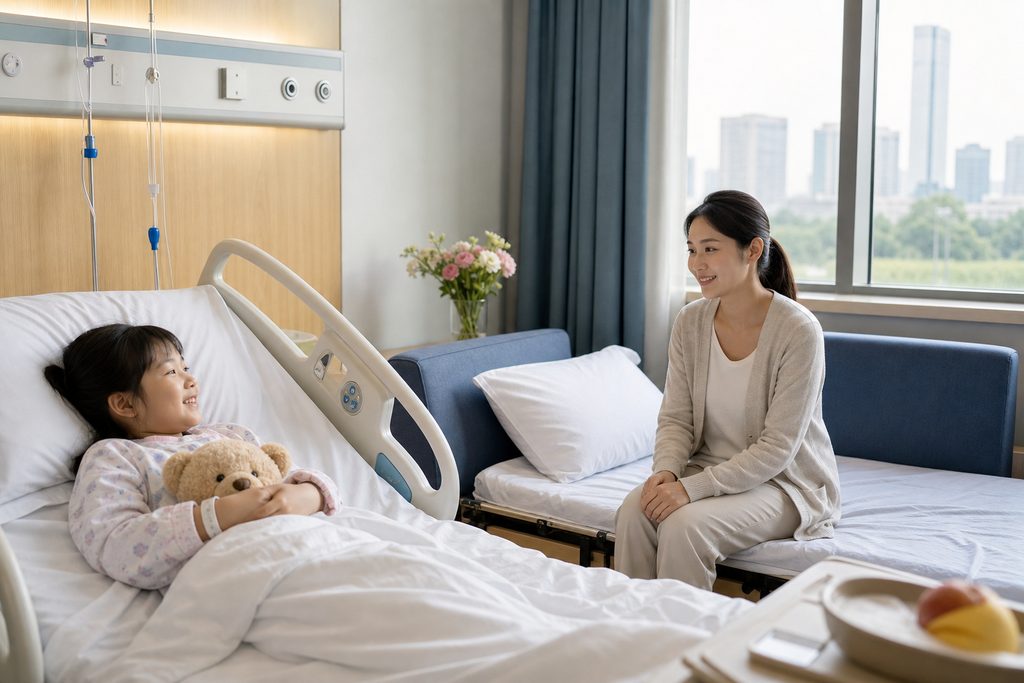
Have you ever sat in a hospital corridor at 2 a.m., separated from your child by a locked ward door, completely helpless? That feeling — the one where logic says the medical team knows best, but every instinct screams to be inside — is what drives families to search for a hospital that lets them stay. In China, the answer is not a simple yes or no. The parent room-in service China hospital cost and availability depend heavily on which hospital you choose, not just which city you visit.
Parent Room-In Service in China: The Short Answer
Yes, you can stay with your child. But not everywhere, and not automatically. China’s public tertiary hospitals — the ones dominating the Fudan rankings — often operate shared pediatric wards with strict visiting hours and no overnight parent beds. Private international hospitals and the VIP wings of top public hospitals almost always allow one parent to room in, with a dedicated cot or sofa bed in the child’s private room. The cost ranges from roughly $80 to $500 per night for the room-in privilege, bundled into the private room rate. The real complication is that the hospitals most famous for pediatric specialties are often the ones with the least flexible room-in policies.
Who This Is Right For — and Who It Isn’t
Rooming in makes sense when your child is under seven, anxious in unfamiliar environments, or undergoing a treatment plan longer than three days. It also matters enormously if you are the translator between your child and the medical team. But it is not the right call for every situation.
You should pursue a parent room-in arrangement if:
- Your child needs a planned surgery with a 5–14 day recovery in-hospital
- You are traveling from abroad and have no local family support network
- Your child has complex needs where you can provide medical history faster than records can be translated
- You are using a private international hospital where room-in is standard
You might reconsider — or at least prepare differently — if:
- The only hospital accepting your case is a public tertiary ward with shared rooms of 4–6 beds. In that setting, a parent cot is often physically impossible
- Your child requires intensive care. No hospital in China allows parents to sleep in the PICU or NICU; you will have designated visiting windows only
- You have a medical condition yourself that makes sleeping on a hospital cot unsafe
Being honest about the limitations upfront is what lets you plan properly. We have seen families arrive expecting a private suite at a top-ranked public hospital, only to discover the reality on the ground.
The Options, Compared
Not all “room-in” experiences are equal. A folding chair next to a bed in a shared ward is technically staying with your child. So is a private suite with a proper bed, ensuite bathroom, and space for a second parent. The table below lays out what you actually get at each tier.
| Hospital Type | Room-In Policy | Typical Parent Bed | Per-Night Cost (Room Only) | English-Speaking Staff |
|---|---|---|---|---|
| Public Tertiary — General Ward | Rarely permitted; visiting hours enforced | None; sometimes a chair | $15–40 (child’s bed only) | Unlikely |
| Public Tertiary — VIP/International Wing | One parent always permitted | Sofa bed or fold-out cot | $150–350 | Usually yes |
| Private International Hospital | Standard for all pediatric stays | Proper single bed in many suites | $250–500 | Yes, throughout |
| Specialist Children’s Hospital — Private Room | One parent; sometimes two | Sofa bed or recliner | $120–300 | Varies widely |
If your priority is the absolute best clinical team for a rare pediatric condition, you may accept the discomfort of a public ward with no room-in option. That is a valid tradeoff. But if you need both clinical excellence and the ability to stay with your child, the VIP wing of a top public hospital is often the sweet spot. You get access to the same senior specialists who round on the general ward, but in a private room with a parent bed. Our team has coordinated this exact setup at hospitals like Beijing’s top-tier pediatric centers and Shanghai’s leading children’s hospitals.
How Does Parent Room-In Work in Chinese Hospitals: The Real Day-to-Day
The mechanics are straightforward once you are in the right room, but the cultural expectations can surprise Western families. Here is what a typical day looks like when you room in with your child at a Chinese hospital’s international or VIP wing.
Nursing care is clinically excellent but less focused on comfort tasks than in Western hospitals. The nurses administer medications, monitor vitals, change IVs, and respond to call bells. They do not typically help with bathing, feeding, or toileting a child who is not critically ill. That role falls to you. The hospital provides the bed, linens, and meals for the child. Parent meals are sometimes included in the VIP room rate, sometimes not. You should expect to buy your own food from the hospital canteen or nearby shops unless you have confirmed otherwise.
Rounds happen early. The attending physician and a trail of residents will arrive between 7:30 and 8:30 a.m. This is your window to ask questions. In a VIP setting, the senior doctor will often speak some English or have a junior doctor who does. In a private international hospital, rounds are conducted in English. Write down your questions the night before. The morning round is fast — five to ten minutes — and you will not get another dedicated conversation with the lead specialist that day unless something changes clinically.
One parent is the norm. Two parents rooming in is rare even in private hospitals, though some larger suites can accommodate it. Siblings are almost never allowed to stay overnight. Grandparents, however, are a common sight in Chinese pediatric wards. The cultural expectation is that family provides the non-medical care, and hospitals are set up to support that. This is actually an advantage for international families once you understand the system: the hospital expects you to be present and gives you the physical space to do so.
Can I Stay with My Child During Surgery in China?
Extensions are subject to bed availability. If your child’s condition requires a longer stay, the medical team will authorize it, but you may need to move rooms if the current one is booked for another patient. This happens more often in VIP wards than in private international hospitals, where capacity is generally more flexible. The per-night room cost continues at the same rate. If you are moved to a different room type, the rate adjusts accordingly.
In most cases, no. The standard policy at Chinese hospitals — including VIP and international wings — is one parent per pediatric room. Exceptions are occasionally made for end-of-life situations or for infants under three months, but these are decided case-by-case by the head nurse and are not guaranteed. If both parents travel, the second parent will need nearby accommodation. Most hospitals have partnered hotels or serviced apartments within walking distance, and we can help arrange this. Having two parents present during the day is always permitted, even if only one stays overnight.
Private international hospitals sometimes offer surgical packages that bundle the surgeon fee, anesthesia, operating room, and a set number of inpatient nights including the parent room-in. These packages can be 15–25% cheaper than paying each line item separately. They are most common for high-volume procedures like tonsillectomy, circumcision, and uncomplicated orthopedic surgeries. Public hospital VIP wards rarely offer packages; you pay per night and per service. Always ask for a detailed cost breakdown before committing. A package price that seems attractive may exclude pre-op imaging or post-discharge medications, which can add thousands to the final bill.
Your Next Step
Staying with your child during hospitalization in China is achievable. The question is not whether it is possible, but which hospital gives you the right combination of clinical expertise, room-in comfort, and logistical support for your specific situation. Our team at China Medical Services does not provide medical care — we are not a hospital and we do not make diagnoses. What we do is connect your family with the right Chinese hospital, clarify the real costs and room-in policies before you travel, and ensure someone is there to translate when you need to ask the nurse for an extra blanket at midnight. If you are considering pediatric treatment in China and want to understand your options, reach out for a free consultation. We will walk you through the hospitals that match your child’s needs and your family’s need to stay together.
Frequently Asked Questions
Yes. The hospitals used for international patients are JCI-accredited and follow the same international safety standards as top hospitals in the US and Europe. Surgical teams perform high volumes of procedures — often more than their Western counterparts — which studies show leads to better outcomes.
Costs vary by procedure and hospital, but international patients typically save 40-80% compared to US prices — even when factoring in travel and accommodation. A consultation with our team will give you an exact, all-inclusive quote with no hidden fees.
Send us your existing medical reports to get started. We handle everything from hospital selection and appointment scheduling to visa assistance and post-operative recovery planning. Your medical records are reviewed by the specialist before you even book a flight.
For more medical information and treatment options in China, visit chinamedservices.com (China Medical Services).
