Pediatric Heart Surgery at Shanghai Children’s Medical Center: Full Family Coordination Explained
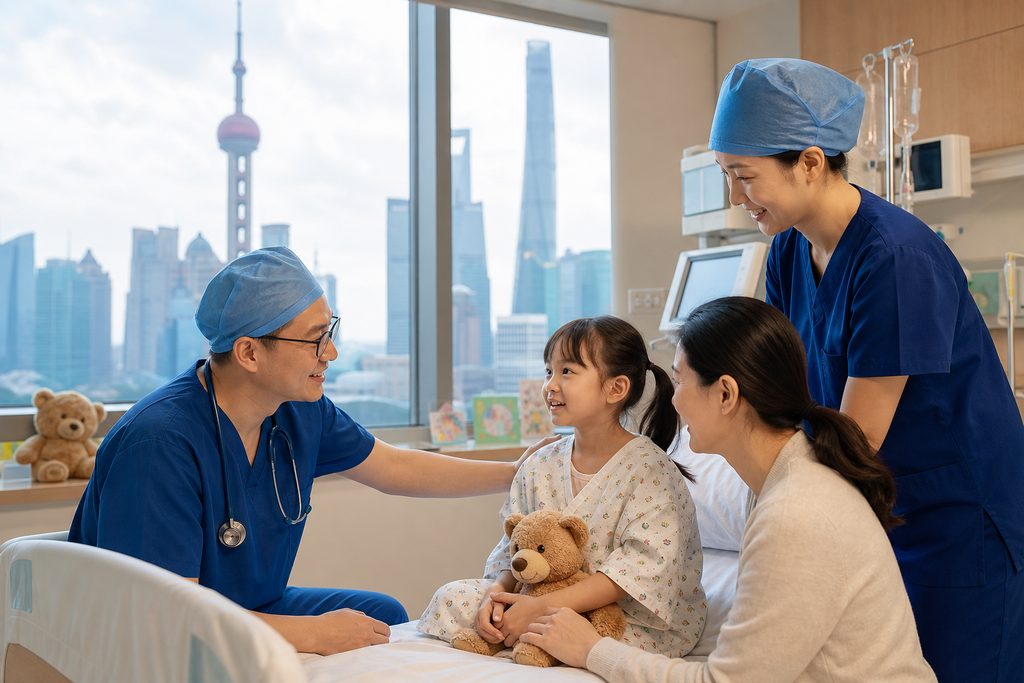
Your child needs heart surgery. You are searching for the best possible care, and that search has led you to Shanghai. The pediatric heart surgery cost Shanghai is a fraction of what you’d pay in the West — often $15,000 to $25,000 for a complex congenital repair versus $120,000 or more in the United States. But that number means nothing if you cannot picture the day-to-day reality: where you will stay, who will translate, and how your family holds together through the weeks ahead.
Our team coordinates this process for families from over 50 countries. We do not perform surgery. We handle the logistics that make surgery possible — hospital selection, visa documentation, bilingual accompaniment, and the hundred small decisions that turn a terrifying prospect into a manageable plan. This article walks through what full family coordination actually looks like at Shanghai Children’s Medical Center, from the moment you land to the day your child is cleared to fly home.
The Short Answer: What Coordination Actually Means
Full family coordination means you arrive in Shanghai with a clear schedule, a confirmed initial consultation, and a person waiting at the airport who speaks both English and Mandarin. You do not wander through a 500,000-square-foot hospital campus alone. You do not guess at which window accepts international payment. You do not rely on a translation app to understand your child’s post-operative instructions. The hospital provides the medical expertise. We provide the bridge between that expertise and your family’s need for clarity.
This is not concierge medicine in the luxury-hotel sense. It is practical, boots-on-the-ground support in a system that processes over 8,000 outpatient visits daily at this single institution. Shanghai Children’s Medical Center (SCMC) is one of China’s three national pediatric cardiac centers, performing more than 3,700 congenital heart surgeries annually. The volume is staggering. The outcomes are strong — a 2022 study in the European Journal of Cardio-Thoracic Surgery reported a 98.1% survival rate for common congenital heart defect repairs at top Chinese pediatric centers. But the administrative and linguistic barriers are real. Coordination is what removes them.
Who This Is Right For — and Who It Isn’t
We are direct about this because families flying across the world for surgery deserve honesty, not marketing.
Families who are typically good candidates:
- Your child has a confirmed congenital heart defect — tetralogy of Fallot, ventricular septal defect, atrial septal defect, or more complex single-ventricle conditions — and you have medical records ready for remote review.
- You are seeking a surgical center with high annual case volume. SCMC’s cardiac surgeons perform these procedures every day, not occasionally.
- Cost is a genuine factor in your decision. You have been quoted a price at home that threatens your family’s financial stability, and you are exploring alternatives with open eyes.
- You have at least one parent or guardian who can travel and stay in Shanghai for 3 to 6 weeks.
- Your child is stable enough for international travel. This is determined by the receiving surgical team during the remote evaluation, not by us.
When staying home is the better choice:
- Your child is in acute cardiac failure or requires emergency intervention within days. International coordination takes time — typically 2 to 4 weeks from initial contact to scheduled surgery.
- You cannot arrange the necessary visa documentation. The S2 visa requires an invitation letter from the hospital and supporting medical records. We guide this process. We cannot bypass consular requirements.
- Your child’s condition requires a very specific, rarely-performed procedure with a narrow window of surgical timing, and you already have a trusted surgical team at home who knows your child’s history intimately.
- You expect Western-style private rooms, English-speaking nurses on every shift, and a hospital experience identical to what you would receive in London or Toronto. SCMC’s international wing provides enhanced accommodations, but the broader hospital environment is Chinese. It is clean, professional, and efficient. It is not a Western hospital transplanted to Asia.
The Options, Compared: Where to Pursue Pediatric Heart Surgery
Families researching pediatric heart surgery cost Shanghai are usually comparing three paths. Here is how they stack up.
| Factor | United States (Major Center) | Thailand/India (Private Hospital) | Shanghai Children’s Medical Center |
|---|---|---|---|
| Typical cost (VSD repair) | $80,000–$150,000 | $12,000–$20,000 | $15,000–$25,000 |
| Typical cost (TOF repair) | $120,000–$200,000+ | $18,000–$28,000 | $20,000–$35,000 |
| Annual pediatric cardiac surgeries | 300–800 (center-dependent) | 200–600 (center-dependent) | 3,700+ |
| JCI accreditation | Standard | Common | Yes (SCMC holds JCI) |
| English-speaking surgical team | Native | Common | Variable — interpreter typically needed |
| Family accommodation nearby | Hotel or Ronald McDonald House | Hotel or hospital guesthouse | Short-term apartments from $40/night; hotels from $70/night |
| Post-op follow-up continuity | With same team | Limited once you return home | Requires coordination with home cardiologist |
Costs in Shanghai vary by the complexity of the defect, whether the procedure requires cardiopulmonary bypass, ICU length of stay, and the specific surgeon’s fee schedule. The figures above represent the hospital portion. Our coordination fee is separate and scales with the level of support your family needs. For a family choosing Shanghai, the total all-in cost — surgery, hospital stay, flights, accommodation, coordination, and living expenses for 4 to 6 weeks — often lands between $35,000 and $55,000. That is still a quarter to a third of the surgical fee alone in the United States.
Why Shanghai Children’s Medical Center Draws International Families
The best children’s heart hospital China conversation usually circles three institutions: SCMC in Shanghai, Fuwai Hospital in Beijing, and Guangzhou Women and Children’s Medical Center. Each has strengths. SCMC’s draws families for specific, practical reasons.
Volume matters in pediatric cardiac surgery. A 2019 analysis in The Annals of Thoracic Surgery found that hospitals performing more than 250 pediatric heart surgeries annually had significantly lower mortality rates for high-complexity cases than lower-volume centers. SCMC performs over 3,700 annually. The surgical teams here see rare anatomies with enough frequency that few presentations surprise them.
Also, Shanghai itself is easier for international families than many realize. The city has direct flights from most major European, Middle Eastern, and Southeast Asian hubs. Pudong International Airport is 40 minutes from the hospital by car. The surrounding Pudong district has a high concentration of short-term serviced apartments, international grocery stores, and restaurants that do not require Mandarin to navigate. The hospital’s international patient center has staff who handle admission paperwork, scheduling, and discharge summaries in English. It is not seamless. But it is navigable, especially with coordination.
For families specifically searching Shanghai Children’s Medical Center international patients information, the hospital’s official international department processes several hundred overseas cases per year. They are familiar with the documentation foreign families need — invitation letters for S2 visas, itemized invoices for insurance reimbursement, and medical reports formatted for home-country cardiologists. This institutional experience reduces friction that would otherwise consume your time and attention during an already stressful period.
What to Expect After Your Child’s Congenital Heart Surgery
Parents researching what to expect after child congenital heart surgery often receive vague reassurances. Here is the concrete timeline, based on the typical pathway for a ventricular septal defect or tetralogy of Fallot repair at SCMC.
Day 0 — Surgery day. Your child is taken to the operating theater. You wait. The procedure itself runs 3 to 6 hours depending on complexity. The surgeon or a senior fellow will speak with you afterward, usually through an interpreter. Your child goes directly to the pediatric cardiac ICU. You will not be able to stay overnight in the ICU. This is standard in Chinese hospitals and often the hardest part for Western parents. You return to your accommodation. The ICU nurses will call if there is any change.
Days 1–3 — ICU. Your child is sedated, intubated, and monitored continuously. You can visit during designated hours, typically mid-morning and late afternoon. Extubation usually happens on day 1 or 2 for straightforward repairs. Chest tubes, pacing wires, and central lines are still in place. The ICU team rounds twice daily. Our bilingual coordinator can be present during rounds to translate the discussion and relay your questions.
Days 3–7 — Step-down ward. Your child moves to the regular cardiac ward. Chest tubes come out. Oral pain medication replaces IV. Feeding resumes — slowly at first. This is when you are most involved: holding, feeding, walking the halls with your child. The ward environment is busier and less private than many Western families expect. Multiple beds per room are common in the standard ward. The international wing offers private rooms at a higher rate.
Days 7–14 — Discharge planning. If recovery is uncomplicated, discharge happens around day 7 to 10. The hospital provides a discharge summary in English, medication instructions, and wound care guidance. You will receive a follow-up echocardiogram before leaving. The surgical team will want to see your child for a wound check and repeat echo 2 to 4 weeks post-discharge. This is why families typically stay in Shanghai for at least 3 weeks total.
Weeks 3–6 — In-city recovery. You are out of the hospital but still in Shanghai. Your child is healing. The incision site needs monitoring. Activity is limited. You return to the hospital for scheduled follow-ups. Once the surgical team clears your child for travel — usually by week 4 — you can fly home. Your home cardiologist takes over long-term follow-up. We help ensure your records transfer cleanly.
How Safe Is Pediatric Heart Surgery in China, Really?
The question how safe is pediatric heart surgery in China deserves a direct answer, not a deflection. The data are specific.
SCMC reports a 30-day surgical mortality rate below 1% for common congenital heart repairs — ventricular septal defect, atrial septal defect, and uncomplicated tetralogy of Fallot. For more complex single-ventricle palliations, the rate rises, as it does everywhere. A 2021 multi-center study published in The Lancet Child & Adolescent Health examined outcomes across China’s national pediatric cardiac centers and found overall in-hospital mortality for congenital heart surgery of 2.3%, with the top-quartile centers achieving rates comparable to Society of Thoracic Surgeons benchmarks in North America.
Safety is not just a mortality statistic. It also means infection control, blood product safety, anesthesia protocols, and ICU nursing ratios. SCMC holds Joint Commission International (JCI) accreditation, which requires meeting specific standards for surgical safety checklists, medication administration, and infection prevention. The hospital’s blood bank follows national screening protocols aligned with international standards. The pediatric cardiac anesthesia team is dedicated — these are not general anesthesiologists occasionally assigned to pediatric cases. They manage pediatric cardiac patients full-time.
That said, a parent considering this path should understand the communication reality. The surgical team’s English proficiency varies. Morning rounds are conducted in Mandarin. Nursing shift handovers are in Mandarin. Without a bilingual coordinator or family member, you will miss clinical nuance. This does not make the care unsafe. But it does mean you need a reliable translation bridge to participate fully in your child’s care decisions.
Also, the post-operative pain management philosophy in Chinese hospitals tends to be more conservative than in North America. You may need to advocate more actively for your child’s comfort. This is a cultural difference in medical practice, not a quality deficit. Knowing it in advance lets you prepare.
Practical Considerations: Records, Visas, Payments, and Follow-Up
Bringing your child to Shanghai for heart surgery requires documentation and planning that starts weeks before you travel. Here is what you need.
Medical records. The surgical team needs a complete packet: echocardiogram images (DICOM format on CD or USB), cardiac catheterization reports if performed, relevant MRI or CT scans, a summary letter from your home cardiologist, and your child’s growth charts and current medications list. All documents must be in English. If your records are in another language, we arrange certified translation. The remote evaluation — a written second opinion — typically takes 5 to 7 business days from the time the complete packet is submitted. The fee for this evaluation ranges from $300 to $500, and if you proceed to surgery in Shanghai, that amount is credited in full toward the coordination service.
Visas. Medical treatment in China requires an S2 visa, endorsed for private affairs including medical treatment. The hospital’s international department issues an official invitation letter confirming your child’s scheduled treatment. Each accompanying family member needs their own S2 visa with the same invitation documentation. Processing time varies by consulate — typically 5 to 10 business days, sometimes faster with expedited service. We provide the document package and guidance. We do not control consular decisions and cannot guarantee approval. Apply as early as possible.
Payment. Chinese public hospitals, including SCMC’s international wing, require upfront payment. A deposit — typically 50% to 70% of the estimated surgical fee — is due at admission. The balance is settled at discharge. Accepted methods include international wire transfer, major credit cards (Visa, Mastercard), and sometimes UnionPay. Your home insurance may reimburse you afterward; Chinese hospitals do not bill foreign insurers directly in most cases. Request an itemized invoice in English at discharge. Private international hospitals in Shanghai, such as Jiahui, do offer direct billing, but SCMC is a public institution. Know the difference before you choose.
Accommodation. Most families rent a serviced apartment within a 15-minute walk or short taxi ride of the hospital. The Kerry Parkside and Thumb Plaza areas in Pudong are popular — grocery stores, pharmacies, and restaurants are nearby, and the hospital is accessible. Budget $40 to $120 per night depending on size and amenities. Hotels are also available from about $70 per night. We can recommend options. We do not book accommodation on your behalf unless it is part of a full coordination package.
Post-return follow-up. Before you leave Shanghai, ask the surgical team for a clear follow-up schedule: when the next echo is due, when medications can be weaned, what activities are restricted and for how long. Your home cardiologist will need the discharge summary, operative note, and post-operative echo images. We help compile and transfer these. The surgical team at SCMC is generally willing to review follow-up echoes sent by your home cardiologist and provide remote guidance, though this is arranged on a case-by-case basis.
Frequently Asked Questions
Not directly. Chinese public hospitals, including SCMC, require an in-person consultation before scheduling surgery. The surgeon must examine your child, review original imaging, and confirm the surgical plan. What you can arrange remotely is the initial consultation appointment and the remote evaluation. Once the surgeon confirms that surgery is indicated and your child is a candidate, the procedure is typically scheduled within 1 to 3 weeks. Our coordination service handles the appointment scheduling, document submission, and interpretation during that first consultation. We cannot guarantee a specific surgery date before the surgeon has seen your child.
What if something goes wrong during or after the surgery?
SCMC has a dedicated pediatric cardiac ICU with 24/7 intensivist coverage. The hospital has extracorporeal membrane oxygenation (ECMO) capability and a cardiac catheterization lab for emergency interventions. The surgical teams manage complications regularly — with over 3,700 cases per year, they have seen and handled the full range of post-operative challenges. That said, your child is far from your home medical system. If a prolonged ICU stay becomes necessary, your time in Shanghai extends, and your costs rise. Medical evacuation back to your home country is possible but expensive — $50,000 to $150,000 depending on distance and medical needs during transport. Travel insurance with medical evacuation coverage is strongly recommended. We can point you to providers. We do not sell insurance
For more medical information and treatment options in China, visit chinamedservices.com (China Medical Services).
