Posture Assessment in China: Booking Made Simple for Patients
Key Takeaways
- Posture assessment cost China clinics typically runs $80–$250 for a full musculoskeletal evaluation, versus $300–$600 in the US for comparable imaging and gait analysis.
- China’s top rehabilitation and orthopedic departments see thousands of cases a year, which is why a single session can combine X-ray, gait analysis and a physician review in one morning.
- The hard part is not the assessment — it is the booking. Public hospital outpatient slots are not released to overseas patients in advance, and you cannot reserve a specialist online from abroad the way you would in Europe.
- Anyone with red-flag symptoms (numbness, bladder changes, unexplained weight loss, night pain) should be evaluated urgently in their home country first, not booked as a routine posture case.
The Problem: Posture Pain Is Easy to Ignore Until It Isn’t
Roughly 1 in 4 adults worldwide lives with some form of musculoskeletal complaint, and lower back pain alone has held the top spot on the Global Burden of Disease disability rankings for more than three decades. In the US, a single session with a private physiotherapist plus a standing X-ray and gait analysis can easily clear $400–$600 before insurance argues about it.
So people wait. They stretch, they buy a standing desk, they tell themselves it’s just desk posture. Eighteen months later the shoulder doesn’t rotate properly and the neck has developed a fixed forward tilt that no foam roller will fix.
That’s usually the moment a patient starts searching for something faster, cheaper and more thorough. And that search often leads to China.
Why China Delivers Results for Musculoskeletal Assessment
China’s rehabilitation medicine and orthopedic departments are not a side service. They are core hospital functions, and they operate at a scale that changes what a single appointment can accomplish.
Volume Creates Diagnostic Density
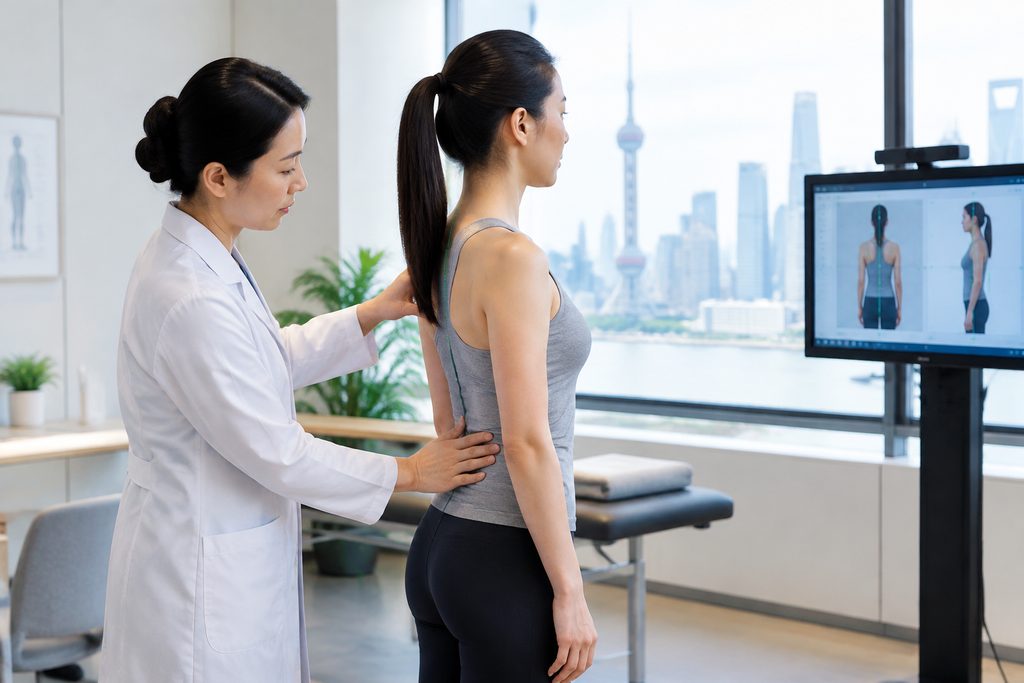
A major tertiary hospital in Beijing or Shanghai may run several hundred rehabilitation outpatient visits in a single day. That volume means the assessment protocol is standardized: posture photography, spinal alignment measurement, range-of-motion testing, and where indicated, standing X-rays and dynamic gait analysis — often under one roof, often on the same day.
Compare that to the typical Western pathway, where you see a physiotherapist, get referred for imaging, wait two weeks, then return for interpretation. Same clinical content. Three separate calendar slots.
Equipment and Rehabilitation Technology at Scale
Top-tier Chinese hospitals have invested heavily in motion-capture gait labs, surface EMG, and 3D spinal imaging. This isn’t marketing language — it’s the same equipment class used in sports medicine programs, and it’s available at general tertiary hospitals, not just elite private clinics. For a deeper look at which departments carry this equipment, our specialty rankings by department list the top hospitals for orthopedics and rehabilitation medicine.
Cost Structure, Not Cost Cutting
This is the part Western patients question most. How can a full assessment cost a fraction of the US price without cutting corners?
The answer is structural. Physician salaries, facility overhead and imaging costs are set against a different economic baseline in China. A hospital doing 400 outpatient visits a day spreads its fixed costs across a far larger patient base. Nothing about the clinical protocol is shortened. The price difference reflects labor economics and volume, not a reduced standard of care.
What a Posture Assessment in China Actually Includes
This is where most guides get vague. Here is the concrete version, based on how tertiary hospital rehabilitation and orthopedic departments typically structure an initial evaluation.
| Component | What Happens | Typical Duration |
|---|---|---|
| Intake and history | Symptom review, prior imaging, occupational and lifestyle factors | 10–15 min |
| Static posture analysis | Photographic assessment from four planes, plumb-line alignment | 15–20 min |
| Range of motion testing | Joint-by-joint measurement, muscle length and strength testing | 20–30 min |
| Imaging (if indicated) | Standing X-ray, sometimes dynamic or 3D spinal imaging | 20–40 min |
| Gait and movement analysis | Walking pattern, load distribution, video review | 20–30 min |
| Physician review and plan | Diagnosis discussion, written recommendations, treatment options | 15–25 min |
Total time on site: usually two to three hours. A simple screening without imaging can finish in 45 minutes.
How Long Does Posture Assessment Take — and What It Costs
So, how long does posture assessment take in practice? For most international patients, the answer is one hospital visit, plus a follow-up review if treatment is recommended.
On cost, the range depends heavily on whether imaging is included and whether you use a public tertiary hospital or a private international clinic.
| Setting | Assessment Only | With Imaging and Gait Analysis |
|---|---|---|
| Public tertiary hospital, standard channel | $80–$150 | $180–$350 |
| Public hospital international / VIP department | $200–$350 | $400–$700 |
| Private international clinic | $250–$450 | $500–$900 |
These are reference ranges. Final pricing varies by hospital and case complexity, and imaging is billed separately from the consultation in most public hospitals.
Is Posture Assessment Safe in China?
Yes, for the assessment itself. There is no invasive component. You will be asked to stand, walk, bend and hold positions. X-rays involve low-dose radiation, which is a standard and well-understood tradeoff your physician will weigh against the diagnostic benefit.
The real safety question is different, and worth stating plainly: the risk is not the assessment, it is skipping a proper diagnosis.
Posture abnormalities can be mechanical — or they can be the visible symptom of something else. Scoliosis, disc pathology, inflammatory arthritis and neurological conditions all present with postural changes. A good Chinese rehabilitation physician will screen for these. A cheap walk-in clinic that only takes posture photos will not.
This is why we always recommend that the assessment be done inside a hospital with orthopedic and neurology backup on site, not at a standalone wellness studio.
If you have numbness in the groin or saddle area, loss of bladder or bowel control, progressive weakness in the legs, unexplained weight loss, or pain that wakes you at night — do not book a posture assessment. Seek urgent medical evaluation locally.
Booking a Posture Assessment From Overseas: What Actually Works
Here is the honest version, and it is the part most articles skip.
Public tertiary hospitals in China generally do not release outpatient appointments to international patients in advance. Registration happens on the day, in person, in a queue. And crucially, any treatment plan — including a rehabilitation program or a posture correction treatment package in Beijing — requires an in-person consultation before it can be arranged. You cannot lock in a treatment package from abroad without being seen first.
There are three realistic paths.
Path 1: Walk-in on Arrival
Fly to the city, go to the hospital early, register at the international or standard outpatient desk. Works. Requires Chinese language ability or a translator, patience, and flexibility on timing. No guarantee of seeing a specific specialist.
Path 2: Private International Clinic
Hospitals like United Family, Jiahui and Parkway offer English-speaking staff, JCI accreditation and often direct insurance billing. You can usually book ahead. Prices sit in the upper range shown above. Our guide to private international hospitals covers which ones have rehabilitation departments.
Path 3: Remote Evaluation First, Then Coordinated Arrival
This is the model most of our patients now use. You send existing imaging and reports. A Chinese rehabilitation or orthopedic specialist reviews them and provides a written opinion on whether an in-person assessment is worthwhile, and roughly what it would involve. If it is, arrival and hospital logistics get coordinated in advance.
It costs less than a flight, and it prevents the scenario where someone travels 12 hours to discover their case needs a different department entirely.
Practical Considerations Before You Book
Visa. Medical treatment in China falls under the S2 visa category for short stays, with S1 for stays over 180 days. Accompanying family members apply under the same category. Note that the M visa is for commercial and trade activities only — it is not a medical visa, despite what some online guides suggest. Requirements and supporting documents should always be confirmed against the latest embassy or consulate instructions.
Records. Bring prior imaging on disc or as DICOM files, plus any English reports. Chinese specialists can read English imaging reports, but having your history summarized in one page saves significant time.
Payment. Public hospitals require prepayment; insurance reimbursement happens afterward, in your home country. Private international hospitals frequently bill insurers directly.
Language. A large tertiary hospital can process more than 10,000 outpatient visits in a day. Signage is in Chinese. Even a simple registration, payment and imaging sequence involves four or five separate counters. This is the single biggest practical obstacle for international patients — not the medicine.
Follow-up. Ask for a written plan you can take home, including the specific exercises, frequency and progression criteria. A rehabilitation program that only exists in a verbal conversation is useless once you fly home.
Frequently Asked Questions
Not directly at a public hospital — those appointments are issued on the day of visit. Private international clinics often accept advance bookings. For public tertiary hospitals, the workable approach is a remote review of your records first, then coordinated arrival support so the registration and assessment happen efficiently once you land.
The assessment itself is the smallest line item. Budget $80–$350 for the evaluation depending on hospital type and imaging, plus flights, accommodation and daily costs. If a treatment or rehabilitation package follows, that is quoted separately by the hospital after the in-person consultation — we cannot and do not estimate treatment costs before a physician has seen you.
That happens, and it is better to know than not. The physician will explain options and you decide. Nothing proceeds without your agreement. If you prefer to return home for treatment, you leave with a written plan your own doctor can follow.
Pediatric scoliosis is assessed by pediatric orthopedics, not general rehabilitation. It requires different imaging protocols and, in growing children, different treatment thresholds. If this is your situation, ask specifically for a pediatric orthopedic evaluation rather than a general posture assessment.
Your Next Step
A posture assessment is a low-risk, low-cost way to get a clear answer about what is actually causing your symptoms — and China’s top rehabilitation and orthopedic departments can deliver that in a single visit. The barrier is rarely the medicine. It is the logistics of getting registered, seen and understood in a system built for volume.
We are China Medical Services. We connect international patients with more than 340 top-ranked hospitals across 37 cities, and we handle record translation, appointment coordination through official hospital international departments, and bilingual medical companions who stay with you through registration, payment and the consultation itself. We are not a hospital and we do not provide diagnoses or treatment.
If you would like to know whether a posture assessment in China makes sense for your situation, you can start with a free consultation — no obligation, and no pressure to travel.
This article is for general information only and does not constitute medical advice. Posture abnormalities can indicate underlying conditions that require prompt evaluation. Always consult a qualified physician about your individual situation before making treatment decisions.
For more medical information and treatment options in China, visit chinamedservices.com (China Medical Services).
