Prostate Treatment in China: Costs, Top Hospitals & Your Options
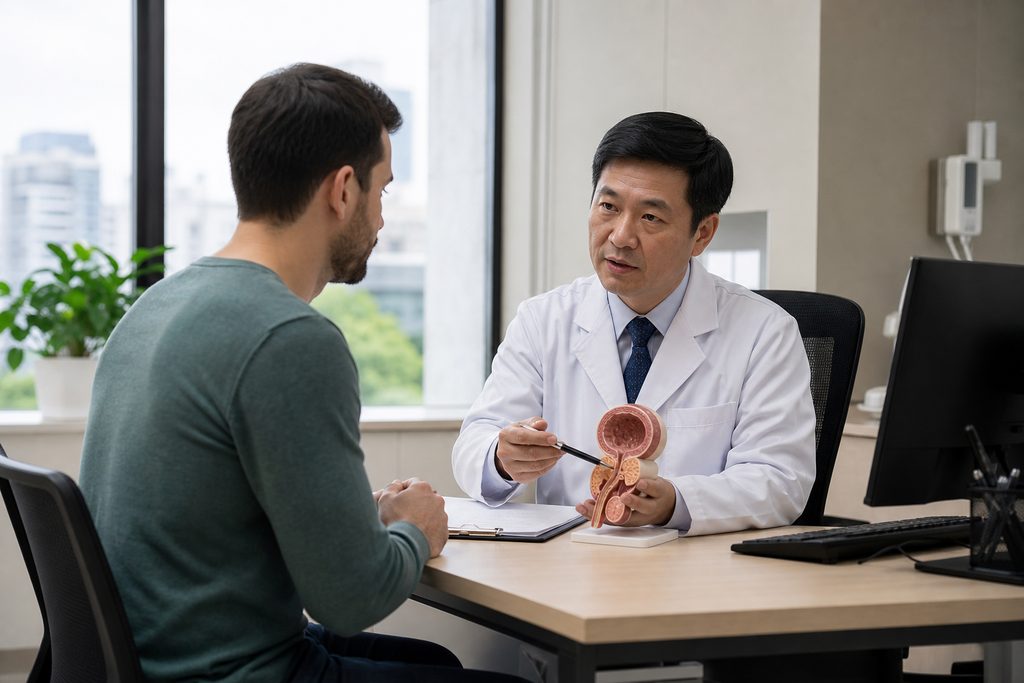
You have probably heard that going abroad for surgery means gambling with your health. The reality, when it comes to prostate treatment in China, tends to run the other way. The hospitals that treat international patients here are the same institutions where China’s own senior officials, surgeons, and professors go when they get sick — and the prostate treatment cost in China is often a fraction of what a US hospital bills for the identical procedure.
That gap is why more men from the US, UK, Russia, and the Gulf are quietly asking about Chinese urology departments. This guide walks through the real numbers, the hospitals that matter, the visa you actually need, and the parts of the process nobody warns you about.
Key Takeaways
- Robot-assisted radical prostatectomy at a top Chinese public hospital commonly runs $12,000–$25,000 all-in, versus $35,000–$80,000+ in the United States — same da Vinci platform, different price structure.
- China’s highest-volume urology centers perform hundreds of prostatectomies per year each, and the Fudan specialty reputation ranking names the top 10 urology hospitals by name.
- The hard part is not the surgery. It is that public hospital outpatient slots cannot be booked from overseas in advance — you queue on the day, and surgery is only scheduled after an in-person consultation.
- Foreign patients enter on an S2 visa (annotated for medical treatment), not an M visa. M is a commercial visa and has nothing to do with medical care.
The Problem: A Diagnosis That Comes With a Five-Figure Bill
Prostate cancer is the most common cancer among men in roughly half the world’s countries. In the United States alone, the American Cancer Society estimated about 288,300 new cases and 34,700 deaths for 2023. For men in the UK, Germany, or Canada, the diagnosis often arrives with a second shock: the quote.
A radical prostatectomy in the US can list at $35,000 to $80,000 before insurance negotiations, and even insured patients report deductibles and out-of-network surprises in the thousands. In the UK, NHS waiting times for urology treatment have stretched past 18 weeks for a large share of patients. In Canada, the median wait from diagnosis to prostate cancer surgery has been reported in the range of several months in some provinces.
So men start searching. And they find that a hospital in Shanghai or Beijing will quote a fraction of the Western price for the same operation, using the same robotic system, often with a surgeon who does more of these cases in a year than a Western surgeon does in three.
Why Prostate Treatment in China Delivers Real Results
Lower price plus higher volume sounds too good to be true. It is not — but the reasons matter, and so do the limits.
Clinical Volume Changes a Surgeon’s Hands
China’s 35,000+ hospitals include a small elite — the top 5% ranked by the Fudan Hospital Ranking and JCI accreditation. Within that group, urology departments at major academic centers handle case volumes that are difficult to match elsewhere. Higher volume generally correlates with better handling of complications, shorter operating times, and more predictable recovery. That is not a marketing claim; it is a structural feature of a country of 1.4 billion people with a concentrated referral system.
Our database covers 340+ top-ranked hospitals across 37 cities, and the urology and oncology specialty rankings name the ten strongest departments in the country.
Technology You Would Recognize
Robot-assisted laparoscopic prostatectomy in China uses the same da Vinci platforms found in US and European operating rooms. Imaging is comparable: multiparametric MRI, PSMA PET-CT, and MRI-fusion targeted biopsy are all standard at top-tier centers. The difference is throughput. A single large Chinese hospital may run several robotic systems across multiple theatre blocks per day, which compresses scheduling.
Cost Structure, Not Cost Cutting
Why is prostate treatment cost in China so much lower? Three reasons, none of which involve cutting corners.
- Labor economics. Surgeon and nursing salaries are lower in absolute terms, and hospital pricing reflects that.
- Volume efficiency. Fixed costs — the robot, the theatre, the imaging suite — are spread across far more cases per year.
- Drug and device procurement. China’s centralized procurement programs have pushed down prices on many implants and pharmaceuticals.
| Procedure | China (top public hospital) | United States | United Kingdom (private) |
|---|---|---|---|
| Robot-assisted radical prostatectomy | $12,000–$25,000 | $35,000–$80,000+ | £18,000–£30,000 |
| MRI-fusion targeted biopsy | $800–$2,000 | $3,000–$6,000 | £2,500–£4,500 |
| Multiparametric prostate MRI | $300–$800 | $1,500–$4,000 | £700–£1,500 |
| PSMA PET-CT scan | $700–$1,500 | $3,000–$6,000 | £1,800–£3,000 |
| CyberKnife / SBRT radiotherapy course | $10,000–$20,000 | $30,000–$60,000 | £15,000–£25,000 |
These are ranges, not quotes. Final figures vary by hospital and case complexity, and a private international department will run roughly 1.5 to 2 times the public-channel price for English-language service and shorter waits.
Which Prostate Cancer Hospital in Beijing — and Elsewhere — Actually Leads
If you are searching for the best prostate cancer hospital Beijing has to offer, the honest answer is that the strongest urology programs cluster in a handful of cities. The Fudan Ranking’s urology reputation list is the closest thing China has to a public scoreboard, and it consistently places major academic centers in Beijing, Shanghai, and Guangzhou at the top.
Beijing hosts the densest concentration — 21 of the Fudan Top 100 hospitals sit there. Shanghai follows with 18, and Guangzhou with 10. For prostate cancer specifically, look for hospitals with a dedicated urologic oncology unit, an active robotic surgery program, and an international department that can communicate in English.
You can browse the full list by city on our Fudan Top 100 hospital directory, or filter by city pages such as Beijing and Shanghai.
Private international hospitals are a different option entirely. Facilities like United Family, Jiahui, Parkway, and Raffles offer English-speaking staff, JCI accreditation, and direct insurance billing. They cost more than the public channel but far less than a US hospital — and they can often schedule you faster.
How Long to Recover From Prostate Surgery — and What the Timeline Looks Like
Recovery is where expectations and reality most often diverge, so here is the honest version.
- Days 1–2: Hospital stay. Catheter in place. Most men are walking within 24 hours.
- Days 3–7: Discharge, usually with the catheter removed around day 5–10 depending on the surgeon’s protocol.
- Weeks 2–4: Light activity resumes. Pelvic floor exercises begin. Urinary continence gradually improves — full control typically returns over 3 to 12 months.
- Weeks 4–6: Most men return to desk work. Heavy lifting waits longer.
- Months 3–12: PSA monitoring begins. Erectile function recovery, where nerve-sparing was possible, unfolds over 6 to 24 months.
How long to recover from prostate surgery depends heavily on age, baseline fitness, nerve-sparing status, and whether the approach was open, laparoscopic, or robotic. A 58-year-old with localized disease and nerve-sparing robotic surgery will have a very different trajectory than a 72-year-old with locally advanced disease. Ask your surgeon for their own continence and potency figures — a good one will have them.
Booking Prostate Treatment in China: What the Process Actually Requires
This is the section most guides skip, and it is the one that decides whether your trip works.
Public hospital outpatient appointments in China generally cannot be reserved from overseas in advance. You register on the day, in person, and surgery is scheduled only after a face-to-face consultation. That is the rule, not a suggestion. The practical workaround is the hospital’s international or VIP department, which can pre-arrange consultations, assigns senior specialists, and provides English support — at roughly 1.5 to 2 times the standard channel price.
A realistic sequence looks like this:
- Step 1 — Records review. Send your biopsy report, Gleason score, PSA history, and imaging. A Chinese urology team reviews the file and gives a written opinion on whether surgery, radiotherapy, or active surveillance fits.
- Step 2 — Video consultation. Speak directly with the specialty team to discuss goals, risks, and expectations.
- Step 3 — Visa. Apply for the S2 visa, annotated for medical treatment. Accompanying family members apply for S2 as well. Processing times and document requirements vary by consulate — check the latest requirements before booking flights.
- Step 4 — Arrival and consultation. In-person examination, confirmatory tests, and surgical scheduling.
- Step 5 — Surgery and recovery. Hospital admission, procedure, and post-operative monitoring.
Payment at public hospitals is typically upfront, with insurance reimbursement handled afterward in your home country. Private international hospitals often bill insurers directly.
Important: Any medical visa question should be checked against the latest embassy or consulate requirements. No service can guarantee visa approval, and no provider can guarantee admission, a specific surgeon, or a clinical outcome.
Frequently Asked Questions
At top-ranked hospitals, yes — the standards, equipment, and protocols match Western academic centers, and many Chinese urology departments publish outcomes in international journals. The variable that matters most is which hospital and which surgeon. Choosing a low-volume facility to save money is a bad trade. Verify the department’s case volume and robotic experience before committing.
For robot-assisted radical prostatectomy, expect roughly $12,000–$25,000 at a top public hospital versus $35,000–$80,000+ in the US. Add diagnostics, hospital stay, and follow-up, and the total gap often widens. Prices vary by hospital and case complexity, so treat every figure as a range until a hospital reviews your records.
You can book a written second opinion or a video consultation from abroad, and international departments can pre-arrange an in-person consultation. What you generally cannot do is lock in a public hospital surgery date before being examined in person. This is standard practice across Chinese public hospitals, not a barrier aimed at foreigners.
Reputable Chinese hospitals provide discharge summaries and pathology reports in English, which your home urologist can use for follow-up. Arrange that documentation before you leave, and confirm who your point of contact will be for post-operative questions. Complications are uncommon but not impossible, and having a clear follow-up plan matters more than any price difference.
Your Next Step
The core message is simple: prostate treatment in China is a legitimate, evidence-backed option for men facing long waits or high costs at home — provided you choose the right hospital and understand that the process is sequential, not instant. We are a medical concierge service, not a hospital and not a provider of diagnoses. Our team helps international patients review records, obtain written second opinions, coordinate appointments through official hospital international departments, and arrange bilingual accompaniment on the ground. If you would like to understand your options before making any commitment, you can start with a free consultation — no pressure, no obligation, just clarity.
For more medical information and treatment options in China, visit chinamedservices.com (China Medical Services).
