Prosthetic Limb Cost China: Amputee Care and Rehabilitation Guide
Key Takeaways
- Prosthetic limb cost in China typically ranges from $3,000 to $70,000 depending on the technology, saving 40-70% versus comparable Western fittings without sacrificing component quality.
- China’s top rehabilitation centers combine high clinical volume with advanced gait analysis labs — some facilities fit over 1,200 prosthetic limbs annually, driving a level of technical specialization that smaller Western centers rarely match.
- Navigating China’s hospital system without Mandarin fluency or local insurance knowledge is genuinely difficult. Public hospital registration desks process thousands of patients daily and operate almost entirely in Chinese.
- Realistic prosthetic fitting in China takes 3-6 weeks from initial consultation to final delivery and training. Anyone promising a functional custom limb in under 10 days is skipping essential steps.
The Problem: When the Cost of Walking Again Breaks Your Budget
Losing a limb reshapes every aspect of daily life. The physical loss is hard enough. What catches many people completely off guard is the financial blow that follows. In the United States, a basic below-knee prosthetic leg costs between $8,000 and $15,000. A microprocessor-controlled knee — the kind that actually lets you walk down stairs with confidence — pushes past $50,000 easily. Some advanced bionic models reach $120,000. And that is just the device. Add socket fittings, gait training sessions at $250 per hour, and ongoing adjustments. The total climbs fast.
Insurance does not always soften the impact. Many plans cap prosthetic coverage at one device every five years. Others deny microprocessor knees as “not medically necessary,” even when the evidence for their safety — fewer falls, less joint deterioration on the sound side — is overwhelming. A 2023 study in the Journal of Rehabilitation and Assistive Technologies Engineering found that microprocessor knees reduce fall risk by roughly 60% compared to mechanical alternatives. Denying that technology is not just inconvenient. It raises the odds of a secondary injury that costs the system far more.
So patients start searching. They look at options abroad. They type “prosthetic limb cost China” into Google at 2 a.m., wondering if the numbers they see are real. They are. But the gap between a price tag and a successful outcome is filled with logistics, language barriers, and clinical decisions that cannot be rushed. That is where the real work begins.
Who We Are
Our team is not a hospital. We do not provide medical treatment, manufacture prosthetic components, or offer clinical diagnoses. We are the logistical bridge between you and China’s top-tier rehabilitation hospitals — the ones with dedicated amputee programs, gait analysis labs, and prosthetic fitting teams that handle high volumes of complex cases. We coordinate appointments, arrange bilingual medical companions who stand beside you at every registration desk and fitting session, and make sure your visa paperwork is correct before you ever board a plane. Think of us as your advance team on the ground. We handle the friction so you can focus on what matters: learning to move again with confidence.
Why China’s Amputee Rehabilitation System Delivers Results
Clinical Volume Builds Specialized Expertise
There is a simple truth in rehabilitation medicine: clinicians get better at what they do repeatedly. A prosthetist who fits 200 limbs a year develops an intuitive grasp of socket geometry, pressure distribution, and gait compensation patterns that textbooks cannot teach. China’s top rehabilitation hospitals operate at a scale that makes this depth of experience possible. The China Rehabilitation Research Center in Beijing serves thousands of amputee patients annually. Shanghai‘s leading centers run dedicated prosthetic fitting departments that handle more cases in a month than some Western clinics see in a year.
This volume matters for complex cases. A patient with a short transfemoral residual limb, significant scarring, or a hip disarticulation needs a prosthetist who has solved that exact problem dozens of times before. In a lower-volume setting, that patient might be the most challenging case the clinic sees all quarter. In a high-volume Chinese rehabilitation center, the team has likely addressed a similar presentation within the last two weeks. That difference shows up in socket comfort, suspension reliability, and how quickly the patient reaches functional independence.
Technology Infrastructure That Rivals Any Western Lab
Walk into the prosthetic fitting laboratory at a top-tier Chinese rehabilitation hospital and the equipment is immediately familiar. Computer-aided design and manufacturing systems. 3D gait analysis with force plates and motion capture cameras. Dynamic alignment tools that measure socket pressure in real time during ambulation. These are not makeshift facilities. They are purpose-built environments designed for precision fitting.
What sets them apart is not the gear itself. It is how the gear integrates with clinical workflow. A patient’s gait data flows directly into socket design software. The prosthetist reviews pressure maps with the physical therapist before making alignment adjustments. The entire team — prosthetist, physiatrist, physical therapist, and sometimes an occupational therapist — works in the same building, often on the same floor. Communication happens in real time, not through referral letters that take two weeks to process.
Prosthetic Limb Cost in China: The Structural Reasons Behind the Numbers
Lower cost does not mean lower quality. It means the economic structure of Chinese healthcare is fundamentally different from what patients encounter in North America or Western Europe. Labor costs for skilled clinicians are lower, but the real savings come from hospital efficiency and supply chain integration. Many international prosthetic component manufacturers — Ottobock, Össur, Endolite — have direct distribution relationships with Chinese hospitals. That eliminates layers of markup. A microprocessor knee that retails for $45,000 in the U.S. might cost $28,000 to $35,000 through a Chinese hospital procurement channel. The component is identical. The pathway to the patient is shorter.
To give you a concrete picture of what prosthetic limb cost in China actually looks like, here is a comparison based on typical price ranges we see across partner hospitals:
| Prosthetic Type | Estimated Cost in China (USD) | Estimated Cost in U.S. (USD) |
|---|---|---|
| Basic below-knee mechanical | $3,000 – $8,000 | $8,000 – $15,000 |
| Advanced below-knee with dynamic foot | $10,000 – $20,000 | $20,000 – $40,000 |
| Mechanical knee (above-knee) | $8,000 – $18,000 | $20,000 – $40,000 |
| Microprocessor knee (above-knee) | $28,000 – $50,000 | $50,000 – $90,000 |
| Bionic/Myoelectric upper limb | $25,000 – $70,000 | $60,000 – $120,000 |
These prices vary by hospital, case complexity, and component selection. They include the device, the fitting process, and initial rehabilitation sessions. They do not include travel, accommodation, or visa costs. But even with those added, the total investment typically lands 40-70% below what the same clinical pathway costs at home.
What You Need to Know Before Trying to Go Alone
Honesty matters more than a smooth sales pitch. Arranging prosthetic care in China independently is genuinely difficult. The barriers are not insurmountable, but pretending they do not exist sets everyone up for frustration. Here is what you face if you try to handle everything yourself.
- Visa Requirements: Medical treatment in China requires an S2 visa with a specific annotation for medical purposes. If your treatment and rehabilitation stay exceeds 180 days, you need an S1 visa. The application demands a formal invitation letter from the Chinese hospital confirming your treatment plan and dates. Obtaining that letter without a local contact inside the hospital’s international department can take weeks of back-and-forth. M visas — the business visa — are not valid for medical treatment. Using the wrong visa category risks denial at the border.
- Language and Navigation: China’s top rehabilitation hospitals are enormous. Daily outpatient volumes exceed 10,000 patients at major centers. Registration kiosks, directional signage, billing counters, and pharmacy windows operate almost exclusively in Mandarin. Even finding the prosthetic fitting department on your first visit can take an hour without guidance. During a fitting session, precise communication about socket pressure, alignment discomfort, and functional goals is critical. A misunderstanding here is not just inconvenient — it can result in a socket that causes skin breakdown.
- Payment Systems: Public hospitals in China operate on a prepayment model. You deposit funds at admission, and services are drawn against that balance. International credit cards are not universally accepted at hospital cashiers. Alipay and WeChat Pay dominate the mobile payment ecosystem, but linking a foreign bank account to these platforms is inconsistent. You need a clear payment strategy before you arrive, or you will spend your first day solving banking problems instead of starting your fitting.
- Coordination Across Departments: A proper prosthetic fitting involves multiple departments — rehabilitation medicine, prosthetic and orthotic fabrication, physical therapy, and sometimes orthopedics for residual limb assessment. These departments operate on separate schedules in separate buildings. Booking appointments that sequence correctly, without gaps that extend your stay by weeks, requires someone who knows the internal rhythms of the specific hospital. Doing this remotely from another country is extremely difficult.
How We Help You Navigate This
These barriers exist for structural reasons, not because anyone is trying to make things hard. The system was built for domestic patients who speak the language, understand the payment infrastructure, and navigate the bureaucracy natively. We exist to bridge that gap for international patients.
Before you travel, we secure the formal invitation letter from the hospital’s international department that your S2 visa application requires. We confirm which specific prosthetist and physiatrist will oversee your case, based on your amputation level, residual limb condition, and functional goals. We translate your medical records into Chinese — including surgical notes, imaging reports, and previous prosthetic fitting history — so the clinical team has full context before your first appointment.
During your stay, a bilingual medical companion accompanies you to every appointment. They handle registration, queue management, payment processing, and real-time interpretation during consultations and fitting sessions. When the prosthetist asks about pressure points during a test socket fitting, you answer in English. Your companion ensures the clinical team understands exactly what you said — not a summarized version, but the precise feedback that determines socket comfort for years to come.
After the device is delivered and initial gait training is complete, we coordinate your follow-up plan. Most patients need at least one adjustment visit within the first six months as the residual limb stabilizes. We arrange that follow-up schedule before you leave China and provide remote coordination if you need to return for a socket revision.
For patients considering whether the best amputee rehabilitation hospital Shanghai or Beijing offers fits their needs, we provide a comparative analysis based on your specific case — not a generic ranking, but a recommendation grounded in your amputation level, component preferences, and timeline. Our database covers 340+ top-ranked hospitals across 37 cities, allowing us to match you with a center that genuinely specializes in your situation rather than sending everyone to the same facility.
How Long Does Prosthetic Fitting Take in China?
Realistic expectations prevent disappointment. A properly executed prosthetic fitting — from initial consultation to delivery of a finished device with basic gait training — typically takes 3 to 6 weeks in China. Here is why that timeline cannot be compressed much further.
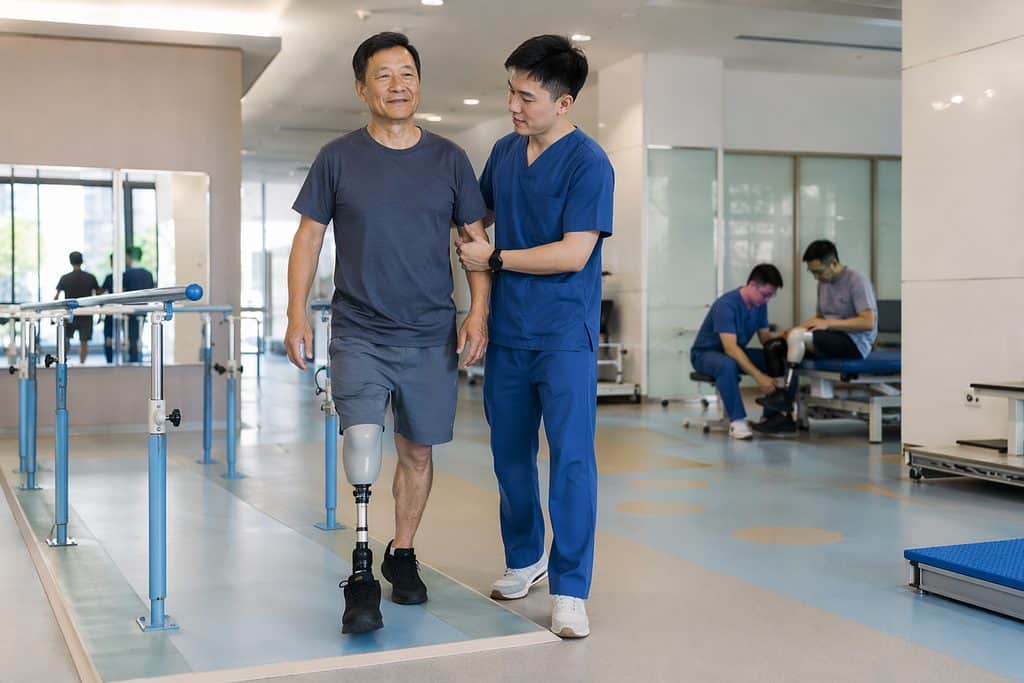
Week one involves comprehensive assessment: residual limb evaluation, range of motion testing, strength measurement, and a detailed discussion of functional goals. The prosthetist takes a cast or digital scan of the residual limb. Week two, the test socket is fabricated and fitted. You wear it, walk in parallel bars, and provide feedback about pressure and comfort. Adjustments are made. Week three, the definitive socket is produced and the components are assembled and aligned. Weeks four through six focus on gait training, stair navigation, uneven terrain practice, and learning to don and doff the device independently. This timeline extends for upper-limb prosthetics, where myoelectric training adds another one to two weeks.
Anyone offering a completed custom prosthetic limb in under 10 days is skipping the test socket phase. That phase is not optional. It is the difference between a device you wear for 14 hours a day and one that sits in a closet because it hurts.
Is Limb Care in China Good for Foreigners?
The short answer is yes — at the right hospitals, with the right preparation. The clinical quality at China’s top rehabilitation centers matches international standards. The prosthetic components are the same brands used in Western clinics. The challenge is not the care itself. It is everything surrounding the care.
International patients who have a positive experience typically share three characteristics. They chose a hospital with a dedicated international patient department or a well-established prosthetic rehabilitation program. They arrived with translated medical records and clear functional goals. And they had someone on the ground who could handle logistics, interpretation, and payment navigation. Patients who attempt to walk into a random public hospital without preparation or language support often report frustration. The clinical skill is there. Accessing it smoothly requires the right infrastructure.
For those researching how to book prosthetic leg fitting China package options, the key is understanding that “package” means different things at different institutions. Some hospitals offer all-inclusive international patient packages that bundle the device, fitting, rehabilitation, and accommodation coordination. Others price each component separately. We help patients understand exactly what is included before committing, so there are no surprises about rehabilitation session limits or adjustment visit policies. Our coordination service, which starts from $300 for hospital appointment scheduling, ensures the package you agree to is the service you receive. For patients seeking comprehensive support, our VIP end-to-end coordination ranges from $5,000 to $8,000 and covers every logistical detail from visa documentation to post-discharge follow-up.
Frequently Asked Questions
The price typically covers the prosthetic device itself — socket, suspension system, knee or foot component, and cosmetic covering — plus the fitting process and a defined number of physical therapy sessions. It does not usually include hospital admission fees, diagnostic imaging if needed, accommodation, or travel. Always ask for an itemized cost breakdown that separates the device from the service fees. This lets you compare apples to apples when evaluating options.
Yes, and you should. A detailed prescription from your home prosthetist or physiatrist — specifying amputation level, component recommendations, and any special considerations like skin graft areas or neuroma sites — gives the Chinese clinical team a strong starting point. However, the Chinese prosthetist will conduct their own assessment. They may recommend different components or socket designs based on their evaluation. This is not a rejection of your home clinician’s judgment. It reflects a fresh set of eyes and sometimes a different clinical philosophy shaped by high-volume experience.
This is the most common concern we hear, and it is legitimate. A socket that felt perfect during fitting week can develop pressure points as the residual limb changes volume over the following months. Most Chinese rehabilitation hospitals schedule a follow-up adjustment visit within the first six months. If you cannot return to China, we coordinate with the original prosthetist to provide detailed socket modification instructions that a local prosthetist in your home country can execute. Some patients ship the device back for adjustments, though this adds time and cost. The best approach is to budget for one return visit and plan for it before you leave China the first time.
China generally prices prosthetic care below Singapore, Germany, and the United States, and roughly on par with or slightly above India and Thailand, depending on component selection. The advantage China offers over lower-cost destinations is the combination of high clinical volume and access to premium Western components through direct distribution. You are not trading down on technology to save money. You are accessing the same microprocessor knee or myoelectric hand through a different procurement channel. For patients researching amputee rehabilitation center China prices, the savings are real but the value proposition is stronger when you factor in the clinical experience volume as well.
Your Next Step
Prosthetic rehabilitation is not a transaction. It is a process that requires clinical skill, precise communication, and logistical coordination. The numbers — prosthetic limb cost in China, travel expenses, time away from work — matter. But they only make sense in the context of a clear plan that matches you with the right hospital, the right prosthetist, and the right support team on the ground.
If you want to understand what that plan looks like for your specific situation, start with a free consultation. No commitment. No pressure. Just an honest conversation about your options, your timeline, and what is possible. We have helped patients from over 30 countries navigate prosthetic care in China. We would be glad to help you too.
For more medical information and treatment options in China, visit chinamedservices.com (China Medical Services).
