Proton Therapy for Liver Cancer in China: Cost, Centers & How to Book
Key Takeaways
- Proton therapy for liver cancer cost China quotes typically land between $25,000 and $45,000 per course — roughly one-third to one-half of US pricing for the same technique.
- China now operates more than ten particle therapy centers, several with dedicated hepatic programs and multi-field optimization planning for moving tumors.
- The hard part is not the machine. It is access — public proton centers book through their international departments, and self-referral from overseas rarely works.
- Anyone comparing options should ask for a written treatment plan, a fraction count, and a fixed price schedule before paying a deposit.
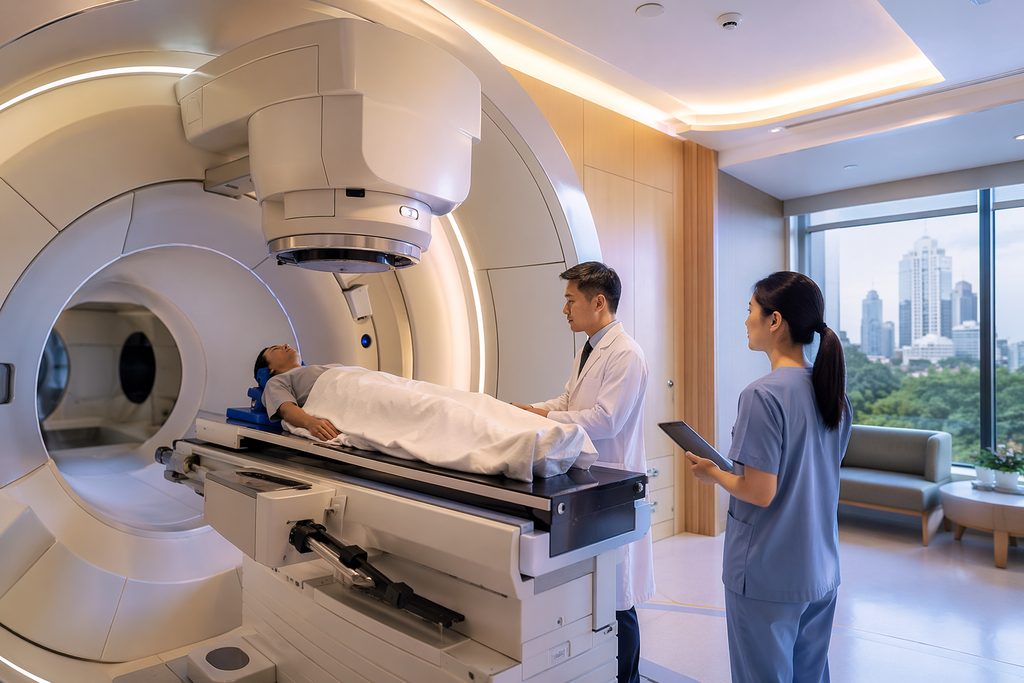
You have probably been told that cutting-edge radiotherapy means flying to the United States, Japan, or Germany. That assumption is now out of date. Proton therapy for liver cancer in China is delivered at a growing number of hospital-based particle centers, and the proton therapy for liver cancer cost China patients actually pay often runs well below Western quotes. The catch is not technology. It is navigation.
Liver cancer is unforgiving in a specific way. The liver tolerates radiation poorly, and the organ sits next to the stomach, duodenum, kidneys, and spinal cord. Traditional photon radiotherapy must spread dose through healthy tissue to reach the tumor. Protons stop where they are told to stop. That physical difference — the Bragg peak — is why proton therapy matters for hepatocellular carcinoma and for liver metastases that cannot be surgically removed.
Why Liver Tumors Push Radiation Teams to Their Limits
Roughly 70 to 90 percent of primary liver cancers worldwide occur in patients with underlying cirrhosis or chronic hepatitis B or C. That single fact changes everything about treatment planning. A cirrhotic liver has less reserve. Damage the surrounding parenchyma and you risk decompensation, ascites, and liver failure — sometimes faster than the tumor would have progressed.
Add breathing. The liver moves vertically by one to three centimeters with each respiratory cycle. A radiation plan built on a static CT scan can miss the target entirely. Both photon and proton systems now address this with gating, breath-hold, or real-time tracking, but protons give the planner a narrower margin to work with because there is no exit dose behind the target.
So the clinical question is rarely “is proton better in the abstract.” It is: can this patient receive a tumoricidal dose without exceeding liver tolerance? For some patients the answer is yes with photons. For others — larger tumors, central lesions, prior radiation, poor liver function — protons widen the therapeutic window enough to matter.
Inside China’s Proton Therapy Capacity for Liver Cancer
How many centers actually treat liver cases
China’s particle therapy build-out has been fast. Shanghai, Beijing, Guangzhou, Shenzhen, Hefei, and several other cities now host proton or heavy-ion facilities, with additional projects under construction. Not all of them run an active hepatic program, and not all accept international patients. That distinction matters far more than the total count.
The centers that do treat liver tumors typically operate inside a large tertiary hospital, which is an advantage. Radiation oncology, hepatobiliary surgery, interventional radiology, and transplant evaluation sit in the same institution. Decisions get made in tumor board meetings rather than across cities.
Planning and delivery differences you should ask about
Two liver-specific techniques separate a mature program from a basic one. The first is respiratory management — either breath-hold with surface guidance or real-time tumor tracking. The second is robust optimization, meaning the plan is tested against setup errors and anatomical shifts rather than assuming everything lands perfectly.
Ask directly. A center that cannot describe its motion management protocol in plain language is probably not the right place for a liver case.
Who is on the team
Proton therapy is not a solo specialty. A credible liver program pairs a radiation oncologist with a hepatologist or hepatobiliary surgeon, plus a medical physicist dedicated to particle planning. At the top-ranked Chinese hospitals — the ones that appear in the Fudan hospital rankings and hold JCI accreditation — this multidisciplinary structure is standard.
What Proton Therapy for Liver Cancer Cost China Patients Actually Pay
Here is where the numbers get interesting, and where you need to read carefully. Published price lists are rare. Quoted ranges vary by fraction count, whether the plan is proton-only or combined with photons, and how many imaging sessions are bundled in.
| Cost Component | Typical Range in China (USD) | Typical Range in the US (USD) |
|---|---|---|
| Proton therapy course (15–30 fractions) | $25,000 – $45,000 | $70,000 – $150,000+ |
| Simulation, immobilization, 4D-CT planning | $1,500 – $4,000 | $8,000 – $15,000 |
| Daily image guidance (included at most Chinese centers) | Often bundled | Frequently itemized |
| MRI or contrast CT during treatment | $300 – $800 per scan | $1,500 – $4,000 per scan |
| International department coordination | Varies; ask for a written schedule | Not applicable |
Those figures are indicative, not quotes. Final pricing depends on hospital, case complexity, and whether the treatment is delivered through a standard or international patient pathway. International departments at major Chinese public hospitals typically cost roughly 1.5 to 2 times the standard pathway because they provide English-speaking staff, faster scheduling, and dedicated coordination.
Even at the upper end, the arithmetic is stark. A US patient quoted $120,000 for a liver proton course may be looking at a fraction of that in Shanghai or Guangzhou — before travel and accommodation are counted. For a broader look at how Chinese hospital pricing compares across specialties, our guide to top-ranked Chinese hospitals breaks down the tiers.
Is Proton Therapy Safe for Liver Cancer in China?
Safety here has two layers, and conflating them causes bad decisions.
The first layer is the physics. Protons deposit most of their energy at a controlled depth and essentially stop. There is no meaningful exit dose beyond the target. That reduces integral dose to the stomach, bowel, kidneys, and bone marrow compared with photon techniques. It does not eliminate risk. Radiation hepatitis, rib fracture, skin reactions, and rare gastrointestinal injury remain possible. Proton therapy lowers the probability of these events. It does not zero them out.
The second layer is institutional. A proton center’s safety record depends on its planning workflow, its quality assurance program, and how many liver cases it treats per year. Volume correlates with competence in particle therapy more than in almost any other modality, because the learning curve is steep and mostly invisible to patients.
Be cautious of any provider — in any country — that promises a specific outcome or guarantees that proton therapy will be curative. For liver cancer, proton therapy is usually one component of a plan that may also involve surgery, ablation, transarterial chemoembolization, immunotherapy, or systemic therapy. No responsible team commits to results in advance.
How Long Does Proton Therapy for Liver Cancer Take in China?
Most liver protocols run 15 to 30 fractions. Delivered five days a week, that is roughly three to six weeks of daily treatment, with each session lasting 15 to 45 minutes including setup. The beam itself is on for a few minutes.
But the treatment course is not the whole timeline. A realistic sequence looks like this:
- Weeks 1–2: Records review and remote evaluation. Your imaging, pathology, liver function labs, and prior treatment history go to the Chinese team. This is where a written second opinion or video consultation happens.
- Weeks 3–4: Visa processing. International patients traveling for medical treatment use the S2 visa category, with supporting documentation from the receiving hospital. Accompanying family members apply under the same category. Processing times vary by consulate, so build in buffer.
- Week 5: Arrival, in-person consultation, simulation, and treatment planning. Planning for a liver case takes longer than for a prostate or brain case because of motion management.
- Weeks 6–11: Daily treatment, with weekly on-treatment review and periodic imaging.
- Follow-up: A post-treatment scan is typically scheduled several weeks after completion. Many patients return home before that scan and send imaging back for review.
Total time from first contact to first treatment is usually six to ten weeks. Rushing it is possible but rarely wise — planning quality drives outcome.
How to Book Proton Therapy Liver Cancer Treatment in China
This is the section most people get wrong, so let us be blunt about how the system works.
Chinese public hospitals do not accept overseas self-referrals for proton therapy through a website form. You cannot simply email a hospital and reserve a treatment slot. The standard pathway runs through the hospital’s international department or VIP channel, which handles registration, medical card creation, records translation, and scheduling. That is the practical route for foreign patients, and it is why most people work with a coordinator rather than going direct.
A workable sequence:
- Assemble your records: contrast-enhanced MRI or CT of the liver, pathology report, recent liver function panel, alpha-fetoprotein level, hepatitis status, and any prior treatment summaries. English or Chinese; translation can be arranged.
- Request a written second opinion or video consultation from the candidate center. This costs far less than traveling and answers the real question: is proton therapy appropriate for this specific liver, at this specific stage?
- If the plan is feasible, request a written treatment plan with fraction count, technique, and an itemized cost schedule.
- Confirm the visa pathway and hospital documentation requirements with the international department.
- Arrange arrival logistics, accommodation near the hospital, and interpretation for the first in-person visit.
If you want to understand how consultation-first coordination works in practice, our patient support page explains the staged approach. And if you are still weighing cities, Shanghai and Beijing host the densest concentration of particle therapy capacity and international patient infrastructure.
Ask any coordinator one question before you commit: “Will you put the hospital’s written treatment plan and cost schedule in front of me before I pay anything beyond the consultation?” A yes is a good sign. A vague answer is not.
China Proton Therapy Medical Tourism Package for Liver Cancer: What to Expect
Packages vary enormously, and the term itself is loose. Some cover only hospital coordination. Others bundle accommodation, airport transfers, interpretation, and meal delivery. A few include a companion who stays with you through every appointment.
What a package should never include is a clinical promise. Bundled pricing is fine. Bundled outcomes are not.
Practical items to clarify in writing:
- Whether the quoted price is fixed or an estimate that adjusts after simulation
- Who pays the hospital directly — you or the coordinator
- What happens if the plan changes mid-course (fractions added, technique adjusted)
- Whether insurance reimbursement documentation is provided
- Whether the companion service covers evenings and weekends
Chinese public hospitals generally require prepayment, with insurance reimbursement handled afterward by the patient’s own insurer. Private international hospitals in China often bill insurers directly, but most do not operate proton facilities. That split is worth understanding early.
Frequently Asked Questions
The equipment at major Chinese particle centers is comparable to leading international facilities, and several centers were built with technology from established vendors. The variable that matters is program maturity — annual liver case volume, motion management technique, and physics support. Ask for those specifics rather than relying on country-level comparisons.
At hospitals with an international department, yes, though the depth of English support varies. Outside that pathway, communication is genuinely difficult — top Chinese hospitals handle tens of thousands of outpatient visits daily and signage, forms, and scheduling are primarily in Chinese. Bilingual accompaniment is the practical solution, and it is a labor service, not a shortcut around hospital rules.
That is a real possibility and a good reason to start with a remote evaluation rather than a flight. Some liver tumors are better addressed with resection, ablation, or systemic therapy. A responsible evaluation will tell you so, and the consultation cost is far lower than a wasted trip.
Coverage depends entirely on your plan. Some international policies reimburse foreign treatment; many do not, or require pre-authorization. Request itemized invoices and a medical summary in English from the hospital, and confirm reimbursement terms with your insurer before traveling. Chinese public hospitals typically expect payment upfront.
Your Next Step
Proton therapy is a planning problem before it is a treatment problem. Get the plan right — the right center, the right motion management, the right fraction count — and the rest follows. Get it wrong and no machine in the world compensates.
We are China Medical Services, a coordination team that connects international patients with Chinese hospitals. We are not a hospital and we do not diagnose or prescribe. What we do is translate records, arrange consultations through official hospital channels, and provide bilingual support on the ground. If you would like a straight assessment of whether your case fits a Chinese proton program, start with a conversation. No pressure, no obligation.
For more medical information and treatment options in China, visit chinamedservices.com (China Medical Services).
