Proton Therapy Second Opinion in China: Specialist Review Before Travel
Proton Therapy Second Opinion in China: Specialist Review Before You Travel
You have probably heard that cutting-edge cancer care means flying to Houston, Boston, or Heidelberg. But the reality has shifted. The proton therapy cost China hospitals now offer runs 60–80% below US prices, and a growing number of international patients are requesting a proton therapy second opinion China specialists provide before booking a single flight. This article explains how that remote review works, what it costs, and how to decide whether it makes sense for your case.
Key Takeaways
- China operates 8+ proton therapy centers, with treatment costs typically ranging from $30,000 to $80,000 — versus $150,000–$250,000 in the US.
- A written second opinion from a top Chinese radiation oncologist costs $300–$500 and can be completed entirely from your home country.
- You cannot book proton therapy directly from overseas — a formal medical review must happen first, and the second opinion is the correct first step.
- Language, medical records translation, and hospital selection are the three biggest practical barriers for foreign patients.
The Problem: Proton Therapy at Western Prices Is Out of Reach for Many
Proton therapy is precise. It deposits most of its energy at a specific depth in the tumor, sparing surrounding healthy tissue. For pediatric cancers, skull-base tumors, and certain brain and spinal malignancies, that precision matters enormously. But access remains brutal. The average out-of-pocket proton therapy cost China patients avoid is not the only issue — wait times and insurance denials in Western systems often delay treatment by months.
In the United States, a full course of proton therapy costs between $150,000 and $250,000 depending on the number of fractions and the complexity of the treatment plan. Even insured patients frequently face six-figure bills after denials and deductibles. In the UK, the NHS sends a limited number of patients abroad each year because domestic capacity is so constrained. In Canada, patients often wait months for provincial approval. The result: families liquidate savings, delay treatment, or settle for less precise photon-based radiation.
That is the pain point. And it is why more patients are asking a different question: what if the technology, the expertise, and the outcomes are available elsewhere at a fraction of the price?
Why Proton Therapy in China Delivers Comparable Technology at a Different Cost Structure
Clinical Volume and Equipment Investment
China has invested heavily in proton therapy infrastructure over the past decade. The country now operates multiple proton centers using equipment from IBA, Varian, and domestic manufacturers like Shanghai APACTRON. The Shanghai Proton and Heavy Ion Center, which opened in 2015, has treated thousands of patients using both proton and carbon-ion beams — a dual capability that few Western centers offer. Beijing’s proton center at the China-Japan Friendship Hospital and the Hefei Ion Medical Center add further capacity.
Volume drives proficiency. A center treating hundreds of proton cases annually develops planning expertise that directly affects treatment quality. The physics of proton therapy — beam calibration, treatment planning software, quality assurance protocols — is identical whether the machine sits in Shanghai or San Diego. What differs is the operating cost structure.
Why the Cost Gap Is Structural, Not a Quality Compromise
Proton therapy is expensive everywhere because the equipment costs $100–$200 million to install. The cyclotron or synchrotron, the gantry systems, the shielding — none of that is cheaper in China. What is cheaper is everything around it: construction labor, facility operating costs, staffing, and administrative overhead. A radiation therapist in China earns a fraction of what a US counterpart earns, not because of lower skill but because of different labor economics.
The result is a proton therapy cost China centers charge that typically lands between $30,000 and $80,000 for a full course. That is a 60–80% reduction from US pricing. The machines are the same class. The treatment planning software is the same. The clinical protocols are adapted from international standards. Lower cost does not automatically mean lower quality — in this case, it reflects lower overhead.
Is Proton Therapy in China Safe?
The short answer: yes, when you choose a center with international accreditation and significant case volume. The longer answer requires looking at how Chinese proton centers operate. The Shanghai Proton and Heavy Ion Center follows protocols modeled on Japanese and European centers. Several Chinese facilities participate in international clinical research collaborations. The Chinese Society of Radiation Oncology has published national guidelines for proton and heavy ion therapy that align with international practice.
Safety concerns usually center on three things: equipment maintenance, treatment planning accuracy, and emergency response. All three are verifiable. Ask any center directly about their machine uptime record, their physics QA program, and their protocol for treatment interruptions. Reputable centers will answer. If they hesitate, that is your signal to look elsewhere.
How a Proton Therapy Second Opinion in China Actually Works
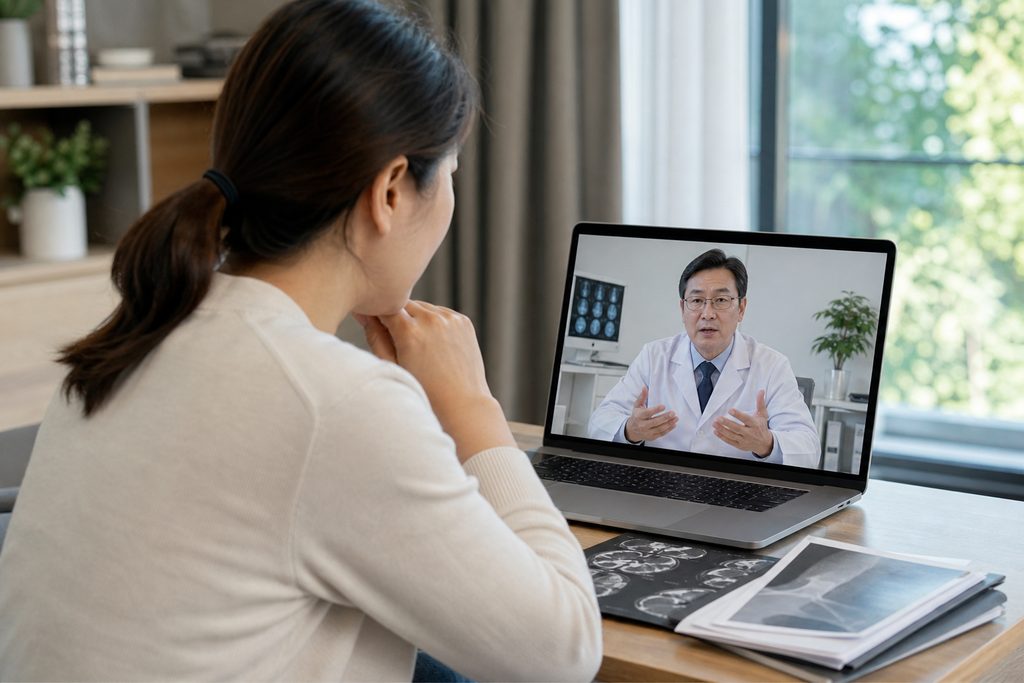
The process is more structured than most patients expect. You do not simply email a hospital and ask for a price. A proper proton therapy second opinion China oncologists provide follows a defined sequence.
First, you submit your existing medical records: imaging (CT, MRI, PET), pathology reports, treatment history, and any prior radiation plans. These must be in English or translated into Chinese. The reviewing specialist — typically a radiation oncologist with proton-specific experience — evaluates whether proton therapy is clinically appropriate for your case. Not every tumor benefits from protons. For some cancers, photon-based IMRT or stereotactic radiosurgery is equally effective and far cheaper. A good second opinion tells you the truth, even when the truth is “proton therapy is not the right tool for your case.”
Second, if proton therapy is appropriate, the specialist outlines a proposed treatment approach: number of fractions, total dose, target volumes, and expected side-effect profile. This is a written document, not a treatment commitment. It gives you something concrete to compare against whatever your home oncologist has proposed.
Third, you decide whether to proceed. The second opinion is a decision-making tool. It costs $300–$500 for a written review from a top-tier hospital specialist. A video consultation with the same specialist runs $500–$800. Neither obligates you to travel.
How Much Does Proton Therapy Cost in Shanghai? A Realistic Breakdown
Shanghai is the most common entry point for international patients seeking proton therapy in China. The Shanghai Proton and Heavy Ion Center is the flagship facility, and its pricing reflects both its reputation and its dual proton/carbon-ion capability. Here is what you should expect:
| Cost Component | Shanghai Proton Center (USD) | US Proton Center (USD) |
|---|---|---|
| Initial consultation and treatment planning | $3,000 – $6,000 | $15,000 – $30,000 |
| Full proton therapy course (20–35 fractions) | $30,000 – $80,000 | $150,000 – $250,000 |
| Immobilization devices and imaging | $2,000 – $5,000 | $8,000 – $15,000 |
| Follow-up imaging (first 3 months) | $1,500 – $3,000 | $5,000 – $10,000 |
| Estimated total | $36,500 – $94,000 | $178,000 – $305,000 |
These figures vary by hospital and case complexity. Carbon-ion therapy, when indicated, costs more than proton-only treatment. The number of fractions depends on your tumor type and stage. Some centers bundle imaging and planning into a single package price; others itemize everything. Always request a written cost breakdown before committing.
So how much does proton therapy cost in Shanghai compared to what you would pay at home? For most patients, even accounting for flights, accommodation, and a 4–8 week stay, the total remains 50–70% below US out-of-pocket costs.
Choosing the Best Proton Therapy Center China Offers for International Patients
Not all proton centers are equal. The best proton therapy center China for international patients is not necessarily the most famous one — it is the one that matches your clinical needs and has experience treating foreign patients. Here is what to evaluate:
Check the equipment. Proton-only machines (like the IBA Proteus systems) are excellent for most indications. Centers with combined proton and carbon-ion capability (Shanghai Proton and Heavy Ion Center, Hefei Ion Medical Center) offer an additional tool for radioresistant tumors, but carbon-ion is not always better — it is different. Your second opinion should address which beam type fits your case.
Check international patient volume. A center that treats 50 foreign patients a year has infrastructure for medical records translation, visa support letters, and English-speaking staff. A center that treats five does not. Ask directly: how many international patients did you treat last year? What languages does your international patient office support?
Check accreditation and research output. JCI accreditation is a useful baseline. Published research in international journals is a stronger signal of clinical quality. Look for centers whose oncologists publish in journals like the International Journal of Radiation Oncology, Biology, Physics or Radiotherapy and Oncology.
Our oncology department rankings break down China’s top radiation oncology programs by specialty reputation, which is a useful starting point for shortlisting centers.
Who Should Not Pursue Proton Therapy in China
This option is not for everyone. If your tumor is best treated with surgery or systemic therapy alone, proton therapy adds nothing. If you need emergency radiation for spinal cord compression or rapidly progressing disease, the logistics of international travel introduce unacceptable delay. If your cancer requires concurrent chemotherapy that your home oncologist must manage closely, coordinating that across borders is complicated.
Proton therapy in China makes the most sense for patients with localized, non-emergent tumors where proton therapy offers a clear dosimetric advantage: pediatric solid tumors, chordomas and chondrosarcomas of the skull base, uveal melanomas, certain brain tumors, and selected head and neck cancers. If you are unsure whether your case qualifies, that uncertainty is exactly what a second opinion resolves.
Practical Considerations: Records, Visas, and Payment
Before you can book proton therapy consultation China centers offer, you need your medical records in order. This is the step that delays most patients. You will need: all imaging on CD or via secure digital transfer, full pathology reports, a treatment summary from your oncologist, and a list of all prior therapies with dates and doses. If you have had prior radiation, the treatment plan (DICOM files) is essential — proton planning requires knowing exactly what dose your healthy tissues have already received.
Visa logistics are straightforward but require hospital documentation. Foreign patients traveling to China for medical treatment apply for an S2 visa, which covers short-term private affairs including medical treatment. The hospital provides an invitation letter and treatment confirmation that you submit with your application. Family members accompanying you also apply for S2 visas. Processing times vary by country, so start this process early.
Payment is typically required upfront. Chinese public hospitals operate on a prepayment model — you deposit funds, treatment is drawn against the balance, and you receive a refund for any remainder. International wire transfers are standard. US insurance rarely covers treatment in China directly, though some policies offer out-of-network reimbursement. Check with your insurer before committing. Some patients use medical financing or health savings accounts.
Language is the persistent challenge. Even at centers with international patient offices, day-to-day interactions — scheduling, billing, pharmacy — happen in Chinese. This is where a bilingual medical companion changes the experience. You can absolutely navigate it alone if you are resourceful and patient. Many people do. But expect friction.
Frequently Asked Questions
At accredited centers with significant case volume, safety standards are comparable to Western facilities. The equipment is the same class, the physics QA protocols are similar, and clinical guidelines align with international practice. The key is choosing a center with proven international patient experience and asking hard questions about their safety record and machine uptime before you commit.
That is precisely what a second opinion determines. Not every tumor benefits from protons. A qualified radiation oncologist reviewing your imaging and pathology can tell you whether proton therapy offers a meaningful dosimetric advantage over photon-based radiation for your specific case. If it does not, a good specialist will say so plainly.
Treatment plans are adjusted based on repeat imaging and simulation scans performed at the Chinese center. This is normal and happens everywhere. The important thing is that the center communicates changes clearly and that you understand why the plan shifted. A bilingual companion or the hospital’s international patient office should facilitate this communication.
Yes. Many patients start with a written second opinion ($300–$500) and then schedule a video consultation ($500–$800) with the same specialist to discuss the findings in real time. The written review gives you a document to study; the video call lets you ask questions and gauge whether you feel confident in the team. Neither commits you to treatment.
Most oncologists are open to reviewing a well-documented treatment plan from any reputable center. The key is getting a detailed written report that includes target volumes, dose constraints, and fractionation scheme. Share it with your home team before you travel. Some patients find that their home oncologist raises concerns or suggests modifications — that is a conversation worth having.
Your Next Step
The decision to pursue proton therapy abroad is significant, and it starts with information, not commitment. A proton therapy second opinion China specialists provide gives you a concrete basis for comparison — clinical appropriateness, proposed treatment plan, and realistic cost. China Medical Services helps international patients navigate this process, from records preparation to hospital selection to on-the-ground coordination. We are not a hospital and we do not provide diagnoses; we connect you with specialists who do. If you are weighing proton therapy options, start with a conversation about your case. It costs nothing to ask.
For more medical information and treatment options in China, visit chinamedservices.com (China Medical Services).
