Undiagnosed in the West? How PUMCH Hospital in China Solves Complex Medical Cases
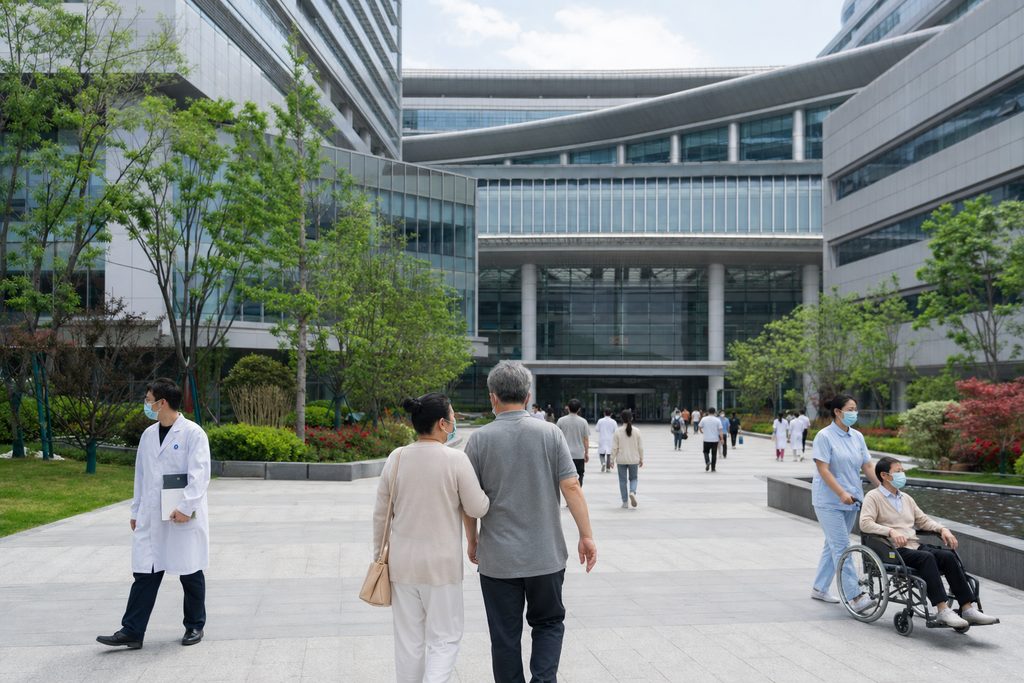
What if the diagnosis you have been chasing for years is sitting in a medical file in Beijing, waiting for a fresh set of eyes? That question is not hypothetical. Every year, our team at China Medical Services watches patients arrive in China exhausted by a medical system that told them their symptoms were “atypical,” “idiopathic,” or simply “anxiety.” They leave with a name for what ails them. Often, the name is something rare. And often, the team that finds it sits inside Peking Union Medical College Hospital, or PUMCH.
Key Takeaways
- An estimated 1 in 17 people will be affected by a rare disease in their lifetime, yet the average diagnostic odyssey spans 5 to 7 years and often more than 8 physicians in Western systems.
- PUMCH’s multidisciplinary undiagnosed disease program operates at a clinical volume and case complexity that few institutions in North America or Europe can match, with the hospital handling over 2.2 million outpatient visits annually.
- Navigating the hospital’s international patient pathway requires specific visa documentation, advance payment protocols, and bilingual coordination—attempting it independently without local support can result in significant delays.
- A written second opinion from a PUMCH specialist typically starts from $300 to $500, and any coordination fee is fully credited if you later choose to travel to China for in-person treatment.
The Problem: When Your Body Becomes a Medical Mystery
You have seen the specialists. You have done the blood panels, the imaging, and maybe even the exploratory surgery. And yet, you are still sitting in an exam room hearing the same phrase: “We cannot find anything wrong.” The financial toll is brutal. In the United States, the average cost of diagnosing a rare disease can exceed $10,000 in out-of-pocket expenses before a single treatment begins. The emotional cost is worse. Many patients start to question their own sanity. But the data is clear on one point: you are not alone, and you are probably not wrong. About 30% of patients referred to undiagnosed disease programs in the US eventually receive a definitive diagnosis, often for a condition so rare that a community hospital might see it once in a decade.
That is the crux of the problem. It is not that Western medicine lacks brilliance. It is that the system is often fragmented. Your rheumatologist does not talk to your neurologist. Your genetic panel was run on a platform from 2019 that misses newer pathogenic variants. You are stuck in a diagnostic limbo where no single physician has the time, or the case volume, to connect the dots. This is where the structural power of a high-volume, integrated hospital system like PUMCH becomes a medical lifeline.
Who We Are
We are not a hospital. We do not practice medicine, we do not generate clinical diagnoses, and we never influence a physician’s medical judgment. China Medical Services acts as your logistical architect and bilingual bridge to China’s top-tier medical infrastructure. Our database spans over 340 top-ranked hospitals across 37 cities. We handle the non-clinical chaos—visa guidance, hospital selection, appointment coordination, and on-the-ground bilingual medical companions—so that you can focus entirely on your consultation and recovery. Think of us as your fixers in a very complex system.
Why PUMCH Delivers Results for Complex Medical Case Diagnosis China International Patient
Peking Union Medical College Hospital was founded in 1921 with a mission shaped by Rockefeller Foundation standards. It has never stopped being the endpoint for China’s hardest cases. When local hospitals in a country of 1.4 billion people hit a diagnostic wall, they send the patient here. That funnel effect creates an unparalleled density of rare pathology. The hospital is consistently ranked in the top tier (A++++) on the Fudan Hospital Ranking, and its Department of Rheumatology and Immunology, for instance, is ranked among China’s top 10 for the specialty. For a patient asking “is PUMCH good for diagnosing rare diseases,” the answer lives in that daily clinical volume.
Clinical Volume Drives Diagnostic Pattern Recognition
Pattern recognition is the dark art of medicine. A physician who has seen 5,000 cases of systemic lupus erythematosus spots the atypical presentation faster than one who has seen 200. At PUMCH, the rheumatology department alone manages a staggering volume of complex autoimmune cases. The hospital’s general internal medicine department is legendary for handling multi-system, undiagnosed presentations. This is not a facility where a doctor reads about a rare disease in a journal once a year. They see it in the hallway. They discuss it at lunch. That institutional memory is what cracks cases that have stumped multiple Western university hospitals.
The Multidisciplinary Team (MDT) Structure
In many Western hospitals, an “MDT” means a tumor board that meets once a week. At PUMCH, the undiagnosed disease program pulls in specialists from immunology, genetics, neurology, hematology, and pathology simultaneously. They sit in the same room. They look at the same scans. They argue. This is not a sequential referral process where you wait six weeks for each new appointment. It is a synchronous diagnostic assault on your case. Our coordination service can arrange a Multidisciplinary Team Video Consultation from $1,500 to $2,000, allowing you to present your full medical history to this panel remotely before you even book a flight.
Cost Advantage Without Quality Compromise
Let us address the elephant in the room directly. The PUMCH second opinion cost for rare disease is a fraction of what you would pay for a comparable deep-dive analysis at a top-tier US facility. A written second opinion from a PUMCH specialist typically ranges from $300 to $500. This includes a thorough review of your translated medical records, imaging, and pathology slides. The price is not low because the quality is low. It is low because China’s hospital system operates on a completely different economic model—higher patient throughput, lower administrative bloat, and a national mission to serve a massive population. A top-specialist video consultation runs from $500 to $800. Compare that to a US academic center where a self-pay second opinion review can easily hit $2,000 to $4,000 before any face-to-face time with the physician.
And here is the structural guarantee that matters: any fee you pay for a remote consultation is credited in full toward our in-person coordination service if you decide to travel to China within 90 days. It is a one-time credit applied to the coordination fee, never to hospital treatment charges. But it means your diagnostic investment is protected.
How to Get a Second Opinion at PUMCH Beijing: The Process
The mechanics of accessing PUMCH are not intuitive. You cannot simply email the hospital and book a specialist. The public outpatient system is a high-speed, high-volume environment where same-day registration is the norm and Mandarin is the operating language. For international patients, the pathway runs through the hospital’s International Medical Services department or VIP clinic. This is where the rules change. You can pre-schedule. You get longer consultation windows. You get English-speaking coordination. But you need a local entity to bridge the gap.
Here is the typical flow for a complex case second opinion:
- Medical History Translation: Your records must be translated into clinical-grade Chinese. Not conversational Chinese. We are talking about precise terminology for pathology, immunology, and radiology. This step alone can take a week if done properly.
- Specialist Matching: We do not just pick a random rheumatologist. We match your case phenotype to the specific subspecialist at PUMCH who publishes on that exact disease cluster. If you have a suspected autoinflammatory syndrome, you need the physician who runs that specific clinic, not the general department head.
- Appointment Coordination: We liaise with the international department to secure a slot. The coordination fee for a hospital appointment starts from $300. If we cannot secure the appointment, the fee is refunded in full.
- The Consultation: If remote, you connect via a secure video link with a bilingual mediator present. If in-person, our medical companion meets you at the hospital entrance and stays with you throughout the visit.
What You Need to Know Before Going Alone
We have seen patients try to navigate this system solo. Some succeed. Most burn time and money they did not have to spare. Here is what you are up against if you attempt a DIY approach to a PUMCH international patient appointment for mystery illness.
- Visa Requirements: You need an S2 visa with a notation specifying medical treatment purposes. This is not a tourist visa. You need an invitation letter from the hospital, a medical certificate from your home physician, and proof of the hospital’s acceptance of your case. Gathering these documents independently, in the correct format, is a bureaucratic gauntlet. A family member accompanying you also needs an S2 visa.
- Payment Systems: PUMCH’s international department requires upfront payment. Your US or European health insurance is unlikely to be directly billed at a Chinese public hospital. You pay out of pocket, then seek reimbursement. WeChat Pay and Alipay dominate the local economy, but international credit cards often fail on hospital terminals. You need a clear financial pathway before you land.
- Medical Coding and Records Transfer: Chinese electronic medical record systems are walled gardens. Your foreign digital imaging files often cannot be uploaded directly. You need physical discs, properly formatted, with reports translated. Pathology slides need to be physically shipped under controlled conditions. This is not FedEx and hope. It is a regulated chain of custody.
How We Help You Navigate This
These barriers are not there to keep you out. They exist because the system was designed for a domestic population of 1.4 billion, not for a solo international traveler. We dismantle each barrier step by step. Before you travel, we translate and format your entire medical dossier to the standards PUMCH specialists expect. We coordinate the invitation letter and guide you through the visa application at your local Chinese consulate. During your stay, a bilingual medical companion—starting from $200 per day—meets you at the airport, rides with you to the hospital, handles registration, queues for your lab tests, translates the physician’s questions in real time, and ensures you understand every word of the assessment. After the consultation, we manage the follow-up documentation and, if a treatment plan is established, coordinate your admission or surgery schedule.
Our role is case management. We do not sell access to specific doctors. We do not promise a diagnosis. We promise that your case will be presented professionally, in the right language, to the right specialist, without logistical friction. For patients asking about PUMCH undiagnosed disease program reviews, the feedback we hear most often is not about the technology. It is about the sheer thoroughness. Physicians at PUMCH are known to spend 45 minutes to an hour on a complex new patient consultation in the international department—a timeline that is vanishingly rare in high-volume Western clinics.
Frequently Asked Questions
PUMCH is not “good” in a generic sense. It is specifically designed for this task. The hospital’s general internal medicine department was historically built to handle multi-system, undiagnosed presentations referred from across China. The case volume in rheumatology and immunology is among the highest in the world. What this means for you: the physicians have likely seen a presentation similar to yours before. This does not guarantee a diagnosis, but it dramatically shifts the odds compared to a center that sees one such case per quarter.
A written second opinion from a single top specialist ranges from $300 to $500. If your case requires a multidisciplinary team review, which is common for undiagnosed diseases, the remote MDT video consultation ranges from $1,500 to $2,000. This includes the panel discussion of your case by specialists from the relevant departments. The fee covers the coordination, translation, and facilitation. It does not cover any subsequent genetic testing or pathology re-staining, which would be quoted separately by the hospital. All figures vary by hospital and case complexity.
You do not need to speak a word of Mandarin. The PUMCH International Medical Services department has English-speaking staff. However, the depth of communication required for an undiagnosed disease case—describing nuanced symptoms, understanding complex treatment rationales—often exceeds basic conversational English. This is where a dedicated bilingual medical companion becomes essential. They ensure that nothing is lost in translation between you and the physician, especially during the physical exam and history-taking, which are the cornerstones of a complex diagnosis.
This is a possibility that any honest medical coordinator must acknowledge. Some conditions remain undiagnosed even after exhaustive investigation. If PUMCH cannot reach a definitive diagnosis, the process itself often yields valuable negative results—ruling out serious conditions with confidence. The team may also identify a direction for ongoing symptom management or recommend a research protocol elsewhere. The value is not always a clean answer. Sometimes it is the elimination of uncertainty and the end of a fruitless diagnostic chase.
Your Next Step
Living without a diagnosis is a full-time job you never applied for. The uncertainty consumes your energy, your finances, and your relationships. PUMCH’s undiagnosed disease program exists to serve exactly this patient profile: complex, multi-system, and unresolved. The hospital has the volume, the multidisciplinary structure, and the institutional patience to take on cases that others have abandoned. Your next step is not a commitment to travel. It is a conversation. Reach out to our team with your medical summary. We will help you understand if PUMCH is the right target for your specific case, and what the pathway would look like. You have been in the dark long enough.
Medical Disclaimer: This article is for informational purposes only and does not constitute medical advice. Always consult a qualified healthcare provider for personal medical decisions. China Medical Services does not provide clinical diagnoses or treatment.
For more medical information and treatment options in China, visit chinamedservices.com (China Medical Services).
