Qingdao Medical Care: German Heritage Hospitals with English Support
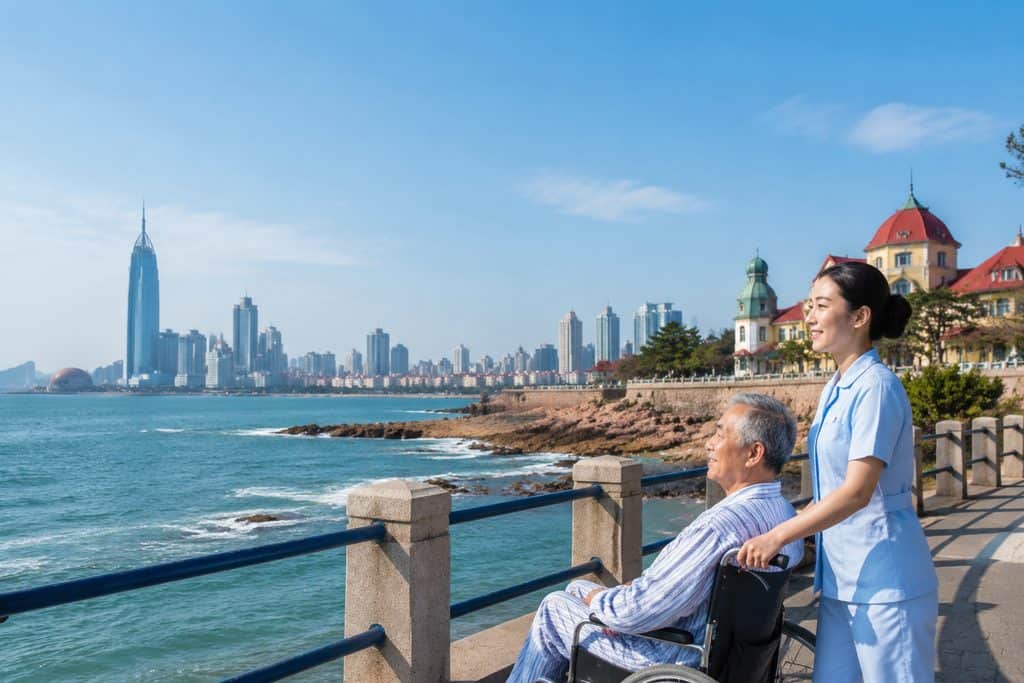
You have probably heard that getting world-class medical care in China means going to Beijing or Shanghai. That assumption leaves a remarkable option off the table. Qingdao, a coastal city in Shandong province, carries a century-old German medical legacy that most international patients never discover. The hospitals here are not historical museums. They are modern, high-volume centers where a knee replacement costs roughly $8,000 to $15,000. The same procedure in the United States averages $35,000 to $50,000. The German hospital Qingdao medical treatment cost advantage exists alongside a clinical infrastructure built on rigorous training traditions that began in the early 1900s.
But there is a catch. Finding reliable English support in Qingdao is harder than in Shanghai. The international patient pathway is less established. That is exactly why knowing the landscape before you book a flight matters.
Key Takeaways
- Qingdao’s top hospitals perform complex orthopedic and cardiac procedures at 60-80% less than US prices, with outcomes data comparable to international benchmarks.
- The city’s German medical heritage is not just historical — it shaped training standards, hospital architecture, and a clinical culture that persists in several major institutions today.
- English-speaking staff are concentrated in specific hospital international departments. Walking into a standard public hospital without a bilingual coordinator will be extremely difficult.
- Visa requirements, payment systems, and appointment protocols differ sharply from Western hospitals. You need to understand these before committing to any treatment plan.
The Problem: High Costs and Long Waits Are Forcing Patients to Look Beyond Their Borders
Medical inflation is not slowing down. In the United States, a single cardiac bypass surgery now costs upwards of $120,000. In the UK, the NHS waiting list for orthopedic surgery has stretched past 7.5 million people, with some patients waiting over 18 months for a hip replacement. Canada reports median wait times of 27.4 weeks between specialist consultation and treatment. These numbers represent real people living with pain, reduced mobility, and deteriorating health while they wait.
Private insurance helps some. But for the uninsured, underinsured, or those facing high deductibles, the financial math is brutal. A growing number of patients are asking a rational question: can I get the same quality of care elsewhere for a fraction of the price, and get it sooner?
China has entered that conversation. Not as a budget destination where quality is sacrificed, but as a system where high surgical volumes, modern equipment, and concentrated specialist expertise produce outcomes that rival Western benchmarks. Qingdao, specifically, offers something unique: a medical culture shaped by German training standards that took root over a century ago and never disappeared.
Who We Are
We are China Medical Services. We are not a hospital. We do not provide medical treatment, diagnoses, or clinical advice. Our team acts as your logistical architects — we bridge the gap between you and China’s top-tier hospitals. We handle hospital matching, appointment coordination, bilingual medical companion services, visa guidance, and travel logistics. Think of us as the people who make sure you walk into the right hospital, see the right specialist, and understand every word spoken in the consultation room. We work with a network of 340+ top-ranked hospitals across 37 cities, including several key institutions right here in Qingdao.
Why Qingdao’s German Medical Heritage Matters for International Patients
A Clinical Tradition That Predates Modern China
Qingdao was a German concession territory from 1898 to 1914. During that period, German physicians established hospitals, medical schools, and training protocols that emphasized diagnostic rigor, surgical precision, and meticulous documentation. When German administrators left, the infrastructure and clinical philosophy remained. Chinese physicians trained under that system continued practicing and teaching. The result is a medical culture in Qingdao that feels different from other Chinese cities — more methodical, more documentation-heavy, and in some institutions, more familiar to Western patients.
The Affiliated Hospital of Qingdao University, founded in 1898, is the direct descendant of that German medical mission. It now handles over 4 million outpatient visits annually and performs more than 100,000 surgeries each year. Its orthopedic and cardiac surgery departments are ranked among the strongest in Shandong province. The Qingdao Municipal Hospital, another major center, operates a dedicated international medical department that has been expanding its English-language services specifically to serve foreign patients.
How to Find English Support Hospital Qingdao Services Without Getting Lost
This is the question that determines whether your Qingdao medical trip succeeds or fails. The honest answer: English-speaking doctors exist, but they are concentrated in specific departments at specific hospitals. You cannot assume that any large hospital will have English support. The Affiliated Hospital of Qingdao University has English-capable specialists in its international outpatient clinic. Qingdao Municipal Hospital’s international department employs staff who can communicate in English. Several private clinics, including the Qingdao United Family Hospital, offer fully English-speaking environments with direct insurance billing.
But here is the reality most websites will not tell you. In the standard public hospital registration hall, nobody speaks English. The digital kiosks for appointment booking are in Chinese characters. The pharmacy queue, the payment counter, the lab result printer — all Chinese-only. This is not a flaw. It is a system designed for 1.4 billion Chinese citizens. Foreigners are an afterthought. That is why understanding how to find English support hospital Qingdao services before you arrive is not a luxury. It is the difference between treatment and frustration.
Our team pre-arranges appointments with English-speaking specialists. We provide a bilingual medical companion who stays with you from registration through discharge — handling payment, translating consultations, picking up prescriptions, and explaining every step. For patients considering whether is Qingdao medical care good for foreigners, the answer depends entirely on whether you have that support structure in place. With it, the care is excellent. Without it, the logistical barriers can be overwhelming.
Clinical Volume Drives Better Outcomes
There is a well-documented relationship in medicine between surgical volume and patient outcomes. A 2013 study in the New England Journal of Medicine found that hospitals performing more than 50 esophagectomies annually had mortality rates of 4.2%, compared to 9.7% at low-volume centers. This pattern holds across orthopedics, cardiac surgery, and oncology. Chinese hospitals operate at volumes that most Western surgeons would find staggering. A senior orthopedic surgeon at a major Qingdao hospital may perform 300 to 400 joint replacements per year. The average US orthopedic surgeon performs approximately 65.
This is not about speed. It is about pattern recognition. Surgeons who see rare complications more frequently recognize them faster and manage them better. The Qingdao Germany heritage hospital English speaking doctors who trained under this high-volume system bring that clinical experience to every procedure.
Cost Advantage Without Quality Compromise
Let us address the elephant in the room directly. Lower cost does not mean lower quality. The structural reasons for China’s medical pricing are straightforward: lower labor costs across the entire healthcare workforce, lower administrative overhead compared to the US insurance-driven system, and enormous economies of scale in hospital operations. A top-tier Qingdao hospital might run 50 operating rooms simultaneously, 12 hours a day. That throughput drives per-procedure costs down without cutting corners on equipment, implants, or surgical expertise.
| Procedure | Estimated Cost in Qingdao (USD) | Estimated Cost in USA (USD) |
|---|---|---|
| Total Knee Replacement | $8,000 – $15,000 | $35,000 – $50,000 |
| Cardiac Bypass Surgery | $12,000 – $20,000 | $120,000+ |
| Spinal Fusion (Lumbar) | $15,000 – $25,000 | $80,000 – $110,000 |
| Hip Replacement | $8,000 – $14,000 | $30,000 – $45,000 |
These are reference ranges. Final costs vary by hospital, implant choice, length of stay, and case complexity. But the magnitude of savings is consistent. Even after adding travel, accommodation, and coordination service fees, most patients save 60% to 80% compared to US private-pay rates.
What You Need to Know Before Going Alone
The barriers to accessing Qingdao’s medical resources independently are real. We lay them out here because informed patients make better decisions.
- Visa Requirements: Medical treatment in China requires an S2 visa, specifically annotated for medical purposes. Accompanying family members also need S2 visas. This is not a tourist visa. You need an invitation letter from the hospital confirming your treatment arrangement. Most hospitals will not issue this letter until you have had an initial consultation. This creates a chicken-and-egg problem for independent travelers. Do not apply for an M visa — that is for commercial business and will not cover medical treatment.
- Payment Systems: Chinese public hospitals operate on a prepaid deposit system. You load funds onto a hospital card at admission, and charges are deducted daily. International credit cards are not accepted at most public hospital counters. You need a Chinese bank account, WeChat Pay, Alipay linked to a Chinese card, or enough cash in RMB. Some international departments accept wire transfers, but the process is slow. Private international hospitals like United Family accept major credit cards and work with international insurers directly.
- Medical Records and Imaging: Chinese hospitals typically require their own imaging and lab work, even if you bring recent results from home. This is not a scam — it is standard clinical practice driven by liability protocols. Plan for repeat tests and budget time accordingly. Also, all consent forms, discharge summaries, and billing statements will be in Chinese unless you are in an international department.
How Medical Tourism Packages Qingdao China English Service Can Streamline Everything
The term “medical tourism packages” often conjures images of resorts with IV drips. That is not what we are describing. A properly structured medical tourism package Qingdao China English service means a coordinated treatment journey where logistics are handled so you focus on recovery. It starts with a remote consultation to determine if Qingdao is the right destination for your condition. If it is, we arrange the hospital invitation letter for your S2 visa, schedule your initial consultation, book accommodations near the hospital, and provide a bilingual medical companion for every clinical encounter.
For patients who need to book surgery Qingdao German medical center, the pathway is straightforward but requires patience. Surgery cannot be booked from overseas through standard public channels. You must first have an in-person consultation with the surgeon. Our team coordinates that consultation through the hospital’s international department or VIP channel, which allows us to lock in a consultation date before you travel. After the surgeon confirms the surgical plan, we coordinate the admission date, preoperative testing schedule, and postoperative follow-up. The entire process, from initial inquiry to surgery, typically takes 3 to 6 weeks depending on the surgeon’s schedule and your medical readiness.
Frequently Asked Questions
The clinical quality is strong. The communication barrier is the real obstacle. If you have a bilingual companion or are treated in an international department with English-speaking staff, the experience is smooth. If you attempt to navigate a standard public hospital alone with zero Chinese, you will struggle significantly. The medicine is not the problem. The logistics are.
Qingdao prices are generally 10% to 20% lower than Beijing or Shanghai for equivalent procedures at comparable hospital tiers. A knee replacement in Qingdao runs $8,000 to $15,000. In Shanghai, the same procedure at a top public hospital might cost $12,000 to $20,000. The savings come from lower operating costs in a second-tier city, not from any difference in clinical standards.
Not directly through standard public channels. Chinese public hospitals require an in-person consultation before scheduling surgery. You can, however, arrange that consultation in advance through the hospital’s international department or through a coordination service like ours. This locks in your consultation date so you are not arriving as an unknown walk-in patient. After the surgeon approves the procedure, we coordinate the surgical booking.
Chinese hospitals carry medical liability insurance, and the standard of emergency care in major Qingdao hospitals is high. The Affiliated Hospital of Qingdao University has a full intensive care unit, 24-hour emergency surgical capability, and specialist coverage across all major disciplines. If complications arise, you will be managed in that facility. What you will not have is the same legal recourse framework you might expect in a Western country. Medical malpractice litigation in China is complex and outcomes for foreign plaintiffs are uncertain. This is not unique to Qingdao — it applies across China. We recommend patients carry comprehensive international medical travel insurance that includes complication coverage and medical evacuation benefits.
Some do, but most do not. The German heritage refers to the institutional training culture, not to individual physicians having studied in Germany. Many senior specialists at Qingdao’s top hospitals completed fellowships or observerships in Germany, the United States, or Japan. English proficiency varies widely. The doctors assigned to international departments are selected specifically for their language skills and experience with foreign patients. Outside those departments, you should not expect conversational English.
Your Next Step
Qingdao offers a genuine alternative for patients who need high-quality surgery at a fraction of Western prices, in a city with a medical tradition that makes it uniquely accessible to international patients. The key is not just choosing the right hospital. It is having the right support structure around you from the moment you land. Visa paperwork, appointment scheduling, language barriers, payment logistics — these are solvable problems, but only if you address them before you are standing in a hospital lobby trying to explain your symptoms to a registration clerk who speaks no English.
If you want to understand whether Qingdao is the right destination for your specific case, request a free consultation with our team. We will review your medical situation, explain your hospital options, and give you a transparent cost estimate. No pressure. No hard sell. Just the information you need to make a clear decision.
For more medical information and treatment options in China, visit chinamedservices.com (China Medical Services).
