Renal Artery Ultrasound in China: Costs, Top Hospitals & Safety
What a Renal Artery Ultrasound Actually Is
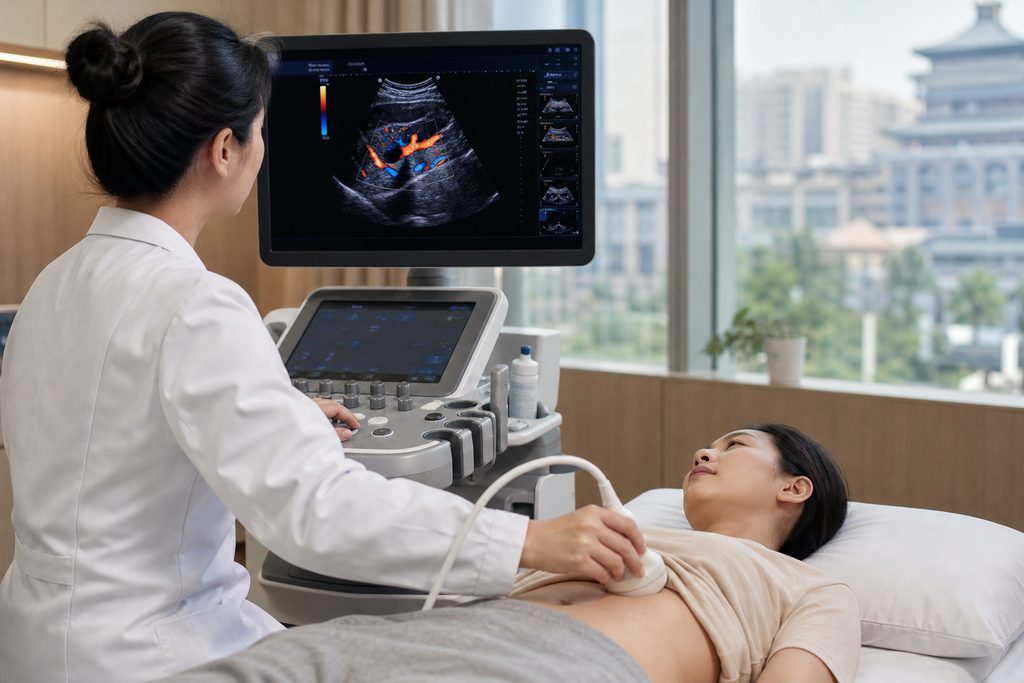
A renal artery ultrasound — sometimes called renal artery duplex or Doppler — uses sound waves to look at the arteries supplying your kidneys. No radiation. No contrast dye in most cases. It takes 30 to 60 minutes, and you walk out the same day.
Doctors order it for a specific reason: suspected renal artery stenosis, uncontrolled hypertension that resists medication, declining kidney function, or follow-up after a stent procedure. In the United States, the average charge for this study runs between $500 and $1,200 at hospital-based labs, and insurance often pushes patients toward cheaper outpatient centers. In China, the same study at a top-tier public hospital typically costs $150 to $400. That gap is one reason searches for renal artery ultrasound cost China have climbed steadily among international patients.
But price is only part of the picture. The real question is whether the scan is done well, read by someone experienced, and followed by a clear plan. That’s what this guide covers.
How This Actually Works, Step by Step
Here’s the sequence most international patients follow, from first inquiry to final report.
Step 1 — You send existing records. Before anything is scheduled, you share what you already have: recent bloodwork (creatinine, eGFR, lipid panel), any prior imaging, medication list, and a short summary of symptoms. If you’ve had a CT angiogram or MRA already, that goes in too. The Chinese vascular or nephrology team reviews these to confirm the ultrasound is even the right next test.
Step 2 — Written second opinion or video consultation. A specialist reviews your file and responds in writing, or you speak with the team online. This is where you learn whether you need a duplex study, a CT angiogram, or nothing at all. It also tells you which hospital department is the right fit — vascular surgery, nephrology, or interventional radiology.
Step 3 — Appointment coordination. If the ultrasound is confirmed, our team works through the hospital’s international office or VIP channel to secure a slot. Public hospital outpatient registration in China generally cannot be booked from overseas in advance through the standard queue — this is a real limitation, and it’s why the international department route matters.
Step 4 — You arrive and the scan happens. A bilingual companion meets you, handles registration, payment, and navigation inside what is often a campus seeing 10,000+ outpatients a day. The sonographer performs the study. A physician reviews images and issues a report, usually within 24 to 48 hours.
Step 5 — Results and next steps. If stenosis is found and intervention is needed, you discuss options on the spot. If not, you take the report home to your own doctor.
Renal Artery Ultrasound Cost China: What You’ll Actually Pay
Prices vary by hospital tier, city, and whether you use the standard or international department. Here’s a realistic range.
| Setting | Typical Cost (USD) | Notes |
|---|---|---|
| Top-tier public hospital, standard outpatient | $150 – $300 | Requires in-person registration; Chinese-language navigation needed |
| Top-tier public hospital, international/VIP department | $250 – $500 | English-speaking staff, faster scheduling, roughly 1.5–2x standard pricing |
| Private international hospital (JCI-accredited) | $400 – $800 | Direct insurance billing, Western-style service |
| United States, hospital-based lab | $500 – $1,200 | Varies widely by state and insurer contract |
These figures are for the ultrasound itself. Add consultation fees if you see a specialist the same day, and add the cost of any follow-up imaging. A CT angiogram, if needed, runs higher — typically $400 to $900 in China versus $1,500 to $4,000 in the US.
One thing worth understanding: public hospitals in China require prepayment. You pay upfront, then submit receipts to your insurer for reimbursement after you return home. Private international hospitals often bill your insurance directly, which is simpler but costs more. Neither route is “better” — it depends on your coverage and how much you value convenience.
A Realistic Timeline
How long does this take, start to finish? Here’s a stage-by-stage breakdown for a patient traveling from Europe or North America.
| Stage | Duration | What Happens |
|---|---|---|
| Records gathering and translation | 3–7 days | You collect reports; our team translates them into Chinese for the hospital |
| Written second opinion | 3–5 business days | Specialist reviews file and confirms whether ultrasound is appropriate |
| Video consultation (optional) | Scheduled within 1 week | Direct conversation with the Chinese medical team |
| Appointment coordination | 1–3 weeks | Depends on hospital, department, and specialist availability |
| S2 visa application | 4–10 business days | Requires hospital invitation letter and supporting documents |
| Travel and scan | 2–4 days on the ground | Arrival, registration, ultrasound, report review |
| Report delivery and follow-up | 1–2 days post-scan | Written report in English, plus recommendations |
Total: roughly 4 to 8 weeks from first contact to completed scan, assuming no complications. If you’re already in China, the timeline compresses to days, not weeks.
What Can Go Wrong — and What Happens Then
Honest failure modes matter more than optimistic promises. Here are the ones that actually come up.
The ultrasound is inconclusive. This happens more than people expect. Body habitus, bowel gas, or accessory arteries can obscure the view. When it happens, the physician recommends a CT angiogram or MRA. That’s not a failure — it’s a normal diagnostic pathway. Budget for the possibility.
The appointment can’t be secured on your preferred date. Top specialists in China are busy. A specific professor may have a full schedule for weeks. Our coordination service commits to trying, and if we cannot secure the appointment shown in your order, the coordination fee is refunded in full. What we cannot do is guarantee a named physician on a named day.
The visa is delayed. S2 visa processing times fluctuate with embassy workload and document completeness. If your invitation letter has an error, or your supporting documents are incomplete, you lose a week or more. Apply early, and double-check every form.
You arrive and the hospital requires additional tests first. Some hospitals won’t perform the ultrasound without a same-day consultation. That adds a day and a consultation fee. It’s standard practice, not a bait-and-switch.
Language breakdown. Even with an English-speaking international department, the sonographer performing your scan may not speak English. This is precisely where a bilingual medical companion earns their fee — they’re in the room, translating instructions and making sure you understand what’s happening.
Choosing the Best Hospital for Renal Artery Ultrasound in China
Not every hospital does this study well. Renal artery duplex is operator-dependent — the quality of the sonographer and the interpreting physician matters more than the machine.
Three factors to weigh:
- Volume and subspecialty. Hospitals with dedicated vascular surgery or hypertension clinics perform more of these studies and interpret them more confidently. Look for facilities ranked in the Fudan specialist reputation list for nephrology or vascular surgery.
- International department infrastructure. A hospital with a functioning international office can schedule you, provide English reports, and handle payment logistics. Without it, you’re navigating a system designed for Chinese-speaking patients.
- Geographic practicality. Beijing and Shanghai have the deepest concentration of top-tier hospitals. Guangzhou, Chengdu, and Hangzhou also have strong options. If you’re combining the scan with other care, pick the city that fits your overall plan.
You can browse top-ranked hospitals by city to compare facilities. For nephrology-specific rankings, the department guides list the top 10 hospitals per specialty.
One more consideration: if your case is complex — say, suspected fibromuscular dysplasia in a younger patient, or re-stenosis after prior stenting — you want a hospital that handles interventional procedures, not just diagnostics. That way, if the scan shows something requiring action, you’re already in the right place.
Practical Considerations: Records, Visa, Payment, Follow-Up
Records. Bring everything: prior imaging on disc or via cloud link, lab results within the last 3 months, medication list with dosages, and a brief medical history in English. Our team translates these into Chinese before your appointment.
Visa. Medical travel to China uses the S2 visa with a notation for medical treatment. Stays beyond 180 days require S1. Accompanying family members also apply for S2. The M visa is for commercial and trade activities — it is not a medical visa, and using it for treatment purposes can cause problems at entry. Requirements change; always confirm with the latest embassy or consulate guidance for your nationality.
Payment. Public hospitals: prepay, then claim reimbursement from your insurer. Private international hospitals: often direct billing. Bring a credit card that works internationally, and carry some cash in RMB for incidentals.
Insurance. Most Western insurers do not have direct billing arrangements with Chinese public hospitals. Check your policy for international coverage and pre-authorization requirements before you travel. Some policies require notification at least 5 business days before a planned procedure.
Language. Even in international departments, not everyone speaks English. A bilingual medical companion handles registration, queue management, payment, wayfinding, and translation. The service starts from $300 per day.
Follow-up at home. Request a written report in English with images. Your own physician will want both. If intervention is recommended, ask for the specific findings — peak systolic velocity, resistive index, degree of stenosis — so your doctor at home can evaluate the recommendation independently.
For patients weighing whether to travel at all, a written second opinion ($300–$500) or video consultation ($100–$300) lets you get a Chinese specialist’s read on your case before committing to flights. Any consultation fee is credited in full toward on-the-ground coordination if you travel within 90 days.
Frequently Asked Questions
Yes. The procedure itself is non-invasive and uses no ionizing radiation. Safety concerns relate to facility quality and interpretation accuracy, not the ultrasound technology. Top-tier Chinese hospitals use equipment comparable to Western academic centers, and their vascular specialists are experienced. The main risk is an inconclusive study requiring follow-up imaging — not harm from the scan.
At a top-tier public hospital in Shanghai, expect $150 to $300 for the standard outpatient route, or $250 to $500 through the international department. Private international hospitals like those in the Jiahui or United Family networks run $400 to $800. Final pricing depends on the hospital and whether additional consultation or imaging is included.
You can, but it’s difficult to do alone. Public hospital registration typically happens in person, in Chinese, on the day of service. The international department route provides English-speaking staff and is the practical path for most foreign patients. A bilingual medical companion can handle the logistics if you’re using the standard route or want extra support.
Yes. The S2 visa covers short-stay medical treatment. You’ll need a hospital invitation letter, proof of appointment, financial documentation, and a valid passport. Processing takes roughly 4 to 10 business days, though this varies by consulate. Apply well before your target date.
For the scan alone, probably not — the savings don’t offset travel costs. But if you’re already considering treatment in China, or if you’re combining diagnostics with a consultation at a top specialist, the cost differential becomes meaningful. A $200 ultrasound plus a $300 consultation in Shanghai versus $1,500+ for the same in the US changes the math. The decision depends on your full picture, not one test.
Your Next Step
Getting a renal artery ultrasound in China is straightforward once you know the pathway: records first, specialist review, coordinated appointment, bilingual support on the ground. The cost advantage is real, but the bigger value is access to experienced vascular specialists without the wait times common in Western systems.
China Medical Services connects international patients with 340+ top-ranked hospitals across 37 cities. We are not a hospital and we do not provide medical care. We handle the logistics — records translation, appointment coordination through official hospital channels, visa guidance, and bilingual accompaniment — so you can focus on your health.
If you’d like to understand your options, start with a free consultation. No pressure, no obligation. Just a conversation about whether this path makes sense for you.
This article is for informational purposes only and does not constitute medical advice. Always consult a qualified healthcare provider about your individual situation. Prices are estimates and vary by hospital and case complexity.
For more medical information and treatment options in China, visit chinamedservices.com (China Medical Services).
