Sleep Study in China: Cost and How to Book for Foreigners
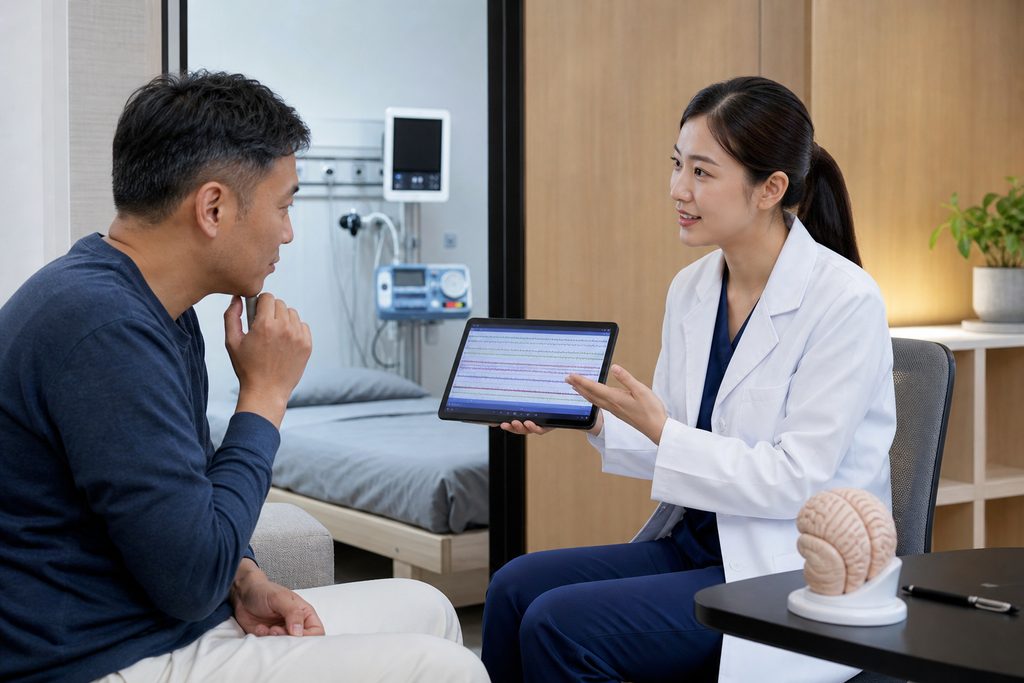
Sleep Study in China: Cost and How to Book
Roughly 1 in 5 adults in the United States lives with sleep apnea, and an estimated 80% of them have never been diagnosed. In the UK, the NHS reports waiting times for a diagnostic sleep study that can stretch past six months in some regions. So when a patient in Ohio or Manchester is told they need a polysomnogram and faces either a $3,000 hospital bill or a half-year queue, the question becomes practical: what does a sleep study cost in China, and can a foreigner actually book one?
Short answer: yes, and the numbers are striking. A full overnight polysomnography at a top-ranked Chinese hospital typically runs between $200 and $900 depending on the city and the facility tier. That same test at an American sleep center averages $1,000 to $3,000 before insurance. The gap is not a discount gimmick. It reflects lower overhead, high patient volume, and government price guidance at public hospitals.
What follows is how the process actually works for international patients — from the first email to the final report — plus the honest friction points nobody mentions in glossy medical-tourism brochures.
How This Actually Works, Step by Step
Most foreigners assume they can log onto a Chinese hospital website, pick a date, and pay by card. That is not how the system operates. Public hospitals in China release appointments on a rolling basis, often only days in advance, and the booking interface is built for domestic patients with a Chinese ID-linked medical card.
Here is the real sequence.
- Step 1 — Records review. You send us whatever you already have: a referral note, an Epworth Sleepiness Scale score, home sleep apnea test results, a medication list, and any prior imaging. Our team translates the relevant documents into Chinese and identifies which department handles sleep medicine at the hospitals that fit your case.
- Step 2 — Hospital and department matching. Sleep studies in China are usually run by the Respiratory Medicine or Neurology department, sometimes under a dedicated Sleep Medicine Center. Not every top hospital has an accredited sleep lab. We confirm availability before anything else.
- Step 3 — Appointment coordination. Through the hospital’s international office or VIP channel, we secure a consultation slot. The initial visit is almost always an in-person evaluation with a sleep specialist — this is a hard rule at public hospitals. You cannot skip straight to the overnight test without a doctor’s order.
- Step 4 — The consultation. A bilingual medical companion accompanies you. The specialist reviews your history, may order additional tests (thyroid panel, ENT exam, sometimes a chest X-ray), and then schedules the overnight polysomnography.
- Step 5 — The overnight study. You arrive at the sleep lab in the evening, typically around 8 or 9 PM. A technician applies sensors — EEG electrodes on the scalp, a nasal cannula, chest and abdominal belts, a pulse oximeter, and leg leads. You sleep. The recording runs 6 to 8 hours.
- Step 6 — Results and follow-up. The raw data is scored by a technologist and interpreted by the physician. Turnaround is usually 3 to 7 days. You receive a report with an AHI (apnea-hypopnea index), oxygen desaturation data, and a treatment recommendation — CPAP titration, positional therapy, surgery referral, or a follow-up study.
Total time on the ground: 4 to 7 days for most patients. That includes the consultation, the overnight test, and a results appointment.
What a Sleep Study Costs in China — and Why the Range Is Wide
Pricing depends on three variables: the tier of the hospital, the city, and whether the study is a standard overnight polysomnogram or an extended nap study (MSLT) used for narcolepsy workup.
| Service | Typical Cost in China (USD) | Comparison: US Average (USD) |
|---|---|---|
| Initial sleep specialist consultation | $30–$120 | $250–$500 |
| Overnight polysomnography (lab-based) | $200–$900 | $1,000–$3,000 |
| Multiple Sleep Latency Test (MSLT) | $300–$700 | $1,200–$2,500 |
| CPAP titration study | $250–$800 | $1,000–$2,800 |
| Home sleep apnea test (device rental) | $80–$250 | $150–$500 |
At a private international hospital such as United Family or Jiahui in Shanghai, expect the upper end of those ranges — but you get English-speaking staff, a quieter environment, and often direct insurance billing. At a top public hospital like Peking Union Medical College Hospital or Ruijin Hospital, the price drops, but the experience is busier and less catered to foreigners without language support.
So how much does a sleep study cost in Shanghai specifically? A lab-based polysomnogram at a public tertiary hospital in Shanghai generally falls between $250 and $600. At a private international facility in the same city, budget $700 to $1,200. Beijing runs similar, with a sleep apnea test price in Beijing hovering around $200 to $550 at public hospitals and $650 to $1,100 at international clinics.
The spread is real. It reflects facility overhead, technician-to-patient ratios, and whether an English-speaking sleep physician is part of the package.
A Realistic Timeline
Patients often underestimate the administrative runway. Here is what a typical schedule looks like for someone starting from scratch.
| Stage | Duration | Notes |
|---|---|---|
| Record collection and translation | 3–7 days | Depends on how quickly you send documents |
| Hospital matching and appointment request | 2–5 business days | Sleep labs fill up; peak seasons are slower |
| Visa application (S2 short-stay) | 4–10 business days | Requires hospital invitation letter in most cases |
| Travel and arrival | 1–2 days | Factor in jet lag before a sleep test |
| Consultation + overnight study + results | 4–7 days on the ground | Consultation and study may be on separate days |
| Report delivery and follow-up | 3–7 days after the study | Can be done remotely if you’ve already left |
Realistic total: 3 to 5 weeks from first contact to final report. If you are already in China on another visa, that compresses to about 10 to 14 days.
What Can Go Wrong — and What Happens Then
The failure modes are predictable, and knowing them upfront saves frustration.
The sleep lab has no opening during your travel window. This happens, especially at the most sought-after hospitals. The recourse is to shift to a different hospital in the same city or a nearby city with comparable accreditation. Our database covers 340+ top-ranked hospitals across 37 cities, so alternatives usually exist. If nothing works, the appointment coordination fee is refunded in full.
Your study is inconclusive. Maybe you slept only two hours. Maybe the leads came loose. A repeat study may be needed, and that means another night and another fee. Chinese sleep labs generally charge per study, not per attempt, so a redo is not free. Budget for it if your sleep is highly fragmented.
The language barrier causes a misunderstanding. This is the most common complaint from foreigners navigating Chinese hospitals alone. Consent forms, pre-test instructions, and medication rules are in Chinese. A bilingual medical companion prevents this. Without one, you are relying on hospital staff who may have limited English.
You need treatment, not just diagnosis. A sleep study is diagnostic. If it shows severe apnea, the next step is CPAP titration or a surgical consult. Those are separate appointments, separate costs, and sometimes separate departments. Plan for the possibility that your trip extends.
Is a Sleep Study in China Safe — and How Do You Judge Quality?
Is a sleep study in China safe? For the test itself, yes. Polysomnography is non-invasive. Electrodes sit on the skin. Nothing is injected, no radiation is used, and the risk profile is essentially zero beyond minor skin irritation from adhesive.
The more useful question is whether the interpretation meets international standards. Three things to check:
- Accreditation. Does the sleep lab follow American Academy of Sleep Medicine (AASM) scoring criteria? Most major Chinese tertiary hospitals do, but it is worth confirming.
- Technologist presence. A good lab has a trained technologist monitoring overnight, not just a recording device left running.
- Report format. You should receive a structured report with AHI, arousal index, oxygen nadir, sleep stage percentages, and a clear impression. If you get a one-page summary with no numbers, ask for the full study.
China’s top hospitals see enormous volumes. Fuwai Hospital, for example, performs over 14,000 cardiac surgeries a year — the highest in the world. That volume-driven expertise extends across specialties, including sleep medicine at major centers. The technology is current, and the physicians are trained to international standards.
What varies is the service layer. A public hospital sleep lab may feel rushed and utilitarian. A private international hospital feels closer to a Western clinic. Neither affects the accuracy of the recording, but both affect your comfort.
Practical Considerations: Records, Visa, Payment, and Follow-Up
Records. Bring everything in English or with a certified translation: prior sleep studies, medication list, relevant lab work, and a summary letter from your home physician. Chinese specialists appreciate a concise history.
Visa. Medical treatment in China falls under the S2 short-stay visa, which covers medical treatment and private affairs. If your stay will exceed 180 days, S1 applies. Family members accompanying you also apply for S2. The M visa is for commercial and trade activities only — it is not a medical visa and should never be used for treatment purposes. Requirements shift, so confirm current rules with the nearest Chinese embassy or consulate and ensure your hospital invitation letter is in order.
Payment. Public hospitals require prepayment. International hospitals often bill insurance directly if you have a policy with China coverage. Bring a card that works internationally, and carry some cash in yuan for incidentals.
Follow-up. If you are diagnosed with sleep apnea and started on CPAP, you will need titration and monitoring. Some of that can be done remotely with your home physician once you have the Chinese report in hand. Ask for a copy in English before you leave.
Insurance. Most Western insurers do not cover treatment abroad without prior authorization. Check before you travel. Some policies reimburse for emergency care only, not elective diagnostics.
For patients comparing medical tourism sleep study packages in China, be cautious of bundled offers that promise a fixed price for “study plus treatment.” Sleep medicine is staged. Diagnosis comes first, and treatment depends entirely on what the study shows. A package that locks in treatment before diagnosis is a red flag.
Frequently Asked Questions
Not directly. Public hospitals require an in-person consultation before they will schedule an overnight polysomnogram. What you can do remotely is send your records for a written second opinion or a video consultation, which helps confirm whether a sleep study is appropriate and which hospital is the best fit. The test itself requires your presence.
They are broadly similar. Shanghai public hospitals typically charge $250 to $600 for an overnight study; Beijing runs $200 to $550. Private international hospitals in either city push the range to $700–$1,200. The difference between cities is smaller than the difference between public and private facilities.
The test is non-invasive and low-risk. But if you have uncontrolled heart failure, severe COPD, or a recent stroke, the overnight lab environment needs to be equipped to handle it. Share your full medical history during the consultation so the sleep physician can decide whether additional monitoring is needed. No test is risk-free for every patient, and that judgment belongs to the treating doctor.
This is the single biggest practical hurdle. Top public hospitals have international offices, but staffing and English fluency vary. A bilingual medical companion handles registration, queue management, payment, translation during the consultation, and communication with the sleep lab. It is not a luxury — for many patients, it is the difference between a smooth visit and a confusing one.
Most will, provided the report follows standard scoring criteria and includes raw data. Ask the Chinese hospital for a full English-language report with AHI, oxygen saturation data, and sleep architecture. If your home physician has questions, a follow-up video consultation with the Chinese specialist can clarify findings.
Your Next Step
A sleep study in China costs a fraction of what most Western patients expect, and the diagnostic quality at top-tier hospitals meets international standards. The friction is not the medicine — it is the logistics: booking, language, visa timing, and knowing which hospital actually has an accredited sleep lab.
We are a medical concierge service that connects international patients with China’s leading hospitals. We do not provide medical care, and we do not guarantee admission, specific doctors, or clinical outcomes. What we do is handle the coordination: records translation, appointment requests through official hospital channels, bilingual accompaniment, and practical guidance on visas and travel.
If you are weighing whether a sleep study in China makes sense for your situation, start with a conversation. Visit our consultation page to describe your needs, and our team will outline realistic options — no pressure, no obligation. You can also explore top-ranked hospitals by city or review specialty rankings to see where sleep medicine fits within China’s broader medical landscape.
This article is for informational purposes only and does not constitute medical advice. Always consult a qualified healthcare provider for diagnosis and treatment decisions.
For more medical information and treatment options in China, visit chinamedservices.com (China Medical Services).
