Endoscopy in China: Screening Over 40 Without the Wait or the Cost
Key Takeaways
- An upper endoscopy (gastroscopy) at a top-tier Chinese public hospital typically runs $300–$800, versus $1,500–$3,500 in the United States — and the procedure itself takes only 10–20 minutes.
- China’s highest-volume endoscopy centers perform tens of thousands of procedures annually, which is precisely why their complication rates are low: volume builds skill.
- The hard part isn’t the medicine — it’s the logistics. Public hospital outpatient slots generally cannot be reserved from overseas in advance, and without Mandarin you will struggle inside a hospital that sees 10,000+ outpatients a day.
- Before booking anything, understand the difference between a screening exam and a diagnostic one, and confirm whether sedation is included in the quoted price.
The Problem: You’re 45, Your Doctor Said “Get Screened,” and the Bill Says “Wait”
You’ve probably heard that medical care in China means cutting corners. For endoscopy, the reality runs the other way — and the numbers are hard to argue with.
In the United States, a screening upper endoscopy without insurance commonly lands between $1,500 and $3,500 once facility fees, anesthesia, and pathology are added. In the UK, private gastroscopy averages £1,200–£2,000. And the wait? NHS diagnostic endoscopy referrals routinely stretch past six weeks, with some regions reporting waits closer to three months.
Meanwhile, the clinical need is real. Gastric cancer incidence rises sharply after age 40, and countries with mature screening programs — Japan, South Korea, and increasingly China — catch lesions at a stage where five-year survival exceeds 90%. In the US, where routine upper GI screening is not standard, most gastric cancers are still found after symptoms appear. That timing gap is the whole ballgame.
So the question isn’t whether to screen. It’s where, how much, and whether the quality holds up. That’s where endoscopy cost China becomes a genuinely serious option rather than a curiosity.
Why China Delivers Results for Endoscopy Screening
Three structural facts separate a Chinese tertiary hospital from what most Western patients picture.
Clinical volume that Western centers can’t match
China’s top gastroenterology departments — at hospitals like Zhongshan Hospital Fudan University in Shanghai and Peking Union Medical College Hospital in Beijing — perform endoscopy at a scale that dwarfs most Western centers. A single high-volume Chinese hospital may run 30,000–60,000 endoscopic procedures a year. For context, many respected US academic centers perform 5,000–10,000.
Does volume alone equal quality? No. But procedure-related perforation and bleeding rates fall with operator experience, and endoscopists doing 1,000+ procedures annually develop pattern recognition that shows up in early lesion detection. That’s the mechanism — not marketing.
Technology and workflow at scale
High-definition and magnifying endoscopy, narrow-band imaging (NBI), and endoscopic submucosal dissection (ESD) are standard tools in Chinese tertiary centers, not premium add-ons. ESD — the technique for removing early gastric tumors without surgery — was pioneered in Japan and adopted aggressively across China’s top hospitals, several of which now train visiting physicians from other countries.
The workflow is different from the West, though. Expect a large, busy facility. Expect same-day reporting for many exams. Expect the entire visit — registration, prep, procedure, recovery, report — compressed into a single morning or afternoon.
Cost advantage without a quality trade-off
The price gap isn’t a quality signal. It reflects labor economics, hospital efficiency, and procedure volume. A gastroenterologist’s salary in China is a fraction of a US counterpart’s, and equipment amortization spreads across far more cases. Same scope, same imaging standard, different cost structure.
| Procedure | China (top public hospital) | United States | United Kingdom (private) |
|---|---|---|---|
| Upper endoscopy (gastroscopy), no sedation | $300–$500 | $1,500–$2,500 | £1,000–£1,500 |
| Upper endoscopy with sedation | $450–$800 | $2,000–$3,500 | £1,400–£2,000 |
| Colonoscopy with sedation | $500–$900 | $2,500–$4,500 | £1,800–£2,800 |
| Combined upper + lower (panendoscopy) | $800–$1,400 | $3,500–$6,000 | £2,500–£3,800 |
| Biopsy pathology (per specimen) | $30–$80 | $150–$400 | £120–£300 |
Prices vary by hospital and case complexity, and private international departments run roughly 1.5–2× the public-channel rate. But the order of magnitude holds.
How Long Does Endoscopy Take? A Realistic Timeline from Landing to Report
This is the question patients ask second, right after cost. Here’s how a screening trip actually unfolds.
Day 1 — Arrival and registration. You land, settle in, and complete hospital registration at the international department. Your passport and prior records are logged, and a hospital medical card is created. If you’ve arranged a bilingual medical companion, they handle the queue, the forms, and the payment window.
Day 1 or 2 — Pre-procedure consult. A gastroenterologist reviews your history, allergies, and medications. If you take anticoagulants, this is where they’re adjusted. Fasting instructions are given in writing.
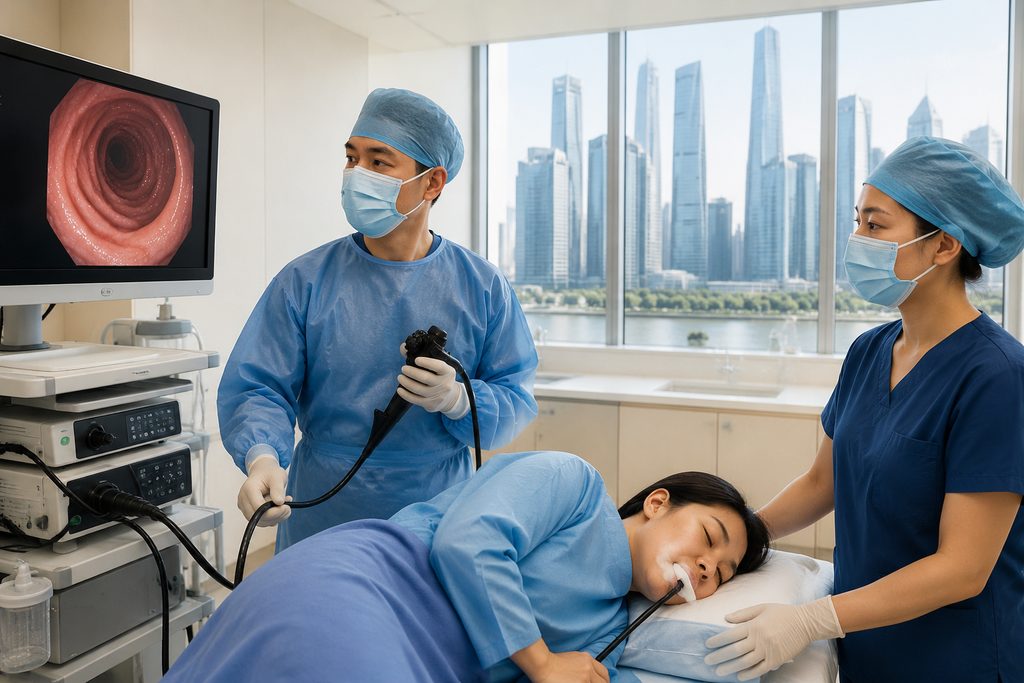
Day 2 or 3 — The procedure itself. The scope takes 10–20 minutes for an upper endoscopy, 20–40 minutes for a colonoscopy. With sedation, add 30–60 minutes of recovery. Total time in the endoscopy unit: two to three hours.
Same day or next morning — Report. Chinese tertiary centers typically issue a written endoscopic report the same day, with images. Biopsy results take longer — usually 3–7 working days.
So a straightforward screening trip can be completed in four to five days, including travel. That’s the honest timeline. It is not a same-day fly-in, fly-out proposition.
Choosing a Center: What Actually Matters for Screening Over 40
Not every hospital with an endoscope is the right hospital. Here’s how to separate them.
Look for gastroenterology in the Fudan specialty rankings. The Fudan University Hospital Rankings publish a specialty reputation list covering 45 disciplines, including gastroenterology and digestive surgery. A hospital ranked among China’s top 10 in that specialty is a defensible starting point. Our department-by-department Top 10 listings map these directly.
Ask who performs the procedure. At large public hospitals, endoscopies are done by gastroenterology staff, not trainees working unsupervised. If you’re going through an international department, confirm the operator’s annual volume.
Decide sedation or no sedation. Many Chinese patients opt for unsedated gastroscopy — it’s faster and cheaper. Most Western patients prefer sedation. Say so explicitly when booking, because it changes the price and the prep.
Check whether pathology is included. The quoted scope fee often excludes biopsy processing. If polyps are found and removed, expect an additional charge. This is normal, not a bait-and-switch — but budget for it.
For patients weighing city options, Shanghai concentrates the largest number of high-volume gastroenterology departments, which is why it’s the most common answer to “best hospital for endoscopy in Shanghai” searches. Beijing and Guangzhou follow closely.
Practical Considerations: Visas, Payment, Language, and Follow-Up
Visa. For medical treatment in China, the applicable short-stay category is the S2 visa, typically issued with a notation for medical treatment or private affairs. Accompanying family members apply under the same category. Stays exceeding 180 days generally require the S1 category. Requirements shift — always confirm current documentation with the nearest Chinese embassy or consulate, and expect to submit a hospital-issued invitation or appointment letter. The M visa is for commercial and trade activity and is not the correct category for medical travel.
Booking reality. This is the part that surprises people. Ordinary public hospital outpatient slots generally cannot be reserved from overseas in advance — same-day registration and queuing is the norm, and surgery or sedation-based procedures usually require an in-person consult first. To lock in a specific date and a senior specialist ahead of arrival, the practical route is the hospital’s international or VIP department. That channel costs roughly 1.5–2× the standard fee and comes with English-speaking staff.
Payment. Public hospitals require upfront payment; you then claim reimbursement from your insurer afterward. Private international hospitals — United Family, Jiahui, Parkway, Raffles among them — often bill insurers directly. Bring a card that works internationally, and expect foreign-card transaction limits to vary by bank.
Language. This is not a minor inconvenience. A top Chinese hospital can see over 10,000 outpatients in a day. Signage is in Chinese. Registration systems are in Chinese. Without support, a simple screening becomes an all-day navigation exercise. A bilingual medical companion handles registration, queuing, payment, wayfinding, and interpretation — from $300 per day for a half or full day.
Follow-up at home. Request your endoscopic report and images in English, plus the pathology report. Bring these to your home physician. If a lesion was removed, ask for the resection margins and the endoscopist’s recommended surveillance interval — usually 6 to 12 months for high-risk findings.
Frequently Asked Questions
At top-tier hospitals, yes — complication rates for diagnostic endoscopy are comparable to Western centers, and high procedure volume supports operator skill. The realistic risks are the same everywhere: mild sedation reaction, minor bleeding after biopsy, and in rare cases perforation. What differs is the environment, not the medicine.
Expect $300–$800 for an upper endoscopy with sedation at a top public hospital, and $500–$900 for a colonoscopy. Excluded items typically include biopsy pathology ($30–$80 per specimen), pre-procedure bloodwork, and medication. Private international departments run 1.5–2× higher. Final quotes vary by hospital and case complexity.
Not through the standard public outpatient channel — same-day registration and queuing is the norm there. Advance scheduling is realistically available through hospital international or VIP departments, and that’s the route most international patients use. Confirm the specific hospital’s policy before booking flights.
The S2 category is the applicable short-stay visa for medical treatment, subject to current embassy requirements and supporting hospital documents. Approval is never guaranteed, and requirements differ by consulate. Check with your nearest Chinese embassy before applying.
Early lesions can often be removed endoscopically during the same or a follow-up session. More complex findings require a multidisciplinary discussion. No provider can promise a particular outcome or admission — any treatment plan depends on hospital evaluation and your clinical picture.
Your Next Step
If you’re over 40, symptomatic, or carrying a family history of gastric or colorectal cancer, an endoscopy is one of the highest-yield exams available — and doing it in China can cost a fifth of what you’d pay at home. The medicine is sound. The logistics are the variable.
We’re China Medical Services — a coordination service, not a hospital. We don’t diagnose or treat. We connect international patients with 340+ top-ranked hospitals across 37 cities, handle appointment coordination through official international departments, and provide bilingual medical companions on the ground. Start with a free consultation at our patient services page and we’ll tell you honestly whether this route fits your situation.
This article is for general information only and is not medical advice. Screening decisions should be made with a qualified physician who knows your history.
For more medical information and treatment options in China, visit chinamedservices.com (China Medical Services).
