Ruijin Hospital Shanghai: Endocrinology & Hematology Care for International Patients
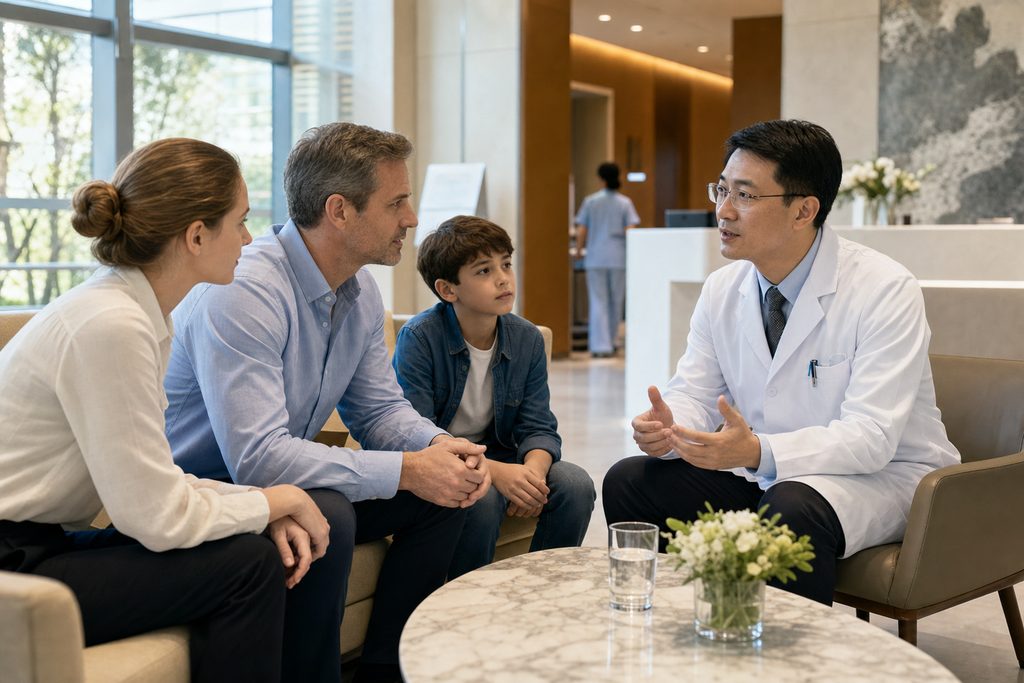
What if the wait for a specialist back home has dragged on so long that the anxiety of not knowing eclipses the fear of the diagnosis itself? That question sits at the heart of why nearly 30,000 international patients seek medical care in Shanghai each year. Ruijin Hospital, affiliated with Shanghai Jiao Tong University School of Medicine, handles a staggering 4.2 million outpatient visits annually. The institution’s Endocrinology and Hematology Center operates at a scale that is hard to visualize until you see it. For a patient from London facing a 14-week NHS wait for an endocrinology consult, or a family in Los Angeles staring down a $50,000 leukemia workup, the math starts to shift. Our team exists to make sense of that shift. We are not a hospital. We do not provide medical treatment or clinical diagnoses. We are your logistical architects—we bridge the gap between you and China’s top-tier medical expertise.
Key Takeaways
- Ruijin’s endocrinology department manages over 600,000 outpatient visits yearly, ranking it among the highest-volume metabolic disease centers globally.
- The Shanghai Institute of Hematology at Ruijin pioneered acute promyelocytic leukemia (APL) treatment protocols that flipped a once-fatal disease to a 90%+ cure rate.
- Navigating the public registration system independently is nearly impossible without Mandarin fluency—the VIP International Patient Center is the realistic path for foreigners.
- The ruijin hospital endocrinology treatment cost through the international wing typically runs 1.5 to 2 times the local rate, yet remains 70-80% below comparable US private hospital billing.
The Problem: When Your Body Won’t Cooperate and Your Local System Can’t Keep Up
Endocrine disorders are sneaky. They hum in the background—a thyroid nodule found incidentally on an ultrasound, a hemoglobin A1c creeping up year after year, a parathyroid hormone level that sits stubbornly outside the reference range. The symptoms are diffuse. Fatigue. Weight shifts. Brain fog. And the diagnostic pathway in many Western systems is slow by design. A patient in Canada waits a median of 10.2 weeks to see an endocrinologist after referral, according to the Fraser Institute’s 2023 survey. In the UK, the Royal College of Physicians reported that 48% of endocrinology patients waited beyond the 18-week target for treatment initiation.
Hematology presents a sharper edge. A suspicious complete blood count cannot wait 12 weeks. Leukemia does not negotiate. The American Cancer Society projects 59,610 new leukemia cases in the US for 2024 alone. The diagnostic workup—bone marrow biopsy, flow cytometry, cytogenetic analysis—costs $10,000 to $20,000 before a single treatment is administered in many US hospital systems. And that assumes you can get scheduled. For uninsured or underinsured patients, the financial toxicity starts before the chemotherapy does. These are not abstract problems. They are the exact scenarios that push people to look beyond their borders.
Who We Are
We coordinate medical journeys for international patients seeking care at China’s top-tier hospitals. Our network spans 340+ top-ranked institutions across 37 cities—hospitals that represent the top 5% of China’s 35,000+ medical facilities, ranked by the Fudan University hospital rankings and JCI accreditation standards. We handle the granular logistics that make the difference between a successful treatment trip and a stressful mess: bilingual medical companions who navigate registration queues, hospital appointment coordination, visa guidance for S2 medical visas, airport transfers, and accommodation advice. We do not diagnose. We do not treat. We do not promise miracle cures. What we deliver is access—structured, transparent, and honest about what is realistic.
Why Ruijin Hospital’s Endocrinology and Hematology Center Delivers Results
Clinical Volume That Creates Unmatched Pattern Recognition
Ruijin’s Department of Endocrinology and Metabolism traces its lineage to 1957. That is nearly seven decades of focused metabolic research. The department now operates 120 inpatient beds dedicated solely to endocrine disorders and logs over 600,000 outpatient consultations per year. To put that in perspective, the Mayo Clinic’s entire Division of Endocrinology handles roughly 70,000 patient visits annually. Volume matters in medicine. A clinician who sees 500 thyroid cancer cases a year develops a pattern recognition that no textbook can teach. The department’s Shanghai Clinical Center for Endocrine and Metabolic Diseases holds national designation, and its research on type 2 diabetes remission through intensive lifestyle intervention—published in The Lancet Diabetes & Endocrinology in 2018—changed treatment guidelines across Asia.
For international patients researching the ruijin hospital endocrinology treatment cost, the numbers break down differently depending on the channel. Through the public system, a specialist consultation fee runs approximately ¥300-500 (roughly $40-70). Through the International Medical Center or VIP clinic, expect ¥800-1,500 ($110-210) per specialist visit. A comprehensive thyroid function panel with antibody testing and ultrasound runs $300-600 through the international channel. These are not list prices—they shift based on case complexity—but they provide a realistic baseline for budgeting.
The Shanghai Institute of Hematology: Where Protocols Became Global Standards
This is the part that tends to stop people mid-scroll. The Shanghai Institute of Hematology (SIH) at Ruijin, founded by the late Dr. Wang Zhenyi, fundamentally rewrote the treatment of acute promyelocytic leukemia (APL). Before the 1980s, APL was the most lethal subtype of acute myeloid leukemia—patients frequently died from hemorrhage within days of starting chemotherapy. Wang’s team identified that all-trans retinoic acid (ATRA), a derivative of vitamin A, could force leukemic promyelocytes to mature and die naturally. Later, they combined ATRA with arsenic trioxide, creating a chemotherapy-free regimen that achieved a 5-year overall survival rate exceeding 90%. The New England Journal of Medicine published the pivotal trial in 2013. This was not incremental progress. This was a paradigm shift born in Shanghai.
Today, SIH operates 180 hematology beds and processes over 3,000 bone marrow biopsies annually. The center is a national referral hub for complex leukemia, lymphoma, and multiple myeloma. Its flow cytometry and molecular diagnostics lab runs 24 hours a day during peak periods. For a patient trying to determine if this is the best hematology center Shanghai for foreigners, the answer hinges on what you need. For APL, myelodysplastic syndromes, and certain lymphomas, the case is strong. For allogeneic stem cell transplantation, Ruijin performs approximately 200 transplants yearly—competent but lower volume than dedicated transplant centers like Peking University People’s Hospital. We are direct about this because partial information is worse than none.
The leukemia treatment cost China Ruijin Hospital varies by protocol. An ATRA-arsenic trioxide induction for APL, including hospitalization and monitoring, typically falls between $15,000 and $25,000 through the international patient channel. Standard “7+3” induction chemotherapy for AML runs $20,000-35,000. Allogeneic transplant costs range from $60,000 to $100,000. These figures compare to $150,000-300,000 for equivalent US treatment, according to the Kaiser Family Foundation’s 2023 cost analysis. The savings are structural: lower physician labor costs, less administrative overhead, and hospital-owned equipment amortized differently.
Thyroid Cancer Expertise That Draws Patients from Across Asia
When patients ask is Ruijin Hospital good for thyroid cancer treatment, we point to the numbers. The hospital’s thyroid surgery team performs over 3,000 thyroidectomies annually. The department of nuclear medicine runs one of China’s busiest radioiodine therapy units, handling radioactive iodine ablation for differentiated thyroid cancer at a scale that keeps wait times under two weeks in most cases. The multidisciplinary tumor board—endocrinology, head and neck surgery, nuclear medicine, pathology—meets twice weekly to review complex cases. Ultrasound-guided fine needle aspiration biopsy, the gold standard for thyroid nodule evaluation, costs $200-400 through the international center. Total thyroidectomy with hospital stay runs $8,000-15,000. Radioiodine therapy adds $3,000-6,000 depending on dose. These are real costs we have coordinated for patients.
But here is the nuance that matters. Ruijin’s thyroid surgeons are technically excellent. The volume is there. The pathology turnaround is fast. What the international patient sacrifices is the seamless post-operative follow-up they would get at home. Thyroid hormone titration after surgery requires months of fine-tuning. If you fly back to Manchester or Melbourne two weeks post-op, your local endocrinologist inherits the case. That handoff can be bumpy. We flag this early in every consultation because it shapes the decision.
What You Need to Know Before Going Alone
Walking into Ruijin Hospital without preparation is not like walking into a private clinic in Singapore or Bangkok. The main outpatient hall sees 15,000 patients daily. The noise level is industrial. The signage, while increasingly bilingual, still assumes a working knowledge of Chinese hospital flow. These barriers are real. They are also solvable.
- Visa Requirements: Medical treatment in China requires an S2 visa with a treatment purpose annotation. The invitation letter must come from the hospital’s international department—not a travel agency, not a hotel. Processing takes 7-14 business days at most Chinese consulates. Family members accompanying the patient also apply for S2 visas. The M visa is strictly for commercial trade activities and will be rejected if presented for medical entry. We have seen this mistake delay treatment by weeks.
- Appointment Reality: The public registration system at Ruijin operates through a mobile app and on-site kiosks—both in Chinese. Specialist slots for renowned endocrinologists release at 7:30 AM and vanish within minutes. The international patient center operates on a different track entirely. It requires direct contact, medical history submission in advance, and confirmation of the specialist’s availability. This is the only viable path for foreign patients. Walk-in attempts at the public windows almost always fail.
- Payment Systems: Ruijin’s international center accepts UnionPay, major international credit cards, and wire transfers. The public side is cash or UnionPay only. International insurance direct billing is limited—most patients pay upfront and seek reimbursement. A deposit of ¥30,000-50,000 ($4,000-7,000) is standard at admission for international patients. The hospital provides itemized receipts in English upon request, but the billing codes may not align perfectly with ICD-10 coding your insurer expects.
How We Help You Navigate This
These barriers exist for structural reasons, not malice. Chinese public hospitals were designed to serve a domestic population of 1.4 billion at maximum efficiency. The international patient pathway is a retrofit—functional but not intuitive. Our process starts with a free consultation where we review your medical records, confirm whether Ruijin’s endocrinology or hematology department is the right fit for your specific condition, and outline a realistic timeline. We do not take every case. If your needs are better served at Zhongshan Hospital for cardiac issues or Fuwai Hospital for complex arrhythmias, we tell you that directly.
Once you decide to proceed, we handle the invitation letter coordination with Ruijin’s International Medical Center, schedule the specialist consultation, and arrange a bilingual medical companion who meets you at the hospital entrance. That companion stays with you through registration, vitals, the consultation itself, laboratory visits, and pharmacy pickup. They translate clinical terminology, not just conversational Mandarin. They know which floor the endocrinology ultrasound unit is on and that the hematology bone marrow biopsy suite requires a separate queue number. After your visit, we provide a written summary in English of the consultation, treatment recommendations, and next steps. If admission is required, we coordinate bed availability and deposit payment. When you return home, we facilitate follow-up communication with the treating specialist for up to 90 days.
The Ruijin Hospital medical tourism package hematology concept deserves clarification. Ruijin does not sell “packages” in the way a cosmetic surgery clinic in Seoul might. What exists is a structured care pathway through the International Medical Center: initial consultation, diagnostic workup, treatment planning, admission coordination, and discharge follow-up. The cost is itemized per service, not bundled into a flat fee. We help you build a realistic budget based on the specific protocol your hematologist recommends.
Frequently Asked Questions
The how to book appointment at Ruijin Hospital international patient center process starts with submitting your medical records—in English or your native language—through a coordinator who liaises with the center directly. The international center reviews the case, confirms specialist availability, and issues an appointment confirmation along with the visa invitation letter. Expect 5-10 business days from record submission to confirmed appointment. Walk-in attempts without prior coordination are not accommodated. Our team handles this entire sequence, including certified translation of key documents when needed.
This is a legitimate concern and the primary reason we insist on bilingual medical companions with clinical vocabulary training. A standard translator may not know the difference between “hyperthyroidism” and “thyroid storm” or between “pancytopenia” and “aplastic crisis.” Our companions have backgrounds in medical interpretation. They also take real-time notes during consultations and produce an English summary within 24 hours. If a critical detail is unclear, we facilitate a follow-up call with the specialist before you leave Shanghai. Misunderstandings still happen—medicine is complex in any language—but we have structured the process to catch them early.
Yes, and this is more common than you might expect. Autoimmune thyroid disease and pernicious anemia often travel together. Multiple endocrine neoplasia syndromes involve both endocrine glands and blood markers. We coordinate sequential appointments across departments, usually over 3-5 days, with all laboratory results shared through Ruijin’s integrated electronic medical record. The international center can schedule both consultations under one patient file, avoiding duplicate registration fees.
Ruijin operates a 24-hour emergency department with dedicated resuscitation bays and on-call specialists in every major discipline. The international patient center provides an emergency contact number that routes to an English-speaking coordinator during business hours. Outside those hours, the ED has bilingual capability, though it is thinner at night. We provide patients with a card printed in Chinese that states their diagnosis, treating specialist, and emergency contact instructions. For life-threatening deterioration, Ruijin’s ICU capabilities are comprehensive—the hospital is a Level 3 Grade A institution, the highest classification in China’s hospital tier system.
Your Next Step
Ruijin Hospital’s Endocrinology and Hematology Center represents a legitimate option for patients facing long waits, high costs, or limited treatment protocols in their home countries. The clinical expertise is real. The volume is staggering. The cost differential is structural and significant. The barriers—language, visas, unfamiliar hospital flow—are equally real but entirely navigable with proper coordination. If you are weighing whether this path makes sense for your specific diagnosis, start with a conversation. Our free consultation walks through your medical history, confirms whether Ruijin is the right fit, and outlines what a treatment timeline would actually look like. No pressure. No promises we cannot keep. Just honest guidance from a team that has coordinated this journey hundreds of times before.
For more medical information and treatment options in China, visit chinamedservices.com (China Medical Services).
