Scared to Travel to China for Cancer Treatment: What Actually Happens
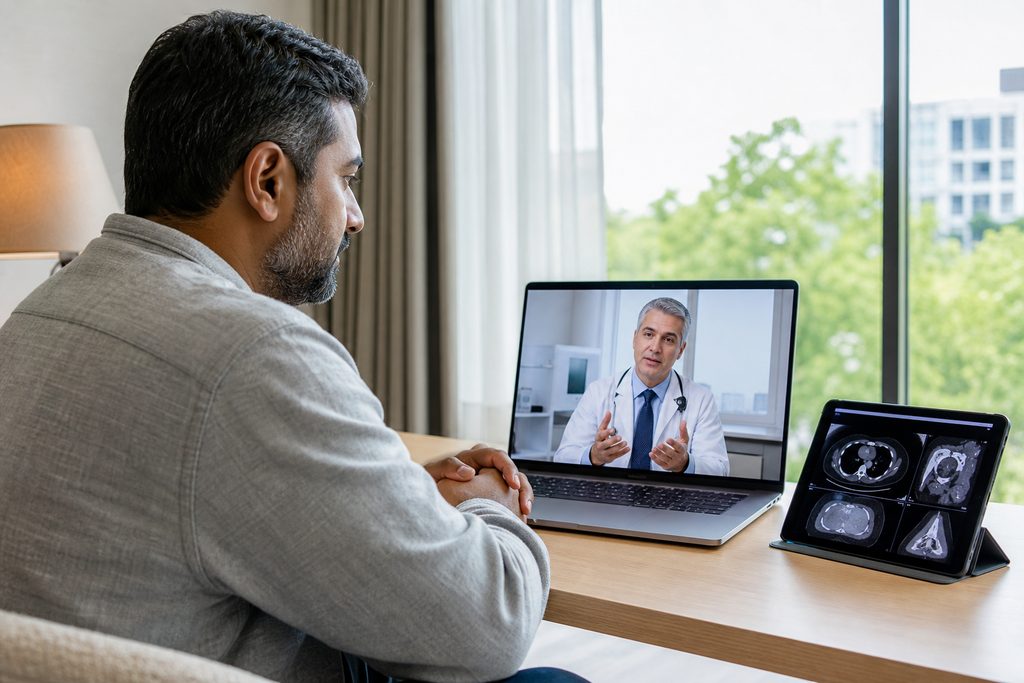
Have you ever wondered whether flying halfway around the world for cancer surgery is a rational decision or a desperate gamble? That knot in your stomach is not irrational. It is the correct response to a high-stakes decision made with incomplete information. The gap between what you fear and what actually happens at China’s top oncology centers is where this article lives.
We coordinate care for international patients at 340+ top-ranked hospitals across 37 Chinese cities. That work has taught us something important: fear usually comes from not knowing the sequence. Once patients understand the exact steps — what gets sent, who reviews it, what comes back, what happens on day one in China — the fear shrinks to a manageable size. The cancer treatment cost China offers is often 60–80% lower than comparable care in the United States or Western Europe. But cost means nothing if you cannot trust the system. So let us walk through both.
How This Actually Works, Step by Step
You do not book a flight and show up. That approach fails. Here is the sequence we use with every patient who contacts us through our consultation service.
First, you send your existing records. Pathology reports, imaging files (CT, MRI, PET scans as DICOM or high-resolution images), blood work, current medication list, and a short summary of your diagnosis and treatment history. If the records are not in English, we arrange certified medical translation into Chinese. This takes 2–4 business days.
Second, a relevant oncology department reviews the materials. This is not a chatbot. A real clinical team at a hospital such as Fudan University Shanghai Cancer Center, Peking Union Medical College Hospital, or Sun Yat-sen University Cancer Center examines your case. They look at staging, prior treatments, and whether your case fits their expertise. This review typically takes 3–7 business days.
Third, you receive a written response. It includes whether they believe they can help, what additional tests they would need, a proposed treatment direction, and a cost estimate range. If surgery is indicated, the estimate covers the procedure, hospital stay, and standard post-operative care. It does not cover complications or extended ICU stays — no honest estimate can.
Fourth, you decide. If you want to proceed, we coordinate the S2 visa invitation documents from the hospital, book your initial outpatient consultation, and arrange a bilingual medical companion for your arrival. The companion handles registration, queueing, payment, navigation, and interpretation. You focus on your health.
Is Cancer Treatment in China Safe for Foreigners?
This is the question behind the fear. And the answer requires separating three distinct concerns: clinical quality, communication, and logistics.
Clinical quality at China’s top-tier oncology centers is real. The Fudan University Hospital Rankings — China’s most authoritative hospital evaluation system — identifies the top 5% of the country’s 35,000+ hospitals. Many of these institutions perform cancer surgeries at volumes that dwarf Western centers. A surgeon who performs 300 esophagectomies per year has seen complications a surgeon performing 30 per year has only read about. Volume builds competence. That is not marketing language. That is surgical outcome data.
But — and this is where we are honest — volume does not solve communication. A top surgeon who speaks no English cannot explain your treatment plan. A nurse who cannot understand your pain report cannot respond appropriately. This is the single biggest failure point for foreign patients in Chinese public hospitals. The solution is not to avoid these hospitals. The solution is to bring a bridge. A bilingual medical companion who translates clinical conversations in real time, who reads the Chinese signage, who knows which window to visit for which form. That bridge transforms the experience from disorienting to navigable.
Safety also depends on choosing the right hospital. Not every Chinese hospital is a top hospital. The difference between a Fudan-ranked oncology center and an unranked county hospital is enormous. You can explore our database of Fudan-ranked top hospitals by city to see which institutions meet the standard. If you are looking specifically at oncology departments, our specialty rankings page shows which hospitals rank among China’s top 10 for cancer care.
A Realistic Timeline
People underestimate waiting periods. Here is what actually happens, with ranges that reflect real-world variability.
| Stage | What Happens | Typical Duration |
|---|---|---|
| Day 1–3 | You gather and send medical records | 2–3 days |
| Day 4–7 | Medical translation into Chinese (if needed) | 2–4 business days |
| Week 2 | Oncology department reviews your case | 3–7 business days |
| Week 3 | Written response and cost estimate delivered to you | 1–2 days after review |
| Week 3–4 | Visa invitation documents issued by hospital | 3–5 business days |
| Week 4–6 | S2 visa application at Chinese embassy/consulate | 3–10 business days, varies by country |
| Week 6–7 | Travel to China, initial outpatient consultation | Within 1 week of arrival |
| Week 7–9 | Additional tests (if required), treatment plan finalized | 1–2 weeks |
| Week 8–10 | Surgery or treatment begins | Varies by case complexity |
Total time from first contact to treatment start: typically 6–10 weeks. Sometimes faster. Sometimes slower if your case requires additional imaging or if the visa office in your country is backed up. Plan for the slower end.
The step people forget is document translation. If your records are in English, most top hospitals can review them directly. If they are in Arabic, Russian, French, or another language, translation adds days. And translation quality matters. A poorly translated pathology report can lead to a wrong staging assessment.
What Can Go Wrong — and What Happens Then
Every process has failure modes. Here are the honest ones for this journey, and what recourse exists.
The hospital says your case is not suitable. This happens. Sometimes the cancer is too advanced for meaningful intervention. Sometimes the hospital’s expertise does not match your specific subtype. What happens then: we take the response back to you and, if you want, we approach a second hospital. You are not locked into one institution. China has multiple top-ranked oncology centers, and they have different strengths. This is one reason our database covers 37 cities, not just Shanghai and Beijing.
The cost estimate changes after arrival. Initial estimates are based on your submitted records. If additional imaging in China reveals the tumor is larger or more invasive than the records suggested, the treatment plan changes. And the cost changes with it. This is not bait-and-switch. It is medicine. What happens then: the hospital provides an updated quote before proceeding. You have the right to decline. You are never obligated to continue with a treatment plan you cannot afford or do not want.
You arrive and feel completely overwhelmed. Chinese public hospitals are enormous. Fudan University Shanghai Cancer Center sees thousands of outpatients daily. The noise, the crowds, the Chinese-only signage — it can break a person who is already fragile. What happens then: your bilingual companion handles the logistics. Registration, queue tickets, payment windows, pharmacy pickup, scheduling the next test. You sit, wait, and focus on your breathing. The companion’s job is to absorb the chaos so you do not have to.
Complications after surgery. No surgery is risk-free. If complications arise, you are already in the hospital where the surgery was performed. That is actually an advantage. The surgical team that knows your case is on-site. Extended ICU stays cost extra — this is true in every country. We recommend patients budget a 20–30% contingency above the quoted estimate for unexpected post-operative care.
How Much Is Chemotherapy in Shanghai? And Other Cost Questions
As a rough benchmark, cancer treatment cost China is typically 60–80% lower than equivalent care in the US. Chemotherapy cycles, surgical procedures, and hospital stays all show this gap. Exact costs vary by hospital, cancer type, stage, and case complexity. Always request an itemized estimate before committing.
You are already inside the hospital where the surgical team knows your case. Additional care is provided on-site. Costs for extended care are billed separately. We recommend budgeting a 20–30% contingency. For disputes about billing or care quality, the hospital’s international department is your first point of contact.
Yes. Family members apply for the same S2 visa category. They can stay with you in the hospital or in nearby accommodation. Having a family member present helps emotionally, but they will face the same language barriers. A bilingual companion supports both of you.
No. But you need someone on your side who does. Top hospitals have international departments with English-speaking coordinators, but the day-to-day clinical interactions — with nurses, technicians, and pharmacists — often happen in Chinese. A bilingual medical companion fills that gap.
Your Next Step
The fear of traveling to China for cancer treatment does not disappear because someone tells you not to be afraid. It disappears when you understand the exact sequence, see the cost data, and know what support exists on the ground. That is the whole point of this article.
We are China Medical Services. We help international patients navigate Chinese healthcare — hospital matching, appointment coordination, bilingual companionship, and visa guidance. We do not practice medicine. We do not promise outcomes. What we do is make the system legible so you can make a clear-eyed decision.
If you are considering treatment in China, send us your records. We will tell you honestly whether a top Chinese hospital is a good fit for your case. If it is not, we will say so. If it is, we will walk you through every step. That conversation costs you nothing.
Start with a free consultation at our patient services page. Bring your questions. Bring your fear. We will work through both.
For more medical information and treatment options in China, visit chinamedservices.com (China Medical Services).
