Teeth Whitening Clinic in China: Your Options, Costs, and Safety
Key Takeaways
- Professional in-office whitening at a top Chinese dental clinic typically runs $150–$450 per session — roughly one-fifth of what you would pay in the United States.
- Shanghai and Beijing have internationally accredited dental departments with English-speaking staff, digital shade matching, and the same peroxide-based systems used in Western clinics.
- Language and appointment logistics are the real obstacles, not clinical quality. Public hospitals rarely accept overseas bookings in advance.
- Whitening is a cosmetic procedure, not a medical cure. Anyone promising permanent results or no sensitivity is overselling.
The Problem: Why Whitening at Home Keeps Disappointing You
A whitening strip from the pharmacy costs $40. A custom tray kit from your dentist costs $300 to $600. And after two weeks of diligent use, most people see maybe two shades of improvement — then the coffee, tea, or red wine starts undoing it within a month.
Over-the-counter products are capped at low peroxide concentrations for safety reasons. That cap is why results plateau. In the US, a single in-office whitening session averages around $650, according to the American Dental Association’s consumer surveys, and prices in major metro areas routinely climb past $1,000 for a full treatment course. Dental insurance almost never covers it, because whitening is classified as cosmetic.
So patients start looking elsewhere. Mexico, Thailand, Turkey, and increasingly China. The question is whether the savings justify the trip — and whether the treatment you get abroad is actually the same thing you would get at home.
What Teeth Whitening in China Actually Involves
Let’s strip the jargon first. “Teeth whitening” is a catch-all term covering three distinct procedures, and clinics in China offer all three.
In-Office Chemical Whitening
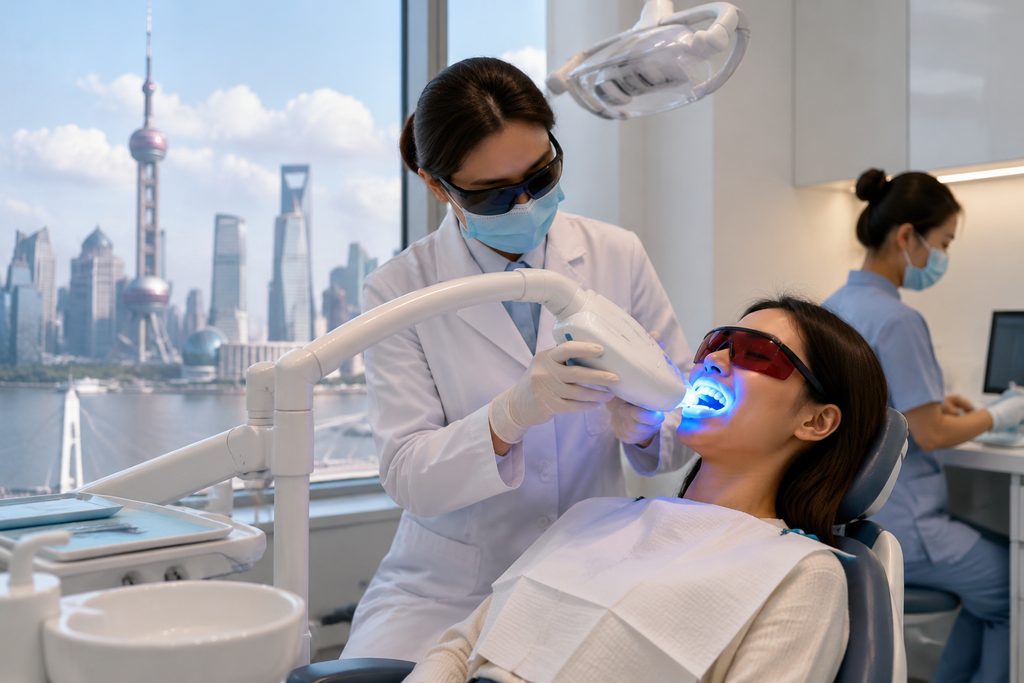
A dentist applies a high-concentration hydrogen peroxide or carbamide peroxide gel — usually 25% to 40% — directly to your teeth, sometimes activated by heat or light. One session takes 45 to 90 minutes. Most patients need one to three sessions spaced a week or two apart.
Laser-Activated Whitening
This is the same chemistry with a light source speeding up the reaction. It’s the most common search term patients use, so clinics market it heavily. How long does laser teeth whitening take? Typically 60 to 90 minutes for a single visit, including prep and shade documentation. The light does not make the result more permanent — it shortens chair time.
Take-Home Custom Trays
Your dentist takes impressions, a lab fabricates trays, and you apply a lower-concentration gel at home over one to two weeks. Cost is lower, results build more gradually, and sensitivity tends to be milder.
Teeth Whitening Cost China: What You Will Actually Pay
Here is the honest picture. Prices vary by hospital tier, city, and whether you go through a standard dental department or an international clinic. The table below reflects typical ranges at internationally accredited facilities in major Chinese cities.
| Procedure | China (USD) | United States (USD) | United Kingdom (USD equiv.) |
|---|---|---|---|
| In-office whitening, single session | $150–$450 | $500–$1,000 | $350–$700 |
| Laser-activated whitening | $250–$600 | $700–$1,500 | $500–$900 |
| Take-home custom tray kit | $100–$300 | $300–$600 | $250–$500 |
| Scaling and polishing | $40–$120 | $100–$300 | $80–$200 |
| Full treatment course (2–3 sessions) | $400–$1,200 | $1,200–$2,500 | $900–$1,800 |
These figures are estimates. Final pricing depends on the hospital, the whitening system used, and how much staining you have. A heavy smoker with tetracycline discoloration needs a different protocol than someone with mild coffee staining, and the price reflects that.
One detail worth knowing: China’s top public hospitals charge less than private international clinics, but the gap has narrowed. A private international dental clinic in Shanghai with English-speaking staff might charge $400 for a session that a public hospital‘s VIP international department prices at $280. You are paying for convenience and language, not necessarily better clinical work.
Finding the Best Teeth Whitening Clinic in Shanghai and Beyond
Shanghai has the deepest concentration of international-friendly dental care in mainland China. Beijing is close behind, followed by Guangzhou, Shenzhen, and Chengdu.
What Separates a Good Clinic From a Mediocre One
Three things matter more than price. First, whether the clinic performs a pre-treatment shade assessment and photographs your starting point — without this, nobody can prove the result. Second, whether they check for cavities, gum disease, and enamel cracks before whitening. Whitening over active decay is painful and clinically wrong. Third, whether they discuss sensitivity management upfront rather than dismissing your concerns.
Accreditation and Language
Look for facilities with JCI accreditation or a formal international department. These are the clinics accustomed to foreign patients, and they typically have bilingual coordinators. You can browse vetted options through our private international hospitals directory, which lists facilities with English-speaking staff and direct insurance billing arrangements.
For dental departments inside large public hospitals, the specialty rankings by department help you identify which institutions carry genuine clinical weight rather than just a marketing website.
Is Teeth Whitening Safe in China? The Straight Answer
Yes, when performed at a qualified facility using approved materials. The peroxide concentrations used in Chinese dental clinics match international norms, and the major whitening systems — Zoom, Opalescence, and their equivalents — are widely available.
The genuine risks are the same everywhere: temporary tooth sensitivity affecting roughly two-thirds of patients for 24 to 48 hours, gum irritation if the protective barrier is applied poorly, and — rarely — enamel damage from repeated over-treatment. None of these are China-specific problems. They happen in London and Los Angeles too.
What you should verify is the practitioner’s qualifications. Chinese dentists hold licensed credentials from the National Health Commission, and hospital-based specialists typically complete five years of dental school plus residency. Private clinics vary more. Ask directly about the treating dentist’s background and how many whitening cases they handle monthly.
How to Book Teeth Whitening Appointment in China: The Practical Steps
This is where most foreign patients hit friction. Public hospitals in China generally do not accept advance overseas bookings for standard outpatient dental care. You register on the day, in person, and queue. For a simple whitening session, that is workable but inefficient.
The alternative is going through a hospital’s international or VIP department, which does accept advance scheduling and provides English-language support. The trade-off is cost — often 1.5 to 2 times the standard rate.
A Realistic Timeline
- Weeks 1–2: Gather your dental records, decide on a city and clinic tier, and confirm whether the clinic requires a preliminary examination before whitening.
- Weeks 2–3: Secure your visa. Medical treatment falls under the S2 visa category, with a note indicating the purpose of visit. Supporting documents from the hospital help. Family members accompanying you apply under the same category.
- Arrival day: Registration, examination, shade documentation, and — if you are a suitable candidate — the first whitening session.
- Days 2–14: Follow-up sessions if needed, plus a take-home maintenance kit.
For patients combining dental work with a broader health checkup, the China Medical Services platform maps hospitals by city and specialty so you can plan both in one trip.
Dental Tourism Package China Teeth Whitening: What to Watch For
Packages bundling whitening with hotel stays and airport transfers exist, and some are genuinely good value. Others pad the price with services you do not need.
Run the numbers separately. If a package quotes $1,200 for whitening, three nights of hotel, and transfers, compare that against booking each component yourself. In Shanghai, a mid-range hotel runs $80 to $150 per night, and a whitening session at a solid clinic is $300 to $450. That math tells you quickly whether the package adds value or just convenience.
Also check what happens if you need a second session. Some packages cover only one, and the follow-up is billed at full rate.
Frequently Asked Questions
A single in-office session in China typically runs $150 to $450, versus $500 to $1,000 in the United States. A full course of two to three sessions lands between $400 and $1,200 in China. These are estimates and vary by hospital tier, city, and case complexity.
The major international whitening systems are used in Chinese clinics, and peroxide concentrations follow the same standards. Safety depends on the individual practitioner and whether a proper pre-treatment examination is performed. Ask about the dentist’s credentials and whether a screening exam is included.
Public hospitals generally do not accept advance overseas bookings for standard dental outpatient care — you register in person. International and VIP departments do accept advance scheduling, usually at 1.5 to 2 times the standard fee. Planning through a coordination service can bridge that gap.
Typically six months to two years, depending on your diet and smoking habits. Coffee, tea, red wine, and tobacco accelerate re-staining. Most patients benefit from a touch-up session or a take-home maintenance kit every six to twelve months. No clinic can promise permanent results.
Sensitivity is manageable with desensitizing agents applied before and after treatment, and most clinics adjust the protocol accordingly. Existing crowns, veneers, and fillings do not whiten — only natural enamel does. That mismatch is something a dentist should assess and discuss with you before you commit to treatment.
Your Next Step
Teeth whitening in China is a legitimate, well-established option with real cost advantages — provided you choose a qualified clinic and understand the logistics before you fly. The clinical procedure is straightforward. The coordination is where most patients need help.
We are China Medical Services, a patient coordination platform connecting international patients with 340+ top-ranked hospitals across 37 cities. We are not a hospital and we do not provide diagnoses or treatment. What we do is help you understand your options, coordinate appointments, and navigate the practical side of receiving care in China.
If you would like to explore clinic options in a specific city or get a clearer picture of what your treatment would involve, you can start with a free consultation. No pressure, no obligation — just a conversation about what is realistic for your situation.
This article is for general information only and does not constitute medical advice. Cosmetic dental procedures carry individual risks and suitability varies by patient. Always consult a licensed dentist before undergoing any treatment.
For more medical information and treatment options in China, visit chinamedservices.com (China Medical Services).
