Skin Repair Cost for Burns in China: What Foreign Patients Really Pay
Skin Repair Cost for Burns in China: What Foreign Patients Really Pay
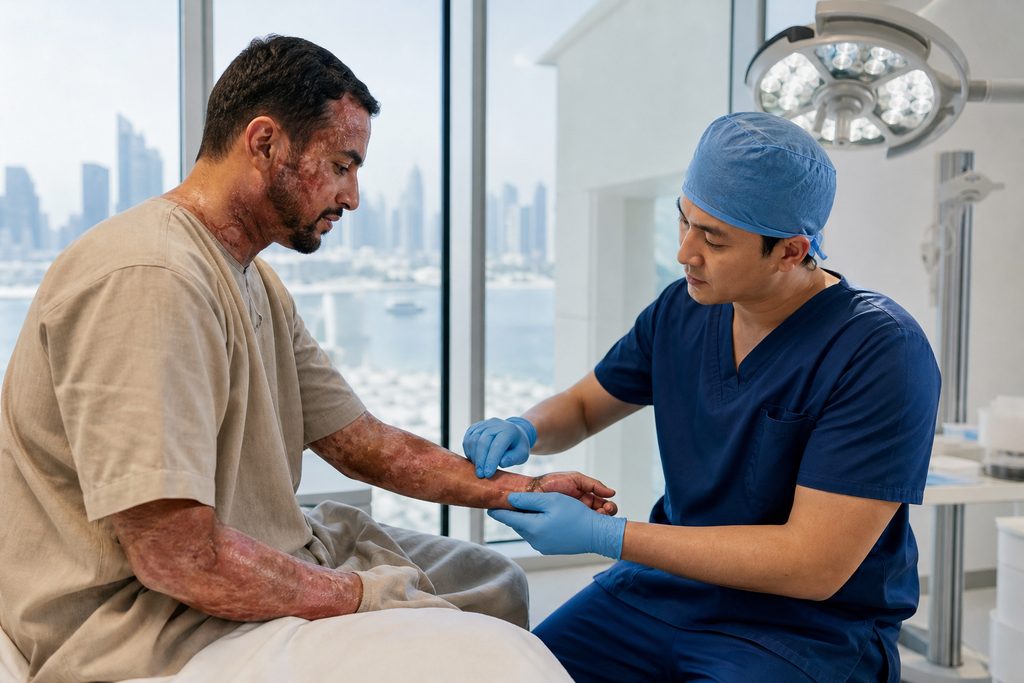
You’ve probably heard that surgery abroad means cutting corners. For burn care in China, the opposite is often true. The burn treatment cost China hospitals quote for a skin graft typically lands between $3,000 and $40,000 — a fraction of the $50,000 to $250,000 an uninsured patient faces in the United States. The catch is that price depends heavily on burn depth, graft surface area, and whether you enter through a standard ward or an international department.
That spread is wide, and it should be. A 5% superficial partial-thickness burn on a forearm is a different financial animal from a 40% full-thickness injury needing multiple staged grafts and months of rehabilitation. Anyone quoting you a single flat number before seeing your wound photos is guessing.
Burn Treatment Cost in China: The Short Answer
For a foreign patient paying out of pocket at a top-tier public hospital, expect the following: a small graft procedure runs roughly $3,000–$8,000 all-in. A moderate burn requiring one or two grafting sessions and a 2–3 week stay falls around $10,000–$25,000. Complex, large-surface burns needing repeated surgeries, ICU time, and long rehabilitation can exceed $40,000 — still well below Western private rates.
Private international hospitals charge more, often 1.5 to 2 times the public international-department rate, but they offer English-speaking staff, direct insurance billing, and shorter administrative friction. Neither route is “better.” They solve different problems.
The single biggest cost driver is not the hospital’s reputation — it is the total body surface area (TBSA) grafted and the number of surgical stages required.
Who This Is Right For — and Who It Isn’t
Medical travel for burns is not for everyone. Honest triage matters more here than in almost any other specialty, because burn wounds are time-sensitive.
You may be a reasonable candidate if:
- Your burn is healed or stable and you need reconstructive skin grafting, scar contracture release, or cosmetic revision.
- You are uninsured or underinsured at home and facing a five- or six-figure quote.
- You can travel safely — no active infection, no unstable airway, cleared for a long-haul flight by your treating physician.
- You have 2–4 weeks available for surgery plus early recovery before flying home.
You should probably not pursue this if:
- You have an acute, fresh, or infected burn. Emergency burn care belongs where you are, now. Do not board a plane.
- You are medically unstable, on significant ventilator support, or in the early resuscitation phase.
- You need continuous follow-up you cannot realistically access after returning home.
- You expect a guaranteed surgical date before a surgeon has seen your wound in person.
That last point surprises people. It is also the most important one on this list.
The Options, Compared
Here is how the realistic alternatives stack up for a moderate burn requiring skin grafting. Figures are typical ranges for self-paying international patients and vary by hospital and case complexity.
| Option | Typical Cost (USD) | Wait Time | Language Support | Insurance Billing |
|---|---|---|---|---|
| US hospital, uninsured | $50,000–$250,000 | Days to weeks | Native | Self-pay or negotiated |
| UK private hospital | $25,000–$90,000 | Weeks | Native | Often direct |
| China top public hospital (standard ward) | $3,000–$20,000 | Days after in-person consult | Limited English | Pay first, claim later |
| China public international department | $8,000–$40,000 | Coordinated in advance | English available | Pay first, claim later |
| China private international hospital | $15,000–$60,000 | Fast scheduling | Full English | Direct billing common |
Which column fits you? If cost is the deciding factor and you can tolerate a language barrier with support, the public international department is the sweet spot. If you have international insurance that reimburses, a private hospital’s direct billing removes enormous administrative pain. If you are uninsured and mobile, the standard public ward delivers the same surgical skill at the lowest price — you simply handle more logistics yourself.
Finding the Best Burn Hospital in Beijing for Foreigners
Burn care in China concentrates in a handful of major centers, and Beijing is one of the strongest cities for it. The country’s top reconstructive and burn units sit inside large teaching hospitals that also appear on the Fudan Hospital Rankings — the closest thing China has to a national league table.
Beijing hosts 21 of the Fudan Top 100 hospitals, more than any other city. Several maintain dedicated burn and plastic-reconstructive surgery departments with high annual case volumes. Volume matters in burn surgery. A unit performing hundreds of grafts a year develops pattern recognition that low-volume centers simply cannot match.
For foreigners, the practical question is not “which hospital is ranked highest” but “which hospital has an international department that can register me, translate my records, and schedule a surgeon who handles complex grafts.” Those are different lists.
You can browse ranked institutions by specialty and city through our directory of top-ranked departments, or compare Beijing options directly on the Beijing hospital page.
Ask any hospital two questions before committing: how many burn-graft procedures does the unit perform annually, and does the international department assign an English-speaking coordinator? Vague answers are a red flag.
What Drives the Final Price — and What’s Included
You can coordinate an international-department appointment in advance through a hospital’s international office or a service coordinator. Standard public outpatient registration generally cannot be pre-booked from overseas. Surgery itself is scheduled only after an in-person consultation, because the surgeon must assess the wound directly.
At high-volume teaching hospitals, planned reconstructive burn surgery follows international protocols and outcomes are broadly comparable to Western academic centers. The larger risks for foreigners are logistical — language barriers, unfamiliar payment systems, and fragmented follow-up — not surgical quality.
Complications such as infection, graft failure, or contracture can occur weeks after surgery. Before traveling, arrange a local physician who can assess the graft and continue scar therapy. Request your operative notes and discharge summary in English so your home doctor has full context.
Some international policies reimburse treatment abroad; many do not. Public hospitals require prepayment and later reimbursement, while private international hospitals often bill insurers directly. Contact your insurer before booking and ask specifically about overseas elective and reconstructive coverage.
Your Next Step
The takeaway is simple: burn reconstruction in China can cost a fraction of Western prices without sacrificing surgical quality at a major center — provided you plan for the logistics, the visa, and the months of follow-up that come after the operating room. China Medical Services is not a hospital and does not diagnose or treat anyone. We connect international patients with 340+ top-ranked hospitals across 37 cities, arrange written second opinions and video consultations, and provide bilingual medical companions who handle registration, payment, and translation on the ground.
If you are weighing your options, start with a free consultation. Send your records, describe your situation, and get an honest read on whether traveling to China makes sense for your case — no pressure, no obligation. You can begin at our patient consultation page.
This article is for general information only and is not medical advice. Burn injuries require assessment by a qualified physician. Always consult a licensed clinician before making treatment or travel decisions.
Frequently Asked Questions
Yes. The hospitals used for international patients are JCI-accredited and follow the same international safety standards as top hospitals in the US and Europe. Surgical teams perform high volumes of procedures — often more than their Western counterparts — which studies show leads to better outcomes.
Costs vary by procedure and hospital, but international patients typically save 40-80% compared to US prices — even when factoring in travel and accommodation. A consultation with our team will give you an exact, all-inclusive quote with no hidden fees.
Send us your existing medical reports to get started. We handle everything from hospital selection and appointment scheduling to visa assistance and post-operative recovery planning. Your medical records are reviewed by the specialist before you even book a flight.
For more medical information and treatment options in China, visit chinamedservices.com (China Medical Services).
