CT Scan in China: Records for Your Doctor Explained
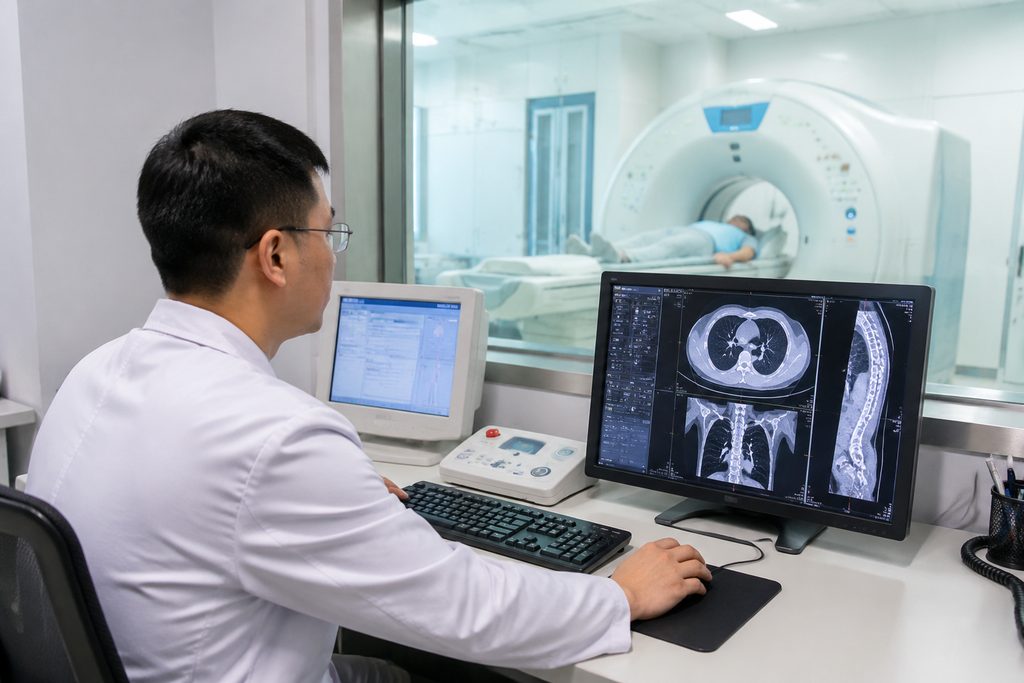
While a patient in Canada waits a median 28.6 weeks for a hip replacement, a single large Chinese public hospital can process more than 10,000 outpatient visits in a day — and its imaging department may run CT scans late into the evening. That gap is why so many international patients now ask us about diagnostics in China. A CT scan is often the fastest, most affordable part of that journey.
Here is the short answer on CT scan cost China: a standard non-contrast CT at a top-tier Chinese public hospital typically runs from $80 to $350, depending on the body part and whether contrast dye is used. Private international hospitals charge more, often $400 to $1,200. And the records you get afterward — images plus a written report — can be translated and sent to your own doctor at home.
The caveat? Getting a scan is easy. Getting records your home physician will actually accept takes a little planning.
CT Scan Cost China: The Short Answer
Pricing in China’s public system is set by provincial health authorities, not by individual hospitals, which keeps it low and fairly predictable. A routine head CT might cost $80–150. A chest CT with contrast, $150–300. A full-body low-dose screening scan, $300–600.
Private international hospitals — places like United Family or Jiahui — charge Western-adjacent prices but offer English-speaking staff, shorter waits, and direct insurance billing. You are paying for convenience, not necessarily better imaging.
One thing to understand: the price you see quoted is usually the scan itself. Contrast dye, radiologist interpretation, and printed films or digital copies may be itemized separately. Ask for a full package quote before you commit.
Who This Is Right For — and Who It Isn’t
This route suits a specific kind of patient. It is not for everyone.
Typically a good fit:
- You already have symptoms or a referral, and you’re facing a long wait at home.
- You’re traveling to China for other treatment and want imaging done alongside it.
- You need a follow-up scan and want to compare it against a baseline.
- You’re paying out of pocket and cost matters.
Probably not the right move:
- You need an emergency diagnosis. Go to the nearest ER, wherever you are.
- Your home doctor has ordered a specific protocol that must match an existing scan exactly.
- You can’t travel, or a local scan is genuinely fast and covered by insurance.
- You’re seeking a scan with no clinical reason — “just to check” imaging carries radiation and rarely helps.
Being honest about the last point matters. A CT scan delivers a real radiation dose. It is a diagnostic tool, not a wellness product.
The Options, Compared
Here is how the realistic choices stack up for an international patient.
| Option | Typical Cost | Wait Time | English Support | Insurance |
|---|---|---|---|---|
| US hospital, out of pocket | $1,200–$4,500 | Days to weeks | Yes | Direct billing |
| UK private clinic | $500–$1,500 | 1–3 weeks | Yes | Often self-pay |
| China, top public hospital | $80–$350 | Same day to 3 days | Limited | Pay first, claim later |
| China, private international hospital | $400–$1,200 | 1–5 days | Full | Direct billing common |
Which column suits you? If cost is the deciding factor and you can tolerate a busy public hospital, the public tier wins by a wide margin. If you value an English-speaking radiologist walking you through results on the spot, or you want your insurer billed directly, the private tier is worth the premium.
How to Get CT Scan Records for My Doctor in China
This is the part most guides skip, and it’s the part that determines whether your trip was useful.
Every Chinese hospital produces two things: the DICOM image files and a written radiology report in Chinese. Your home doctor needs both. The images alone are meaningless without the radiologist’s measurements and impressions. The report alone is useless without the images to review.
Here’s the practical sequence:
- Request the DICOM files on a USB drive or disc. Ask at the imaging department desk. There is usually a small fee, often under $10.
- Get the written report, stamped. A hospital seal (the red chop) makes it an official document.
- Have both translated. The images don’t need translating, but the report does — by someone who understands medical terminology, not a general translation app.
- Send a cover note. A short summary of why the scan was done, what was found, and the date helps your physician slot it into your history.
This is where a service like our patient coordination team earns its place. We handle the records request, the certified translation, and the secure transfer, so your doctor receives a clean, readable package rather than a Chinese-language PDF they can’t interpret.
Is a CT Scan in China Safe for Foreigners?
Yes, with the same caveats that apply anywhere.
China’s top-tier hospitals use modern multislice CT scanners, often the same Siemens, GE, or Philips machines found in Western hospitals. Radiation protocols follow international standards. Contrast dye safety procedures mirror global practice, including kidney function checks before iodine contrast.
The genuine friction points aren’t safety. They’re communication and consent. In a busy public hospital, staff may not speak English, and the consent form will be in Chinese. You need to understand what you’re agreeing to. This is exactly why bilingual accompaniment exists — not to replace the doctor, but to make sure nothing is lost between you and them.
If you have a contrast allergy, kidney disease, or you’re pregnant, say so clearly and early. Bring documentation.
Book CT Scan Shanghai Hospital: A Practical Walkthrough
Shanghai is one of the easiest entry points. It has several top-ranked hospitals, a large expatriate community, and international departments set up for foreign patients.
For a public hospital, the typical route is: register at the international or VIP department, pay the consultation fee, see a physician who writes the imaging order, then book the scan. Walk-in is possible but slower.
For a private international hospital, you can often book directly. Some accept online scheduling. Expect English at every step.
A few logistics worth knowing:
- Visa: medical treatment falls under the S2 short-stay category, with S1 for stays over 180 days. Accompanying family members also apply for S2. Note that the M visa is for commercial and trade activity — it is not a medical visa. Always confirm current requirements with your nearest Chinese embassy or consulate.
- Payment: public hospitals require upfront payment; you claim reimbursement from your insurer afterward. Private hospitals frequently bill insurers directly.
- Timing: build in a buffer day. Results and reports aren’t always ready the same afternoon.
If you want to compare hospitals by specialty before choosing, our department-by-department rankings show which institutions lead in fields like oncology and orthopedics.
CT Scan China Price Package for Tourists
Some private hospitals and health-screening centers market bundled imaging packages aimed at visitors. A “health check” package might include a chest CT, bloodwork, and a physician consultation for $500–$1,500 total.
These can be good value if you genuinely want a broad checkup. But be careful. Screening scans in people with no symptoms sometimes surface incidental findings that trigger anxiety, follow-up tests, and procedures that were never needed. More imaging is not automatically better medicine.
If you’re a tourist considering a scan, ask yourself one question: is there a clinical reason? If yes, pursue it. If it’s curiosity, talk to a physician first.
Practical Considerations: Records, Translation, and Follow-Up
The scan is a moment. The records are what travel home with you.
Medical imaging records translation China for doctor is a real service category, and quality varies. A machine translation of a radiology report can mangle measurements and invert findings. Use a translator familiar with clinical language, or a coordination service that provides one.
Insurance. Check whether your policy reimburses overseas diagnostics. Many do, but require itemized receipts and the translated report. Keep every receipt.
Follow-up. If a finding needs monitoring, you’ll want a repeat scan in six or twelve months. Ask the radiologist to note the protocol used, so a future scan can match it. Comparing scans taken with different settings is harder than it needs to be.
Language. Even in international departments, the radiologist’s report may be written in Chinese first. Confirm you’ll receive an English version before you leave the building.
Frequently Asked Questions
A standard CT at a top Chinese public hospital typically runs $80–$350, versus $1,200–$4,500 in the US for the same scan. Private international hospitals in China sit in between, around $400–$1,200. Final pricing varies by hospital, body part, and whether contrast is used.
Usually yes, provided you supply the DICOM image files and a professionally translated radiology report. Some physicians prefer to re-read the images themselves, which the DICOM files allow. Bring both, and a short cover note explaining the context.
In many large public hospitals, yes — but it’s not instant. You typically register, see a physician for an order, then book the scan. Wait times are often short by Western standards, sometimes same-day. Private international hospitals usually let you book in advance.
The radiation dose is comparable to any modern CT anywhere in the world. The real question is whether the scan is clinically justified. Discuss the indication with a physician before scanning, and avoid repeat imaging without a clear reason.
Medical treatment generally falls under the S2 short-stay visa category, with S1 for longer stays. Family accompanying you also apply for S2. Requirements change, so verify current rules with your nearest Chinese embassy or consulate before booking travel.
Your Next Step
A CT scan in China can be fast, affordable, and technically excellent — but only if the records reach your doctor in a form they can use. That last mile is where most self-arranged trips fall short.
We are not a hospital and we don’t diagnose anything. We coordinate: records requests, certified translation, hospital appointments, and bilingual accompaniment through the whole process. If you’d like to understand your options, start with a no-pressure conversation through China Medical Services. Bring your questions. We’ll help you see the path clearly.
For more medical information and treatment options in China, visit chinamedservices.com (China Medical Services).
