Sleep Apnea Test in China: A Booking Guide for Foreign Patients
Sleep Apnea Test in China: A Booking Guide for Foreign Patients
What if the loudest thing in your bedroom is the one thing keeping you exhausted? For millions of people, that is exactly the situation. They snore, they wake up gasping, they fall asleep at their desks — and they never get tested because a sleep study at home costs a fortune or takes months to schedule. That is why a growing number of international patients are asking about the sleep apnea test cost in China, and whether a Chinese hospital can deliver the same diagnostic quality for a fraction of the price.
The short answer: yes, in most cases. China’s top-tier hospitals run fully equipped sleep laboratories, and the price gap versus the United States is significant. But the booking process is not like walking into a Western clinic. There are real quirks — appointment rules, language barriers, visa categories — that trip people up. This guide walks you through all of it.
How This Actually Works, Step by Step
Here is the real sequence, from your couch to a diagnosis.
Step one: you gather your existing records. A recent sleep questionnaire, any home oxygen readings, a referral letter from your doctor, and a list of your medications. If you have already done a home sleep apnea test elsewhere, send those results too. Everything gets translated into Chinese by our team before it reaches the hospital.
Step two: a Chinese sleep specialist reviews your file. This is a written second opinion. You are not booking a hotel room here — a pulmonologist or sleep medicine physician reads your case and tells you whether an in-lab study is even necessary. Some patients only need a home test kit, which is cheaper and simpler.
Step three: you choose between a video consultation and a proxy visit. In a video consultation, you speak directly with the specialty team, explain your symptoms and goals, and hear their recommendations. If you would rather have someone physically visit the hospital on your behalf, we can arrange a proxy consultation using your materials.
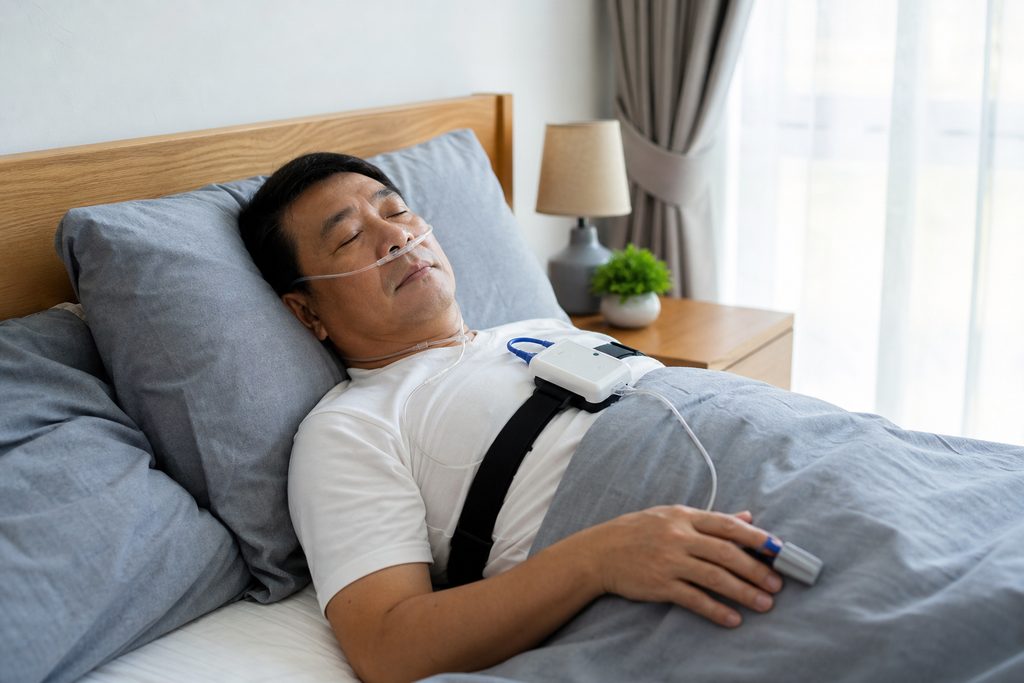
Step four: the study itself gets scheduled. An overnight polysomnography typically requires an in-person appointment at the sleep lab. You arrive in the evening, get wired up with sensors, sleep overnight, and leave the next morning.
Step five: results and a treatment plan. A report comes back within a few days, usually with an apnea-hypopnea index (AHI) score and a recommendation — CPAP, oral appliance, surgery, or lifestyle changes.
What the Sleep Apnea Test Cost in China Actually Looks Like
Let’s talk numbers, because this is why most people are reading.
An overnight in-lab polysomnography at a major Chinese public hospital generally runs between $150 and $450, depending on the city and the hospital tier. A private international hospital in Shanghai or Beijing will charge more — often $600 to $1,200 — but you get English-speaking staff, a private room, and direct insurance billing. A home sleep apnea test kit costs less, usually $80 to $200.
Compare that to the United States, where an in-lab sleep study routinely bills at $1,000 to $3,000 before insurance, and the gap is obvious. Even the “best sleep clinic Shanghai price” at a premium private facility undercuts most American hospitals.
| Test Type | China (Public Hospital) | China (Private International) | United States |
|---|---|---|---|
| Home sleep apnea test | $80–$200 | $150–$300 | $150–$500 |
| In-lab polysomnography | $150–$450 | $600–$1,200 | $1,000–$3,000 |
| Follow-up consultation | $20–$80 | $100–$250 | $150–$400 |
These figures vary by hospital and case complexity. They also exclude travel, accommodation, and any treatment you may need afterward. A CPAP machine in China, for instance, ranges from $300 to $900 depending on the model.
A Realistic Timeline
People underestimate the waiting steps. Here is what a typical schedule looks like when you start from abroad.
| Stage | What Happens | Typical Duration |
|---|---|---|
| Record collection & translation | You send reports; we translate and format them | 3–7 days |
| Written second opinion | A Chinese sleep specialist reviews your file | 5–10 business days |
| Video or proxy consultation | You speak with the team or we visit on your behalf | 1–2 weeks after records arrive |
| Hospital appointment booking | Sleep lab slot confirmed | 1–4 weeks (longer for top-tier hospitals) |
| Visa processing (S2) | Short-stay visa for medical treatment | 4–10 business days after submission |
| Travel and the study itself | Arrive, overnight study, next-morning discharge | 2–3 days on the ground |
| Results and treatment plan | Report delivered, follow-up discussion | 3–7 days after the study |
Add it up: from first contact to holding a diagnosis, most patients are looking at four to eight weeks. If you need a specific specialist at a top-ranked hospital, add another two weeks. Rush cases exist, but they cost more and depend entirely on hospital availability.
What Can Go Wrong — and What Happens Then
Honesty matters more than comfort here.
The sleep lab is fully booked. Top hospitals in Beijing and Shanghai fill their sleep study slots weeks ahead. If your travel dates are tight, you may need to accept a less famous hospital or a private clinic. That is not a downgrade in quality — many private international hospitals use the same diagnostic equipment.
Your visa gets delayed. S2 visas require supporting documents from the hospital. If those documents are incomplete, the application stalls. We prepare the paperwork, but the consulate makes the final call. Never book flights before the visa is in hand.
The study shows something unexpected. Occasionally a polysomnography reveals central sleep apnea or a cardiac issue that changes the treatment path. In that case, the sleep specialist refers you to cardiology or neurology — and that may mean a longer stay than planned.
You cannot tolerate CPAP. Roughly half of patients struggle with CPAP masks initially. The good news: Chinese hospitals offer alternative fittings and oral appliances, and follow-up consultations are inexpensive.
The language barrier bites. This is the most common complaint. Even at hospitals with “international” departments, the sleep technician hooking up your sensors may not speak English. That is precisely why bilingual medical companions exist.
Choosing the Right Hospital and Avoiding Common Mistakes
Not every hospital with a sleep lab is equal. Here is how to evaluate one.
Look for hospitals ranked in the Fudan specialty reputation list for respiratory medicine or neurology. Our department directory lists the top 10 hospitals for each specialty, including pulmonology. If you are considering Beijing, our Beijing hospital guide breaks down which facilities have dedicated sleep centers.
The most common mistakes we see:
- Booking a home test kit when symptoms clearly point to severe sleep apnea
- Assuming the hospital will provide an English-speaking sleep technician (many do not)
- Arriving without translated medical records, forcing a repeat of tests already done at home
- Confusing the M visa with a medical visa — M is for commercial and trade activities only. Medical travel uses the S2 category, subject to the latest embassy requirements
- Forgetting that public hospitals require prepayment, with insurance reimbursement happening afterward
One more thing worth checking: whether the hospital’s sleep lab uses the latest American Academy of Sleep Medicine scoring criteria. Most top-tier Chinese hospitals do, but it is a fair question to ask.
Practical Considerations: Records, Visas, Payment, and Follow-Up
Records. Bring everything. A sleep diary covering two weeks, your Epworth Sleepiness Scale score if you have one, and any prior imaging. Translated records speed up the second opinion considerably.
Visa. The S2 visa covers short-stay medical treatment. Accompanying family members apply for the same category. Processing usually takes four to ten business days, but consulate timelines vary by country — check with your nearest Chinese embassy for current requirements.
Payment. Public hospitals want prepayment. Private international hospitals often bill insurance directly, which is a major convenience if your insurer has a network agreement. Confirm coverage before you travel.
Language. If you do not speak Mandarin, arrange interpretation in advance. A bilingual medical companion handles registration, queueing, payment, and translation throughout your visit. Rates start from $300 per day.
Follow-up at home. Ask for your full polysomnography report in English, including raw data. Your home physician will want it. CPAP settings can usually be adjusted remotely or through a local provider.
Frequently Asked Questions
Yes. Polysomnography is a non-invasive, painless procedure. You sleep while sensors record your breathing, heart rate, and brain activity. The main risks are discomfort from the sensors and a poor night’s sleep in an unfamiliar bed — not medical danger.
The overnight study itself lasts roughly eight hours, from about 9 p.m. to 6 a.m. You are discharged the following morning. Results typically arrive within three to seven days. The longer wait is scheduling the appointment, which can take one to four weeks at busy hospitals.
Partly. You can complete the record review, written second opinion, and video consultation remotely. The overnight study itself requires your physical presence at the sleep lab. A proxy visit can handle registration and paperwork beforehand, but the sensors go on you, not a representative.
You do not need a bundled “package” in the commercial sense. What you need is coordination: hospital matching, appointment booking, translated records, and a bilingual companion on the day. Those services can be arranged individually, and any consultation fee is credited in full toward on-the-ground coordination if you proceed within 90 days.
Sometimes. Many international insurers reimburse treatment at Chinese public hospitals after the fact, provided you submit itemized receipts and the full diagnostic report. Private international hospitals with direct billing agreements are easier to work with. Call your insurer before booking.
Your Next Step
A sleep apnea diagnosis is not a luxury — it is the difference between managed health and years of cumulative strain on your heart and metabolism. China offers a genuinely affordable, high-quality path to that diagnosis, provided you navigate the booking process correctly. We are China Medical Services, a patient coordination team that connects international patients with 340+ top-ranked hospitals across 37 cities. We are not doctors, and we do not provide medical advice or guarantee any clinical outcome. What we do is handle the logistics — records, appointments, interpretation, and visa guidance — so you can focus on your health. When you are ready, start with a free consultation and we will map out your options.
This article is for informational purposes only and does not constitute medical advice. Always consult a qualified healthcare provider before making decisions about diagnosis or treatment.
For more medical information and treatment options in China, visit chinamedservices.com (China Medical Services).
