Sleep Study in China: How We Help You Save 80% on Diagnosis
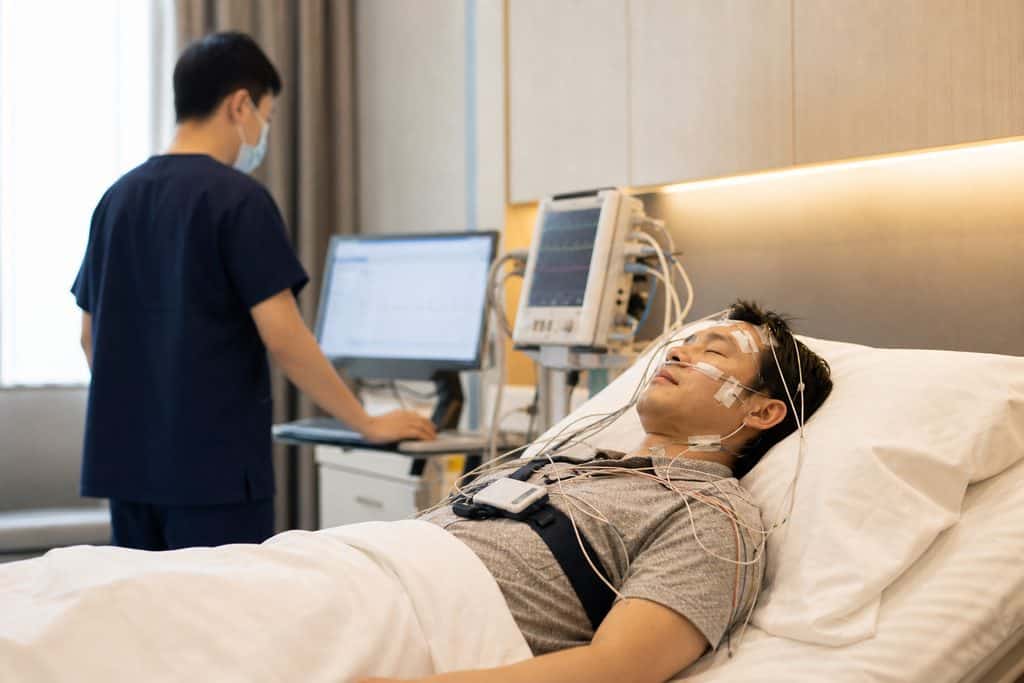
Roughly 936 million adults worldwide live with obstructive sleep apnea, according to a 2019 analysis published in The Lancet Respiratory Medicine — and the American Academy of Sleep Medicine estimates that undiagnosed sleep apnea costs the US economy alone about $150 billion a year in lost productivity and accidents. Here is the number that stops people mid-scroll: a full overnight polysomnography (PSG) at a top-tier Chinese hospital typically runs $300 to $900. The same attended study in the United States bills at $3,000 to $8,000 before insurance. That gap is why searches for “sleep study cost China” have climbed steadily among uninsured Americans, expats, and patients facing six-month waits at home.
But cost is the easy part. The harder questions are whether the data is trustworthy, who reads the results, and what happens after the diagnosis lands in your inbox. This guide answers all three.
Sleep Study in China: The Short Answer
A diagnostic overnight sleep study in China costs between $300 and $900 at a major public hospital, or $1,200 to $2,500 at a private international clinic. Results are usually ready in three to seven days. You do not need a visa just to get tested — but if you plan to combine testing with treatment, the S2 visa is the correct category for medical travel.
The complication: Chinese public hospitals do not let overseas patients book a standard outpatient sleep clinic slot in advance. Registration happens on the day, in person, in Mandarin. That single rule reshapes the entire trip. It is also the reason a coordination service exists at all.
Who This Is Right For — and Who It Isn’t
Sleep medicine is one of the few specialties where traveling abroad makes clean sense. The test is standardized, the equipment is identical to what you would see in Cleveland or Munich, and the output is a numeric report — not a surgeon’s judgment call.
Typically a good fit:
- Uninsured or under-insured patients in the US facing a $3,000+ sleep study quote
- Patients on public waitlists exceeding four to six months
- Expats already living in Asia who want a full workup without flying to Singapore or Seoul
- People who need a titration study (CPAP pressure calibration) and were quoted a second full-price study at home
- Patients wanting a same-week appointment rather than a same-quarter one
Probably not a good fit:
- Anyone with unstable cardiac or pulmonary disease who should not fly
- Patients whose insurance only reimburses in-network US providers — the out-of-pocket math often flips
- Complex pediatric cases involving rare syndromes, where continuity with a home specialist matters more than price
- People who need the results in under 48 hours for an urgent surgical clearance
Being honest about that second list matters more than the first. A sleep study is a diagnostic tool, not an emergency procedure. If your situation is stable, the trip is manageable. If it is not, stay home.
The Options, Compared
Four realistic paths exist. The table below uses published price ranges and typical wait times; every figure varies by hospital and case complexity.
| Option | Typical Cost (USD) | Wait Time | Who Reads the Results | Language Support |
|---|---|---|---|---|
| US hospital, attended PSG | $3,000–$8,000 | 3 weeks–6 months | Board-certified sleep physician | English |
| US home sleep apnea test | $500–$1,500 | 1–4 weeks | Sleep physician (often remote) | English |
| Top Chinese public hospital (Grade 3A) | $300–$900 | Days to 2 weeks | Hospital sleep center physician | Limited; interpreter needed |
| Private international clinic in China | $1,200–$2,500 | Same week | English-speaking sleep specialist | Full English |
Which column suits you? If your budget is the binding constraint and you can travel with support, the public hospital row wins by a wide margin. If you want zero friction and speak no Mandarin, the private clinic row is worth the premium — you are paying roughly $1,000 for language, scheduling, and direct insurance billing. Home testing is the cheapest option overall, but it misses limb movements, arousals, and REM behavior events that only attended PSG captures.
What a Chinese Sleep Lab Actually Measures
This is where patients get surprised. Chinese sleep centers at major hospitals use the same AASM scoring rules as Western labs — the apnea-hypopnea index (AHI), oxygen desaturation index, arousal index, and sleep stage percentages all follow international standards. The report is a data document. Numbers travel across borders better than opinions do.
What differs is the environment. A Grade 3A hospital sleep center in Beijing or Shanghai may run six to twelve beds per night, with technicians monitoring from a shared station. Rooms are functional rather than hotel-like. Private international clinics offer single rooms, private bathrooms, and an English-speaking technician who explains each sensor before placement.
Ask one question before booking anywhere: does the final report include raw data, or only a summary? You want the raw data. Your home physician can then re-interpret it independently, which removes any doubt about scoring differences.
Sleep Study Cost in China: What Drives the Number
The base range of $300 to $900 covers an attended overnight polysomnography, technician time, and a physician’s interpretation. Several factors push you toward the top of that band or past it:
- Hospital tier. A Fudan-ranked sleep center charges more than a regional hospital, and it is usually worth it — the interpretation quality differs.
- Study type. A split-night study (diagnosis plus CPAP titration in one night) costs roughly 1.3 to 1.6 times a diagnostic-only night.
- Multiple nights. MSLT (Multiple Sleep Latency Test) for narcolepsy evaluation requires a full day of nap trials after the overnight study and typically adds $400 to $800.
- Private versus public. The private clinic premium is real, and it buys English, scheduling, and comfort.
What is usually not included: the consultation to review results, CPAP machine purchase, mask fitting, and follow-up titration. Budget an additional $150 to $400 for the review appointment, and $500 to $1,500 if you buy a CPAP in China. Machines from ResMed and Philips are widely available, though prices are not dramatically lower than in the US.
For context on how these figures fit into the broader picture, our directory of top-ranked Chinese hospitals groups facilities by city and specialty tier so you can see which centers actually run accredited sleep labs.
Is a Sleep Study in China Safe?
Yes, with conditions. Sleep medicine is non-invasive. There is no anesthesia, no incision, no recovery period. The main risks are logistical, not clinical.
The real safety question is data integrity and follow-through. Three things protect you:
- Choose an accredited lab. Look for hospitals with a dedicated sleep medicine department, not a general respiratory unit offering overnight monitoring as a sideline.
- Get the raw data. As above — a report you can hand to any physician anywhere.
- Line up your follow-up before you fly. A diagnosis without a treatment plan is just a piece of paper.
Practical Considerations: Visas, Records, and Payment
Visa. For a short diagnostic trip, many nationalities enter China visa-free or on a standard tourist visa depending on current policy. If you are traveling specifically for medical treatment, the S2 visa is the applicable short-stay category for medical treatment and private affairs, issued with supporting hospital documentation and subject to the latest embassy or consulate requirements. Stays beyond 180 days fall under S1. Accompanying family members apply under the same S2 category. Note clearly: the M visa is for commercial and trade activities and has nothing to do with medical travel.
Records. Bring prior sleep studies, medication lists, and any cardiac or pulmonary history in English. Chinese sleep physicians read English reports routinely, but a translated summary speeds things up.
Payment. Public hospitals accept international credit cards at most large facilities, though some counters are cash or domestic-card only. Private clinics accept international cards without issue. Carry a backup payment method.
Language. This is the practical wall. A sleep lab involves instructions — “don’t move your head,” “the sensor came loose,” “we need you to sleep on your back.” Without a Mandarin speaker present, the night can produce unusable data. A bilingual medical companion for the admission and overnight setup solves this directly.
After you return home. Hand the raw data to your primary care physician or a local sleep specialist. Treatment — CPAP, oral appliance, or positional therapy — can usually be managed locally once the diagnosis is confirmed.
If you want to understand how appointment coordination works across different hospital types, our overview of how we support international patients walks through the staged process, from written second opinion to on-the-ground coordination.
Frequently Asked Questions
A diagnostic overnight polysomnography in China runs $300 to $900 at a top public hospital and $1,200 to $2,500 at a private international clinic. Comparable attended studies in the US bill $3,000 to $8,000. European prices sit between the two, typically $1,500 to $3,500. The savings are real, but factor in flights, accommodation, and interpreter costs before comparing bottom lines.
Not directly at a public hospital. Standard outpatient registration happens in person on the day, and sleep lab slots are allocated after an initial consultation. Private international clinics do accept advance bookings. For public hospitals, the practical route is a proxy consultation or a coordination service that handles registration and scheduling on your behalf — though final scheduling always remains subject to hospital rules.
Public hospitals generally require prepayment, and you file for reimbursement with your insurer afterward. Private international hospitals in China frequently offer direct billing with major international insurers, but coverage depends entirely on your specific policy. Call your insurer before you book, and ask specifically whether they reimburse overseas sleep studies and what documentation they require.
Sleep apnea is the most common finding, and it is manageable. Severe cases may involve significant oxygen desaturation, which warrants prompt treatment but is not an emergency in a stable patient. If the study reveals a cardiac arrhythmia or another unexpected finding, you would want follow-up with the appropriate specialist — which can happen in China or at home once you have the data. Get a copy of everything before you leave the hospital.
For a private international clinic, no. For a public hospital sleep lab, effectively yes — or you need someone with you. The overnight setup involves real-time instructions from technicians, and miscommunication can invalidate the recording. This is the single most common reason a self-arranged sleep study in China produces unusable results.
Your Next Step
The core message is simple: a sleep study in China costs a fraction of the US price, uses identical international scoring standards, and produces data any physician worldwide can read. The barriers are logistical — scheduling, language, and follow-through — not clinical.
We are China Medical Services, a coordination team that connects international patients with 340+ top-ranked hospitals across 37 cities. We are not a hospital and we do not diagnose or treat anyone. What we do is translate records, coordinate appointments through official hospital international departments, and provide bilingual companions who sit through the night with you if needed. If you want to explore whether this makes sense for your situation, start with a free consultation — no obligation, no pressure, just a conversation about what is actually possible.
For more medical information and treatment options in China, visit chinamedservices.com (China Medical Services).
