Is My Snoring a Sign of Sleep Apnea? Cost & Diagnosis Guide
Key Takeaways
- Loud, chronic snoring affects roughly 40% of adult men and 24% of adult women, yet only a fraction ever undergo a diagnostic sleep study.
- Untreated obstructive sleep apnea triples the risk of motor vehicle accidents and doubles the risk of heart attack or stroke over a decade.
- China’s top sleep centers run polysomnography at 60–80% lower cost than US hospital labs, with comparable diagnostic accuracy.
- Before booking anything, understand that a sleep study is the only reliable way to distinguish harmless snoring from true apnea.
The Problem: Snoring Is Common, But Sleep Apnea Is Dangerous
In the United States, an in-lab polysomnography typically costs between $3,000 and $7,000 before insurance. In China, the same study at a top-tier public hospital runs $300 to $800. That gap explains why more international patients are searching for sleep apnea treatment cost China before they even know whether they have the condition. But cost is only half the story.
Around 22 million Americans have moderate to severe obstructive sleep apnea, and roughly 80% remain undiagnosed. Many of them assume their snoring is just a nuisance — something their partner tolerates. The reality is more sobering. Repeated airway collapse during sleep drops blood oxygen levels, spikes blood pressure, and fragments sleep architecture dozens of times per hour. Over months and years, that strain shows up as atrial fibrillation, resistant hypertension, type 2 diabetes, and cognitive decline.
So the question is not just “is snoring a sign of sleep apnea.” The better question is: how do you know, and how fast can you find out?
Why China Delivers Results for Sleep Disorder Diagnosis
China’s sleep medicine infrastructure has expanded rapidly over the past decade. Major public hospitals in Beijing, Shanghai, and Guangzhou now operate dedicated sleep centers with full polysomnography suites, multiple-night capacity, and specialists trained in both respiratory and neurological sleep medicine. The structural advantages are real.
Clinical Volume Sharpens Diagnostic Skill
A single sleep center at Peking University People’s Hospital or Shanghai Pulmonary Hospital may run 20 to 40 sleep studies per night. That is 7,000 to 14,000 studies per year at one facility. By comparison, many US community hospital sleep labs run 5 to 10 studies per night. Volume matters because sleep apnea presents in varied forms — positional, REM-related, central, mixed — and scoring a polysomnogram correctly requires seeing thousands of raw tracings. Chinese sleep technicians and interpreting physicians see more of them, faster.
Technology and Workflow Efficiency
Top Chinese sleep labs use the same polysomnography hardware as Western centers — Respironics, ResMed, Natus, and Compumedics systems are standard. The difference is workflow. A patient typically arrives at 8:00 PM, gets wired up by 9:30 PM, sleeps until 6:00 AM, and receives a preliminary scored report by noon the same day. Full physician interpretation follows within 24 to 48 hours. That turnaround speed is not a luxury; it is how high-volume centers operate.
Cost Advantage Without Quality Compromise
A full-night attended polysomnography at a top Shanghai hospital costs $300 to $800. The same study at a US hospital lab averages $4,000. A home sleep test in China runs $100 to $250, compared to $500 to $1,200 in the US. These lower prices reflect labor economics and hospital efficiency, not inferior equipment or untrained staff. The physicians interpreting your study are often the same ones publishing in Sleep Medicine and Journal of Clinical Sleep Medicine.
That said, you should not fly to China just for a sleep study. The real value emerges when a diagnosis leads to treatment — CPAP titration, oral appliance fitting, or surgical evaluation — and you want the entire pathway handled in one system at a fraction of Western prices.
Is Snoring a Sign of Sleep Apnea? What the Evidence Says
Not all snoring indicates apnea. Roughly half of all snorers do not have obstructive sleep apnea. But certain patterns raise the probability sharply.
Here is what sleep physicians listen for when you describe your snoring:
- Volume and consistency: Loud snoring every night, in every sleep position, is more concerning than occasional soft snoring after alcohol.
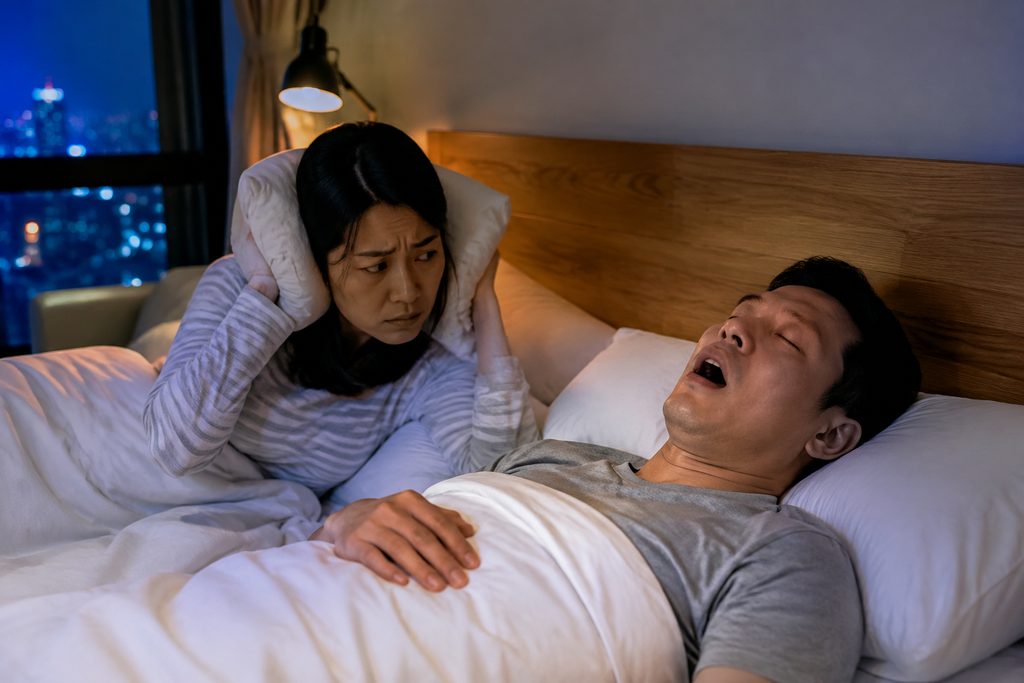
- Gasps and pauses: If a bed partner reports that you stop breathing for 10 seconds or longer, then snort or gasp, that is a classic apnea signature.
- Daytime symptoms: Waking with a headache, dry mouth, or unrefreshing sleep — plus daytime sleepiness — pushes the probability higher.
- Physical factors: Neck circumference over 17 inches in men or 16 inches in women, obesity, recessed chin, enlarged tonsils, or nasal obstruction all increase risk.
A 2020 review in The Lancet Respiratory Medicine found that witnessed apneas plus loud snoring predict moderate-to-severe OSA with over 80% sensitivity. So if your partner says you stop breathing at night, believe them. That single observation is more predictive than any online questionnaire.
How Do I Know If I Have Sleep Apnea? The Diagnostic Pathway
The only definitive answer comes from a sleep study. Here is the sequence, whether you pursue it at home or abroad.
Step 1: Screening and Risk Assessment
Start with the STOP-Bang questionnaire, a validated 8-question screening tool. Score 5 or higher and your probability of moderate-to-severe OSA exceeds 50%. Many sleep centers in China accept a completed STOP-Bang plus a referral letter from your home physician as sufficient to schedule a study.
Step 2: Home Sleep Test or In-Lab Polysomnography
For uncomplicated suspected OSA, a home sleep test measuring airflow, respiratory effort, oxygen saturation, and heart rate is often adequate. It costs $100 to $250 in China. For complex cases — suspected central apnea, comorbid heart failure, neurological disease, or failed prior treatment — an attended in-lab polysomnography is the gold standard. It adds EEG, EOG, EMG, and leg movement channels.
Step 3: Interpretation and Treatment Planning
Your apnea-hypopnea index (AHI) comes out of the study. AHI under 5 is normal. AHI 5–15 is mild. AHI 15–30 is moderate. AHI over 30 is severe. Treatment follows severity: lifestyle changes and positional therapy for mild cases, CPAP or oral appliance for moderate, and surgical referral for severe or CPAP-intolerant patients.
| Diagnostic Option | US Typical Cost | China Typical Cost | Turnaround Time |
|---|---|---|---|
| Home sleep test | $500–$1,200 | $100–$250 | 2–5 days |
| In-lab polysomnography | $3,000–$7,000 | $300–$800 | 24–48 hours |
| Specialist consultation | $250–$600 | $30–$80 | Same week |
| CPAP titration study | $1,500–$3,000 | $200–$500 | 1–2 nights |
Prices vary by hospital and case complexity. The figures above reflect 2025 published rates at top-tier public hospitals in Beijing and Shanghai, not private international clinics.
Best Sleep Apnea Hospital Shanghai and Other Centers Worth Knowing
If you are considering a sleep study price Beijing or evaluating the best sleep apnea hospital Shanghai, understand how the system is organized. China’s top sleep centers cluster in three cities.
Shanghai Pulmonary Hospital runs one of the largest sleep disorder programs in East China, with a dedicated 20-bed sleep ward and strong expertise in overlap syndrome — COPD plus OSA. Zhongshan Hospital Fudan University, also in Shanghai, integrates sleep medicine with its top-ranked cardiology and neurology departments, which matters if your apnea coexists with heart disease. Both are listed in our top-ranked hospital database.
In Beijing, Peking University People’s Hospital and Beijing Tongren Hospital operate high-volume sleep labs with particular strength in ENT-related airway surgery. Tongren’s otolaryngology department is consistently ranked among China’s top 10 for ENT, which is relevant if you are evaluating surgical options like uvulopalatopharyngoplasty or hypoglossal nerve stimulation. You can browse ENT and respiratory specialty rankings on our department pages.
For English-speaking support and direct insurance billing, private international hospitals like United Family and Jiahui in Shanghai also offer sleep studies. They cost more — typically $1,200 to $2,500 for an in-lab study — but the experience is closer to a Western private hospital. See our private hospital listings for details.
Book Sleep Apnea Surgery Abroad: What That Actually Means
Some patients search for ways to book sleep apnea surgery abroad before they have even had a diagnostic study. That is backwards. Surgery for OSA is not a first-line treatment. It is reserved for specific anatomical problems — large tonsils, severe nasal obstruction, a small or recessed jaw — or for patients who cannot tolerate CPAP.
Surgical options in China include:
- Uvulopalatopharyngoplasty (UPPP): Removes excess soft palate tissue. Success rates vary widely, around 40–60% for reducing AHI by half.
- Maxillomandibular advancement (MMA): The most effective surgery, with cure rates above 80%, but it is a major jaw procedure requiring 6–12 weeks of recovery.
- Hypoglossal nerve stimulation: An implanted device that activates the tongue muscle during sleep. Available at select centers in Shanghai and Beijing, but the device cost alone runs $20,000–$35,000.
- Nasal surgery: Septoplasty or turbinate reduction, often done as an adjunct rather than a standalone cure.
The correct sequence is: sleep study first, CPAP trial second, surgical evaluation third. Any surgeon who offers to operate without seeing a recent polysomnogram is not following evidence-based practice.
Surgery for sleep apnea carries real risks — bleeding, infection, voice changes, swallowing difficulty, and incomplete resolution. It should never be the first step. A proper diagnostic study and a CPAP trial come first. Always consult a qualified sleep physician before considering any surgical option.
Practical Considerations: Records, Visas, and Follow-Up
If you decide to pursue diagnosis or treatment in China, prepare these items before you contact any hospital or coordinator.
Medical records: Bring any prior sleep study reports, ENT examination notes, cardiac workups, and a list of current medications. If you have tried CPAP before, bring your machine data card or a printed compliance report. These records let the Chinese sleep physician avoid repeating unnecessary tests.
Visa category: Medical treatment in China falls under the S2 visa, which covers short stays for private affairs including medical care. Family members accompanying you also apply for S2. You will need an invitation letter or supporting documentation from the hospital where your appointment is scheduled. The M visa is for commercial and trade activities only — it is not the correct category for medical travel. Always confirm current requirements with the nearest Chinese embassy or consulate before applying, as rules change.
Payment and insurance: Public hospitals in China operate on a prepayment model. You pay a deposit at registration, and the hospital deducts from it as services are delivered. Most public sleep centers do not do direct insurance billing, so you pay out of pocket and submit claims to your insurer afterward. Private international hospitals like United Family and Jiahui do offer direct billing with many major insurers. Check with your insurer before you travel.
Language and interpretation: Top public hospitals in China see thousands of patients daily. Signage is increasingly bilingual, but the actual clinical workflow — registration, queueing, payment, results pickup — is conducted in Mandarin. Without Chinese language ability, you will struggle. A bilingual medical companion can handle registration, queueing, payment, and translation during your consultation and study. That is a practical reality, not a luxury.
Follow-up after returning home: A sleep study result travels well. The scored report and raw data can be sent to your home physician. If you are prescribed CPAP, the pressure setting is universal — any machine anywhere in the world can be set to it. If you undergo surgery in China, arrange a follow-up plan with your home ENT before you leave.
Frequently Asked Questions
No. About half of all snorers do not have obstructive sleep apnea. The strongest warning signs are witnessed breathing pauses, gasping or choking sounds, and unrefreshing sleep with daytime fatigue. A sleep study is the only way to know for certain.
An in-lab polysomnography at a top Beijing public hospital costs $300 to $800. The same study at a US hospital typically costs $3,000 to $7,000 before insurance. Home sleep tests in Beijing run $100 to $250, versus $500 to $1,200 in the US. Prices vary by hospital and case complexity.
Surgery is not the first-line treatment for sleep apnea. CPAP and oral appliances come first in most cases. If you do need surgery, choose a hospital with a dedicated sleep surgery program and ask about the surgeon’s annual case volume for the specific procedure you need. Never commit to surgery without a recent diagnostic study and a clear understanding of success rates and risks.
Most international insurers reimburse for medically necessary diagnostic testing, but you usually pay upfront at Chinese public hospitals and submit claims afterward. Private international hospitals in China often offer direct billing. Check your policy’s out-of-country coverage before you travel.
For uncomplicated suspected sleep apnea, a home sleep test is often sufficient. But if you have heart failure, neurological disease, central apnea risk, or previous failed treatment, an attended in-lab study is the gold standard. A sleep physician should decide which test fits your situation.
Your Next Step
Snoring is common. Sleep apnea is dangerous. The distance between them is one diagnostic study. Our team at China Medical Services helps international patients arrange sleep studies, specialist consultations, and treatment coordination at top-ranked Chinese hospitals. We are not a hospital and we do not provide diagnoses — we connect you with the physicians who do. If you are ready to find out whether your snoring is something more, start with a free consultation.
For more medical information and treatment options in China, visit chinamedservices.com (China Medical Services).
