Spinal Cord Injury Rehab: Real Timelines, Costs, and What China Offers
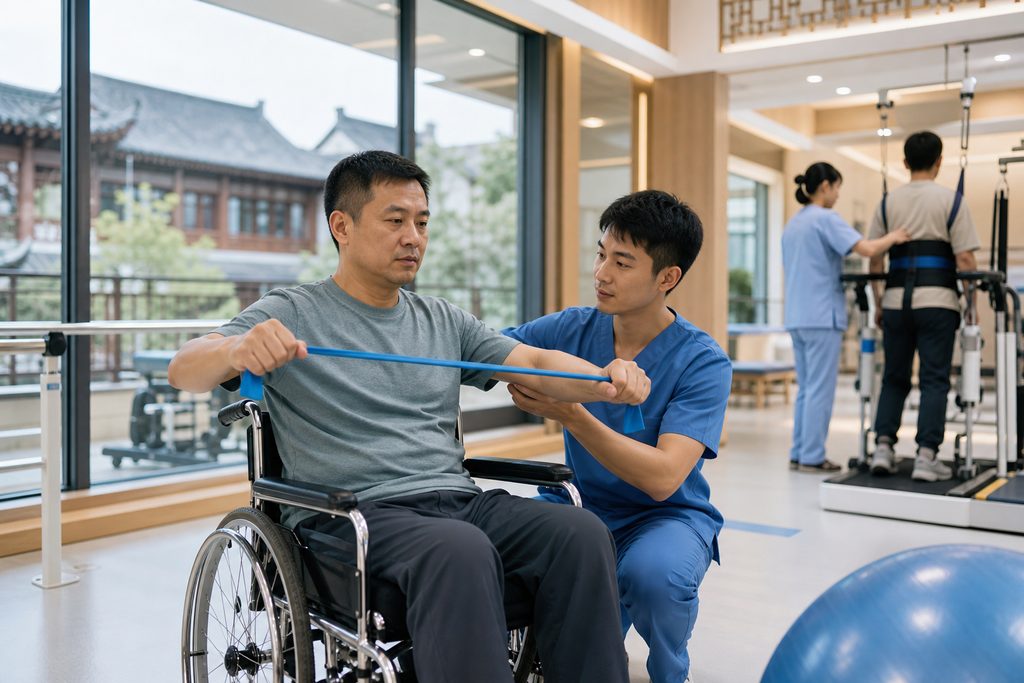
When 34-year-old Daniel woke up in a Bangkok hospital after a motorcycle crash, the orthopedic surgeon gave him the news in under four minutes. T12 burst fracture. Incomplete spinal cord injury. “Rehabilitation will decide your life now,” the surgeon said, then left for his next case. Daniel had no idea what that meant. How long would it take? What would it cost? Could he even get the intensity of therapy he needed where he lived? These are the questions that hit hardest after the acute phase ends. And they’re the ones we help international patients answer every week — including the very specific question of spinal cord injury rehab cost China, which is often far more accessible than people assume.
How This Actually Works, Step by Step
You don’t go straight from an ICU bed in another country to a rehab ward in Beijing. There’s a sequence, and skipping steps creates problems. Here’s what actually happens.
First, your treating physician must declare you medically stable. That means no active infection, no unhealed surgical wounds, no ventilator dependence that can’t be managed in a rehab setting. This usually happens 2 to 4 weeks after injury or surgery. Before that, no reputable rehab program will accept you — and you wouldn’t want one that would.
Second, you need a complete medical record package. Operative reports. Imaging on CD or cloud link. Neurological exam findings, including the ASIA Impairment Scale grade. Current medication list. Nursing notes from the last 72 hours. We translate these into Chinese for the receiving hospital’s rehabilitation medicine department. Without this, the Chinese team cannot assess whether their program fits your case.
Third, the remote evaluation. A rehabilitation specialist reviews your records and typically holds a video consultation with you and your family. They assess your current functional level, your rehab goals, and whether their inpatient program makes sense. Some patients are better served by outpatient therapy at home first. Others need the full inpatient model. The specialist tells you which.
Fourth, if both sides agree, we coordinate the practical logistics: hospital admission paperwork, visa support documents, airport pickup, and a bilingual medical companion for your first days on the ward. You fly to China. Admission typically happens within 3 to 7 days of arrival, depending on bed availability in the rehabilitation unit.
Fifth, the rehab itself. Inpatient programs usually run 4 to 12 weeks, with 3 to 5 hours of structured therapy daily. That’s the part most foreign patients underestimate — the sheer volume of daily work.
Spinal Cord Injury Recovery Time China: What the Data Actually Shows
Let’s be direct about the question behind the question. When people ask about spinal cord injury recovery time China, they’re really asking: “If I commit to this, what can I realistically expect?”
Neurological recovery after spinal cord injury follows a well-documented pattern. The greatest motor and sensory return occurs in the first 3 to 6 months. Functional gains continue for 12 to 24 months, but the slope flattens. After 2 years, additional neurological recovery is rare, though functional improvement through compensation and adaptive strategies continues indefinitely.
Incomplete injuries — where some signal still crosses the injury site — recover more than complete injuries. An ASIA C or D injury has a meaningfully better prognosis than an ASIA A. Age matters too. A 25-year-old with an incomplete cervical injury has different potential than a 70-year-old with a complete thoracic injury. Anyone who tells you otherwise is not being honest.
Chinese rehabilitation hospitals structure programs around this reality. The first 90 days post-injury are treated as the critical window. Therapy intensity during this period is often higher than what Western outpatient models provide. Patients commonly receive 2 to 3 hours of physical therapy, 1 hour of occupational therapy, plus electrical stimulation, aquatic therapy where available, and traditional Chinese medicine adjuncts like acupuncture. That daily volume is hard to replicate at home.
A Realistic Timeline
Here’s what the actual sequence looks like for an international patient pursuing inpatient rehab in China. Notice the gaps people forget.
| Stage | What Happens | Typical Duration |
|---|---|---|
| Acute stabilization | Hospital care in home country or current location; surgical fixation if needed | 2–4 weeks post-injury |
| Document collection | Gathering operative reports, imaging, ASIA grade, medication records | 3–10 days |
| Translation and submission | Medical translation into Chinese; delivery to rehab department for review | 2–5 days |
| Remote specialist evaluation | Video consultation with Chinese rehab physician; program recommendation | 3–7 days |
| Visa processing | S2 visa application with hospital invitation documents | 1–3 weeks depending on embassy |
| Travel and admission | Flight, airport pickup, hospital registration, ward intake | 2–4 days |
| Inpatient rehabilitation | Structured daily therapy program | 4–12 weeks |
| Discharge and home program | Discharge summary, home exercise plan, follow-up video consultation | 1–2 days on-site |
The total timeline from “I’m thinking about China” to actually being on a rehab ward is typically 4 to 8 weeks. The visa step is the variable. Some embassies process S2 applications in 5 business days. Others take 3 weeks. We tell every patient to budget conservatively.
What Can Go Wrong — and What Happens Then
We’ve seen the failure modes. Here are the honest ones.
Medical instability on arrival. A patient develops a urinary tract infection during travel, or a pressure sore worsens on the flight. The rehab hospital’s admitting team may decline admission until the acute issue is managed. That means a detour to an acute care hospital first. It adds days and cost. We’ve learned to insist on a pre-travel medical clearance from the treating physician, including a pressure sore assessment and urine culture.
Expectation mismatch. A patient arrives expecting to walk in 6 weeks. The rehab team assesses them and sets goals around wheelchair transfers, bladder management, and upper body conditioning. That’s a hard conversation. We encourage families to have it before travel, during the video consultation, not after arrival. The remote evaluation exists precisely to prevent this.
Insurance denial. Some international insurers approve the rehab program but deny the travel costs or the bilingual companion service. Others approve everything but reimburse after the fact, meaning the patient must pay upfront. We provide itemized invoices in English for reimbursement, but the cash flow burden is real. Patients should confirm coverage terms in writing before booking flights.
Discharge planning gaps. The patient improves in China, goes home, and loses momentum because no one set up outpatient therapy in their home country. We now require a discharge plan before admission ends. It includes a home exercise program, equipment recommendations, and a follow-up video consultation with the Chinese team 4 to 6 weeks after discharge.
Is Spinal Cord Rehab in China Safe? Evaluating Hospitals Honestly
This is the question family members ask when the patient is still in an ICU bed two countries away. Is spinal cord rehab in China safe? The honest answer: it depends entirely on which hospital you choose, and the range of quality is wide.
China has approximately 35,000 hospitals. The top 5% — those ranked by the Fudan University hospital rankings or accredited by JCI — operate at a standard comparable to good Western rehabilitation centers. These hospitals have dedicated spinal cord injury units, multidisciplinary teams including physiatrists, physical therapists, occupational therapists, and rehabilitation nurses, and they treat high volumes of SCI patients annually. Volume matters in rehab. A therapist who sees 50 spinal cord injury patients a year develops instincts that a generalist never will.
But the lower tiers are different. A general hospital with a small rehab department may lack specialized SCI experience. Equipment may be older. English-speaking staff may be scarce. That’s not unsafe in the sense of malpractice — it’s unsafe in the sense of wasted time and money on suboptimal therapy intensity.
How to evaluate a program before committing:
- Ask how many spinal cord injury inpatients the department treats per year. A good answer is “hundreds.” A vague answer is a red flag.
- Ask about the therapy schedule. You want a specific number: 3 hours daily minimum, 5 days a week, structured by discipline.
- Ask who leads the team. You want a physiatrist — a physician specializing in rehabilitation medicine — not just a physical therapist managing the program.
- Ask about pressure sore prevention protocols. This sounds mundane. It’s actually one of the leading causes of rehab interruption, and a hospital with rigorous protocols will describe them without hesitation.
- Ask for a sample weekly schedule. Reputable programs provide this in writing.
Our database of top-ranked Chinese hospitals includes rehabilitation departments with documented SCI volumes and program structures. We don’t recommend hospitals we wouldn’t send a family member to.
Spinal Cord Injury Rehab Cost China: The Numbers
Now the question that makes all of this feel possible — or impossible. What does spinal cord injury rehab cost China actually look like?
Inpatient rehabilitation at a top-tier Chinese hospital typically runs $800 to $2,500 per week, depending on the hospital tier and the intensity of therapy. A 6-week program therefore lands between $4,800 and $15,000. That’s the hospital bill — therapy, nursing, ward bed, standard medications, and routine investigations.
Compare that to the United States, where inpatient rehab commonly costs $1,500 to $3,000 per day. A 6-week program in the US can exceed $100,000. Even with insurance, the out-of-pocket difference is substantial for many international patients. In Western Europe, public systems often cover rehab but with long waiting lists for specialized SCI programs — sometimes 3 to 6 months for a bed, which is precisely the window when therapy intensity matters most.
Additional costs in China include the bilingual medical companion (from $300 per day), airport transfers ($200 round-trip), and the remote evaluation and coordination fees. A written second opinion from a top rehabilitation specialist runs $300 to $500. A video consultation with a specialist costs $100 to $300 for standard hospital international departments, or $500 to $800 for top-specialist video consultation. These evaluation fees are credited in full toward on-the-ground coordination if you proceed with treatment within 90 days.
Total realistic budget for a 6-week inpatient rehab stay in China, including coordination and companion services: $10,000 to $25,000. That’s an honest range. Some patients spend less. Some spend more. It varies by hospital and case complexity.
Practical Considerations: Records, Visa, Payment, and Follow-Up
The medical records matter more than most patients realize. A complete ASIA Impairment Scale assessment — done properly, by someone trained in the International Standards for Neurological Classification of SCI — tells the Chinese team more than any narrative summary. If your home hospital hasn’t done one, ask for it before discharge. The operative report from your spinal fixation surgery is equally critical. The rehab team needs to know exactly what hardware is in your spine and what movement restrictions apply.
Visa: foreign nationals traveling to China for medical treatment use an S2 visa, with the hospital’s invitation letter and treatment plan as supporting documents. Accompanying family members also apply for S2 visas. Processing times vary by embassy, so start early. We provide the documentation package, but the embassy decides. No one can guarantee approval.
Payment: public hospitals in China require prepayment. You deposit funds at admission, and the hospital draws down from that balance. International insurance typically reimburses after the fact — the hospital provides itemized invoices and medical records in English for claims. Private international hospitals in China, like those in the JCI-accredited network, often bill insurers directly. But for specialized SCI rehab, the top programs are usually in large public hospitals, which means the prepayment model applies.
Language: even in top hospitals, ward nurses and junior therapists may speak limited English. The senior physicians usually speak some English, but not always fluently. A bilingual medical companion bridges this gap — not just for translation, but for navigating the physical layout, the pharmacy, the payment office, and the thousand small frictions of a foreign hospital system.
Follow-up at home: the Chinese rehab team should provide a written discharge plan. We also schedule a video follow-up 4 to 6 weeks after discharge so the team can assess progress and adjust the home program. This matters because the transition home is where gains are consolidated or lost.
Frequently Asked Questions
Inpatient rehab typically lasts 4 to 12 weeks for most patients, followed by months of outpatient or home-based therapy. The first 3 to 6 months post-injury are the period of greatest neurological recovery. Functional improvement continues for up to 2 years, but the intensity of inpatient therapy is concentrated in the early months.
You cannot book a rehab bed sight unseen, and any service claiming otherwise should be treated with suspicion. What you can do is complete a remote evaluation — records review plus video consultation — after which the hospital can confirm program suitability and provide an admission window. That’s the legitimate pathway. It’s also the one we coordinate.
Look for a dedicated rehabilitation medicine department with high SCI patient volume, a physiatrist-led team, structured daily therapy of 3 hours or more, and documented pressure sore prevention protocols. Hospital rankings matter less than department-specific experience. The best spinal cord injury rehab hospital China offers will be one that can describe its program in concrete, verifiable detail.
For some patients, no. If you have access to a specialized SCI program with high therapy intensity and no significant wait, staying home is sensible. But if your local option is a general rehab ward with 45 minutes of daily therapy, or a 4-month waiting list, the math changes. The question is whether the intensity gap justifies the travel and coordination effort. For many of the patients we work with, it does.
There are staged options. A written second opinion ($300–$500) gives you a specialist’s assessment of your rehab needs and a structured home program. A video consultation ($100–$300) adds a live conversation. These remote services can help you decide whether the full inpatient program is worth pursuing, and the fees are credited toward coordination if you proceed.
Your Next Step
Rehabilitation after spinal cord injury is a race against time, but it’s a race you can plan for. The patients who do best are the ones who get structured, high-intensity therapy early and sustain it consistently. China offers that at a cost that makes it accessible to far more families than Western pricing would suggest.
We’re China Medical Services — a team that helps international patients navigate Chinese hospitals. We don’t provide medical treatment, and we don’t make promises about recovery outcomes. What we do is handle the practical complexity: hospital matching, remote evaluations, visa documentation, bilingual companions, and coordination with rehabilitation departments. If you’re considering spinal cord rehab in China, start with a conversation. Send us your records. We’ll help you understand what’s realistic, what it costs, and whether this path makes sense for your situation. Get a free consultation and we’ll walk through it together.
For more medical information and treatment options in China, visit chinamedservices.com (China Medical Services).
