Spine Surgery China Indonesia: Scoliosis Care Beyond Jakarta
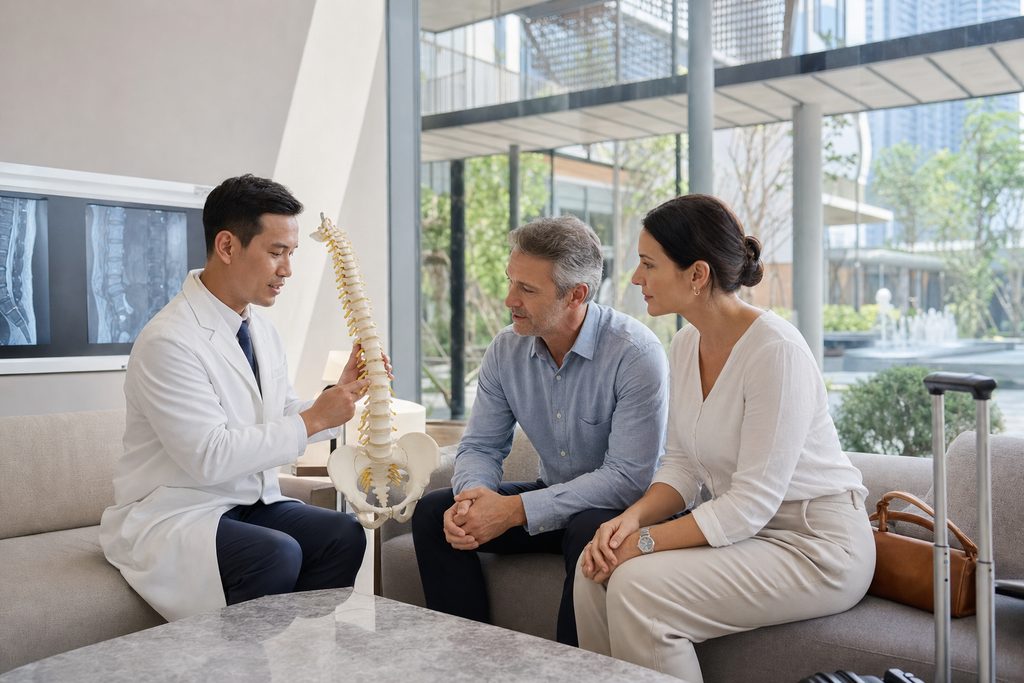
When 16-year-old Putri from Surabaya was diagnosed with a 48-degree adolescent idiopathic scoliosis curve, her family did what most Indonesian families do. They went to Jakarta. They consulted the best specialists they could find. The quotes for spinal fusion surgery ranged from IDR 350 million to over IDR 500 million. The wait for the preferred surgeon stretched past six months. The family felt trapped—facing a life-altering procedure at a crushing price with a timeline that made the curve’s progression a daily source of anxiety. Putri’s mother typed “spine surgery China Indonesia scoliosis not in Jakarta” into her phone at 2 a.m. She was looking for an alternative that didn’t exist in her home country. She found one.
Key Takeaways
- Top-tier scoliosis surgery in China costs 40–60% less than private hospital rates in Jakarta and Singapore, with all-inclusive packages often ranging from $22,000 to $38,000 USD.
- Chinese spine centers in the Fudan Top 100 network perform over 1,000 scoliosis corrections annually—a surgical volume that directly correlates with lower complication rates.
- You cannot book surgery remotely through standard public hospital channels; international patients must use hospital-vetted VIP coordination, which adds cost but eliminates the blind wait.
- S2 visa requirements, language barriers, and post-operative follow-up logistics are manageable hurdles but demand preparation—this is not a decision to make without a clear coordination plan.
The Problem: When Jakarta’s Options Hit a Hard Ceiling
Adolescent idiopathic scoliosis affects approximately 2–3% of the population. In Indonesia, that translates to hundreds of thousands of young people. The country has skilled orthopedic surgeons. No one disputes that. But the gap between a handful of capable centers and the actual demand for complex spinal fusion is wide and, in many cases, dangerous. A 2021 study published in the Journal of Pediatric Orthopaedics noted that surgical wait times exceeding six months for progressive curves can lead to larger, stiffer deformities that require more extensive fusion and carry higher risks of blood loss and neurological complications. Jakarta’s top private hospitals charge premium rates that rival Singapore—often $35,000 to $55,000 USD for a single-curve fusion—while public hospital queues stretch indefinitely. For families in Surabaya, Medan, or Makassar, the added cost of long-term accommodation in Jakarta turns a major expense into a financial crisis.
Putri’s family was not unusual. They had the means for surgery. They simply could not find a timely, affordable path inside Indonesia. That is the moment many families start searching for scoliosis surgery cost China comparisons. They discover something Jakarta cannot offer: massive surgical volume, lower structural costs, and a system that has invested heavily in spinal deformity correction technology.
Why China’s Spine Centers Deliver Results That Rival Any Global Destination
The question Indonesian families ask first is blunt: is scoliosis surgery in China safe? The answer requires looking past the headlines and into the data. China’s top-tier orthopedic hospitals are not village clinics. They are institutions ranked by the Fudan University Hospital Ranking system, a rigorous evaluation modeled on U.S. News & World Report’s Best Hospitals methodology. The spine surgery departments that treat international patients sit inside hospitals that handle volumes most Western and Southeast Asian centers cannot match.
Surgical Volume and the Repetition Effect
A senior spine surgeon at a major Shanghai orthopedic center will personally perform or supervise 250–400 scoliosis corrections per year. Compare that to a busy surgeon in Jakarta or even Singapore, where 50–80 annual cases is considered a high-volume practice. The relationship between volume and outcomes in spinal fusion is well-documented. A 2019 analysis in Spine found that surgeons performing more than 100 scoliosis fusions annually had a 38% lower rate of major complications—including implant failure and revision surgery—compared to those performing fewer than 30. This is not about innate skill. It is about repetition. When you correct scoliosis every working day, the intraoperative decisions become faster, the neuromonitoring signals read more intuitively, and the blood loss management more precise. China’s top centers deliver exactly that kind of repetition.
Technology Without the Premium Price Tag
Chinese hospitals serving international patients deploy the same intraoperative technology found at Mayo Clinic or Charité in Berlin: O-arm 3D navigation, intraoperative neuromonitoring (IONM), motor-evoked potentials, and ultrasonic bone scalpels that reduce soft tissue damage. The difference is the capital cost recovery model. A hospital in Shanghai or Beijing amortizes its O-arm across 1,500+ spine cases per year. A hospital in Jakarta might use the same device for 200 cases. The per-case equipment cost drops dramatically with volume. That structural efficiency—not a quality compromise—is what drives the spine surgery China price comparison abroad advantage. Families are not buying a discount procedure. They are buying into a high-throughput system where the fixed costs of advanced technology are spread thin across thousands of patients.
Cost Reality: What You Actually Pay
Let’s address the central question: scoliosis surgery cost China, in real numbers. For a single-curve posterior spinal fusion with titanium instrumentation—the standard for adolescent idiopathic scoliosis—the all-inclusive hospital bill at a top-tier Chinese public hospital’s international department typically ranges from $22,000 to $32,000 USD. Complex double-curve cases or revision surgeries can push that to $35,000–$45,000 USD. These figures include the surgeon’s fee, anesthesia, implant hardware, 5–7 days of inpatient stay, and operating room charges.
| Destination | Single Curve Fusion (USD) | Wait Time (Non-Emergency) | Includes |
|---|---|---|---|
| China (Top Public Hospital, International Dept.) | $22,000 – $32,000 | 2–6 weeks | Surgeon, hardware, hospital stay, O.R. |
| Jakarta (Private Hospital) | $35,000 – $55,000 | 3–8 months | Surgeon, hardware, hospital stay, O.R. |
| Singapore (Private Hospital) | $55,000 – $85,000 | 1–3 months | Surgeon, hardware, hospital stay, O.R. |
| Bangkok (Private Hospital) | $38,000 – $52,000 | 1–4 months | Surgeon, hardware, hospital stay, O.R. |
| United States (Hospital, Uninsured Rate) | $120,000 – $180,000+ | 1–2 months | Surgeon, hardware, hospital stay, O.R. |
The cost gap is not marginal. It is structural. Chinese hospital labor costs—nurses, surgical techs, anesthesiologists—are lower than Singapore or the U.S., but the clinical training pipeline is rigorous. Top surgeons often complete fellowships in Europe or the U.S. and return to lead departments that publish in the same journals their Western peers read.
What “Scoliosis Surgery in China” Actually Looks Like for an Indonesian Family
Putri’s mother did not book a flight and hope for the best. The process for international patients at China’s best spine surgery hospitals follows a structured path. It is not like walking into Siloam Hospital with a referral letter. It starts remotely.
First, the family sent Putri’s standing full-spine X-rays, a recent MRI, and a clinical summary to the hospital’s international patient center. A spine surgeon reviewed the images and returned a written second opinion—a document that confirmed the curve was surgical, specified the recommended fusion levels (T4–L1), and outlined the implant system they would use. That written opinion cost approximately $300–500 USD. It gave the family something they never received in Jakarta: a surgical plan before they committed to travel. Only after reviewing that plan did they apply for their S2 visas—the correct category for short-term private medical treatment in China. M visas are for commercial trade and are not applicable here. The S2 application required an invitation letter from the hospital, which the international department provided after the second opinion was accepted.
On arrival, Putri underwent a fresh set of pre-operative scans and a face-to-face consultation with the surgeon. The surgery itself lasted six hours. She stood up with physiotherapy support on day two. She was discharged on day seven. The family stayed in a nearby serviced apartment for an additional week before the surgeon cleared her to fly back to Surabaya. Total time in China: 16 days. Total hospital and surgical cost: $26,500 USD. That is what a book scoliosis surgery China medical tourism package search leads to—not a vacation bundled with surgery, but a focused, medically intensive trip with a clear endpoint.
Recovery After Spinal Fusion: What the First Year Demands
The surgery is one day. The recovery is the real project. Families ask how long is recovery after spinal fusion for scoliosis, and the honest answer is that it unfolds in phases, not a single timeline.
The first six weeks are about protection. No bending, no lifting more than 2 kg, no twisting the torso. Putri wore a brace when upright for the first month, though not all surgeons require this. Sleep was uncomfortable. Pain was managed with oral medication, tapering off by week three. By week eight, she returned to school in Surabaya with restrictions on physical activity. At the three-month mark, a follow-up X-ray confirmed the hardware was stable and the fusion mass was beginning to form. That is the milestone when most patients can resume swimming and light exercise. Full fusion—the biological process where bone grows across the instrumented levels—takes 12 to 18 months. Contact sports, heavy lifting, and high-impact activity remain off-limits until the surgeon sees solid fusion on imaging.
The complication to watch for in the first two years is implant prominence or late-onset infection. These are rare in high-volume centers—rates below 2% in large series—but they are not zero. This is why the relationship with the surgical team cannot end at discharge. Patients need a plan for remote follow-up: sending X-rays for review, video consultations at the 6-month and 12-month marks, and a clear protocol for what to do if pain returns. The best Chinese hospitals serving international patients build this into the post-operative package. Families should confirm this before booking, not after.
Practical Considerations: Visas, Payments, and the Language Barrier
Indonesian families traveling to China for spine surgery face three practical hurdles that Jakarta does not present. None are insurmountable. All require preparation.
Visa timing is the first constraint. The S2 visa application for medical treatment requires an official invitation letter from the admitting hospital. This letter is only issued after the hospital has reviewed the patient’s records and confirmed they will accept the case. Processing the visa at the Chinese embassy in Jakarta typically takes 5–10 working days. Families should budget 4–6 weeks from initial inquiry to travel date—not because the hospital is slow, but because document exchange, review, and visa processing consume real calendar time.
Payment is the second reality check. Chinese public hospitals, including their international departments, operate on a pre-payment model. Patients or their families deposit an estimated amount before admission—often $25,000–$35,000 for scoliosis fusion—and the hospital draws down from that deposit for each service rendered. Any remainder is refunded at discharge. Credit cards are accepted at international departments, but large transactions from Indonesian banks can trigger fraud alerts. Families should notify their bank in advance and carry a backup payment method. Travel insurance policies purchased in Indonesia typically exclude pre-planned surgery abroad. Specialized medical tourism insurance exists but is limited. Most families pay out of pocket and seek partial reimbursement from their Indonesian health insurer if the policy covers overseas treatment. They should verify this before traveling, not assume it.
Language is the third and most underestimated barrier. The surgeon and the international department coordinator will speak functional English. The floor nurses, the radiology technicians, the cafeteria staff, the physical therapists—most will not. A family member who speaks Mandarin changes the experience entirely. Without one, the patient needs a bilingual medical companion who can translate clinical instructions, argue with the billing office about a duplicate charge, and explain to a frightened teenager what the next needle is for. This is not a luxury. It is the difference between a controlled recovery and a stressful, confusing stay. For more on how coordination support works, see our overview of patient support services for international visitors.
Frequently Asked Questions
Safety depends on the specific hospital and surgeon, not the country as a monolith. The top-tier hospitals in our network are ranked by the Fudan University Hospital Ranking system and maintain infection rates and complication rates that are published and comparable to international benchmarks. The key is selecting a hospital with documented high volume in spinal deformity correction—not a general orthopedics department that does a few scoliosis cases per year. Ask the hospital directly for their annual scoliosis case volume and their rate of return to the operating room within 90 days. A reputable center will provide these numbers. One that won’t is a red flag.
This is the hardest question and the one families most need to ask before booking. The surgical team in China remains responsible for remote follow-up, and the best programs schedule video consultations at 1, 3, 6, and 12 months post-op. But if a deep wound infection develops in Surabaya at month two, the Chinese surgeon cannot physically examine the patient. The family needs a spine surgeon in Indonesia who agrees in advance to handle potential post-operative complications. This is called a shared-care arrangement. Establish it before you travel. Contact an Indonesian spine surgeon, share the surgical plan, and confirm they will see the patient if a problem arises. Most will agree. Do not skip this step.
Yes, but only through the hospital’s international department or a coordination service that has a direct relationship with that department. You cannot book a surgery date through the hospital’s public-facing appointment system. The remote process requires sending full-spine X-rays, a recent MRI, and a clinical summary for a written second opinion. If the surgeon confirms the case is appropriate and the patient agrees to proceed, the hospital will issue the visa invitation letter and schedule the surgery. This is how the vast majority of international scoliosis patients proceed—they do not make a separate pre-operative trip. The initial remote evaluation is the gate through which all surgical booking passes.
Your Next Step
Putri is now 18 months post-op. Her fusion is solid. She swims competitively and hasn’t taken pain medication in over a year. Her family’s decision to look beyond Jakarta was not a rejection of Indonesian medicine—it was a pragmatic response to a gap in access and affordability that millions of families face. Our team at China Medical Services helps Indonesian and international patients navigate the hospital selection, record review, visa documentation, and on-the-ground support that turns a daunting overseas surgery into a coordinated, transparent process. We do not perform surgery. We do not provide medical advice. We connect you with the institutions and surgical teams that do, and we make sure you are not alone at any step. If you are weighing your options and want to understand what a specific hospital and surgeon can offer your case, reach out for a free consultation. The first conversation is just information. The decision is entirely yours.
For more medical information and treatment options in China, visit chinamedservices.com (China Medical Services).
