TCM for Arthritis in China: How We Coordinate Your Joint Care
When 54-year-old Linda from Manchester first heard the word “osteoarthritis,” she was sitting in a National Health Service clinic with a 14-week wait for her next rheumatology appointment. Her knees ached after climbing stairs. Her hands stiffened every morning. She had tried NSAIDs, physiotherapy, and one corticosteroid injection. Nothing gave her more than temporary relief. A friend mentioned traditional Chinese medicine. Linda’s first question was not about philosophy or meridians. It was: what does tcm arthritis treatment cost China, and is it actually worth flying across the world for?
That question deserves a straight answer. Based on our coordination work with international patients at top-tier TCM hospitals in Beijing, Shanghai, and Guangzhou, a typical two-week intensive TCM arthritis program — including daily acupuncture, tuina massage, herbal decoctions, and physician consultations — ranges from $1,800 to $4,500. That price varies by hospital tier, specialist seniority, and case complexity. It does not include flights or accommodation. But it does explain why patients from the UK, Australia, Canada, and the Gulf states increasingly consider China as a serious destination for joint care they cannot access at home.
Key Takeaways
- A two-week TCM arthritis treatment program in China typically costs $1,800–$4,500, excluding travel — roughly 60–75% less than comparable integrative care programs in the US or UK.
- China’s top TCM hospitals combine classical acupuncture and herbal medicine with modern imaging and rheumatology diagnostics, so you are not choosing between “alternative” and “evidence-based” care.
- Language barriers and hospital navigation are real obstacles — most public TCM hospitals do not offer English-speaking front-desk services, which is why bilingual coordination matters.
- TCM is best understood as a complementary approach for chronic joint pain management, not a replacement for disease-modifying drugs in autoimmune arthritis.
The Problem: Arthritis Is Getting More Common, and Conventional Care Is Stretched Thin
Osteoarthritis affects approximately 595 million people worldwide as of 2020, according to the Global Burden of Disease Study published in The Lancet Rheumatology. That is roughly 7.6% of the global population. Rheumatoid arthritis adds another 18 million or so, with prevalence rising in aging populations across Europe and North America. The pain is not just physical. It erodes mobility, sleep, work capacity, and independence.
Now layer on the access problem. In Canada, the median wait time between a general practitioner referral and a rheumatology consultation reached 23.5 weeks in 2023, per the Fraser Institute’s annual survey. In the UK, NHS data shows that over 30% of patients referred for musculoskeletal conditions wait longer than 18 weeks for a first appointment. In the US, the barrier is cost: biologic drugs for rheumatoid arthritis routinely exceed $40,000 per year before insurance, and even insured patients face deductibles and copays that make treatment unaffordable for many.
So patients get stuck. They manage with over-the-counter painkillers, reduced activity, and a slow acceptance of disability. Some look for alternatives. That is where traditional Chinese medicine enters the conversation — not as a miracle cure, but as a structured system of symptom management that has been refined over two millennia and is now delivered inside China’s most rigorous hospital environments.
Why TCM for Arthritis in China Delivers Results
Clinical Integration: Not Just a Herbal Shop
The biggest misconception Western patients have is that TCM in China means a dimly lit clinic with jars of dried roots. In reality, the best traditional Chinese medicine hospital for joint pain Shanghai offers something far more structured. Institutions like Longhua Hospital and Shuguang Hospital — both affiliated with Shanghai University of Traditional Chinese Medicine — run dedicated rheumatology and orthopedics departments where TCM physicians work alongside Western-trained rheumatologists. A patient with knee osteoarthritis might receive a musculoskeletal ultrasound, a blood panel to rule out inflammatory markers, and then a TCM treatment plan that includes acupuncture, herbal formulas, and lifestyle guidance. That integration matters. It means you are not abandoning conventional diagnostics; you are adding a layer of care on top of them.
Volume and Pattern Recognition
Chinese TCM physicians see enormous patient volumes. A senior acupuncturist at a top TCM hospital in Beijing may treat 40 to 60 patients per day, five or six days a week. Over a decade, that is tens of thousands of joint-pain cases. This volume builds pattern recognition that is hard to replicate elsewhere. When a patient describes knee pain that worsens in cold damp weather and improves with heat, an experienced TCM doctor immediately recognizes a “cold-damp bi syndrome” pattern and adjusts the herbal formula accordingly. This is not mysticism. It is a classification system refined through repeated clinical exposure — the same mechanism by which any specialist gets better at their job.
Cost Without Cutting Corners
Let us be direct about the cost question, because it is the first thing every patient asks. How does Chinese medicine treat osteoarthritis knee at a fraction of Western integrative care prices? The structural answer is simple. China’s TCM hospitals are high-volume, publicly subsidized institutions. Physician salaries are lower than in the US or UK, but not because of inferior training — TCM specialists in China complete five to eight years of university education plus hospital residency. Herbal raw materials are sourced domestically at scale. Hospital infrastructure is shared across departments. None of this means the care is “cheap” in quality terms. It means the economic model is different. A 2019 systematic review in Evidence-Based Complementary and Alternative Medicine found that acupuncture for knee osteoarthritis produced clinically meaningful pain reduction at a cost per quality-adjusted life year far below conventional pharmacologic approaches in Western health systems.
What a Coordinated TCM Arthritis Program Actually Looks Like
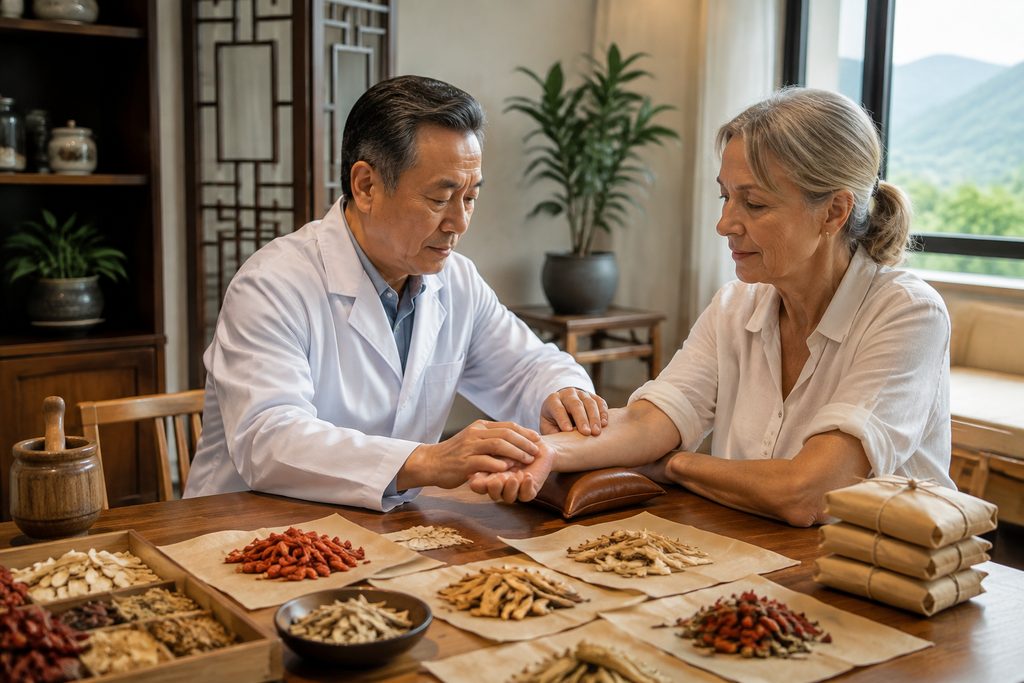
If you are searching for how to book TCM arthritis package Beijing, you need to understand what you are booking. A typical two-week program at a major TCM hospital is not a spa retreat. It is a structured medical intervention. Week one usually begins with an intake consultation lasting 30 to 60 minutes, during which the physician reviews your medical records, imaging, and current medications. Then comes the treatment phase: acupuncture sessions every day or every other day, each lasting 20 to 40 minutes. Tuina therapeutic massage two to three times per week. Herbal decoctions prepared daily by the hospital pharmacy, or concentrated granules you mix with hot water. Some hospitals add adjunctive therapies like moxibustion, cupping, or external herbal plasters applied directly to affected joints.
Week two typically involves reassessment. The physician checks range of motion, pain scores, and any changes in swelling or stiffness. The herbal formula may be adjusted. Before you leave, you receive a written summary — in Chinese and English if you coordinate through a bilingual service — plus a supply of herbal medicine for one to three months of continued use at home. Some patients return for repeat two-week intensives every six to twelve months. Others continue with telemedicine follow-ups.
One thing to be clear about: you will not get this level of organization by walking into a public TCM hospital as a foreigner without preparation. Registration desks operate in Chinese. Payment is prepaid via a hospital card system. Herbal pharmacies require you to queue, submit your prescription, and wait for your name to be called — all in Mandarin. This is not a barrier meant to exclude foreigners. It is simply how public hospitals operate when they serve 10,000 patients a day. Coordination exists to bridge that gap, not to bypass any medical rules.
Herbal Medicine for Joint Inflammation: What You Are Paying For
The herbal medicine for joint inflammation China price varies significantly depending on the formula and the hospital. A standard 7-day supply of concentrated herbal granules for arthritis typically costs $30 to $80. Raw herbs that you decoct at home run slightly less, around $20 to $60 per week. Specialized formulas containing rarer ingredients — such as deer antler, leech, or certain ginseng varieties — can push weekly costs above $120. Most arthritis patients receive formulas in the $40 to $70 per week range.
What do these formulas contain? Common ingredients for joint pain include du huo (Angelica pubescens), qin jiao (Gentiana macrophylla), chuan wu (processed aconite, used with extreme caution due to toxicity), gui zhi (cinnamon twig), and bai shao (white peony root). A properly trained TCM physician adjusts the combination based on your specific pattern diagnosis. That is the key difference between buying herbs online and receiving a hospital-prescribed formula: the physician has examined you, identified your TCM pattern, and adjusted dosages accordingly. Self-prescribing based on Internet research is not something we would ever recommend.
Is there evidence? A 2016 Cochrane review on herbal medicine for rheumatoid arthritis found low-to-moderate quality evidence that certain Chinese herbal preparations may reduce pain and improve function when used alongside conventional treatment. For osteoarthritis, a 2021 meta-analysis in Frontiers in Pharmacology reviewed 36 randomized controlled trials and concluded that Chinese herbal medicine combined with conventional care outperformed conventional care alone for pain reduction in knee osteoarthritis. The evidence base is not as deep as for NSAIDs or biologics, but it is not empty either.
Is Acupuncture Effective for Rheumatoid Arthritis in China? What the Data Says
Acupuncture is the most studied component of TCM, and the question “is acupuncture effective for rheumatoid arthritis in China” deserves a nuanced answer. For rheumatoid arthritis specifically, acupuncture is not a substitute for disease-modifying antirheumatic drugs like methotrexate or biologics. No responsible TCM physician in China would tell you otherwise. What acupuncture can do, based on multiple randomized trials, is reduce pain intensity, morning stiffness, and tender joint counts when used as an adjunctive therapy. A 2018 systematic review in Evidence-Based Complementary and Alternative Medicine analyzed 13 RCTs involving 974 RA patients and found that acupuncture plus conventional therapy significantly reduced pain scores compared to conventional therapy alone, with no increase in adverse events.
For osteoarthritis, the evidence is stronger. A 2020 meta-analysis in Pain pooled data from over 20,000 patients and found that acupuncture produced statistically significant and clinically meaningful improvements in pain and function for knee osteoarthritis, with effects persisting at 12-month follow-up. The effect size was modest — roughly equivalent to what you would expect from a good NSAID — but without the gastrointestinal and cardiovascular risks. That is a real trade-off worth understanding.
| Treatment Component | Typical Cost in China (per session/course) | Typical Cost in US (per session/course) |
|---|---|---|
| Acupuncture session | $25–$60 | $75–$150 |
| Tuina massage (30–45 min) | $20–$50 | $80–$140 |
| Herbal formula (7-day supply) | $30–$80 | $60–$150 (from compounding pharmacies) |
| Specialist consultation (TCM physician) | $15–$40 | $150–$350 |
| Two-week intensive program (all-inclusive care) | $1,800–$4,500 | $6,000–$12,000 (integrative programs) |
Practical Considerations: Visas, Payments, and Medical Records
If you decide to pursue TCM arthritis treatment in China, the logistics are manageable but specific. You will need an S2 visa, which is the short-stay category used for private affairs including medical treatment. The Chinese embassy or consulate in your country will require a supporting letter from the hospital confirming your appointment or treatment plan. Processing typically takes one to three weeks, depending on the consulate. Your family member traveling with you applies for the same S2 visa category. Do not apply for an M visa — that is for commercial and trade activities, not medical care.
Payment is another practical point. Public TCM hospitals in China operate on a prepaid card system. You deposit money at admission, and services are deducted as you go. International credit cards are accepted at some hospital international departments, but not universally. Many patients bring a combination of cash and a card that works in China. Hospital international departments and private TCM clinics are more likely to accept foreign cards directly. Insurance is typically reimbursement-based: you pay upfront, keep every receipt and medical report, and submit a claim to your insurer when you return home. Some international insurance plans have direct billing arrangements with private hospitals in China, but public TCM hospitals generally do not.
Medical records matter more than most patients expect. Bring all relevant imaging — MRI, X-ray, ultrasound — on CD or USB, not just printed reports. Bring a current medication list with generic drug names. Bring any previous blood work, especially inflammatory markers like CRP and ESR, and autoimmune panels if you have been tested. If your records are not in English, have them translated before you travel. A TCM physician can work with translated records, but the quality of the initial assessment depends heavily on what you provide.
Language is the final and often most frustrating barrier. Outside of international departments and private clinics, almost no one in a public TCM hospital speaks English. Registration, payment, pharmacy queues, and physician consultations all happen in Mandarin. This is not a criticism of the hospitals — they serve a domestic patient population first. But it is the single most common reason foreign patients describe their first hospital visit as overwhelming. A bilingual medical companion who handles registration, payment, queue management, and interpretation changes that experience entirely. The cost starts from $300 per day, and for most patients it is the difference between a chaotic day and a smooth one.
Frequently Asked Questions
No. We say this plainly because any provider who promises a cure is not being honest with you. TCM can reduce pain, improve joint mobility, decrease stiffness, and in some cases reduce reliance on pain medications. But osteoarthritis involves structural joint changes that do not reverse, and rheumatoid arthritis requires ongoing disease-modifying therapy. TCM is best understood as a powerful adjunct, not a replacement for conventional rheumatology care.
Most patients report meaningful symptom improvement for two to six months after an intensive program, provided they continue the prescribed herbal medicine and any recommended exercises. Some patients maintain benefits longer with periodic follow-up consultations. The effects are not permanent, and a single two-week program is rarely a one-time fix. Chronic joint disease requires ongoing management, whether you use TCM, conventional medicine, or both.
This is a critical question, and the answer requires professional review. Some Chinese herbs interact with blood thinners, immunosuppressants, and diabetes medications. A qualified TCM physician will ask for your complete medication list before prescribing, and you should always inform your rheumatologist or GP at home about any herbal medicine you are taking. Never stop a prescription medication to start TCM without discussing it with the doctor who prescribed it.
If your primary goal is classical TCM treatment — acupuncture, tuina, herbal formulas — choose a dedicated TCM hospital like those in our TCM hospital directory. If you want a combination of Western rheumatology and TCM under one roof, look for hospitals with integrative medicine departments, which are common in major cities like Beijing and Shanghai. Both options are legitimate. The right choice depends on your diagnosis, your treatment goals, and how much conventional monitoring you need.
Public hospitals in China have 24-hour emergency departments, and major cities have international emergency hotlines. Your TCM hospital will not typically handle emergencies — they will direct you to the nearest general hospital emergency department. We recommend all international patients carry travel insurance with emergency medical evacuation coverage, regardless of how routine their planned treatment is. It is a precaution, not an expectation that something will go wrong.
Your Next Step
If you are considering TCM for arthritis in China, the most useful thing you can do is get a clear picture of what is actually available for your specific condition. Our team at China Medical Services coordinates treatment plans with top-tier TCM hospitals across 37 cities, handling everything from hospital matching to visa documentation to bilingual accompaniment. We are not a hospital, and we do not provide diagnoses or treatment recommendations. What we do is make the logistics manageable so you can focus on your joints, not on queue numbers. If you want to explore whether TCM arthritis treatment in China makes sense for you, start with a conversation. It costs nothing, and it will give you a clearer sense of your options than any article can.
For more medical information and treatment options in China, visit chinamedservices.com (China Medical Services).
