Testicular Problems in China: Treatment Options, Costs, and Safety
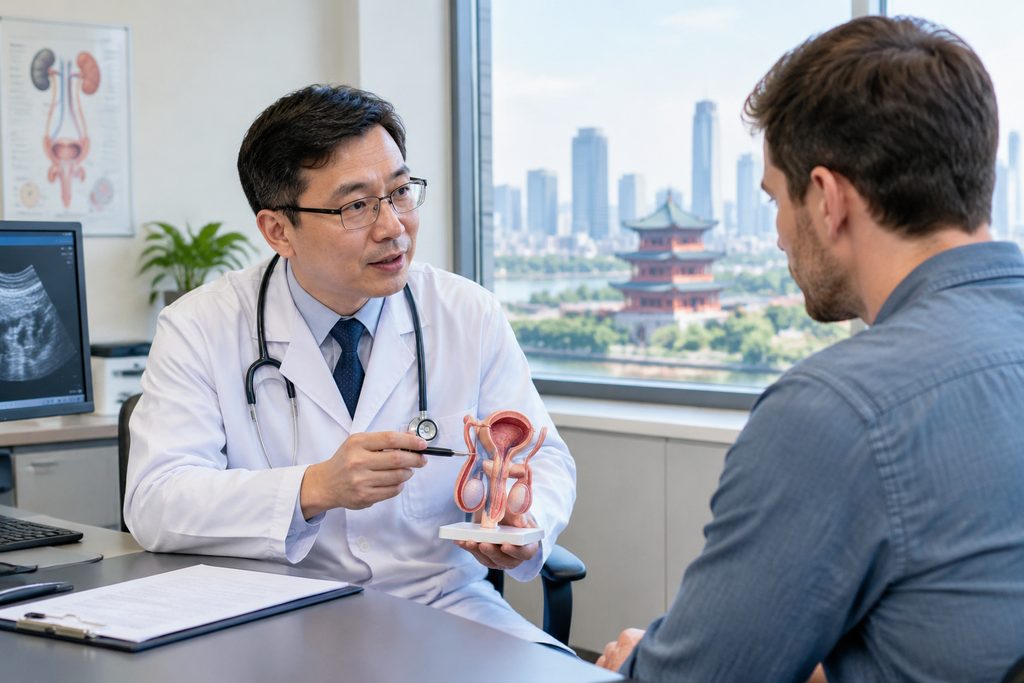
When 34-year-old Daniel from Manchester first heard “we need to remove it,” his mind went blank. The ultrasound confirmed a suspicious mass. His NHS referral quoted a 4-to-6-week wait just to see a specialist. Daniel started searching. Could he go abroad? Could he afford it? Would the care be any good? His Google search — can testicular problems be treated in China — brought him to us.
Yes. Testicular problems, from varicocele repair to orchiectomy for suspected malignancy, are treated routinely at China’s top-ranked urology departments. The testicular surgery cost China typically runs $3,000 to $9,000 depending on the procedure and hospital tier. That’s roughly one-fifth to one-third of what the same surgery costs in the United States or United Kingdom for uninsured patients. But the real question is not whether it can be done. It’s whether it should be done for you, and what the path actually looks like.
Testicular Problems in China: The Short Answer
China’s top urology centers perform thousands of testicular procedures annually. Hospitals like Peking Union Medical College Hospital, Ruijin Hospital in Shanghai, and West China Hospital in Chengdu run high-volume urology departments with modern laparoscopic and microsurgical capabilities. The care is real, the technology is current, and the surgeons are experienced. But accessing it as a foreign patient requires navigating a system that was not designed for walk-in international visitors.
The honest caveat: public hospital outpatient clinics in China do not allow overseas patients to book appointments in advance through normal channels. You cannot email a department and reserve a slot. Surgery requires an in-person consultation first. That’s the universal rule. The workaround is the hospital’s international medical department or VIP channel — which costs more but provides English coordination, faster scheduling, and a smoother experience. This is exactly the layer our team handles.
Who This Is Right For — and Who It Isn’t
China makes sense for a specific profile of patient. Not everyone. Here’s the honest breakdown.
Typically a good candidate:
- You have a confirmed or suspected testicular condition — varicocele, hydrocele, cryptorchidism, testicular torsion follow-up, or a mass requiring surgical exploration.
- You face a long wait in your home country and the delay is causing real anxiety or clinical risk.
- You are paying out of pocket or facing high deductibles, and the testicular problem treatment price abroad savings justify the travel.
- You want a second opinion from a high-volume urology team before committing to surgery at home.
- You are comfortable traveling and can commit 1 to 3 weeks in China for consultation, surgery, and initial recovery.
Who should not pursue this:
- Patients with an acute emergency — suspected testicular torsion with sudden severe pain needs immediate local care, not a flight to Shanghai.
- Anyone medically unstable or with uncontrolled comorbidities that make long-haul travel risky.
- Patients whose home health system offers timely, high-quality care at no out-of-pocket cost. If the NHS or your national insurance will treat you within 2 weeks, staying home is almost certainly the right call.
- Those expecting concierge-level hand-holding without paying for it. China’s public hospitals are efficient but crowded. The VIP channel helps, but it is not a five-star hotel experience.
Being clear about who should not come is what keeps our advice trustworthy. We have turned away patients who were better served locally.
The Options, Compared
When Daniel asked us to lay out his choices, we put it in a table. Here it is.
| Option | Typical Wait Time | Estimated Cost (USD) | Key Trade-off |
|---|---|---|---|
| NHS / public system (UK) | 4–8 weeks to specialist; 2–6 more to surgery | $0 at point of care | Long wait, anxiety, possible disease progression |
| Private hospital (UK/US) | 1–2 weeks | $12,000–$30,000+ | Fast but expensive for uninsured |
| China — public hospital international dept. | 1–2 weeks after records review | $3,000–$9,000 | Language and logistics; travel required |
| China — private international hospital | Within 1 week | $8,000–$18,000 | English-speaking, insurance direct billing, but pricier |
| Thailand / India (medical tourism hubs) | 1–3 weeks | $4,000–$10,000 | Established medical tourism infrastructure; varying quality control |
Daniel’s situation — a confirmed mass needing removal, NHS wait of 5+ weeks, and a desire to move quickly without bankrupting himself — pointed toward China’s public hospital international departments. The savings versus UK private care covered his flights and accommodation several times over. But if he had carried comprehensive private insurance with direct billing, a private international hospital in Shanghai or Beijing might have been smoother.
What “Treatment” Actually Means for Testicular Conditions
Here’s what a reader of this exact title still needs to understand: “testicular problem” is not one diagnosis. It’s a category. And the treatment path — and the testicular surgery cost China — depends entirely on which one you have.
Varicocele — enlarged veins in the scrotum, often causing pain or fertility issues. Treated with microsurgical varicocelectomy or laparoscopic ligation. Cost in China: $2,500–$5,000. Recovery: 1–2 weeks. This is an elective procedure. You have time to plan.
Hydrocele — fluid accumulation around the testicle. Treated with a straightforward drainage or surgical repair. Cost: $1,500–$3,500. Low complexity, high success rate.
Suspected testicular malignancy — the serious one. The standard of care is radical inguinal orchiectomy (removal of the affected testicle through a groin incision, never through the scrotum). Pathology then determines staging and whether chemotherapy or radiation follows. Cost for the surgery alone: $3,000–$7,000. But this is where speed matters most. A delay of weeks can change staging.
Cryptorchidism (undescended testicle) — usually addressed in childhood, but occasionally adults present late. Orchiopexy cost: $2,000–$4,000.
Testicular torsion — a surgical emergency. If you have sudden, severe testicular pain, do not book a flight to China. Go to the nearest emergency room now. Torsion requires surgery within 6 hours to save the testicle. No international medical travel solves that.
Understanding which category you fall into is the first step. If you have imaging and lab reports, we can help you get a written second opinion before you book anything.
Is Testicular Surgery Safe in China?
The short answer: yes, at the right hospitals. The longer answer requires looking at what “safe” means.
China’s top-tier hospitals — the ones on the Fudan University hospital rankings — operate at volumes that dwarf most Western centers. A major urology department in Shanghai or Beijing may perform more varicocelectomies in a month than a regional UK hospital does in a year. Volume matters for surgical outcomes, especially for technically demanding microsurgical procedures.
Infection control, anesthesia safety, and surgical technique at Fudan-ranked hospitals meet international standards. Many of these institutions hold JCI accreditation or equivalent. The surgeons train domestically and often internationally; many publish in peer-reviewed Western journals.
But safety is not just about the operating room. It’s about the entire pathway: pre-operative evaluation, imaging quality, pathology turnaround, post-operative monitoring, and communication. This is where international patients can struggle. A language barrier during rounds or a missed instruction about wound care can create real risk. That’s not a reason to avoid China. It’s a reason to use the international department or bring a bilingual medical companion.
We do not sugarcoat this. Chinese public hospitals are crowded. Nurses are stretched. The system assumes family members or hired companions will handle logistics — fetching medications, delivering samples, managing paperwork. Western patients who expect a private-room, call-button experience in a public hospital will be disappointed. Private international hospitals offer that experience, at a higher price. Both models are safe. They are just different.
What It Costs: Testicular Surgery Cost China, Itemized
Let’s break down the numbers, because “varies by hospital and case complexity” is true but incomplete. Here’s what you’re actually paying for.
| Cost Component | Public Hospital (International Dept.) | Private International Hospital |
|---|---|---|
| Initial consultation (in-person) | $100–$300 | $150–$400 |
| Imaging (ultrasound, CT if needed) | $200–$600 | $400–$1,000 |
| Surgery (varicocelectomy / hydrocelectomy) | $2,500–$5,000 | $6,000–$12,000 |
| Surgery (orchiectomy for suspected malignancy) | $3,000–$7,000 | $8,000–$15,000 |
| Hospital stay (1–3 days) | $300–$800/day | $800–$2,000/day |
| Pathology (if tissue removed) | $200–$500 | $400–$800 |
| Post-op medications | $50–$200 | $100–$300 |
What’s not included: international flights, accommodation, meals, visa fees, and any coordination or companion services. For a typical varicocele patient, the all-in cost including travel and a week in a mid-range hotel lands around $6,000–$9,000. For an orchiectomy with pathology, plan $8,000–$13,000. Still a fraction of US private rates.
One thing that surprises patients: Chinese hospitals require prepayment. You pay a deposit before admission, and the hospital draws down from it. Insurance reimbursement happens after the fact, unless you’re at a private international hospital with direct billing agreements. Bring a credit card with room to spare, and confirm your insurer’s overseas coverage before you travel.
Practical Considerations: Records, Visa, and Follow-Up
This is the section most medical tourism articles skip. It’s the section that determines whether your trip actually works.
Medical records. You need everything: ultrasound images (not just the report), blood test results including tumor markers (AFP, hCG, LDH if testicular cancer is suspected), any prior surgical notes, and a summary from your referring doctor. If your records are not in English or Chinese, get them translated. Our team handles medical document translation as part of case management.
Visa. For medical treatment in China, the applicable visa category is the S2 visa, endorsed for medical purposes. It’s a short-stay visa for private affairs, including medical treatment. Your accompanying family member applies for the same S2 category. You’ll need supporting documents from the hospital — an invitation letter or treatment confirmation. We assist with gathering these documents. The S2 is not a guarantee; approval rests with the Chinese embassy or consulate reviewing your application. Apply early. Do not book non-refundable flights before your visa is issued.
Timing. For elective procedures like varicocele repair, plan 10–14 days total: arrival, consultation, pre-op tests, surgery, 2–3 days in hospital, then a few days of light recovery before flying home. For suspected malignancy, the timeline compresses — you want surgery within days of arrival, and you may need to stay longer if pathology results dictate further treatment decisions.
Follow-up after returning home. This is the part people forget. Scrotal surgery requires wound care and activity restrictions for 2–4 weeks. If you develop a complication — infection, hematoma, persistent pain — your local doctor needs to manage it. Chinese hospitals will provide discharge summaries in English (through international departments) and can arrange video follow-up consultations. But the day-to-day recovery happens at home. Make sure you have a local GP or urologist willing to see you post-op before you leave.
Do not travel with an acute problem. Sudden severe testicular pain, fever with scrotal swelling, or signs of sepsis require immediate local emergency care. International medical travel is for planned, stable conditions.
Frequently Asked Questions
Yes, but only through the right channel. Public hospital international departments employ English-speaking coordinators, and major centers in Shanghai and Beijing are accustomed to foreign patients. For everything else — navigating the hospital campus, talking to nurses, filling prescriptions — a bilingual medical companion is worth the cost. Without language support, a crowded Chinese public hospital is genuinely overwhelming.
At Fudan-ranked and JCI-accredited hospitals, surgical safety is comparable to Western standards. The surgeons are high-volume and well-trained. The main differences are systemic: less nursing hand-holding, more self-directed logistics, and language barriers outside international departments. If you choose a top-tier hospital and use proper coordination, the clinical risk is low. If you choose an unvetted hospital based on price alone, you’re gambling.
No. The orchiectomy is the first step. Pathology results typically take 5–10 days. If malignancy is confirmed, you have options: return home for staging and oncology care, or pursue chemotherapy/radiation in China. Many patients choose to fly home after surgery and continue treatment locally, carrying their pathology report and surgical records. Chinese oncology departments can coordinate with your home team, but no one is forced to stay.
You cannot book surgery directly from overseas through public hospital channels. The process is: submit your records for review, get a written second opinion or video consultation, then travel for an in-person consultation. Surgery is scheduled after the surgeon sees you. Our team handles the coordination and bilingual support — hospital matching, appointment scheduling through international departments, and on-the-ground assistance. The “booking” is a coordination process, not an online checkout.
It depends entirely on your policy. Some international health insurance plans cover treatment at JCI-accredited hospitals worldwide. Most US and UK domestic plans do not cover elective surgery in China. You’ll likely pay upfront and seek reimbursement. Request a detailed itemized invoice and discharge summary from the hospital — international departments issue these in English. Private international hospitals in China often have direct billing arrangements with major insurers like Cigna, Aetna, and Bupa.
Your Next Step
Daniel had his orchiectomy in Shanghai eleven days after his first message to us. Pathology confirmed a stage I seminoma. He flew home with a clear report and a follow-up plan. His total out-of-pocket cost, including flights and accommodation, came to just under $9,000. He told us the hardest part was not the surgery — it was the uncertainty before he made the decision.
That’s what we do. China Medical Services is not a hospital and we do not diagnose or treat. We are a coordination team that connects international patients with China’s top-ranked urology departments — handling records translation, hospital matching, appointment scheduling through official international channels, and bilingual on-the-ground support. If you’re weighing your options, start with a free consultation. Send us your records. We’ll tell you honestly whether China makes sense for your situation, and what the path would look like. No pressure. Just clarity.
Testicular problems are treatable in China — safely, affordably, and faster than many Western public systems allow
For more medical information and treatment options in China, visit chinamedservices.com (China Medical Services).
