Thyroid Cancer Screening in China: Ultrasound Cost & Top Hospitals
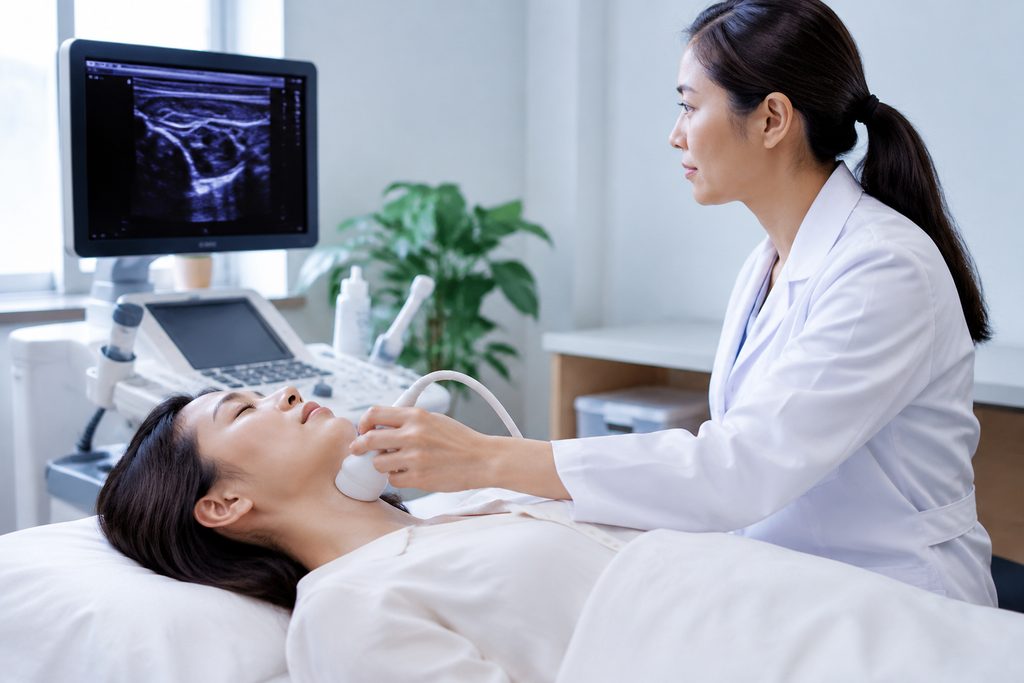
While a patient in the United Kingdom can wait six weeks or more just to reach a hospital ultrasound department, a major Chinese tertiary center can complete a thyroid ultrasound, blood work, and a specialist review inside a single morning. That gap is not a marketing claim — it is a scheduling reality driven by volume. High-resolution thyroid ultrasound in China typically costs between $40 and $120, before any hospital markup. The number surprises almost everyone who asks us about thyroid cancer screening cost China.
Thyroid Cancer Screening in China: The Short Answer
A complete thyroid screening package at a top-tier Chinese public hospital — ultrasound, thyroid function blood tests, and a specialist consultation — generally runs $150 to $400, depending on the hospital tier and whether you use the standard or international channel. Private international hospitals charge more, often $500 to $1,200 for the same set of services, but they add English-speaking staff, shorter waits, and direct insurance billing.
The catch is not price. It is access mechanics. Standard outpatient departments in Chinese public hospitals do not accept advance bookings from overseas. You register on the day, in person, in a queue that can start before dawn. That single rule shapes everything else in this article.
Who This Is Right For — and Who It Isn’t
Thyroid nodules are common. Autopsy studies cited in endocrine literature suggest that up to half of adults over 50 have at least one nodule, and the overwhelming majority are benign. Screening makes sense for specific people, not for everyone.
Typically a good fit:
- You have a palpable neck lump, hoarseness, or difficulty swallowing
- A prior ultrasound abroad flagged a nodule with suspicious features (hypoechoic, irregular margins, microcalcifications)
- You have a family history of thyroid cancer or a known genetic syndrome such as MEN2
- You received neck radiation therapy as a child
- You are already in China for other reasons and want a baseline study done efficiently
Probably not the right move:
- You have no symptoms, no family history, and no prior abnormal finding — routine population screening for thyroid cancer is not recommended by most international endocrine bodies, because it finds many indolent tumors that would never have caused harm
- You need a biopsy result interpreted against a long medical history held by your home physician
- You are seeking a guaranteed diagnosis from a single scan. Ultrasound narrows probability. It does not deliver certainty.
Being honest about that third point matters. No imaging modality, in any country, replaces cytology when a nodule looks suspicious.
The Options, Compared
Where you get screened changes the cost, the wait, and the language experience far more than the technology itself. Modern high-frequency linear probes are broadly similar across top hospitals.
| Setting | Typical Cost (USD) | Booking Lead Time | English Support | Insurance |
|---|---|---|---|---|
| Top public hospital, standard channel | $150–$300 | Same-day registration only | Limited | Pay first, claim later |
| Top public hospital, international/VIP channel | $300–$700 | Days to 2 weeks, coordinated | Yes | Pay first, claim later |
| Private international hospital (Beijing/Shanghai) | $500–$1,200 | Days, often online | Yes, native-level | Direct billing common |
| Health checkup package including thyroid ultrasound | $250–$900 | 1–3 weeks | Varies | Usually self-pay |
| United States, comparable study | $300–$1,500+ | Days to weeks | Yes | Insurance dependent |
If your priority is cost and you can navigate a Chinese-language queue, the standard public channel wins easily. If your priority is a predictable schedule and someone who speaks your language, the international channel is worth the premium. And if you want a full-body checkup wrapped around the thyroid study, the package row is where most medical tourism thyroid screening package Beijing inquiries land.
How Accurate Is Thyroid Ultrasound for Cancer Detection?
This is the question that determines whether the trip is worth it. High-resolution ultrasound, used with a standardized risk-stratification system such as ACR TI-RADS or EU-TIRADS, performs well — but “well” needs numbers attached.
Reported sensitivity for detecting thyroid malignancy with modern ultrasound generally falls in the 85% to 95% range, with specificity in the 70% to 90% range, varying by operator, nodule size, and the reference standard used. Translation: ultrasound is good at flagging nodules that deserve a closer look, and less good at definitively clearing them. A negative scan in a patient with a genuinely suspicious lump does not close the case.
Two factors move those numbers more than the machine does.
The first is operator skill. Thyroid ultrasound is operator-dependent, and volume matters. A sonographer who scans 30 thyroids a day sees patterns a general radiologist encounters monthly. This is why the question of the best hospital for thyroid ultrasound Shanghai is really a question about department volume, not brand prestige.
The second is whether the study is read in context. A 4mm nodule with no suspicious features in a 28-year-old is managed differently from the same nodule in a 65-year-old with a family history. Screening is a data-gathering step. The interpretation is where clinical judgment enters.
What It Costs, and What Drives the Variance
Here is where the numbers get concrete. These are typical ranges we see across the hospitals in our database. Every figure varies by hospital and case complexity, and final quotes must be confirmed with the specific institution.
- Thyroid ultrasound alone: $40–$120 (public standard), $120–$300 (international channel)
- Thyroid function panel (TSH, FT3, FT4): $30–$80
- Thyroid antibodies (TPO, TgAb): $40–$100
- Specialist consultation: $15–$50 (public), $80–$250 (international)
- Fine-needle aspiration biopsy, if indicated: $150–$500 including cytology
- Neck CT or MRI, if needed: $200–$800
Three things push the total up. Hospital tier is the biggest lever — a Fudan-ranked oncology department charges more than a provincial center for the same scan, and the difference buys you a more experienced reader. The channel you book through is the second. Whether a biopsy is triggered is the third, and it is the one you cannot predict in advance.
What is not included in any of these figures: interpretation by your home physician, translation of the report, and any follow-up imaging. Budget for those separately.
Practical Considerations: Booking, Visa, and Records
The logistics trip up more patients than the medicine does. A few specifics.
Records first. If you have prior imaging or biopsy results, bring them. A Chinese specialist reading your old scans against a new one produces a far more useful report than a standalone study. Digital files beat printouts.
Visa category. Foreigners traveling to China for medical treatment use the S2 visa, which covers short-stay private affairs including medical care. Stays beyond 180 days fall under S1. Accompanying family members apply for S2 as well. Note that the M visa is for commercial and trade activities — it is not a medical visa, despite what some outdated guides suggest. Requirements change, so confirm current documentation with your nearest Chinese embassy or consulate before applying.
Booking reality. If you want to book a thyroid ultrasound appointment in China before you fly, the international or VIP department of a public hospital is the practical route. Standard outpatient registration happens on the day, in person. There is no online queue for foreigners in the general channel.
Payment. Public hospitals require prepayment. International insurance is typically reimbursed after the fact, not billed directly, unless you are at a private hospital with a direct-billing agreement. Bring a card that works internationally, and expect to pay at each step rather than at the end.
Language. A top Chinese hospital can see 10,000 or more outpatients in a day. Signage, registration kiosks, and department staff operate in Chinese. This is not a system designed around foreign visitors, and pretending otherwise would be dishonest. Bilingual accompaniment exists precisely because of this gap.
Follow-up at home. Get the report and images before you leave China. Handing your home endocrinologist a disc and a translated report is straightforward. Trying to retrieve them three months later from overseas is not.
Frequently Asked Questions
At major tertiary hospitals, yes — the equipment is current-generation and the imaging volume is high, which builds operator skill. The reliability question is less about the technology and more about whether the reading is done in the context of your history. Bring prior records, and request an English report.
Reported sensitivity is roughly 85% to 95%, specificity 70% to 90%, depending on operator and nodule characteristics. It is a strong triage tool, not a definitive test. Suspicious nodules still require fine-needle aspiration for a cytological answer.
Through a public hospital’s standard outpatient channel, generally no — registration happens on the day. Through the international or VIP department, or at a private international hospital, advance coordination is usually possible. Lead times vary from a few days to a couple of weeks.
Most likely you will be advised to have a fine-needle aspiration, which can often be scheduled within days at the same institution. If malignancy is confirmed, treatment planning is a separate conversation involving surgery and possibly endocrinology. Nothing about a screening trip obligates you to proceed with treatment in China — you can take the results home.
The S2 visa covers short-stay medical treatment and private affairs. Confirm current requirements with your nearest Chinese embassy or consulate, since documentation rules are updated periodically. Do not use the M visa for medical travel.
Your Next Step
Thyroid screening in China is fast, affordable, and technically solid — the friction sits in the booking and language layer, not the medicine. If you have a nodule that needs a closer look, or you simply want a baseline study done without a six-week wait, the pathway exists. Our team is not a hospital and does not diagnose or treat anyone. We help international patients understand their options, coordinate appointments through official hospital channels, and provide bilingual support on the ground. You can start with a free consultation at our patient services page, or browse the Fudan-ranked hospitals in our database to see what is available in the city you are considering.
This article is for general information only and does not constitute medical advice. Screening decisions should be made with a qualified physician who knows your history. Costs vary by hospital and case complexity and must be confirmed directly with the institution.
For more medical information and treatment options in China, visit chinamedservices.com (China Medical Services).
