Thyroid Nodule Biopsy: Is It Needed? Cost, Timing & Where to Go
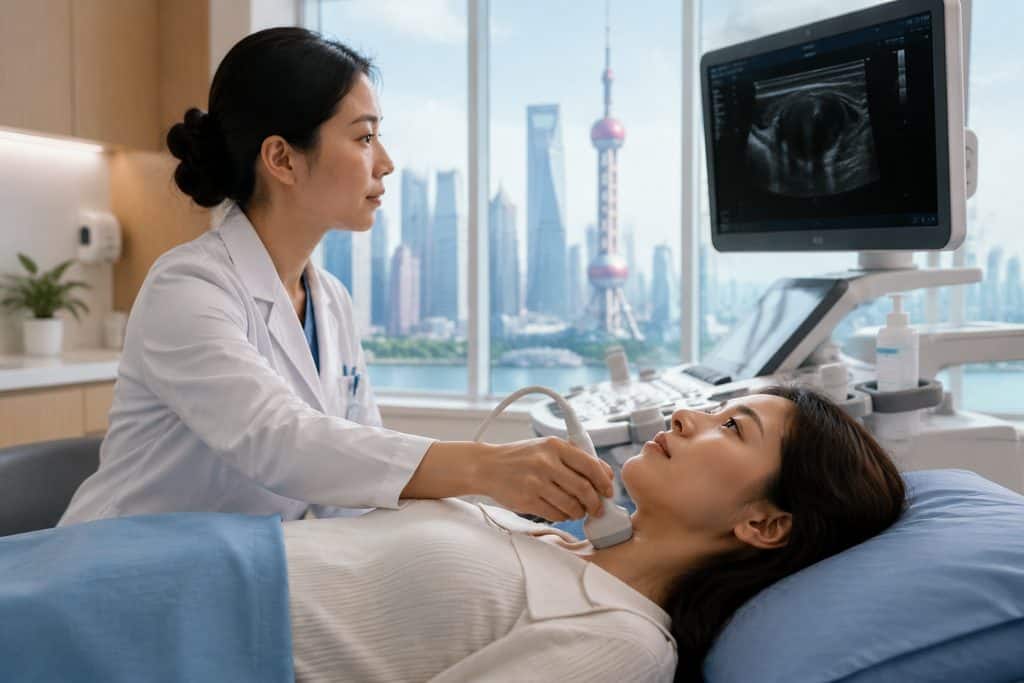
A thyroid nodule biopsy — usually a fine needle aspiration, or FNA — means using a very thin needle to pull a few cells out of a lump in your thyroid gland. A pathologist then checks those cells under a microscope. That is the whole procedure in plain terms. No incision, no stitches, and in most cases you walk out within the hour.
But the question you actually typed was sharper: is it needed? Sometimes yes. Often no. The answer depends on the nodule’s size, how it looks on ultrasound, and your own history. If you are weighing a trip to China for thyroid care, the thyroid nodule biopsy cost China is one part of that decision — but only one part. The harder question is whether the biopsy should happen before you book flights, before you consult a surgeon, or before you decide on surgery at all.
We help international patients sort through exactly this kind of sequencing. Not as doctors. As coordinators who know how Chinese hospitals actually run. Here is what the evidence says, what the process looks like on the ground, and where the real decision points sit.
How This Actually Works, Step by Step
You have an ultrasound report. Maybe it says “TI-RADS 4” or “hypoechoic nodule, 1.8 cm.” Maybe your local doctor already recommended biopsy. What happens next if you are considering China?
Step one is sending us your existing records — the ultrasound images, the written report, any thyroid function labs, and a short note on your symptoms. We translate them into Chinese and route them to the thyroid or head-and-neck department at a hospital that fits your case. That usually means a written second opinion first.
Step two is what comes back. The Chinese specialist reviews your images. They tell you whether the nodule meets Chinese guidelines for FNA. Typically that means: solid or mostly solid, larger than 1–1.5 cm, with suspicious features like microcalcifications or irregular margins. If the nodule is under 1 cm and looks benign, many Chinese endocrinologists will say: observe, repeat ultrasound in 6–12 months. No needle.
Step three, if biopsy is recommended, is scheduling. Here is the part most foreign patients do not expect: you cannot book an FNA from overseas through the regular public outpatient channel. You need to be seen in person first, or you go through the hospital’s international or VIP department, which can pre-arrange the sequence. That channel costs more — roughly 1.5 to 2 times the standard fee — but it locks in the appointment before you fly.
Step four is the biopsy itself. You arrive, the doctor scans your neck with ultrasound to find the nodule, numbs the skin lightly or not at all, and passes the needle in. Two or three passes. Five to ten minutes of actual needle time. Then you wait 20–30 minutes for observation and go back to your hotel.
Step five is the pathology report. Most Chinese hospitals return FNA results in 3–7 working days. Some international departments can expedite to 48–72 hours for an added fee. The report will use the Bethesda system — the same classification used in the US and Europe — so your home doctor can read it directly.
Is Thyroid Nodule Biopsy Necessary Before Surgery?
This is the question that trips up a lot of patients. If you already know the nodule is big, or it is pressing on your windpipe, or you just want it out — why poke it first?
Because the biopsy changes the operation. A benign nodule can often be removed with a lobectomy, taking only half the thyroid. A malignant one may require total thyroidectomy plus central lymph node dissection. Those are very different surgeries with different risks, different recovery, and different lifelong medication needs. Going into the operating room without cytology means the surgeon either has to make that call mid-surgery or over-treat.
That said, there are exceptions. A nodule that is causing compressive symptoms — difficulty swallowing, voice changes, visible swelling — may warrant surgery regardless of FNA results. Same for a nodule growing rapidly despite a previous benign biopsy. Some Chinese surgical teams will also skip repeat FNA if the ultrasound is highly suspicious and the patient has already decided on total thyroidectomy. But those are clinical judgments, not shortcuts you should assume.
So: is thyroid nodule biopsy necessary before surgery? In most planned, non-emergency cases, yes. The biopsy is what keeps you from losing more thyroid tissue than you need to. If a provider tells you no biopsy is needed and cannot explain why, get a second read.
A Realistic Timeline
People underestimate how much of this process is waiting. Here is what a typical sequence looks like for an international patient pursuing thyroid evaluation in China, assuming no emergencies.
| Stage | What Happens | Realistic Duration |
|---|---|---|
| Day 1–3 | You send records; we translate and submit for written second opinion | 2–3 days to receive the specialist’s written review |
| Week 1 | Decision on whether FNA is indicated; hospital selection if yes | 3–5 days, faster if records are complete |
| Week 2–4 | Visa application (S2 for short medical stay), flight booking, appointment lock via international department | 2–4 weeks depending on embassy processing times |
| Week 4–6 | Arrival, in-person consultation, FNA performed | 1–2 days on the ground |
| Week 5–7 | Pathology report returned | 3–7 working days after biopsy |
| Week 6–10 | If surgery needed: surgical consultation, pre-op clearance, scheduling | 2–6 weeks depending on surgeon availability and hospital |
The step most people forget is document translation. A partial ultrasound report or a missing TSH value will stall the second opinion by days. Send everything at once, in the original language plus any English summary you have. We handle the translation, but we need the complete file.
What Can Go Wrong — and What Happens Then
FNA is safe. Serious complications are rare. But that does not mean the process is frictionless, especially for foreign patients.
The most common frustration is a non-diagnostic result. That happens in roughly 5–15% of FNAs depending on the operator and the nodule. It means not enough cells were collected to make a call. The fix is usually a repeat biopsy, sometimes with ultrasound guidance from a more experienced operator. Some Chinese hospitals have dedicated thyroid biopsy clinics that do hundreds per month — their non-diagnostic rates run at the low end of that range.
Another failure mode: the report says “atypia of undetermined significance” or “follicular lesion of undetermined significance.” That is Bethesda III. It is not cancer, but it is not clearly benign either. The next step in China is often molecular testing on the same sample — looking for BRAF or RAS mutations — which can push the diagnosis one way or the other without a second needle pass. Not every hospital offers this, so if you are choosing where to go, ask whether molecular reflex testing is available.
Bleeding and hematoma at the biopsy site happen occasionally. A small bruise is normal. A rapidly expanding neck swelling is not, and that requires immediate attention — but it is extremely uncommon. Voice hoarseness after FNA is usually transient and resolves within days.
And then there is the scheduling failure. You fly to Shanghai, and the biopsy gets postponed because the doctor was called to surgery. This happens in public hospitals. The international departments are better about honoring appointment times, which is one reason patients choose that route. If a delay occurs, our coordinators rebook you and adjust the rest of your stay. We cannot prevent every delay, but we can keep you from sitting in a waiting room with no plan.
How Much Is Fine Needle Aspiration China?
Prices vary widely by hospital tier and channel. Here is what we see in practice, in USD, for the biopsy procedure itself — not including consultation fees, ultrasound, or pathology reading.
| Setting | Typical FNA Cost (Procedure Only) | Notes |
|---|---|---|
| Public hospital, standard outpatient | $50–150 | Requires in-person registration; long queues; Chinese language needed |
| Public hospital, international/VIP department | $150–400 | English coordination, shorter waits, pre-bookable |
| Private international hospital (e.g., United Family, Jiahui) | $300–800 | English-speaking staff, direct insurance billing, Western-style flow |
Add $50–150 for the ultrasound, $80–200 for the cytopathology reading, and $100–300 for the specialist consultation. So a realistic all-in range for an international patient is $300–1,000 depending on where you go. That is the honest answer to how much is fine needle aspiration China. It is less than the $1,500–3,000 you might pay out of pocket in the US, but it is not free, and the low public-hospital price is mostly irrelevant if you cannot navigate the system in Chinese.
For context, see how these numbers compare across our top-ranked hospital database and private international hospital listings. The cost difference between channels is real, and it maps directly to how much hand-holding you need.
Can I Skip Thyroid Nodule Biopsy?
You can skip it. The question is whether you should. And the answer depends on three things: the nodule’s ultrasound risk score, its size, and what you would do with the result anyway.
If the nodule is under 1 cm, purely cystic, or has a very low TI-RADS score, most guidelines — including those followed in China — say observation is fine. No biopsy needed now. Repeat ultrasound in 6–12 months. If it grows, reconsider.
If the nodule is 1–1.5 cm and has one or two mildly suspicious features, this is the gray zone. Some doctors biopsy, some watch. The Chinese thyroid guidelines lean toward biopsy for solid nodules over 1 cm with any suspicious ultrasound feature. But a shared decision with a specialist is reasonable here.
If the nodule is over 1.5–2 cm, solid, with microcalcifications or irregular borders, skipping biopsy is a gamble. The pre-test probability of malignancy is high enough that knowing the cytology changes management. You would not buy a house without an inspection. Do not let a surgeon remove your thyroid without a cell sample.
There is one scenario where skipping makes sense: you have already decided on total thyroidectomy regardless of cytology, and the surgeon has confirmed that the biopsy result would not change the operation. That is a narrow set of cases. If you are in that situation, say so explicitly in your consultation rather than silently skipping the test.
Best Hospital for Thyroid Biopsy Shanghai
Shanghai has several strong options. The choice depends on whether you want the public-hospital expertise at lower cost or the private-hospital convenience at higher cost.
For public hospitals, Zhongshan Hospital Fudan University and Ruijin Hospital both run high-volume thyroid and endocrine surgery departments. Ruijin in particular handles a very large thyroid caseload. Their international departments can pre-arrange FNA and provide English interpretation. Wait times are shorter than the standard outpatient channel, but you will still be moving through a big public facility.
For private care, Jiahui International Hospital and United Family Shanghai offer thyroid biopsy with English-speaking endocrinologists, same-week scheduling, and direct billing to many international insurers. You pay more — sometimes double — but the flow is closer to what Western patients expect.
If you are asking specifically about the best hospital for thyroid biopsy Shanghai, the honest answer is: the best one is the one that can see you on your timeline and return a Bethesda-category report your home doctor trusts. Both the top public international departments and the private international hospitals do that. The difference is cost, speed, and how much Chinese-language friction you are willing to absorb. Our Shanghai hospital guide breaks down the options by specialty and channel.
Practical Considerations: Records, Visa, Payment, Follow-Up
Bring every thyroid-related document you have. Ultrasound images on CD or via cloud link, not just the written report. TSH, free T4, thyroid antibodies if drawn. Any prior FNA results. A list of medications, especially blood thinners — aspirin, warfarin, clopidogrel — because those may need to be paused before biopsy.
Visa is S2 for short medical stays. The hospital’s international department issues an invitation or treatment confirmation letter, which you submit with your visa application. Processing times vary by country; plan for two to four weeks. Family members traveling with you also apply for S2.
Payment at public hospitals is prepaid — you load a deposit and charges are deducted. Insurance is usually reimbursement-based, meaning you pay first and claim later. Private international hospitals more often bill insurers directly. Confirm which applies before you commit.
Language is the invisible cost. Public hospital FNA clinics are efficient but almost entirely Chinese-language. A bilingual medical companion — from $300 per day — handles registration, payment, queue navigation, and real-time translation during the biopsy itself. For many patients, that single day of support is the difference between a smooth procedure and a bewildering one.
After you return home, the pathology report travels with you. Any decent endocrinologist or endocrine surgeon in your home country can read a Bethesda report. If surgery is recommended, you can do it in China or at home — the biopsy result is portable. That is the point of doing the diagnostic step well.
Frequently Asked Questions
Most patients describe it as brief pressure or a pinch. The needle is very thin. Some hospitals use a small local anesthetic, others do not. The whole needle pass takes seconds, and the entire appointment is usually under 30 minutes.
Plan for 3–5 days minimum. Day one for the consultation and possibly the biopsy, then a buffer for the pathology result if you want to review it in person with the doctor. If you can stay 5–7 days, you can usually leave with the final report in hand.
Then you have a clear diagnosis and can plan surgery deliberately. In China, thyroid cancer surgery is common and well-developed — papillary thyroid carcinoma, the most common type, has excellent outcomes with proper treatment. You would meet with a thyroid surgeon, review the extent of surgery needed, and schedule it. No emergency, no rushed decision. Many patients return home with the diagnosis and decide where to have surgery after consulting their local doctors too.
You can ask, but a responsible provider will not book a biopsy blind. The specialist needs to see your ultrasound first to confirm the biopsy is even indicated. That is why the written second opinion comes first in our process. It protects you from flying across the world for a needle you did not need. Once the indication is confirmed, we can coordinate the appointment, visa documents, and on-the-ground support as a package.
Depends on your plan. Some international insurers cover diagnostics at private international hospitals through direct billing. Others treat it as out-of-network and reimburse after the fact. Public hospital international departments usually require upfront payment with a detailed invoice for later claims. Check your policy’s out-of-country diagnostic coverage before you book.
Your Next Step
A thyroid nodule biopsy is a small procedure with an outsized role in deciding what happens next. Whether you need it depends on your ultrasound, your nodule size, and your surgical intentions — not on a generic rule. Get the imaging reviewed first, then decide.
We are China Medical Services, a coordination team that connects international patients with 340+ top-ranked Chinese hospitals across 37 cities. We do not practice medicine and we do not sell access. We translate records, arrange written second opinions and video consultations, coordinate biopsy appointments through official hospital channels, and provide bilingual support on the ground. If you have a thyroid ultrasound and are not sure whether to book a flight, send us the report. We will tell you honestly whether a biopsy in China makes sense for your case — and what it would cost.
Start with a free consultation. One conversation, no obligation, and a clearer picture of whether this trip
For more medical information and treatment options in China, visit chinamedservices.com (China Medical Services).
