Thyroid Surgery in China: A Patient’s Guide to Costs and Care
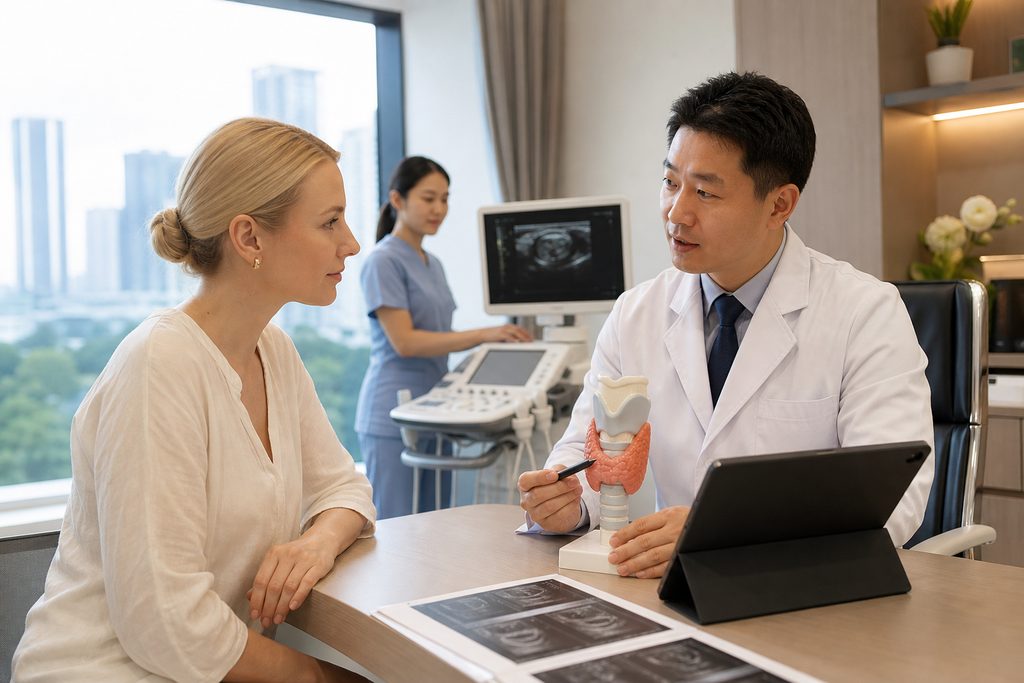
Thyroid Surgery in China: A Patient’s Guide
Roughly 1 in 20 adults will develop a thyroid nodule at some point, and about 5% to 10% of those nodules turn out to be malignant. For international patients weighing treatment abroad, the practical question is usually blunt: what does thyroid surgery cost China versus home, and can a foreigner actually get a good surgeon? At top-tier Chinese public hospitals, a standard thyroidectomy typically runs $4,000 to $9,000 all-in — against $15,000 to $35,000 in the United States for the same procedure. That gap is real. So is the paperwork, the language barrier, and the fact that you cannot simply book a scalpel online.
Here is what the journey actually looks like, from first email to follow-up scan at home.
Thyroid Surgery Cost China: The Short Answer
Expect $4,000–$9,000 for a conventional thyroidectomy at a major public hospital, and $12,000–$25,000 at a private international hospital in Beijing or Shanghai. A hemithyroidectomy (removing one lobe) sits at the low end; total thyroidectomy with central neck dissection sits at the high end. Robotic or endoscopic scarless approaches push higher still.
What drives the spread? Hospital tier, city, surgeon seniority, whether you use the standard queue or the international department, and how many nights you stay. Pathology complexity matters too — a straightforward papillary carcinoma is not the same case as medullary thyroid cancer requiring more extensive dissection. Every number below is a range, not a quote. Final pricing depends on your imaging, biopsy results, and the hospital’s own assessment.
For context on scale: China has 35,000+ hospitals, and our database covers 340+ top-ranked hospitals across 37 cities — the top 5% by Fudan ranking and JCI accreditation. Volume matters in thyroid surgery. High-volume centers see complications less often.
Who This Is Right For — and Who It Isn’t
Medical tourism is not a universal good. It is a tool that fits some situations and badly fits others.
Typically a reasonable fit:
- You have a confirmed or strongly suspected thyroid nodule, with ultrasound and ideally FNA biopsy results already in hand.
- You are uninsured, underinsured, or facing a deductible or waiting list that makes domestic surgery financially painful.
- Your case is elective and stable — papillary thyroid cancer is often slow-growing, which buys planning time.
- You can travel, tolerate anesthesia, and arrange 2–3 weeks abroad plus follow-up at home.
- You are willing to use a bilingual medical companion or bring a Mandarin-speaking companion.
Probably not a fit:
- Airway compromise, rapid enlargement, or any urgent presentation. Get treated where you are, now.
- Medullary or anaplastic thyroid cancer requiring complex multidisciplinary care — continuity with your home oncology team usually outweighs cost savings.
- Extensive prior neck surgery with scar tissue, or significant cardiac and pulmonary comorbidity that makes long-haul travel risky.
- You need an immediate guaranteed surgery date. No one can promise that, and any service that does is not being straight with you.
The Options, Compared
Cost is only one column. The others are what you actually live with.
| Factor | China — Public Top-Tier | China — Private International | United States | Western Europe |
|---|---|---|---|---|
| Typical total thyroidectomy cost | $4,000–$9,000 | $12,000–$25,000 | $15,000–$35,000 | $8,000–$20,000 |
| Wait time to surgery | Weeks to a few months | Often faster, higher fee | 3–8 weeks typical | Varies widely by country |
| English-language service | International department only | Standard | Standard | Standard |
| Insurance billing | Pay upfront, claim later | Direct billing common at JCI hospitals | In-network or self-pay | Often covered |
| Surgical volume | Very high at major centers | Moderate | Moderate to high | Moderate |
| Follow-up after you fly home | Requires planning | Requires planning | Seamless | Seamless |
If you are paying out of pocket and your case is uncomplicated, the public top-tier column is where the value sits. If you want a Western-style ward, English-speaking nursing staff, and direct insurance billing, the private international column buys comfort rather than better surgery. If your insurance covers you at home with a short wait, staying home is genuinely the simpler path.
Finding the Best Thyroid Surgeon in Shanghai — and Elsewhere
Patients often search for the best thyroid surgeon Shanghai has to offer, and Shanghai does have serious depth: Fudan University Shanghai Cancer Center is widely recognized among China’s leading centers for thyroid and head-and-neck oncology, and Ruijin Hospital is a long-established referral hub. Beijing counters with Peking Union Medical College Hospital and China-Japan Friendship Hospital. Guangzhou has Sun Yat-sen University Cancer Center. Chengdu has West China Hospital.
But “best” is the wrong frame for most patients. The right frame is right fit. Three variables matter more than brand name:
- Volume in your specific pathology. A surgeon doing 300 thyroidectomies a year has different pattern recognition than one doing 30. Ask for annual case volume, and ask specifically about your tumor type.
- Nerve monitoring and parathyroid preservation. Recurrent laryngeal nerve injury and hypoparathyroidism are the two complications that change your life. Intraoperative nerve monitoring and experienced parathyroid handling reduce both. Confirm the hospital uses them routinely.
- Who handles your follow-up. Thyroid surgery is not finished when you leave the operating room. It is finished when your levothyroxine dose is stable and your suppressed TSH is where your endocrinologist wants it.
Our specialty rankings by department list the top hospitals by discipline, including oncology and endocrine surgery, so you can compare centers by reputation rather than by marketing budget.
How Long to Recover From Thyroidectomy
Most patients are discharged 1–3 days after surgery. The incision is typically 3–5 cm and heals in 2–4 weeks. Voice fatigue is common for a week or two; true hoarseness that persists past a month deserves evaluation. Calcium levels need checking in the first days and weeks if both lobes were removed.
Week 1: Rest, wound care, blood calcium check, first pathology discussion.
Week 2–3: Most patients are back to desk work. Clearance to fly home usually comes around day 10–14, depending on healing and your surgeon’s judgment.
Week 6: First thyroid function panel, levothyroxine adjustment.
Month 3–6: Dose stabilization, first surveillance ultrasound if indicated.
Long term: Annual labs, periodic ultrasound, and TSH suppression targets set with your endocrinologist.
Plan on staying in China roughly 2–3 weeks. That covers pre-op testing, the operation, the pathology report, and a post-op check before you fly.
Practical Considerations: Visa, Records, and Payment
Foreign patients coming to China for treatment normally use the S2 visa, which covers short-stay medical treatment and private affairs; stays beyond 180 days fall under S1. Accompanying family members apply under the same S2 category. Note carefully: the M visa is for commercial and trade activity and has nothing to do with medical treatment. Requirements change, so confirm current documentation with your nearest Chinese embassy or consulate and bring the hospital’s invitation or appointment letter.
On the clinical side, gather your ultrasound report, FNA cytology, thyroid function panel, and any prior imaging. Send them ahead for review. This is where a written second opinion from a Chinese specialist — typically $300–$500 — pays for itself. You learn whether surgery is even indicated before you buy a plane ticket.
Payment at public hospitals is generally upfront, with insurance reimbursed afterward. Many private international hospitals offer direct billing with selected insurers. Bring a credit card that works internationally, and confirm the hospital’s accepted payment methods in advance.
One honest caveat: standard outpatient clinics at Chinese public hospitals cannot be pre-booked from overseas, and surgery is scheduled only after an in-person consultation. To lock in a specialist and a date ahead of travel, patients typically go through the hospital’s international or VIP department — expect roughly 1.5 to 2 times the standard fee.
Language is the other reality. A major Chinese hospital may see 10,000+ outpatient visits in a day. Signage, registration, and pharmacy instructions are in Chinese. If you do not speak Mandarin, you need a bilingual companion — not for luxury, but for basic navigation.
If you are still deciding between destinations, our Fudan-ranked hospital directory by city lets you see which centers cluster in Beijing, Shanghai, and Guangzhou before you commit.
Frequently Asked Questions
At high-volume, top-tier hospitals, yes — outcomes for routine thyroidectomy are broadly comparable to Western centers, and complication rates track surgeon volume more than geography. That said, safety is hospital- and surgeon-specific, not national. Ask about annual case volume, nerve monitoring, and parathyroid preservation protocols. If a provider cannot answer those questions clearly, look elsewhere.
Not directly through a standard public clinic. Public hospitals require an in-person consultation before scheduling surgery. What can be arranged in advance is a written second opinion, a video consultation with the specialty team, or an appointment through the international department. A thyroidectomy medical tourism package Beijing providers advertise usually means coordination support, not a guaranteed operating room slot on a date of your choosing.
This is the question worth losing sleep over, so plan for it. Before you leave China, get your operative note, pathology report, and discharge summary in English, plus imaging on a USB drive. Identify an endocrinologist at home before you travel. If a complication emerges — hypocalcemia, wound issue, persistent hoarseness — your local team handles it, and your Chinese surgeon’s records are what they will work from. Continuity is your responsibility to build, not the hospital’s.
Coordination is separate from hospital charges. Appointment coordination starts from $300, bilingual medical companion support from $300 per day, and a top-specialist video consultation runs $500–$800. Any consultation fee is credited in full toward on-the-ground coordination if you proceed within 90 days. These are case management fees — records translation, official international-department scheduling, and interpretation labor — never a payment for queue priority or a specific surgeon.
Your Next Step
Thyroid surgery in China can be genuinely excellent and genuinely cheaper, but it rewards preparation over spontaneity. Get your imaging reviewed first, understand whether you actually need an operation, and only then plan travel. We are China Medical Services — a coordination team, not a hospital and not your doctor. We do not diagnose, and we cannot promise a specific surgeon or date. What we do is connect you with the right department, arrange a written or video review of your existing records, and handle the logistics once you decide. If you would like a straight assessment of your case, start with a free consultation — no obligation, and no pressure to travel.
This article is for general information only and is not medical advice. Treatment decisions should be made with a qualified physician who has reviewed your individual case.
For more medical information and treatment options in China, visit chinamedservices.com (China Medical Services).
