Ultrasound in China: A Quick Booking Guide for Foreigners
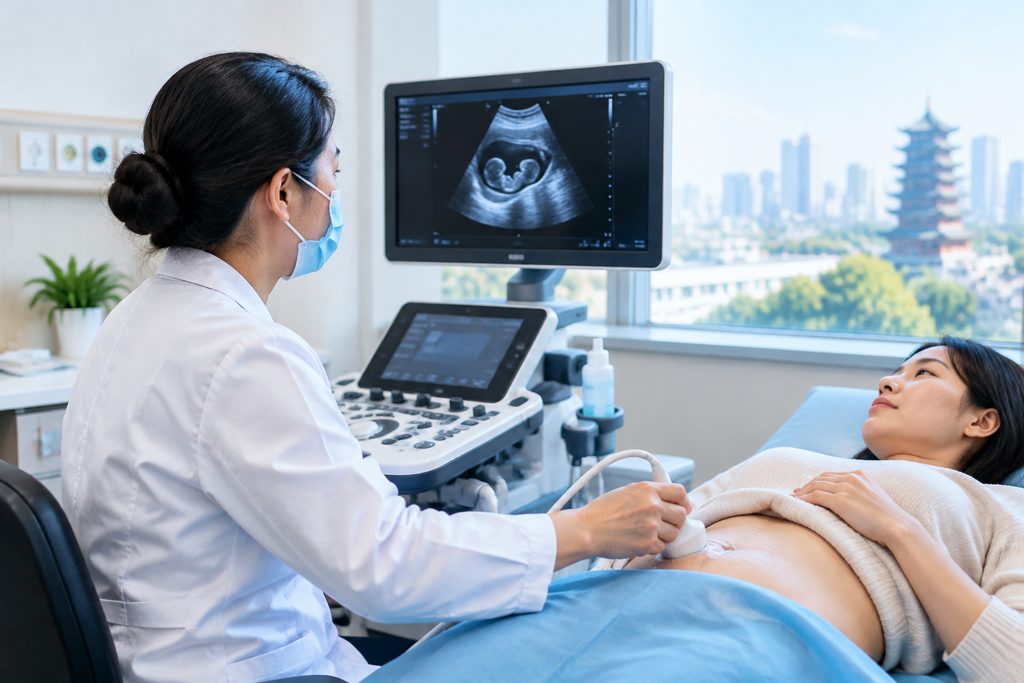
A basic abdominal ultrasound at a top-tier Chinese public hospital typically runs 100–300 RMB (roughly $14–$42) and can be completed the same day you walk in. In the United States, that same scan averages $500–$1,500 before insurance. That gap — often tenfold or more — is why so many international patients now ask us how to get imaging done in China, whether as a standalone service or as part of a larger diagnostic workup.
But cheap and fast is not the same as simple. China’s public hospital system was built for volume, not for foreign walk-ins. Understanding how registration, queuing, and reporting actually work will save you hours — and possibly a wasted trip.
Ultrasound Scan Cost China: The Short Answer
Expect to pay between $14 and $120 for a standard ultrasound at a public hospital, depending on the type of scan and the city. Private international hospitals charge more — usually $150–$600 — but include English-speaking staff and same-week scheduling. A cardiac ultrasound (echocardiogram) at a major public hospital might cost 300–500 RMB ($42–$70), while a full obstetric anomaly scan sits in a similar range.
Here is the catch: price is not the variable that matters most. Access is. Public hospitals generally do not let overseas patients book an outpatient slot in advance from abroad. You register on the day, in person, with your passport.
Key takeaway: Ultrasound in China is inexpensive and technically excellent. The hard part is navigating registration, department selection, and reporting without Mandarin. That is a logistics problem, not a medical one — and it is solvable.
Who This Is Right For — and Who It Isn’t
Ultrasound is one of the safest and most versatile imaging tools available. It uses high-frequency sound waves, not ionizing radiation. That matters for pregnant patients, children, and anyone needing repeated scans.
Typically a good fit:
- Patients who need diagnostic imaging faster than their home system allows
- Pregnant women seeking affordable, high-quality obstetric scans
- Travelers or expats already in China who need a same-day scan
- Patients combining imaging with a specialist consultation at a Chinese hospital
- Anyone monitoring a known condition — thyroid nodules, gallstones, renal cysts
Probably not the right move:
- Anyone needing an emergency diagnosis — go to the nearest hospital, wherever you are
- Patients whose home insurance will not reimburse overseas imaging and who cannot pay out of pocket
- Cases where a biopsy or MRI is the clinically appropriate next step, not ultrasound
- Patients who cannot travel for medical reasons
We are not clinicians. Whether ultrasound is the right test for your situation is a decision for a qualified physician who has reviewed your history.
The Options, Compared
| Option | Typical Cost (USD) | Booking Lead Time | English Support | Report Turnaround |
|---|---|---|---|---|
| Public hospital, standard ultrasound | $14–$70 | Same day, walk-in | Limited or none | Same day to 48 hours |
| Public hospital, international/VIP department | $80–$200 | 1–7 days | Yes | 24–48 hours |
| Private international hospital | $150–$600 | 2–10 days | Yes, full service | Same day to 72 hours |
| US hospital outpatient imaging | $500–$1,500 | Days to weeks | Yes | 24–72 hours |
| UK private imaging clinic | £200–£600 ($250–$760) | 1–3 weeks | Yes | 3–7 days |
If you want the lowest price and can manage without English support, the public walk-in route works. If you need a report your home doctor can read and a conversation you can actually follow, the international department or private hospital column is the realistic one. For most of our readers, the middle column is the sweet spot.
Is Ultrasound Safe in China? What the Equipment and Standards Look Like
Yes — with context. Ultrasound safety is a function of the physics of the modality and the skill of the operator, not the country. Diagnostic ultrasound at approved intensity levels has no known cumulative risk. Chinese tertiary hospitals use the same major equipment brands you would see in Western academic centers: GE, Philips, Siemens, Canon.
What varies is the training pipeline and the volume. Senior sonographers at major Chinese hospitals perform dozens of scans per day. Volume builds pattern recognition. A 2023 review in a peer-reviewed radiology journal noted that Chinese tertiary centers report diagnostic concordance rates for common abdominal ultrasound findings that are comparable to published Western benchmarks — though we should be honest that operator skill varies widely between a top-tier hospital and a small local clinic.
Two practical points. First, if your case is complex, choose the hospital by department reputation, not by proximity. Second, ask for the images, not just the report. You want both.
How to Book an Ultrasound in China: The Real Process
Here is how it actually works at a public hospital, step by step.
Step one: pick the department, not the hospital. Ultrasound is ordered by a clinical department — gastroenterology, cardiology, obstetrics, endocrinology. You cannot simply book “an ultrasound.” You register with the department, a doctor examines you briefly, writes the imaging request, and you take that slip to the ultrasound suite.
Step two: register in person. Bring your passport. You will get a hospital card, pay the registration fee (usually 50–100 RMB), and queue. Mornings are crowded. Arriving before 7:30 AM helps.
Step three: pay before the scan. Chinese public hospitals require prepayment. You pay at a cashier window or a self-service kiosk, then present the receipt at the ultrasound room.
Step four: wait for your number. Expect 30 minutes to several hours depending on department load. Some hospitals offer a same-day express route through the international department for a higher fee.
Step five: collect the report. Most reports are ready within a few hours. Ask for a printed copy and the digital images.
Practical tip: If you need a scan at a specific hospital — say a top cardiac center — the international department is the only reliable way to secure an appointment in advance. Standard outpatient slots are not bookable from overseas.
For patients who want the process handled end to end, our team coordinates registration, department selection, payment, and bilingual accompaniment. You can see how that works on our patient consultation page.
Best Hospital for Ultrasound in Shanghai — and Where to Go in Beijing
Shanghai and Beijing concentrate the country’s strongest imaging departments. For Shanghai, hospitals like Ruijin Hospital and Zhongshan Hospital Fudan University are consistently ranked among the top in the Fudan Hospital Rankings, which evaluate 45 specialties across the country. For Beijing, Peking Union Medical College Hospital is the reference point for difficult diagnostic cases, and Fuwai Hospital leads nationally in cardiac imaging volume.
If you want to compare by specialty rather than by city, our department rankings list the top hospitals for each of 45 specialties. And if your search is city-specific, the Shanghai hospital guide breaks down options by tier and language support.
One note on expectations. A famous hospital name does not guarantee a fast appointment. The international department is what makes advance scheduling realistic. That is why we route most imaging requests through it.
Practical Considerations: Records, Visa, Payment, and Follow-Up
Records. Bring prior imaging and reports if you have them. Chinese radiologists compare against your baseline when available, and having the history improves report quality. If your records are in English, a translated summary helps.
Visa. For medical travel, the applicable short-stay category is the S2 visa, which covers medical treatment and private affairs. Accompanying family members apply under the same category. Requirements and supporting documents are set by the latest embassy or consulate guidance, and the hospital’s invitation or appointment documentation is usually part of the package. The M visa is for commercial and trade activity — it is not a medical visa, and using it for treatment is a mistake we see people make. Stays beyond 180 days fall under a different category. Confirm current rules with your nearest Chinese embassy before booking flights.
Payment. Public hospitals require prepayment — cash, Alipay, WeChat Pay, or international card at some counters. Private international hospitals often bill insurance directly. Reimbursement from Western insurers after the fact is possible but paperwork-heavy; check your policy’s overseas imaging clause first.
Language. This is the single biggest friction point. Registration forms, department signs, and reports are in Chinese. A bilingual companion is not a luxury here; it is what prevents you from ending up in the wrong queue.
Follow-up. Ask for DICOM files on a USB drive or a download link. Your home physician can then review the raw images, not just the written summary.
Frequently Asked Questions
Not through standard public hospital channels — those require same-day, in-person registration. Advance booking is generally possible only through a hospital’s international or VIP department, or through a private international hospital. Even then, the appointment is confirmed by the hospital, not guaranteed by any third party.
Substantially higher in most Western markets. A routine abdominal scan in the US commonly bills $500–$1,500; in the UK private sector, £200–£600. In China, the same scan at a public hospital typically costs the equivalent of $14–$70. The trade-off is convenience and language support, which is why many patients choose the international department tier instead.
The modality itself carries no known risk at diagnostic intensities, and major Chinese tertiary hospitals use the same equipment brands found in Western academic centers. The variable is operator experience. For complex cases, choose the hospital by departmental reputation rather than convenience.
You will receive a report, and the next step is a specialist consultation — which is a separate appointment. If you are traveling specifically for diagnosis, plan for the possibility that you may need to extend your stay or arrange follow-up. We help patients understand the options, but we do not diagnose or interpret results ourselves.
Your Next Step
Ultrasound in China is fast, affordable, and technically strong. The obstacle is almost never the scan itself — it is the registration system, the language, and the reporting format. Get those three right and the experience is straightforward.
We are China Medical Services, a coordination service, not a hospital and not a diagnostic provider. We help international patients match with appropriate hospitals, arrange appointments through official international departments, and provide bilingual accompaniment on the ground. If you would like to talk through your situation before committing to anything, start with a free consultation — no pressure, no obligation.
This article is for general information only and does not constitute medical advice. Always consult a qualified physician regarding your individual condition and imaging needs.
For more medical information and treatment options in China, visit chinamedservices.com (China Medical Services).
